Audit Log Service
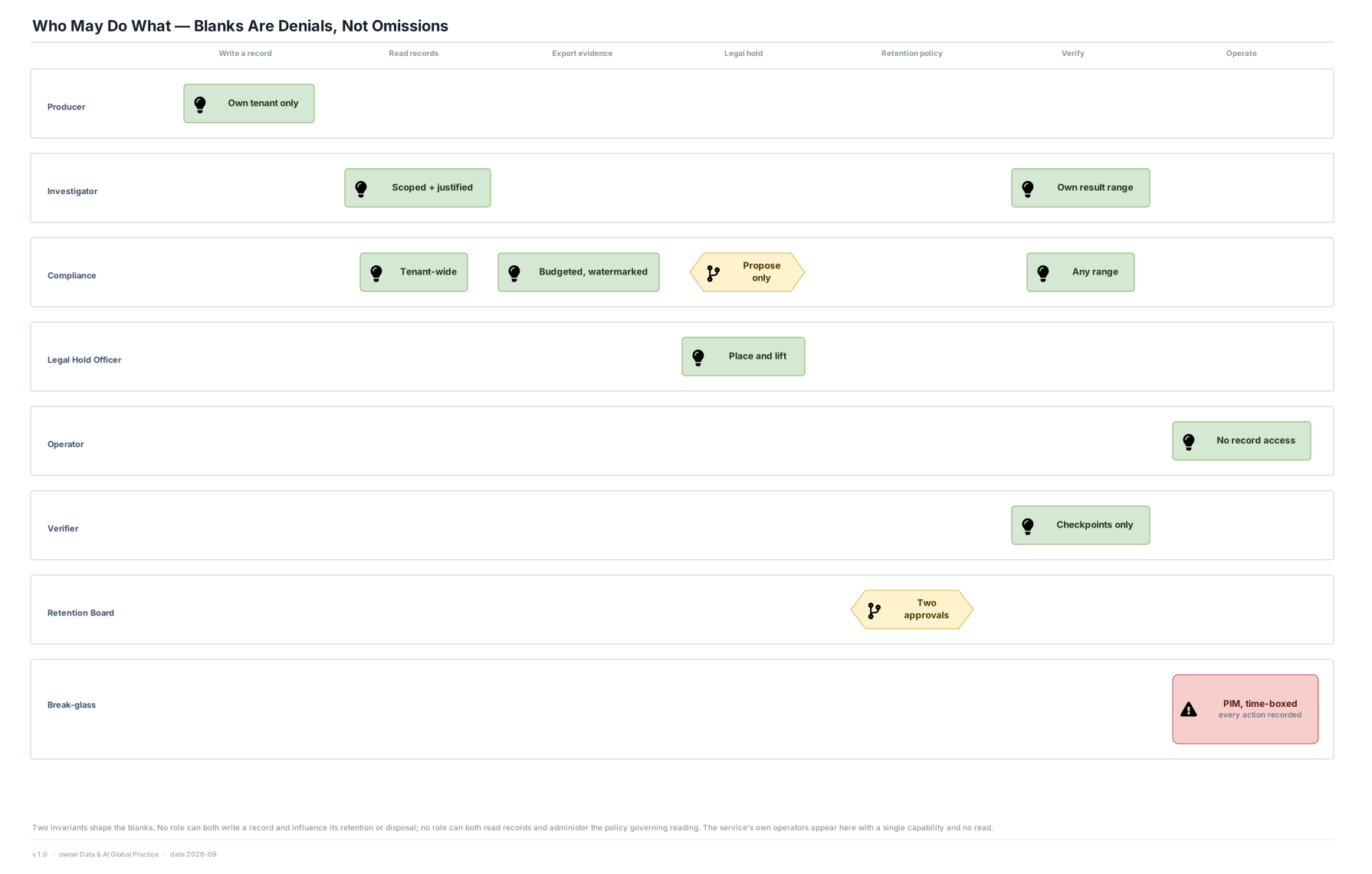
A shared audit log for the whole estate: it accepts security- and compliance-relevant events from every application and administrative surface, holds them so that nobody — including its own operators and the subscription's administrators — can alter or remove one inside its retention period, and answers investigative and regulatory questions against thirteen months of that history. Read the set in order. Act 1 fixes the boundary and the plane separation everything else follows from; act 2 says who the record is actually for and where each of them is currently let down; acts 3 and 4 give the structure and say which store is the truth and which is merely convenient; act 5 is what happens when the thing is used; act 6 is running and paying for it; act 7 is why it is safe, with the operators inside the threat model rather than outside it. One decision governs the whole set: the write path holds no authority over a record's lifetime, and no principal exists anywhere that can both write a record and remove it.
1 · Context and scope What sits inside the boundary, who feeds it, who checks it, and the four-plane separation that the rest of the architecture is a consequence of.
01
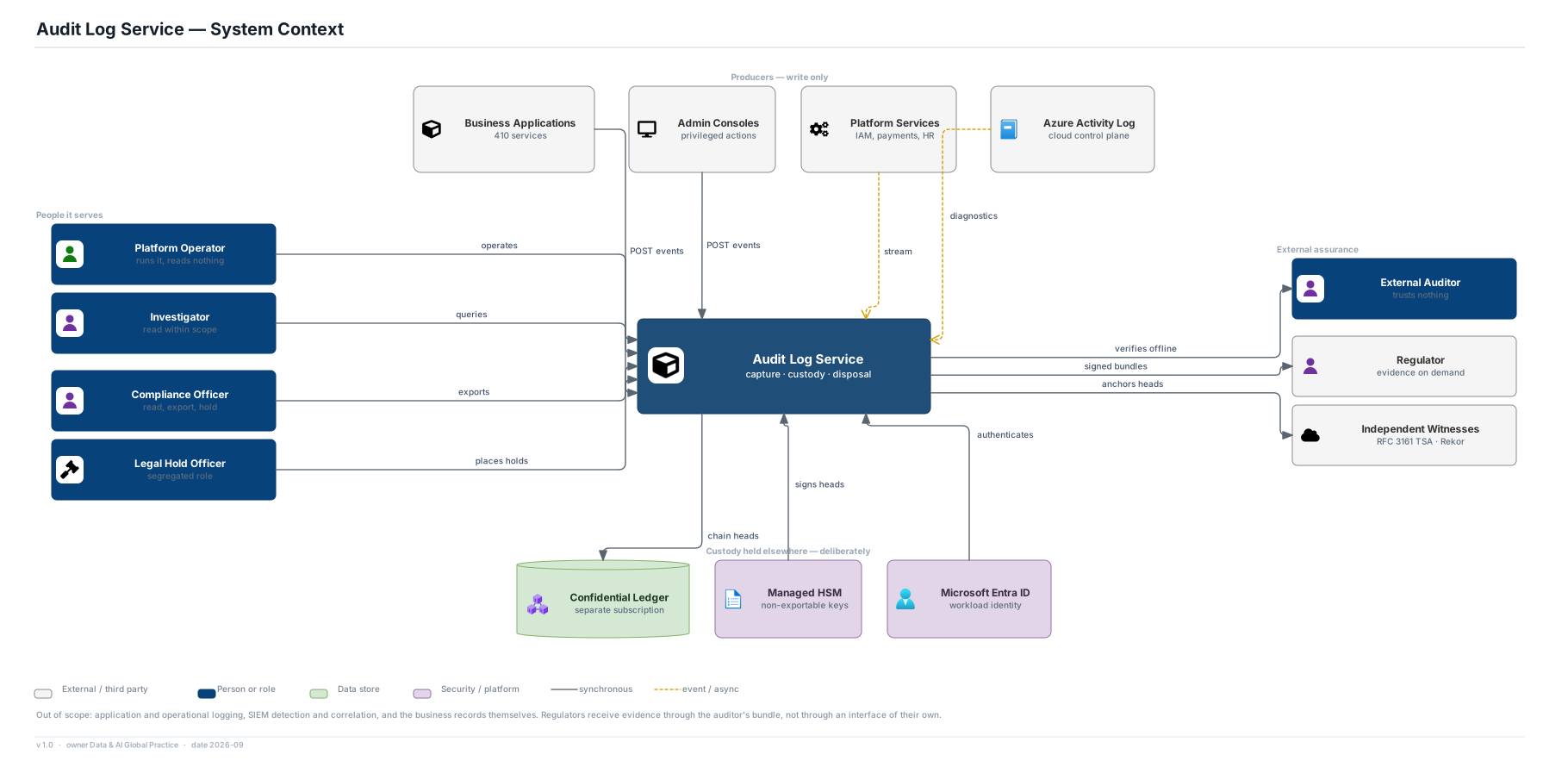
Producers — write only Business Applications 410 services Admin Consoles privileged actions Platform Services IAM, payments, HR Azure Activity Log cloud control plane People it serves Platform Operator runs it, reads nothing Investigator read within scope Compliance Officer read, export, hold Legal Hold Officer segregated role External assurance External Auditor trusts nothing Regulator evidence on demand Independent Witnesses RFC 3161 TSA · Rekor Audit Log Service capture · custody · disposal Custody held elsewhere — deliberately Confidential Ledger separate subscription Managed HSM non-exportable keys Microsoft Entra ID workload identity operates queries exports places holds POST events POST events stream diagnostics verifies offline signed bundles anchors heads chain heads signs heads authenticates Audit Log Service — System Context External / third party Person or role Data store Security / platform synchronous event / async Out of scope: application and operational logging, SIEM detection and correlation, and the business records themselves. Regulators receive evidence through the auditor's bundle, not through an interface of their own. v 1.0 · owner Data & AI Global Practice · date 2026-09
System Context
Who writes to the audit log, who reads it, who checks it — and which custody is deliberately held by somebody else.
HTML page
SVG
draw.io
03
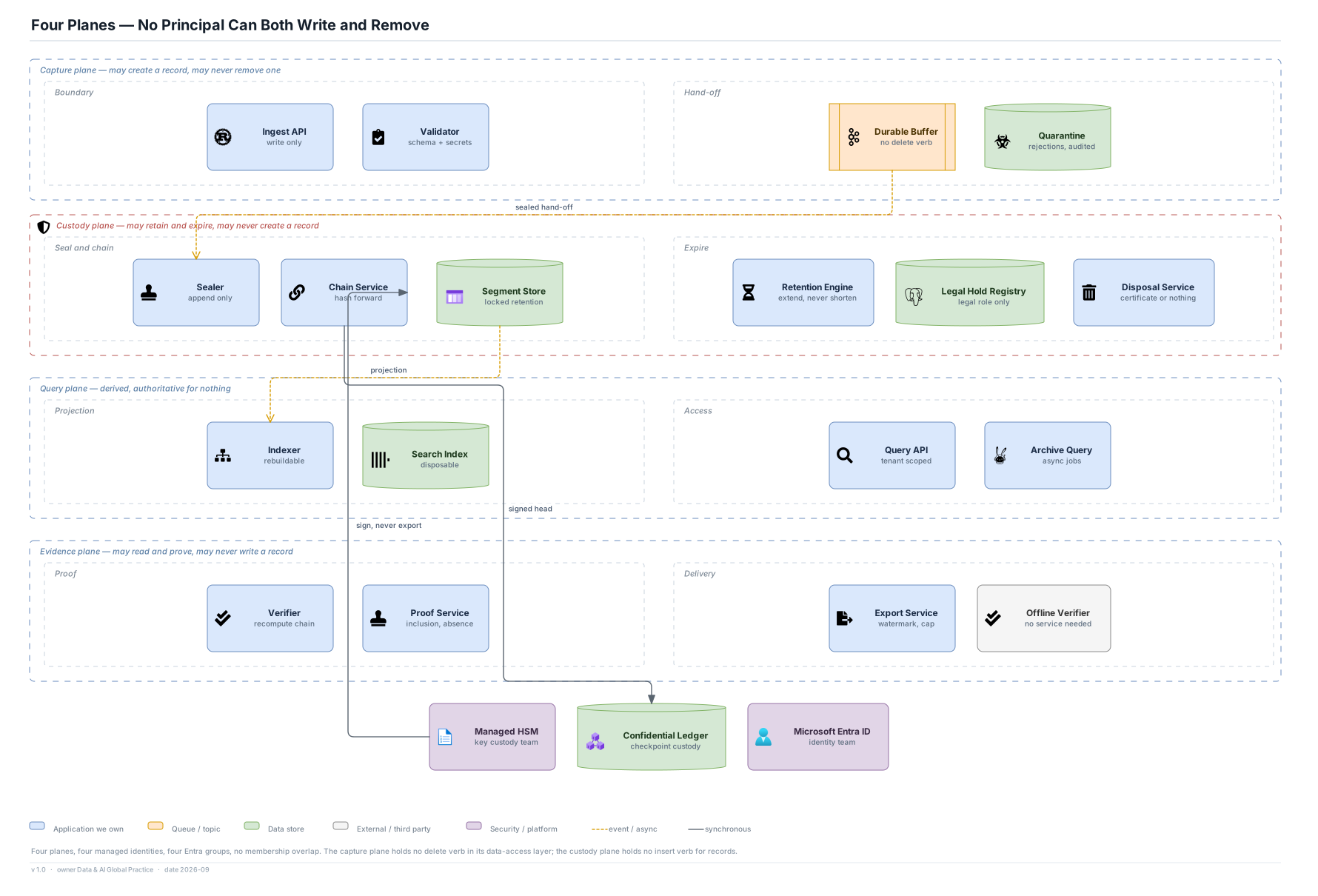
Capture plane — may create a record, may never remove one Boundary Ingest API write only Validator schema + secrets Hand-off Durable Buffer no delete verb Quarantine rejections, audited Custody plane — may retain and expire, may never create a record Seal and chain Sealer append only Chain Service hash forward Segment Store locked retention Expire Retention Engine extend, never shorten Legal Hold Registry legal role only Disposal Service certificate or nothing Query plane — derived, authoritative for nothing Projection Indexer rebuildable Search Index disposable Access Query API tenant scoped Archive Query async jobs Evidence plane — may read and prove, may never write a record Proof Verifier recompute chain Proof Service inclusion, absence Delivery Export Service watermark, cap Offline Verifier no service needed Managed HSM key custody team Confidential Ledger checkpoint custody Microsoft Entra ID identity team sealed hand-off projection signed head sign, never export Four Planes — No Principal Can Both Write and Remove Application we own Queue / topic Data store External / third party Security / platform event / async synchronous Four planes, four managed identities, four Entra groups, no membership overlap. The capture plane holds no delete verb in its data-access layer; the custody plane holds no insert verb for records. v 1.0 · owner Data & AI Global Practice · date 2026-09
Four Planes and the Rule Between Them
The critical design decision drawn as a boundary: which plane may create a record, which may retain and expire one, and which may only prove things about them.
HTML page
SVG
draw.io
2 · People and journeys Who the record is for, what each of them is trying to get done, and the three journeys that decide whether this service is worth having.
04
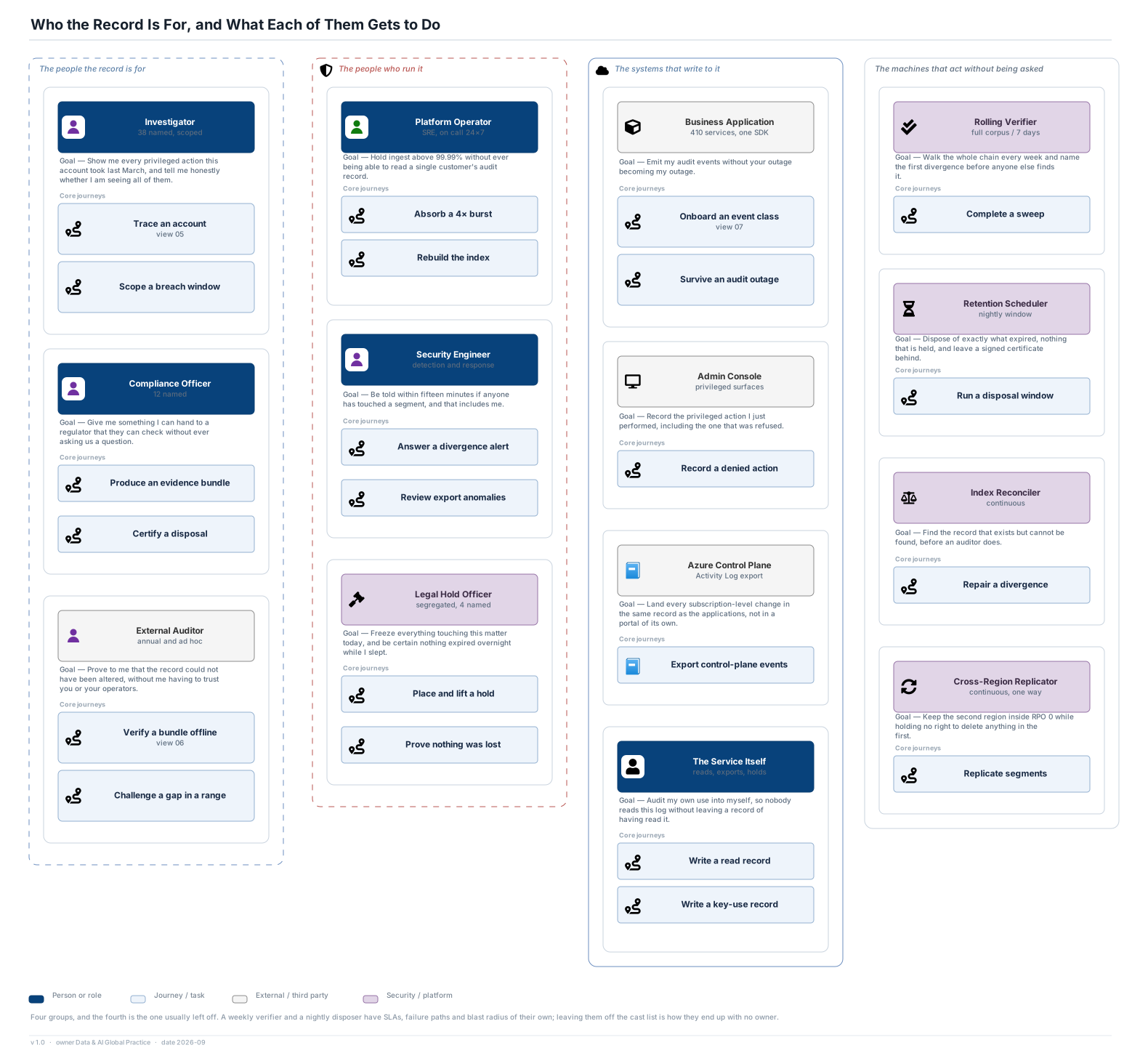
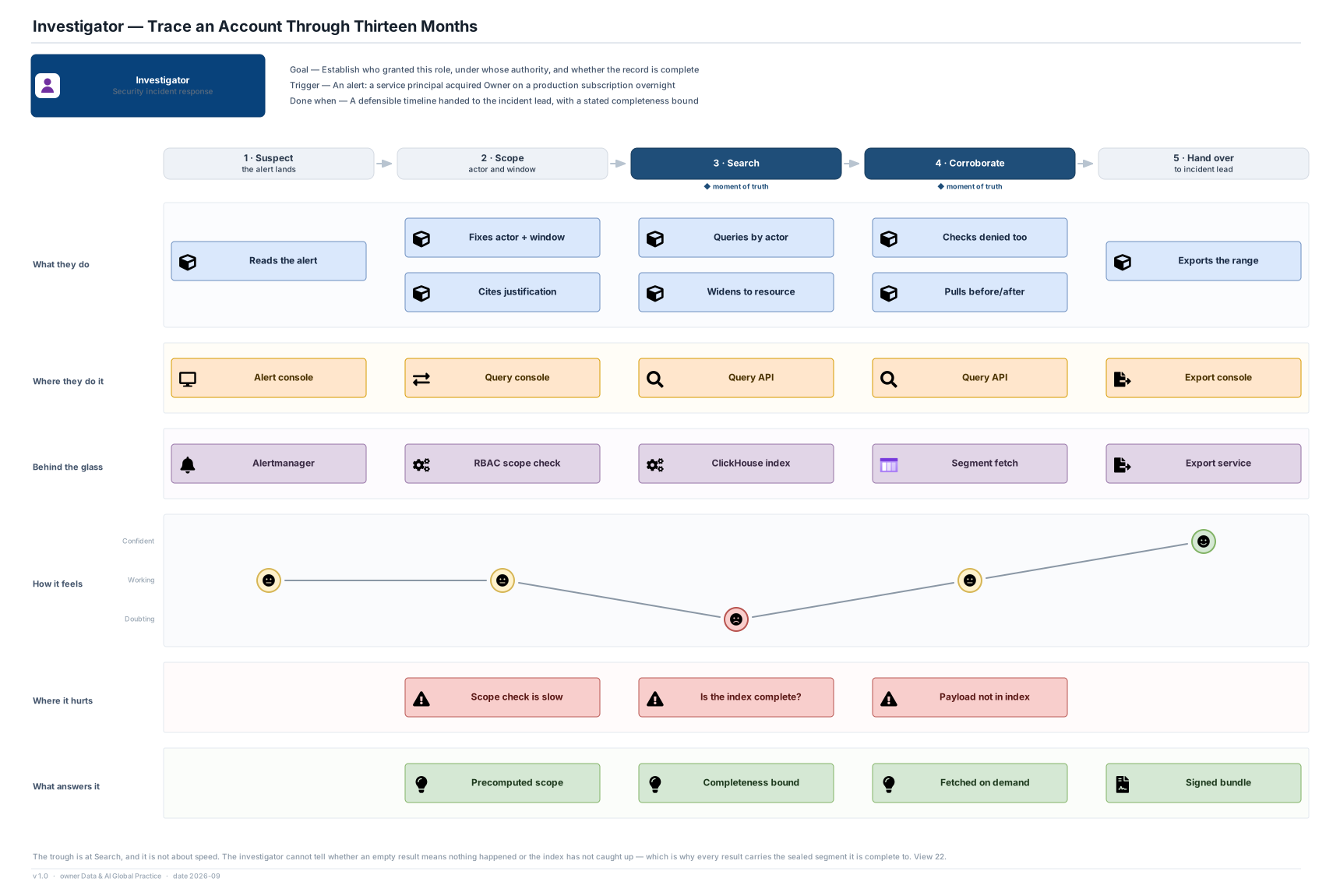
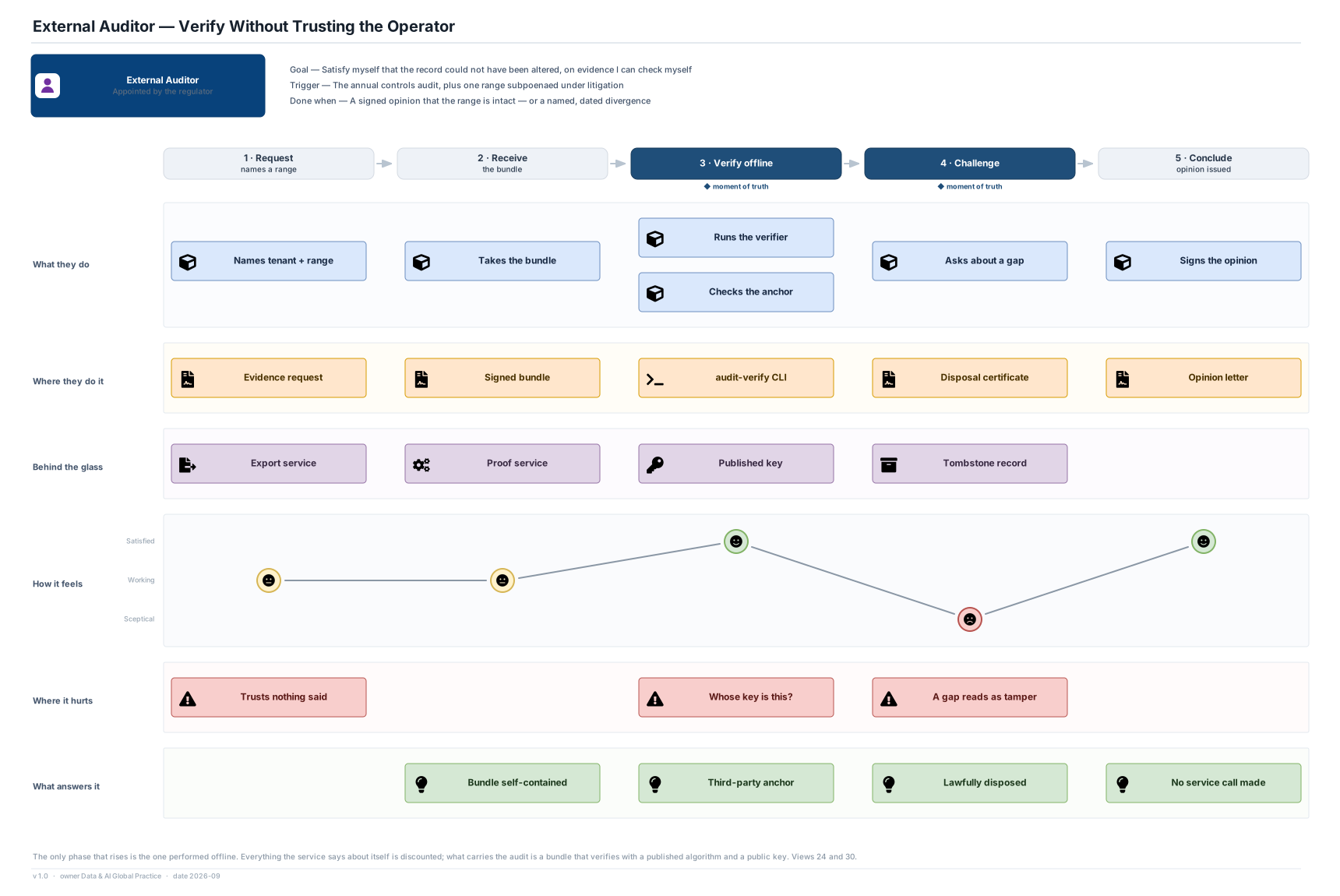
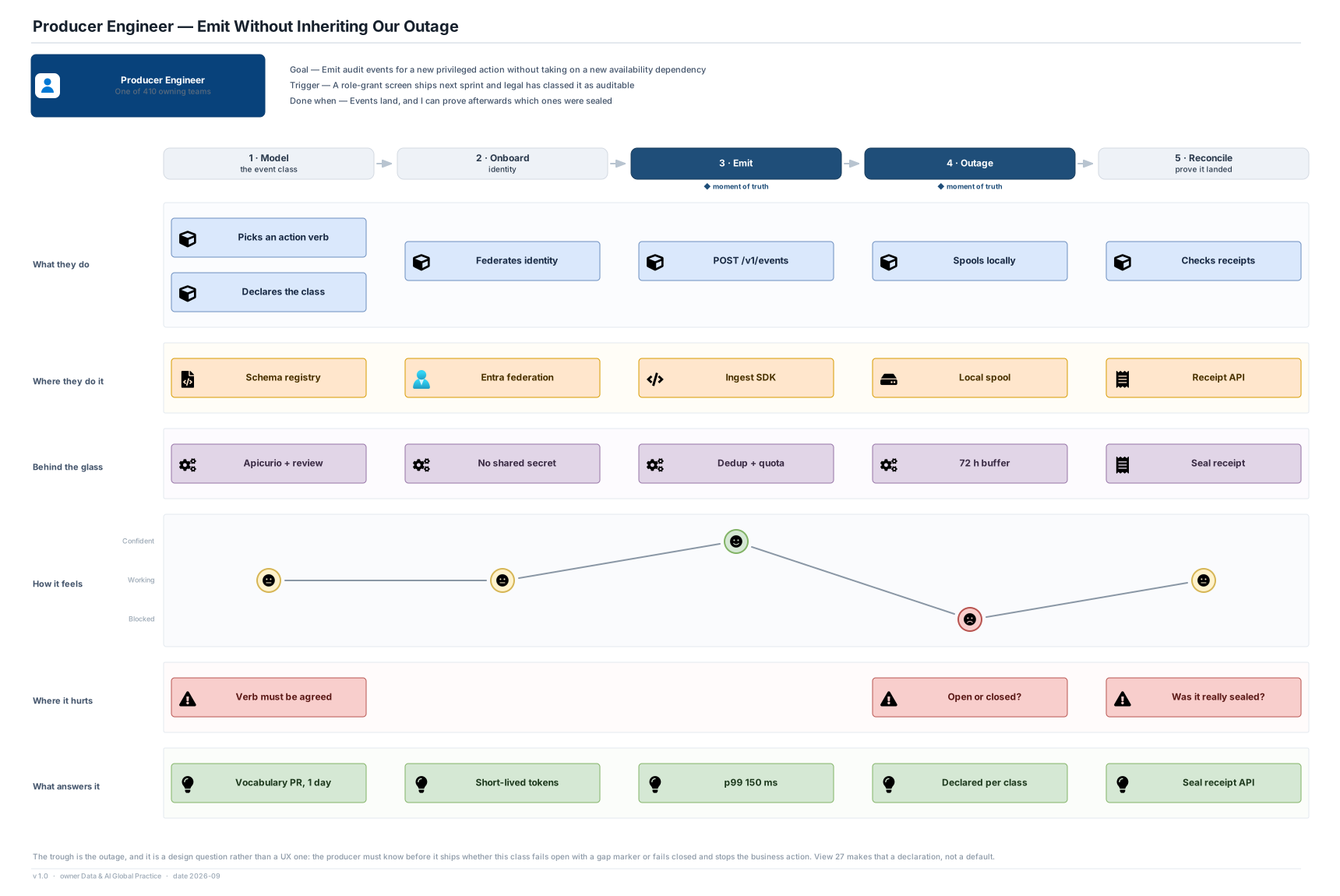
The people the record is for Investigator 38 named, scoped Goal — Show me every privileged action this account took last March, and tell me honestly whether I am seeing all of them. Core journeys Trace an account view 05 Scope a breach window Compliance Officer 12 named Goal — Give me something I can hand to a regulator that they can check without ever asking us a question. Core journeys Produce an evidence bundle Certify a disposal External Auditor annual and ad hoc Goal — Prove to me that the record could not have been altered, without me having to trust you or your operators. Core journeys Verify a bundle offline view 06 Challenge a gap in a range The people who run it Platform Operator SRE, on call 24×7 Goal — Hold ingest above 99.99% without ever being able to read a single customer's audit record. Core journeys Absorb a 4× burst Rebuild the index Security Engineer detection and response Goal — Be told within fifteen minutes if anyone has touched a segment, and that includes me. Core journeys Answer a divergence alert Review export anomalies Legal Hold Officer segregated, 4 named Goal — Freeze everything touching this matter today, and be certain nothing expired overnight while I slept. Core journeys Place and lift a hold Prove nothing was lost The systems that write to it Business Application 410 services, one SDK Goal — Emit my audit events without your outage becoming my outage. Core journeys Onboard an event class view 07 Survive an audit outage Admin Console privileged surfaces Goal — Record the privileged action I just performed, including the one that was refused. Core journeys Record a denied action Azure Control Plane Activity Log export Goal — Land every subscription-level change in the same record as the applications, not in a portal of its own. Core journeys Export control-plane events The Service Itself reads, exports, holds Goal — Audit my own use into myself, so nobody reads this log without leaving a record of having read it. Core journeys Write a read record Write a key-use record The machines that act without being asked Rolling Verifier full corpus / 7 days Goal — Walk the whole chain every week and name the first divergence before anyone else finds it. Core journeys Complete a sweep Retention Scheduler nightly window Goal — Dispose of exactly what expired, nothing that is held, and leave a signed certificate behind. Core journeys Run a disposal window Index Reconciler continuous Goal — Find the record that exists but cannot be found, before an auditor does. Core journeys Repair a divergence Cross-Region Replicator continuous, one way Goal — Keep the second region inside RPO 0 while holding no right to delete anything in the first. Core journeys Replicate segments Who the Record Is For, and What Each of Them Gets to Do Person or role Journey / task External / third party Security / platform Four groups, and the fourth is the one usually left off. A weekly verifier and a nightly disposer have SLAs, failure paths and blast radius of their own; leaving them off the cast list is how they end up with no owner. v 1.0 · owner Data & AI Global Practice · date 2026-09
Actors and Their Core Journeys
Fourteen actors in four groups, each with the goal they actually arrive with — including the four that are machines.
HTML page
SVG
draw.io
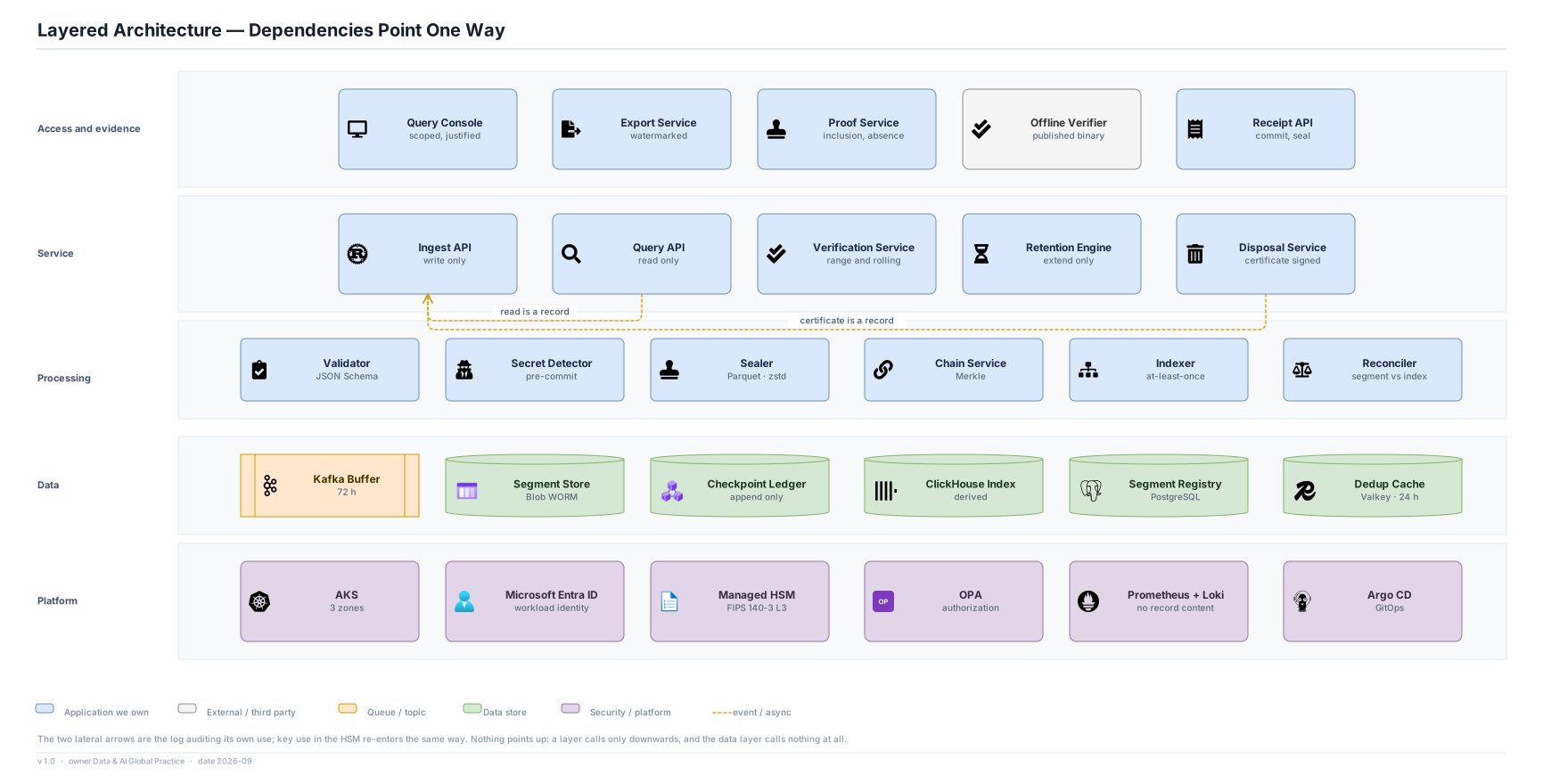
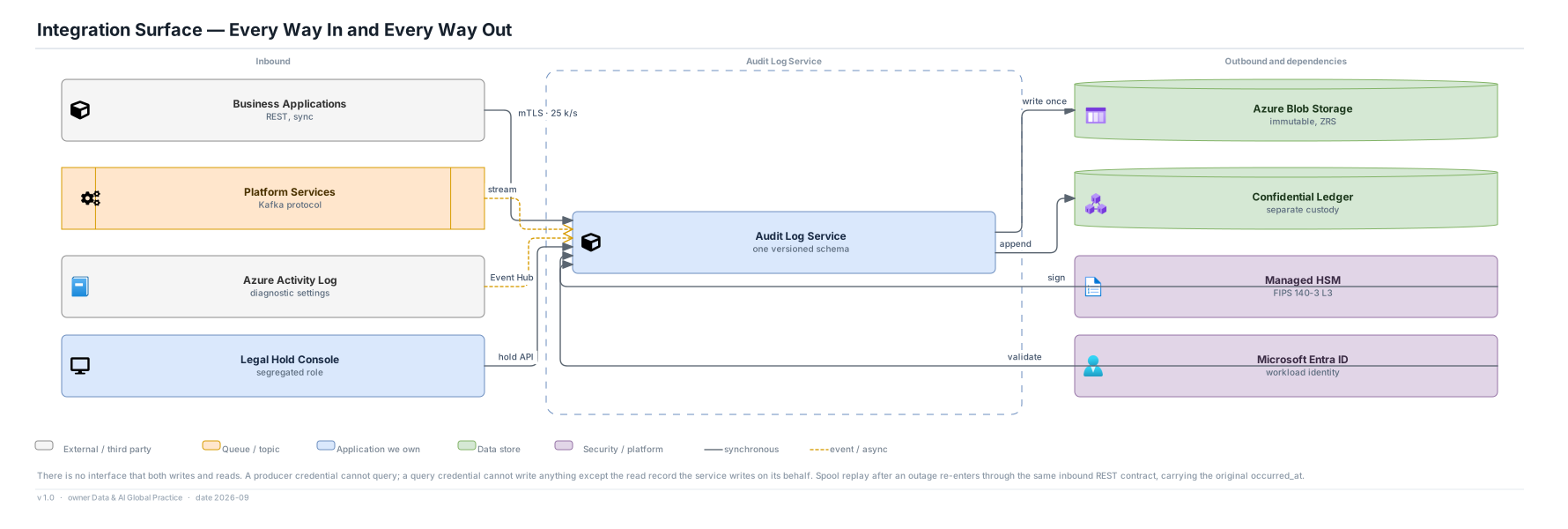
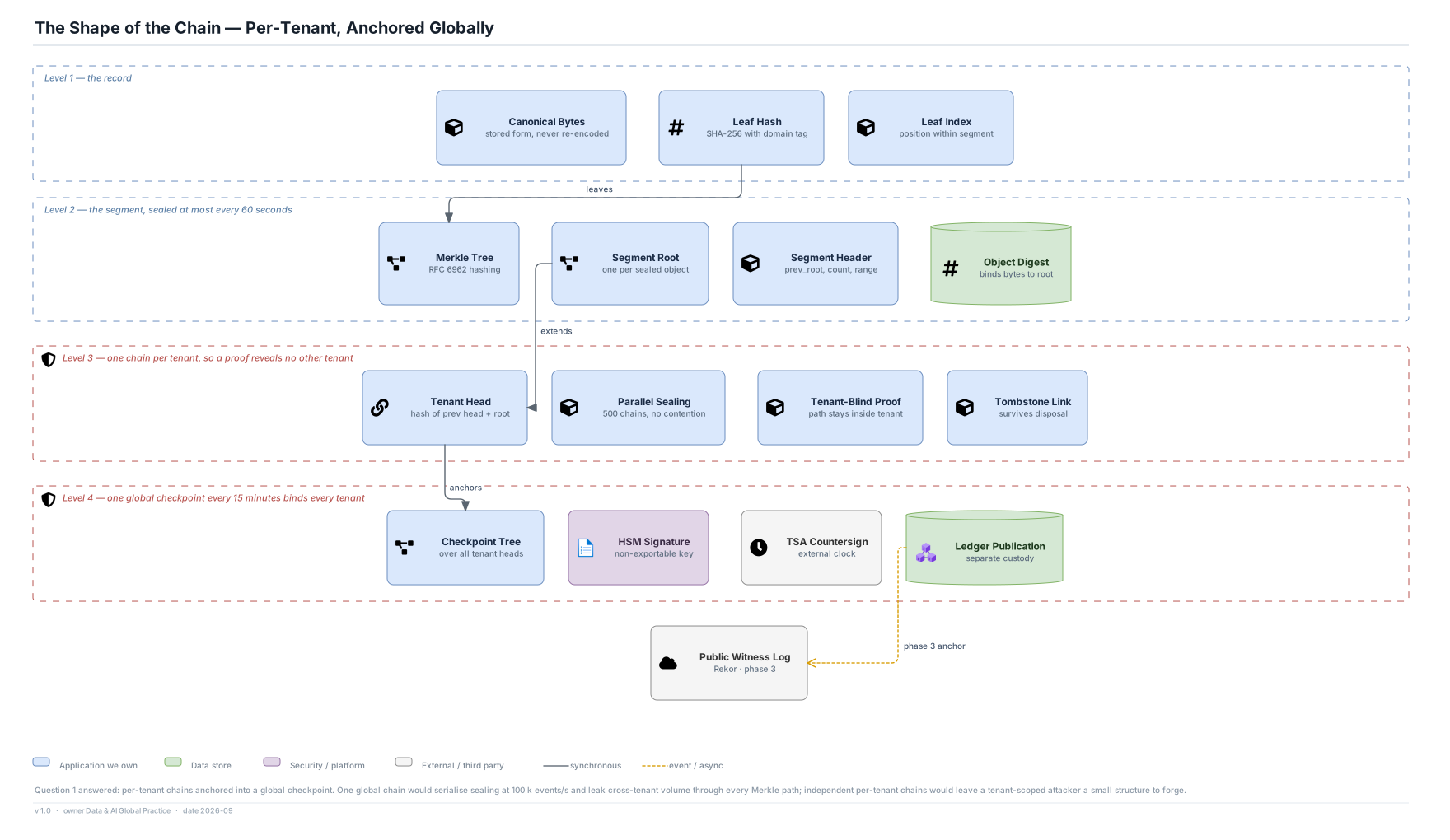
3 · Structure The layering rule, the deployable units inside each plane, every interface in and out, and the shape of the hash chain that makes tampering provable.
09
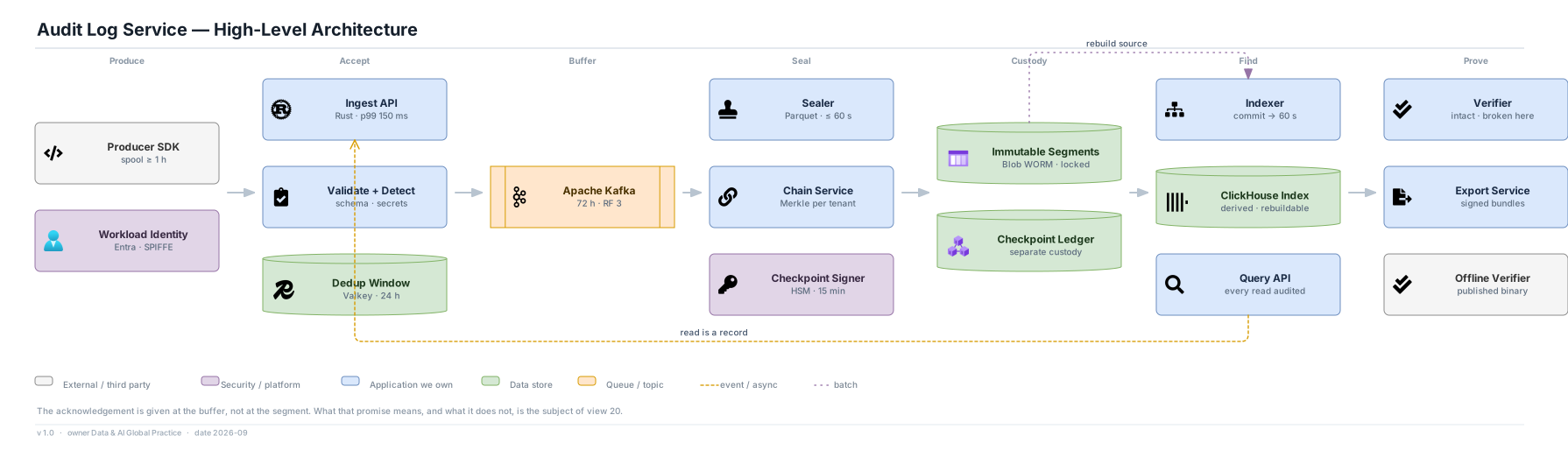
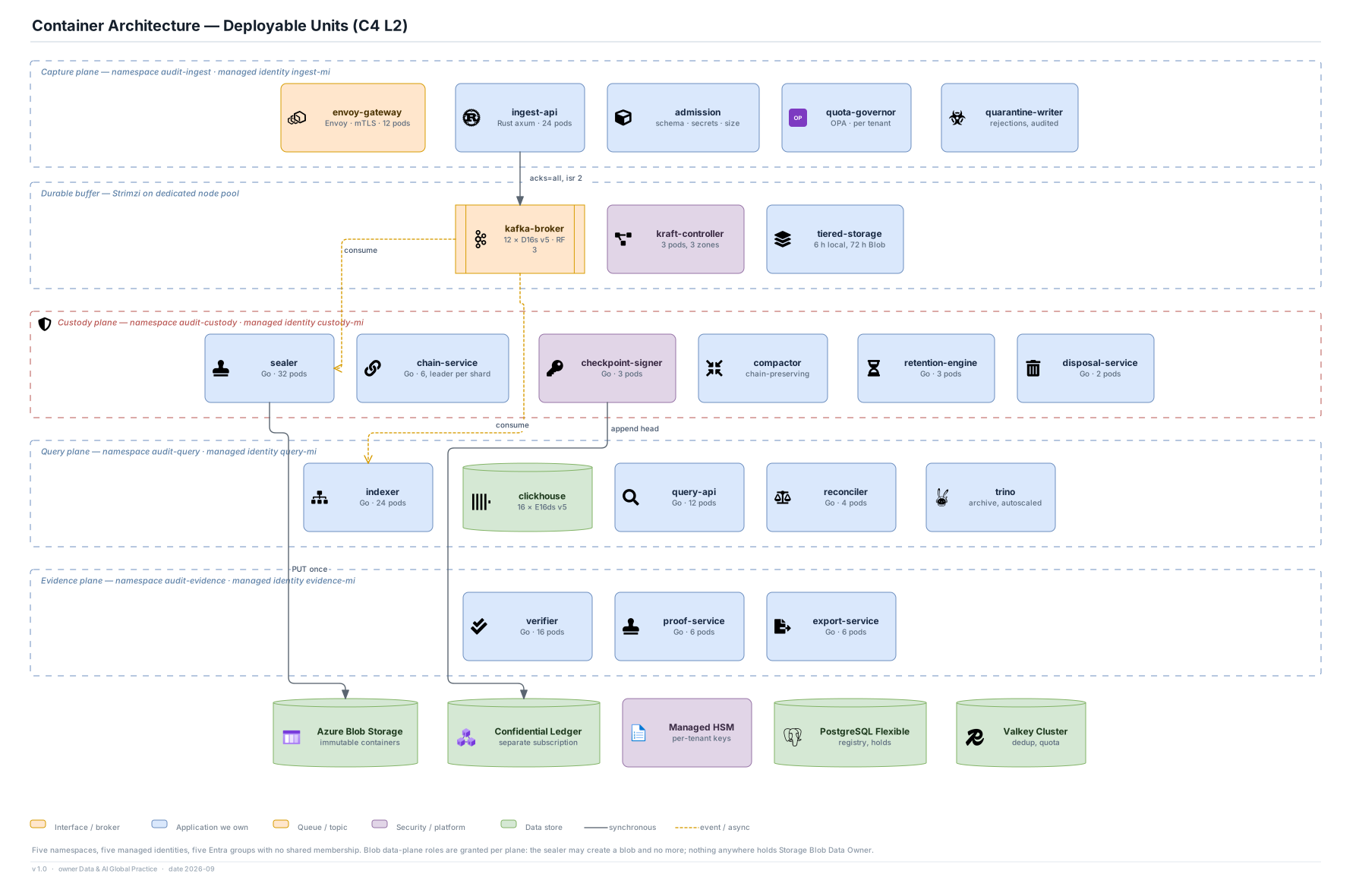
Capture plane — namespace audit-ingest · managed identity ingest-mi envoy-gateway Envoy · mTLS · 12 pods ingest-api Rust axum · 24 pods admission schema · secrets · size quota-governor OPA · per tenant quarantine-writer rejections, audited Durable buffer — Strimzi on dedicated node pool kafka-broker 12 × D16s v5 · RF 3 kraft-controller 3 pods, 3 zones tiered-storage 6 h local, 72 h Blob Custody plane — namespace audit-custody · managed identity custody-mi sealer Go · 32 pods chain-service Go · 6, leader per shard checkpoint-signer Go · 3 pods compactor chain-preserving retention-engine Go · 3 pods disposal-service Go · 2 pods Query plane — namespace audit-query · managed identity query-mi indexer Go · 24 pods clickhouse 16 × E16ds v5 query-api Go · 12 pods reconciler Go · 4 pods trino archive, autoscaled Evidence plane — namespace audit-evidence · managed identity evidence-mi verifier Go · 16 pods proof-service Go · 6 pods export-service Go · 6 pods Azure Blob Storage immutable containers Confidential Ledger separate subscription Managed HSM per-tenant keys PostgreSQL Flexible registry, holds Valkey Cluster dedup, quota acks=all, isr 2 consume PUT once append head consume Container Architecture — Deployable Units (C4 L2) Interface / broker Application we own Queue / topic Security / platform Data store synchronous event / async Five namespaces, five managed identities, five Entra groups with no shared membership. Blob data-plane roles are granted per plane: the sealer may create a blob and no more; nothing anywhere holds Storage Blob Data Owner. v 1.0 · owner Data & AI Global Practice · date 2026-09
Container Architecture (C4 L2)
Every deployable unit, its technology and its scale, grouped by the plane whose identity it runs under.
HTML page
SVG
draw.io
11
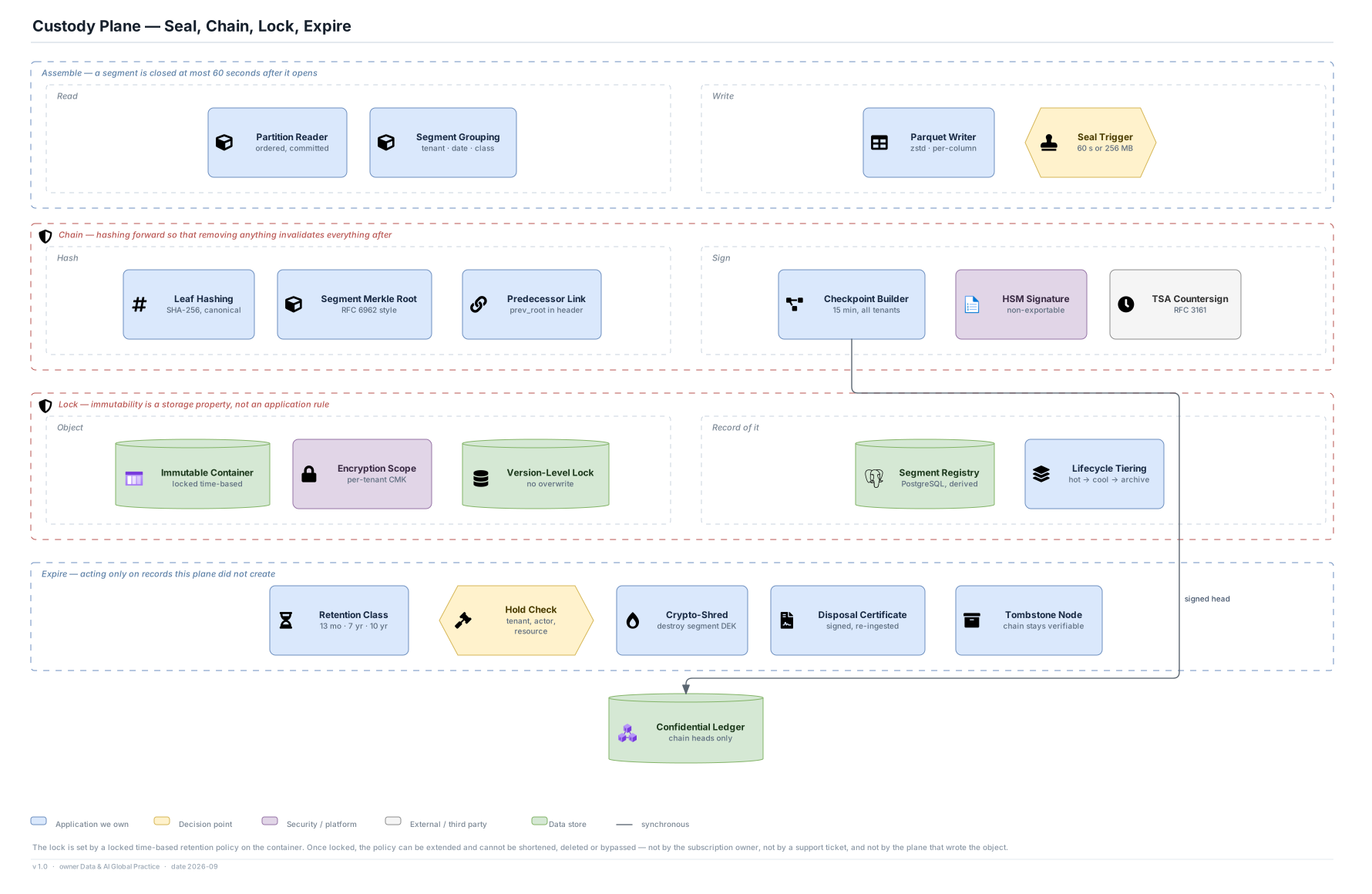
Assemble — a segment is closed at most 60 seconds after it opens Read Partition Reader ordered, committed Segment Grouping tenant · date · class Write Parquet Writer zstd · per-column Seal Trigger 60 s or 256 MB Chain — hashing forward so that removing anything invalidates everything after Hash Leaf Hashing SHA-256, canonical Segment Merkle Root RFC 6962 style Predecessor Link prev_root in header Sign Checkpoint Builder 15 min, all tenants HSM Signature non-exportable TSA Countersign RFC 3161 Lock — immutability is a storage property, not an application rule Object Immutable Container locked time-based Encryption Scope per-tenant CMK Version-Level Lock no overwrite Record of it Segment Registry PostgreSQL, derived Lifecycle Tiering hot → cool → archive Expire — acting only on records this plane did not create Retention Class 13 mo · 7 yr · 10 yr Hold Check tenant, actor, resource Crypto-Shred destroy segment DEK Disposal Certificate signed, re-ingested Tombstone Node chain stays verifiable Confidential Ledger chain heads only signed head Custody Plane — Seal, Chain, Lock, Expire Application we own Decision point Security / platform External / third party Data store synchronous The lock is set by a locked time-based retention policy on the container. Once locked, the policy can be extended and cannot be shortened, deleted or bypassed — not by the subscription owner, not by a support ticket, and not by the plane that wrote the object. v 1.0 · owner Data & AI Global Practice · date 2026-09
Custody Plane
Assemble, chain, lock, expire — the four things that happen to a record after nobody can change it any more.
HTML page
SVG
draw.io
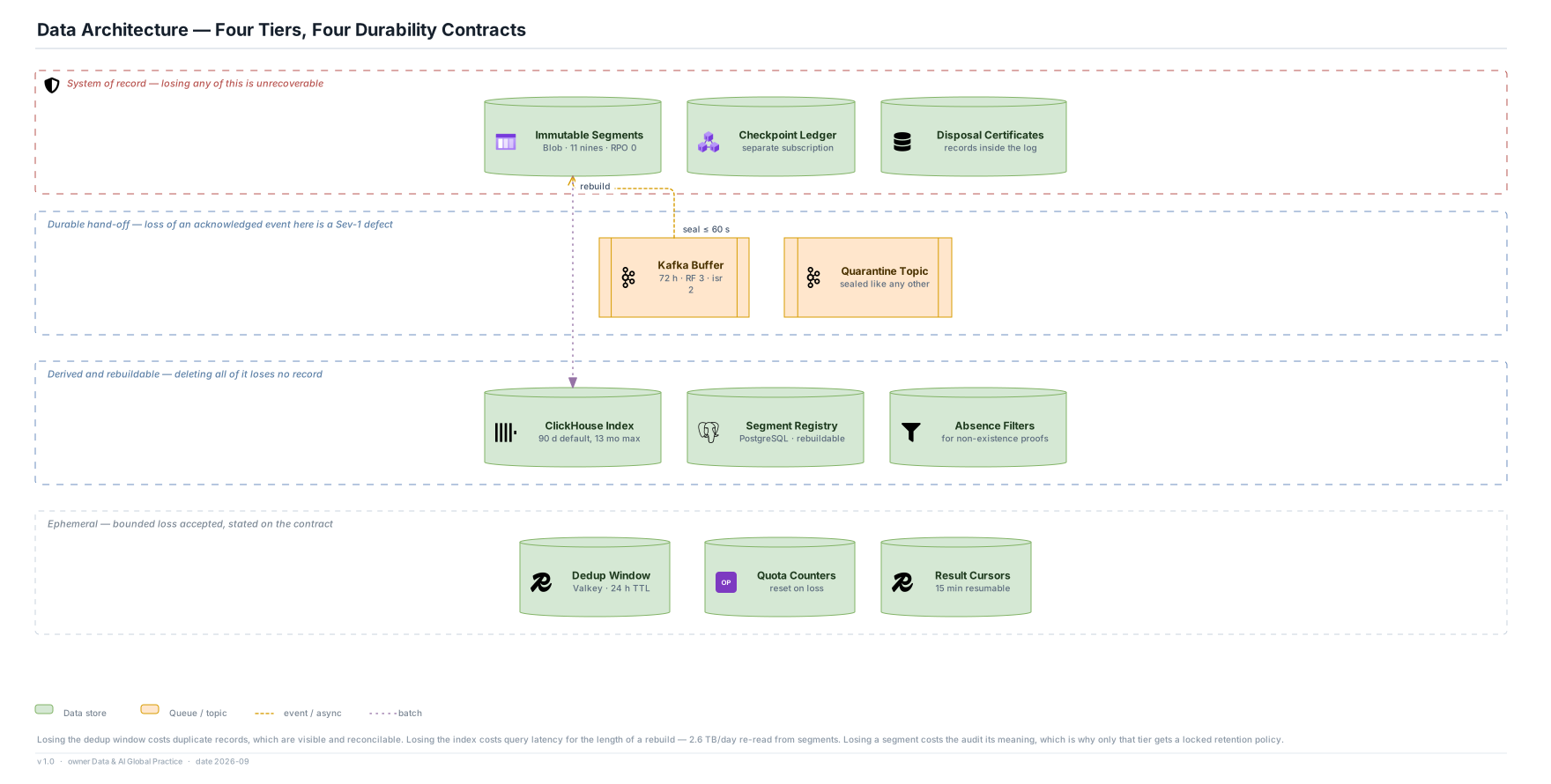
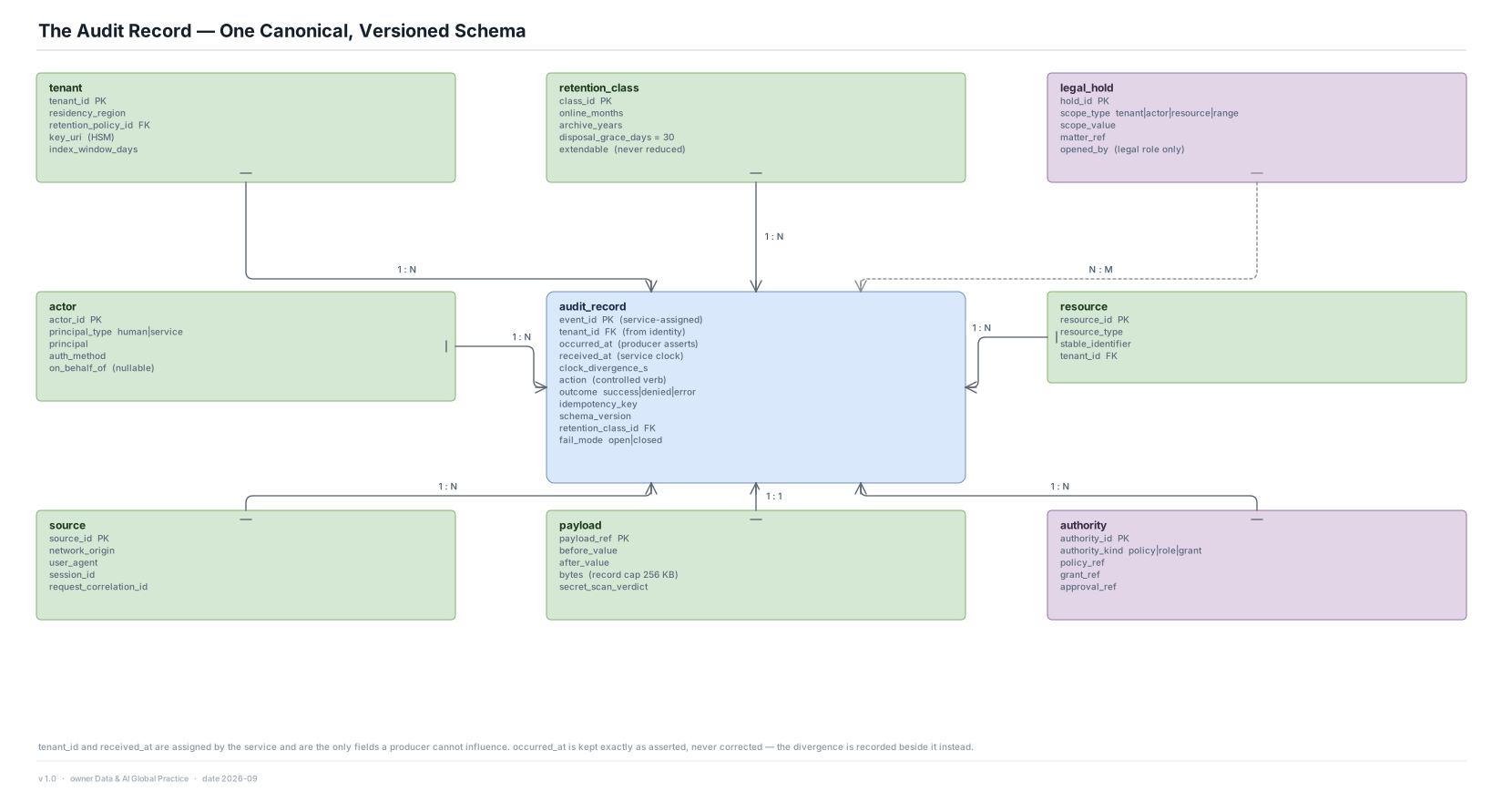
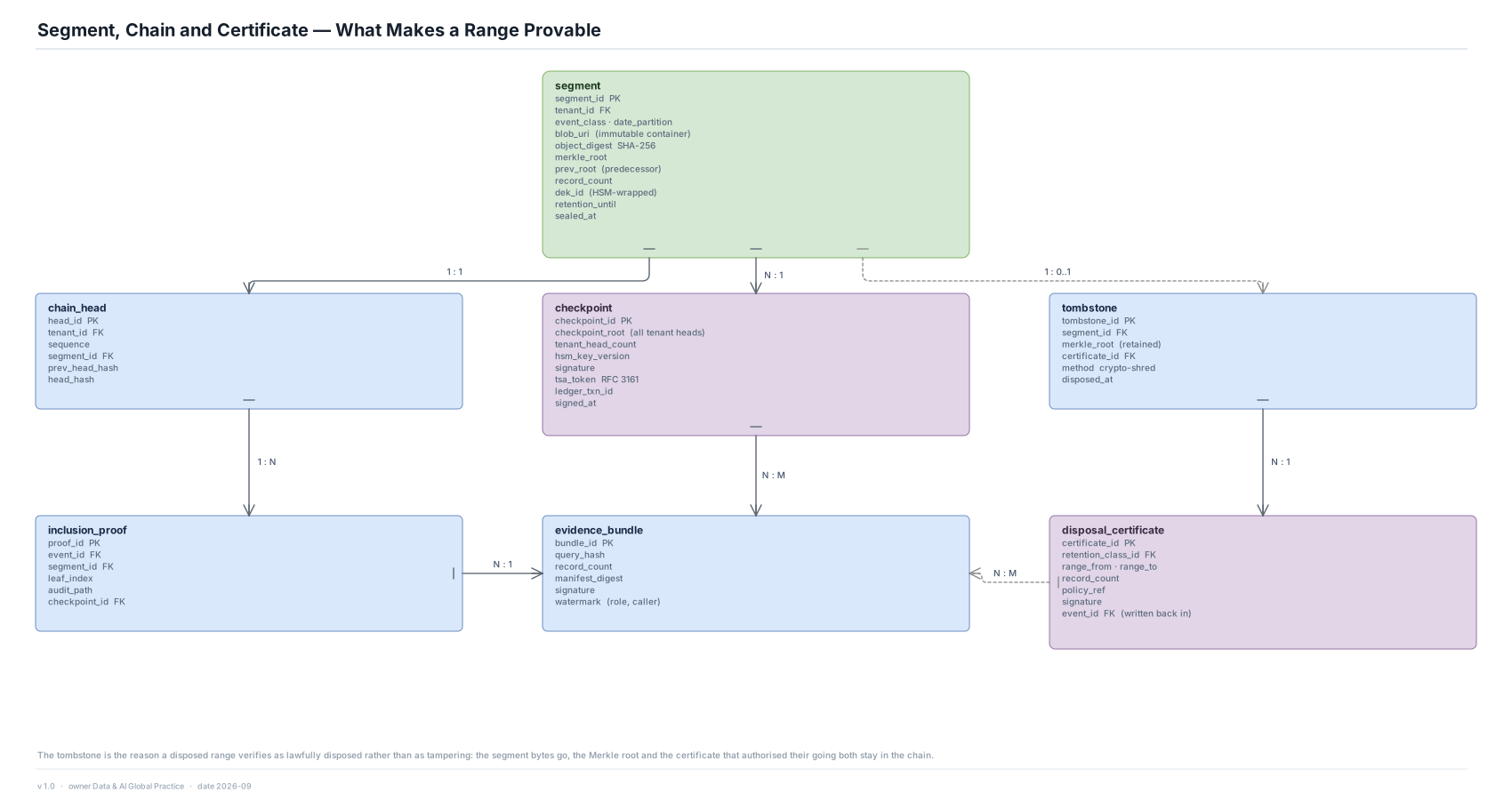
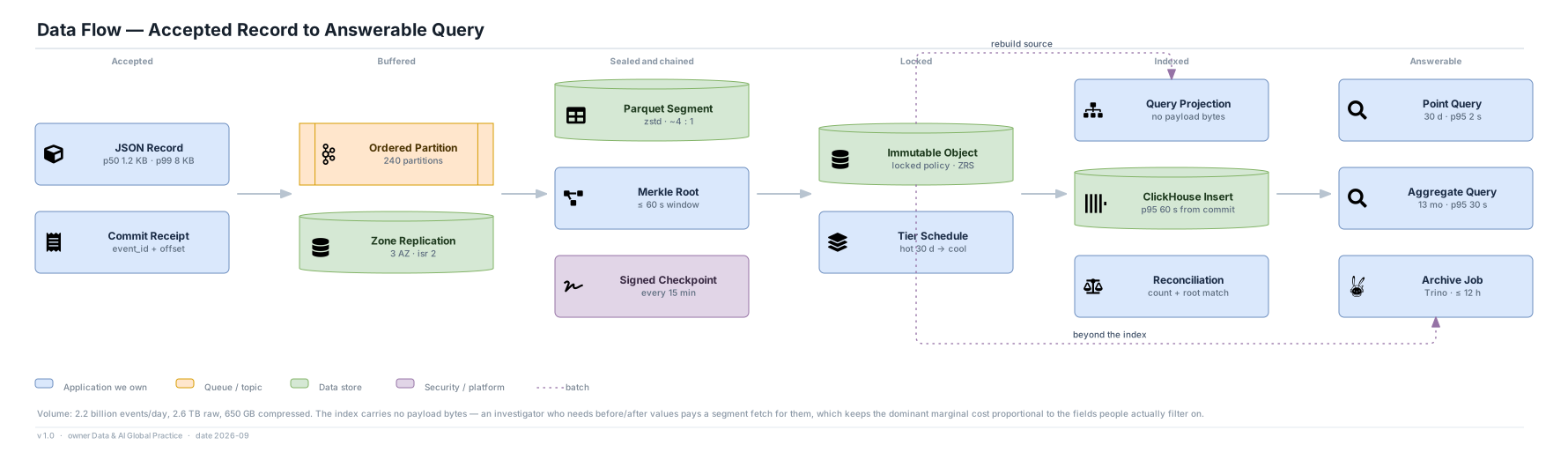
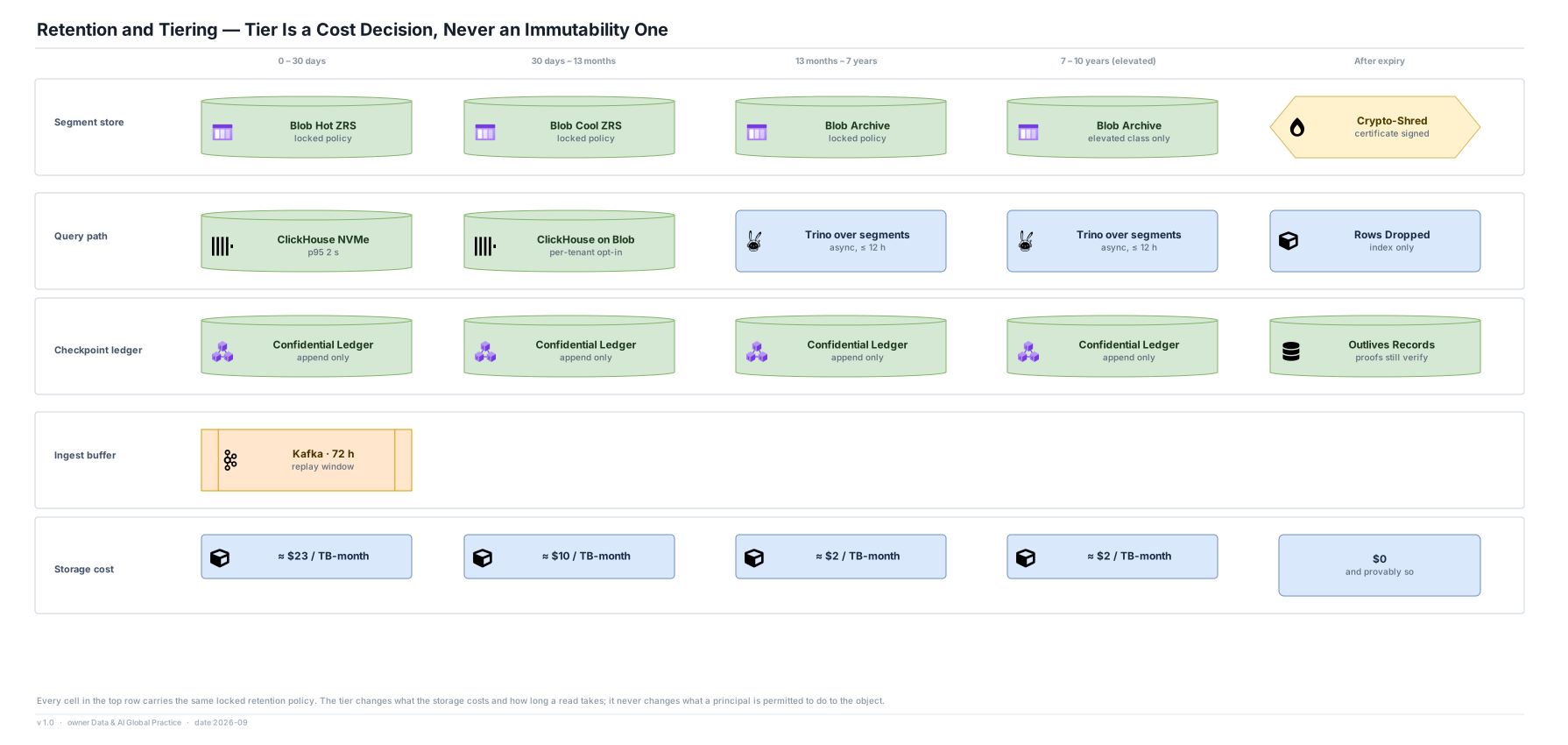
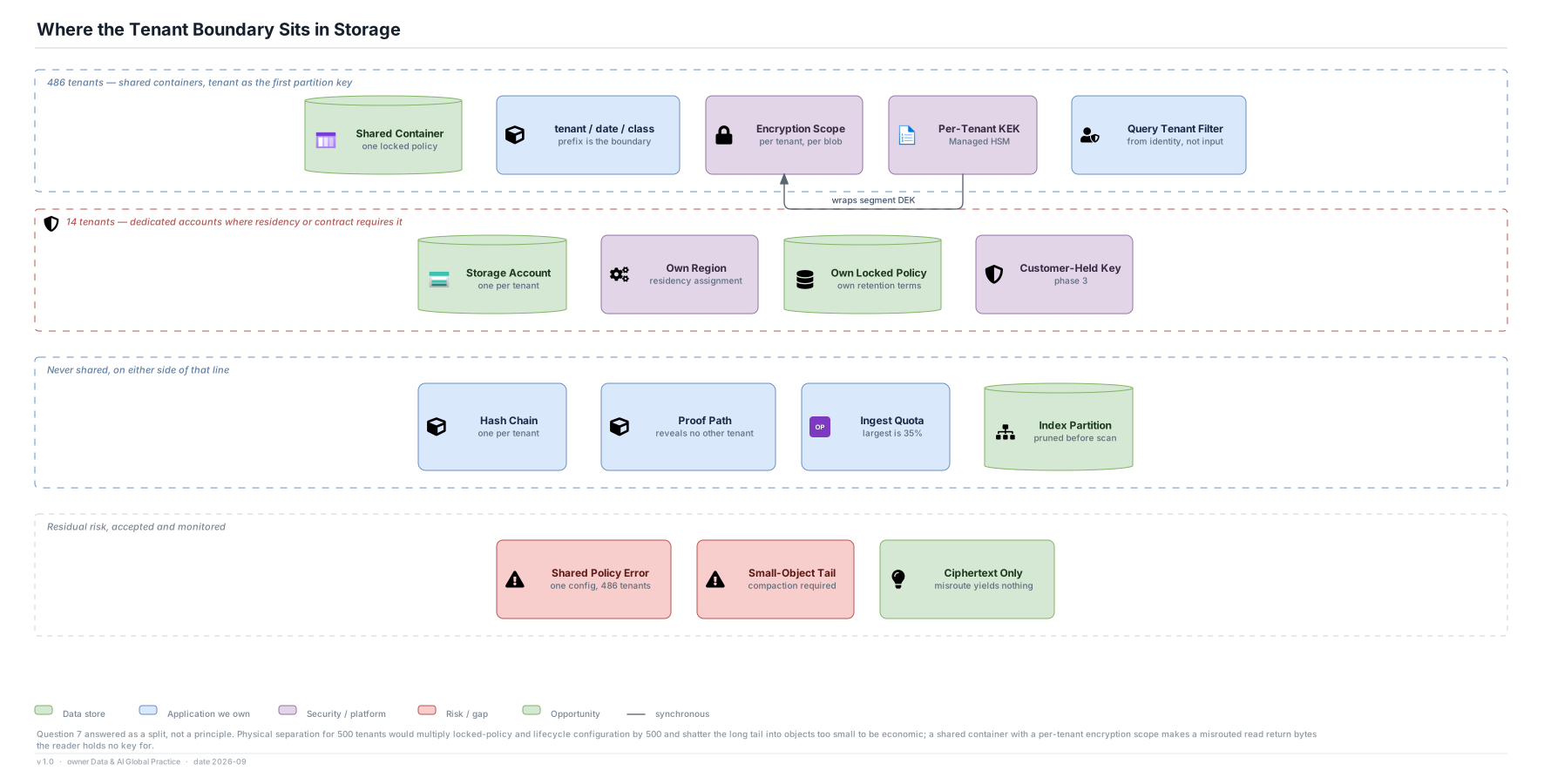
4 · Data Which tier is the system of record and which is disposable, the canonical record, the model behind a proof, and where the tenant boundary sits in storage.
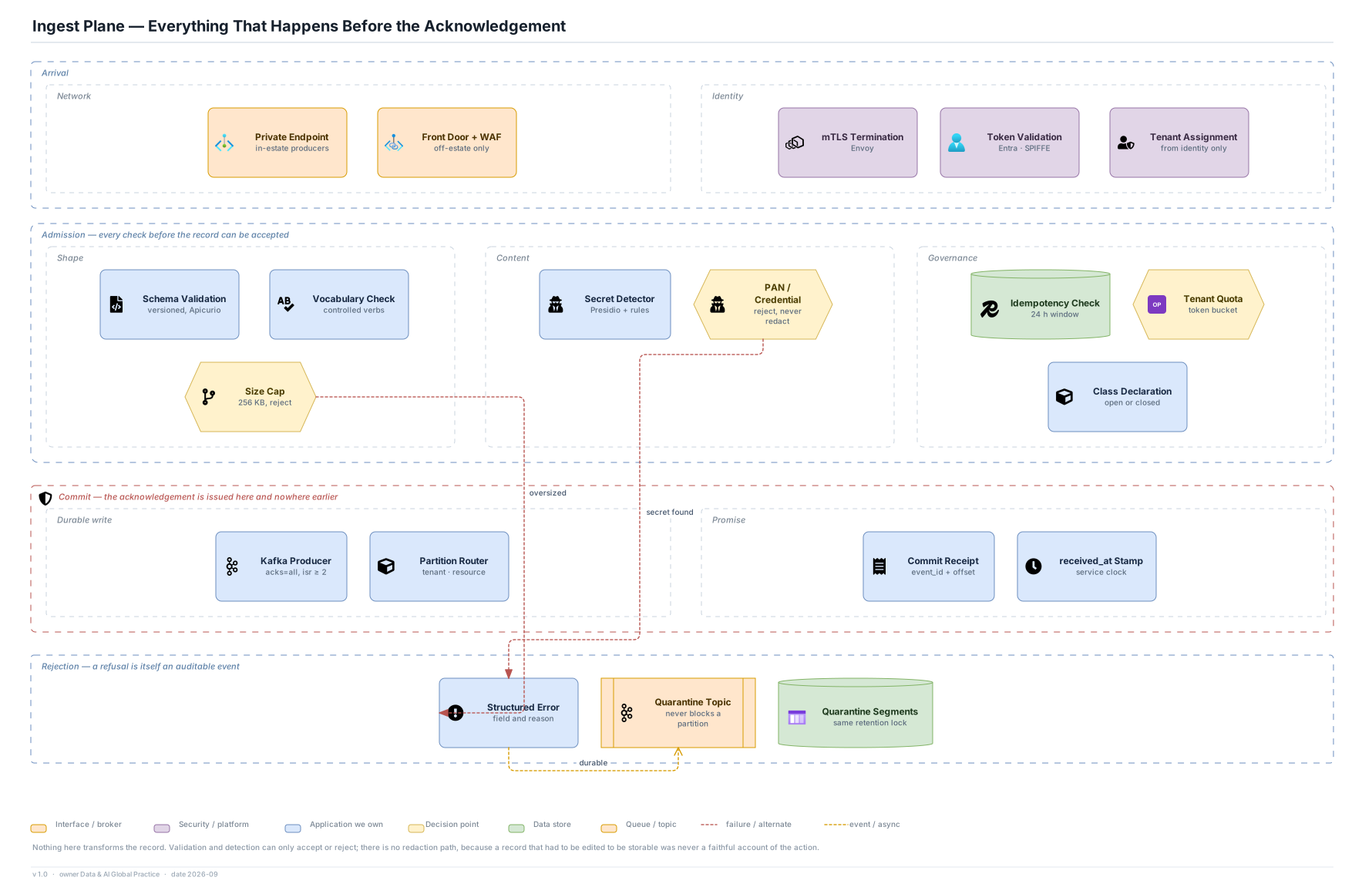
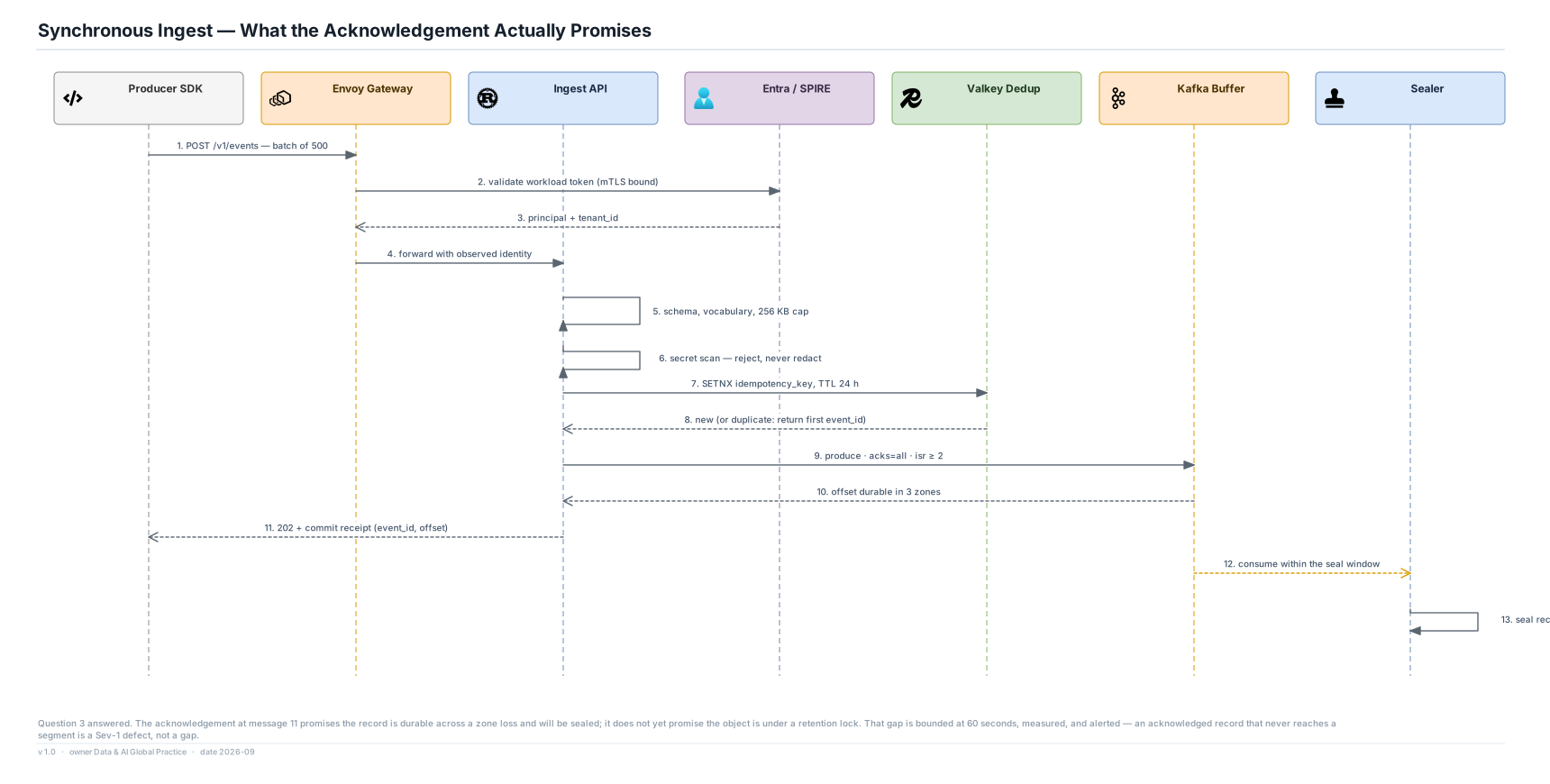
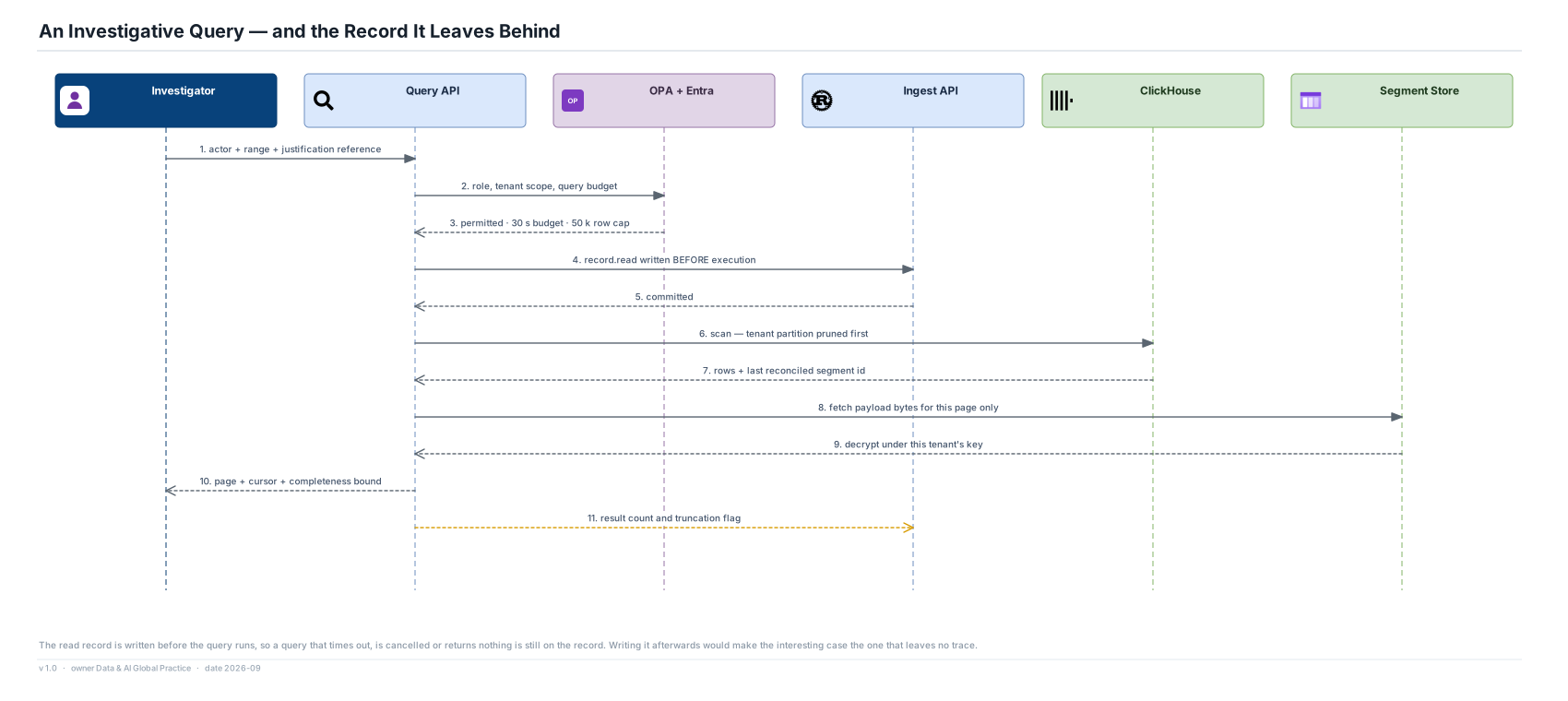
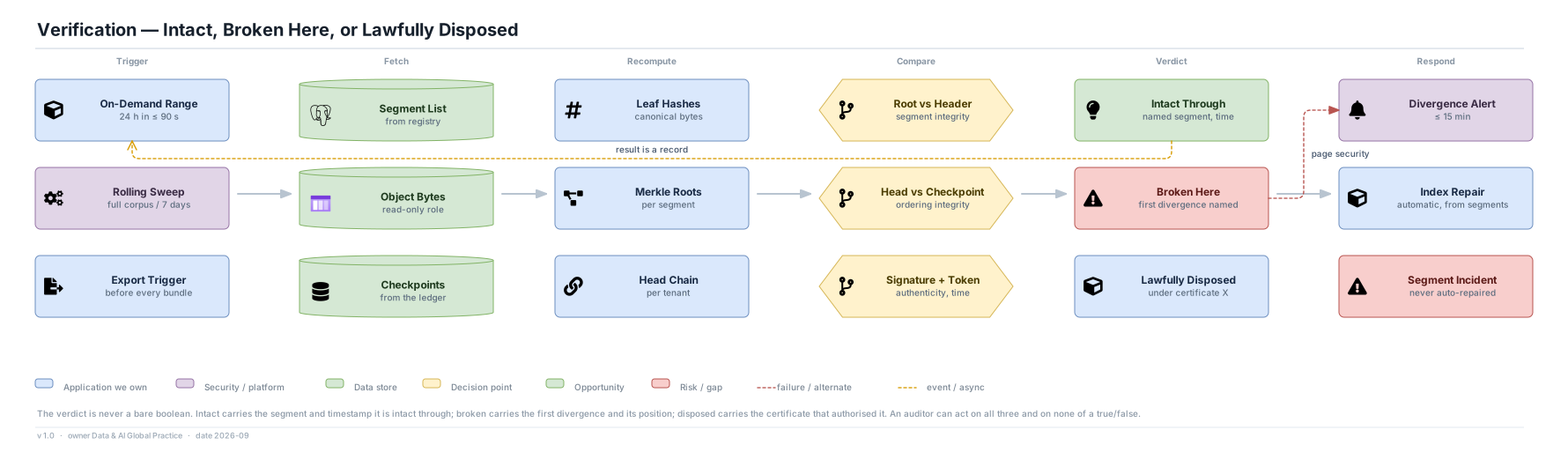
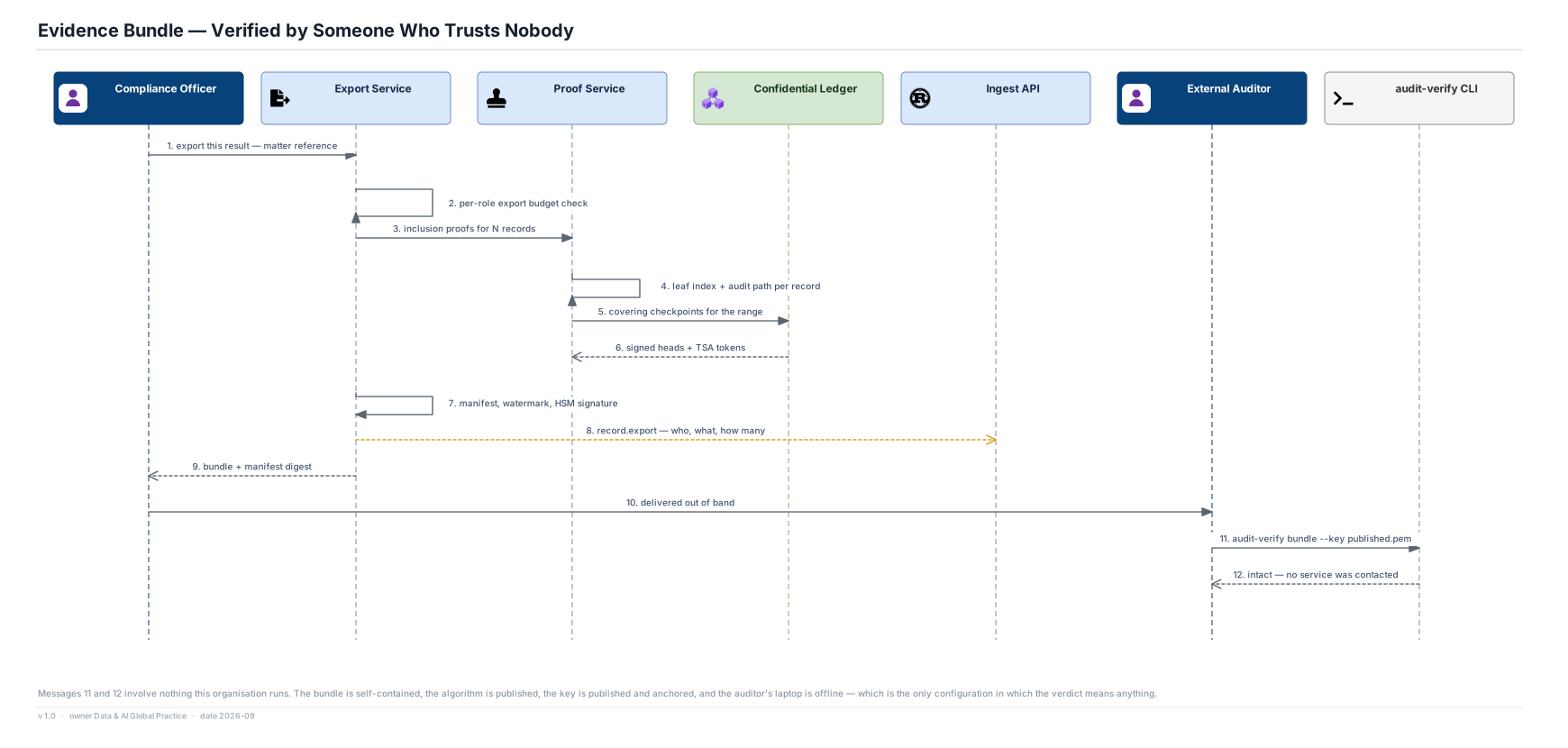
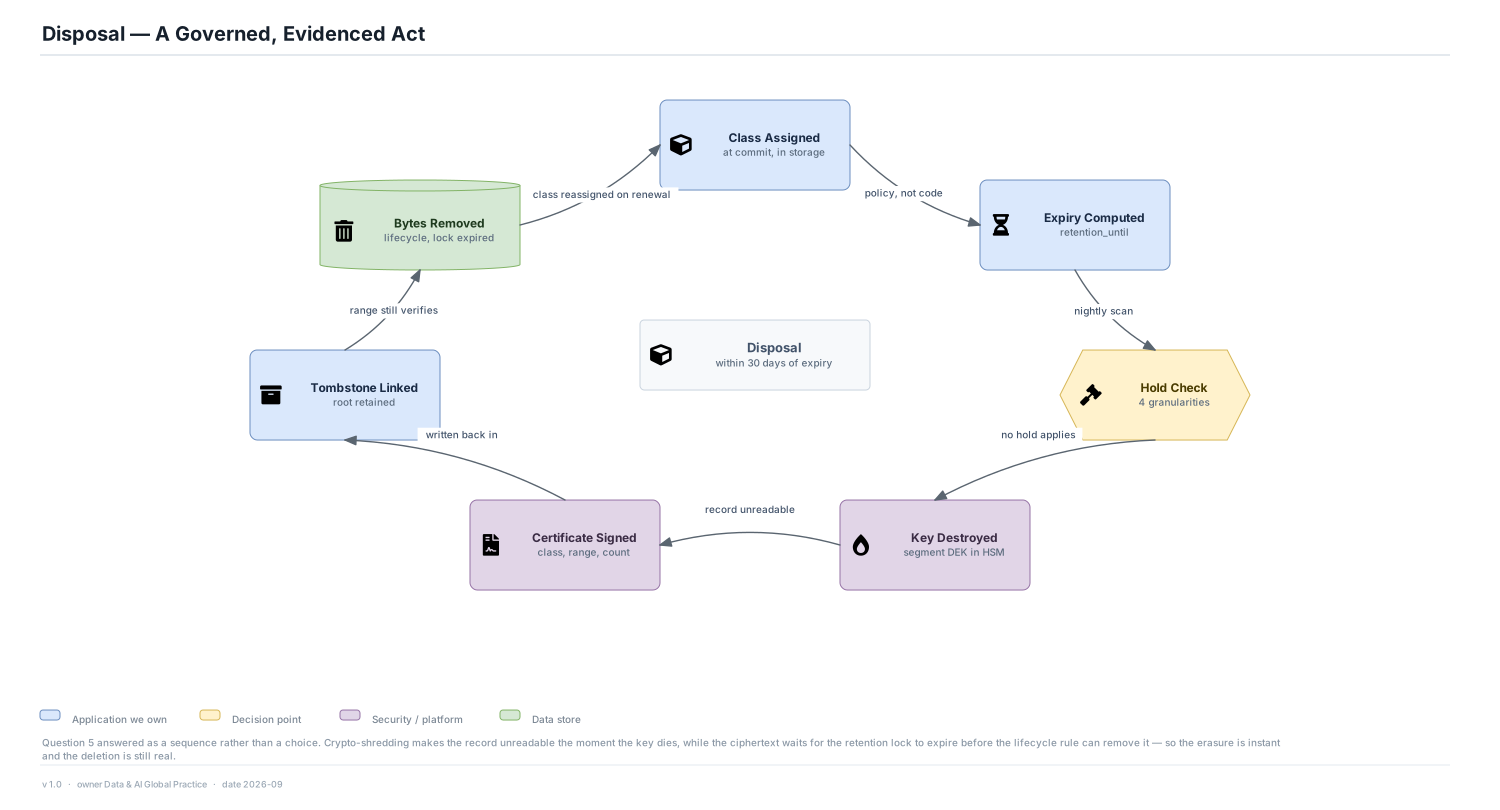
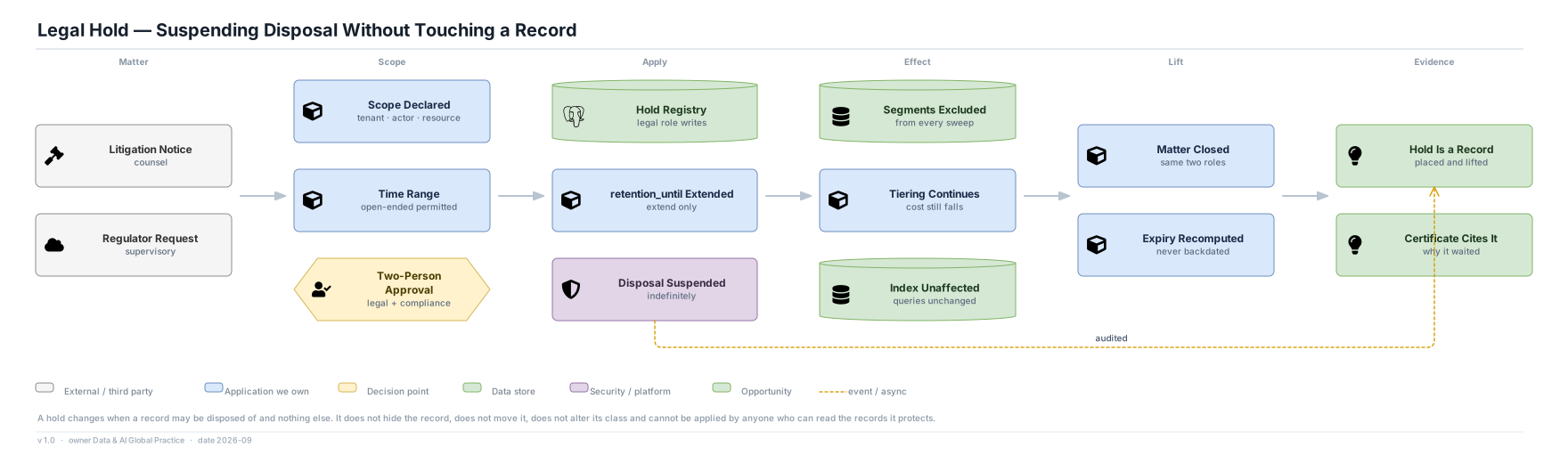
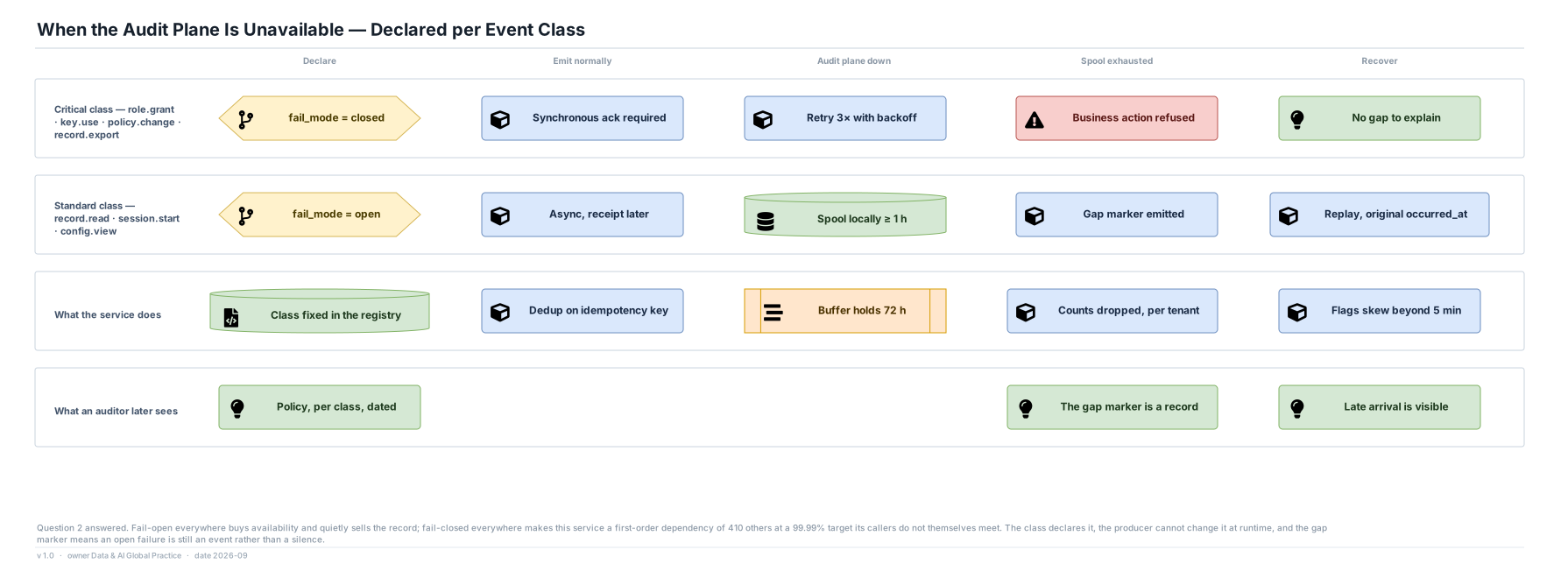
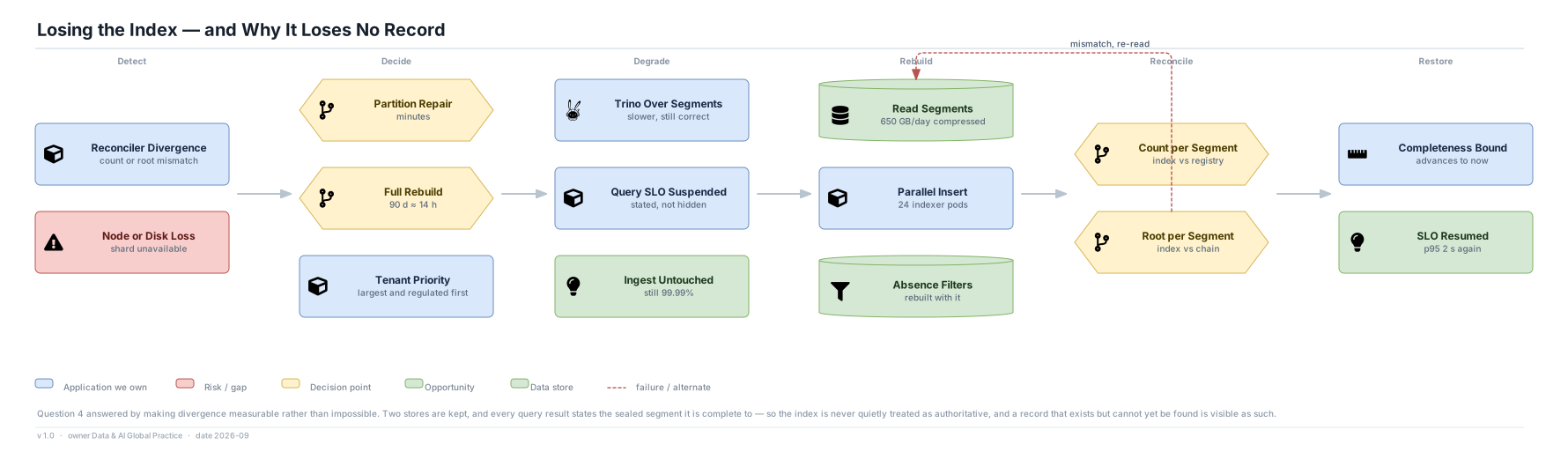
5 · Runtime Ingest and what the acknowledgement promises, sealing and signing, querying and the record a query leaves, verification, export, disposal, legal hold, an audit-plane outage and an index rebuild.
21
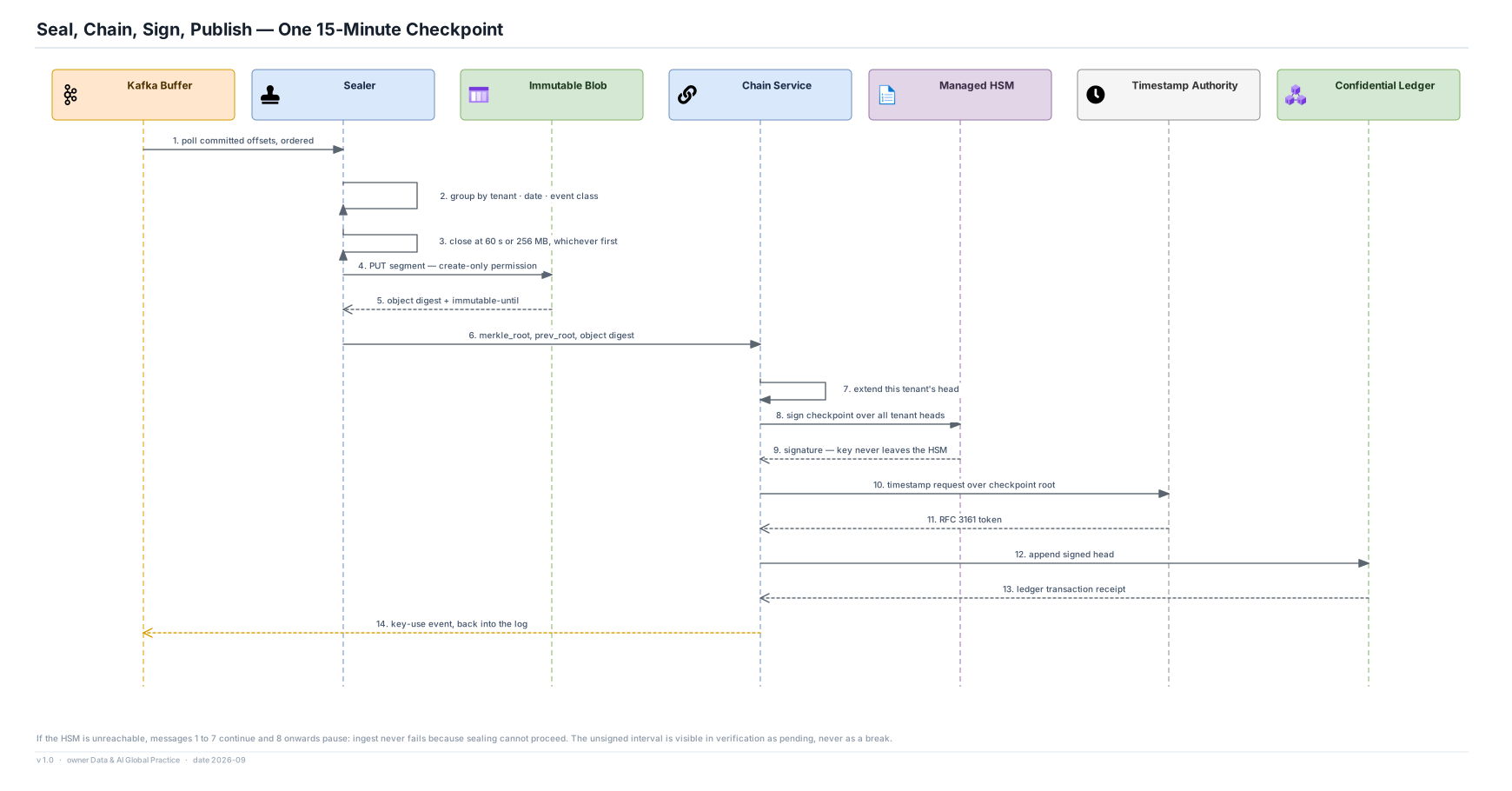
Kafka Buffer Sealer Immutable Blob Chain Service Managed HSM Timestamp Authority Confidential Ledger 1. poll committed offsets, ordered 2. group by tenant · date · event class 3. close at 60 s or 256 MB, whichever first 4. PUT segment — create-only permission 5. object digest + immutable-until 6. merkle_root, prev_root, object digest 7. extend this tenant's head 8. sign checkpoint over all tenant heads 9. signature — key never leaves the HSM 10. timestamp request over checkpoint root 11. RFC 3161 token 12. append signed head 13. ledger transaction receipt 14. key-use event, back into the log Seal, Chain, Sign, Publish — One 15-Minute Checkpoint If the HSM is unreachable, messages 1 to 7 continue and 8 onwards pause: ingest never fails because sealing cannot proceed. The unsigned interval is visible in verification as pending, never as a break. v 1.0 · owner Data & AI Global Practice · date 2026-09
Seal, Chain, Sign, Publish
One fifteen-minute checkpoint end to end, including what happens when the key service is unreachable.
HTML page
SVG
draw.io
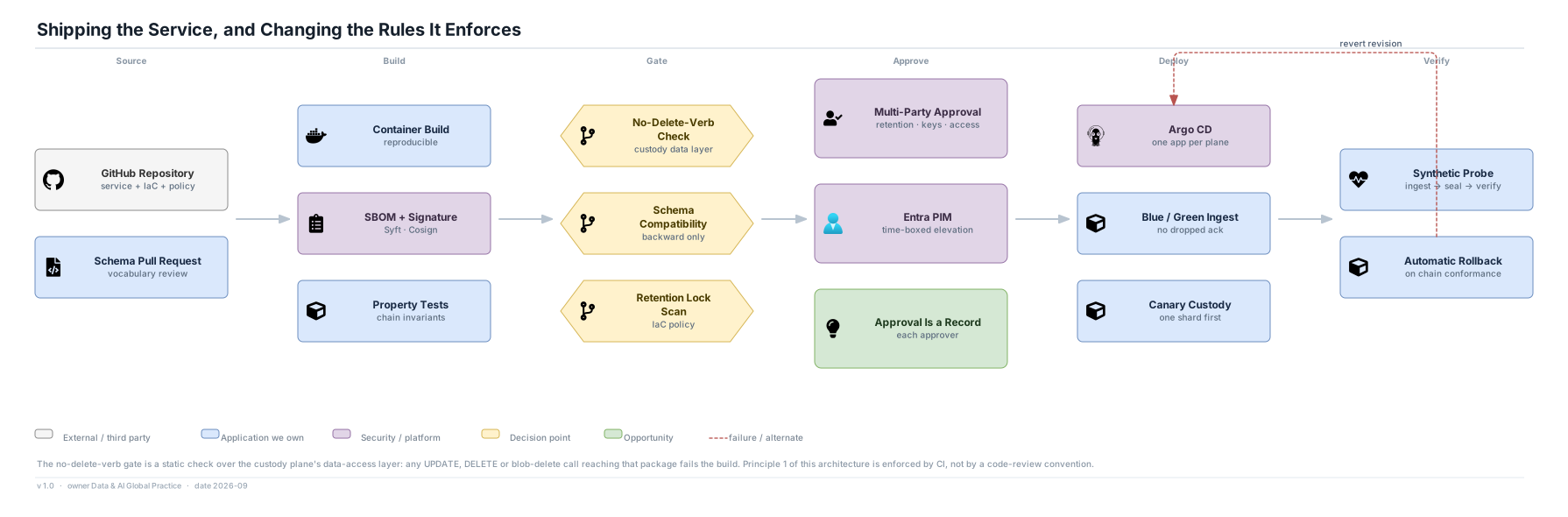
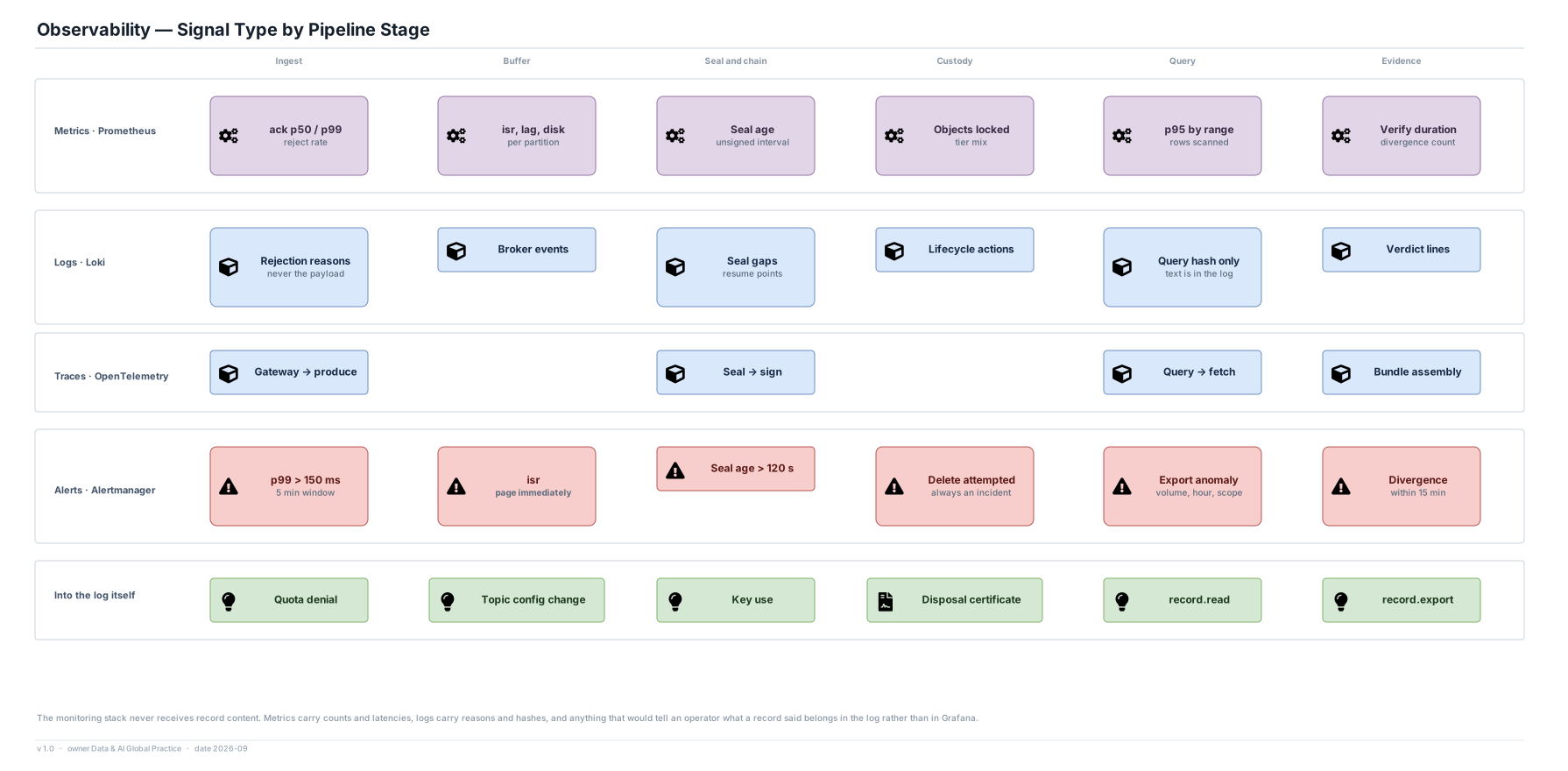
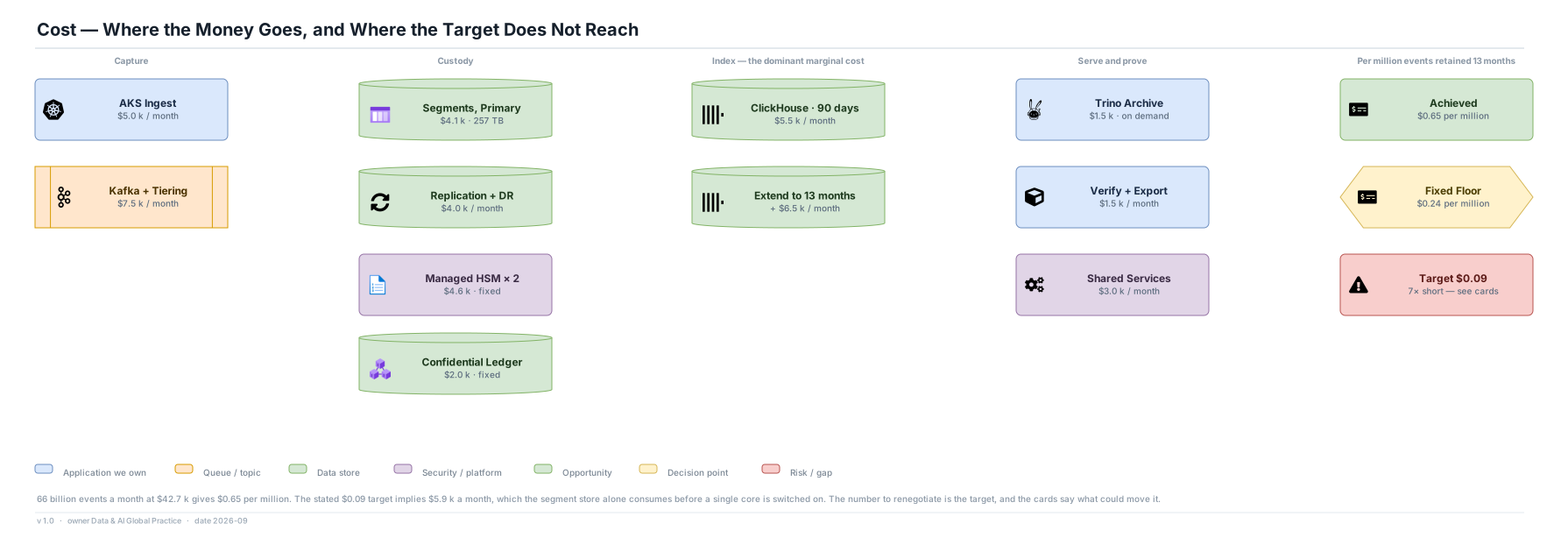
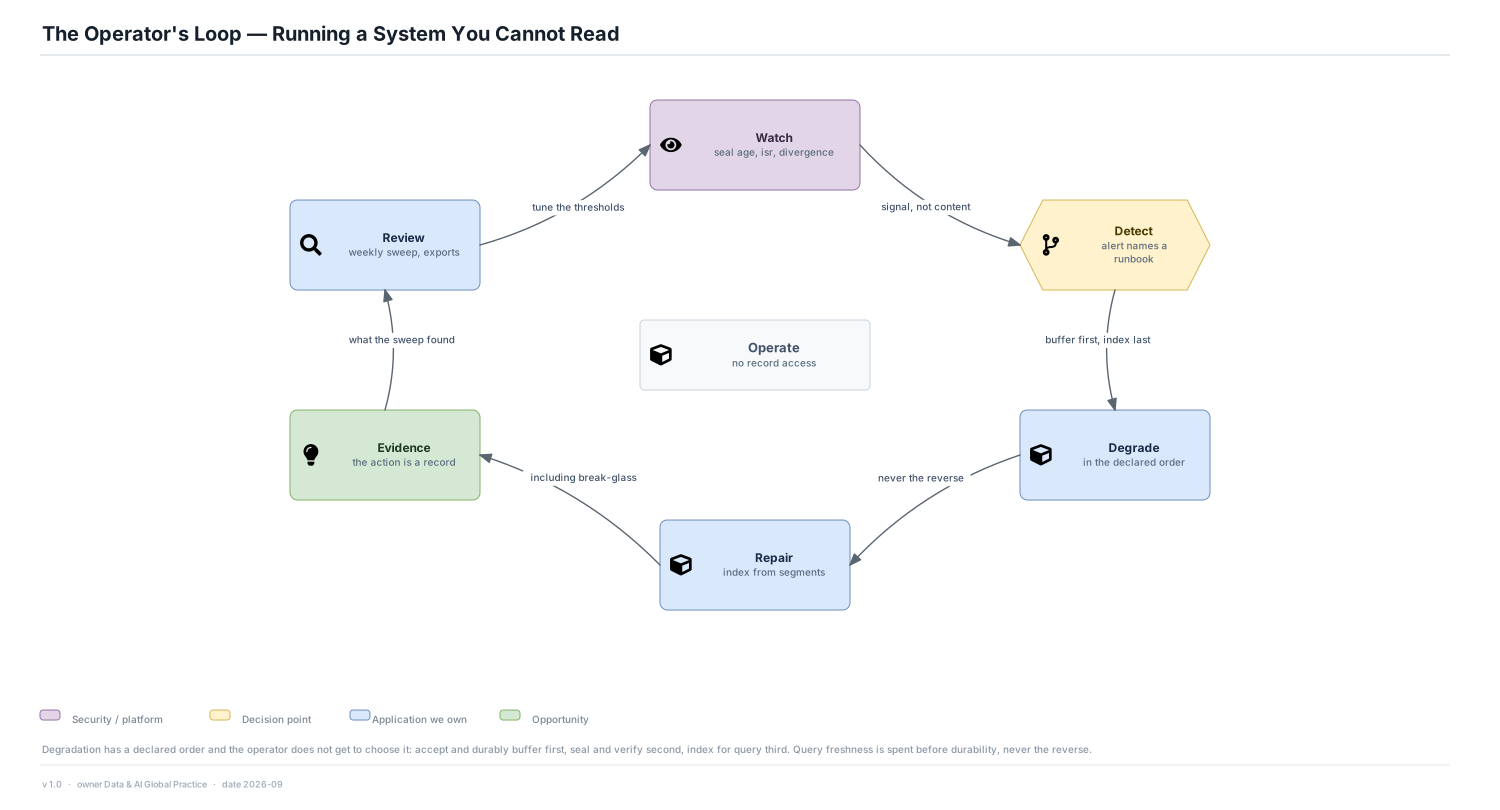
6 · Operations Where it runs, how it survives a region, how a change to the rules is approved, what is watched, what it costs, and the operator's loop over a system they cannot read.
29
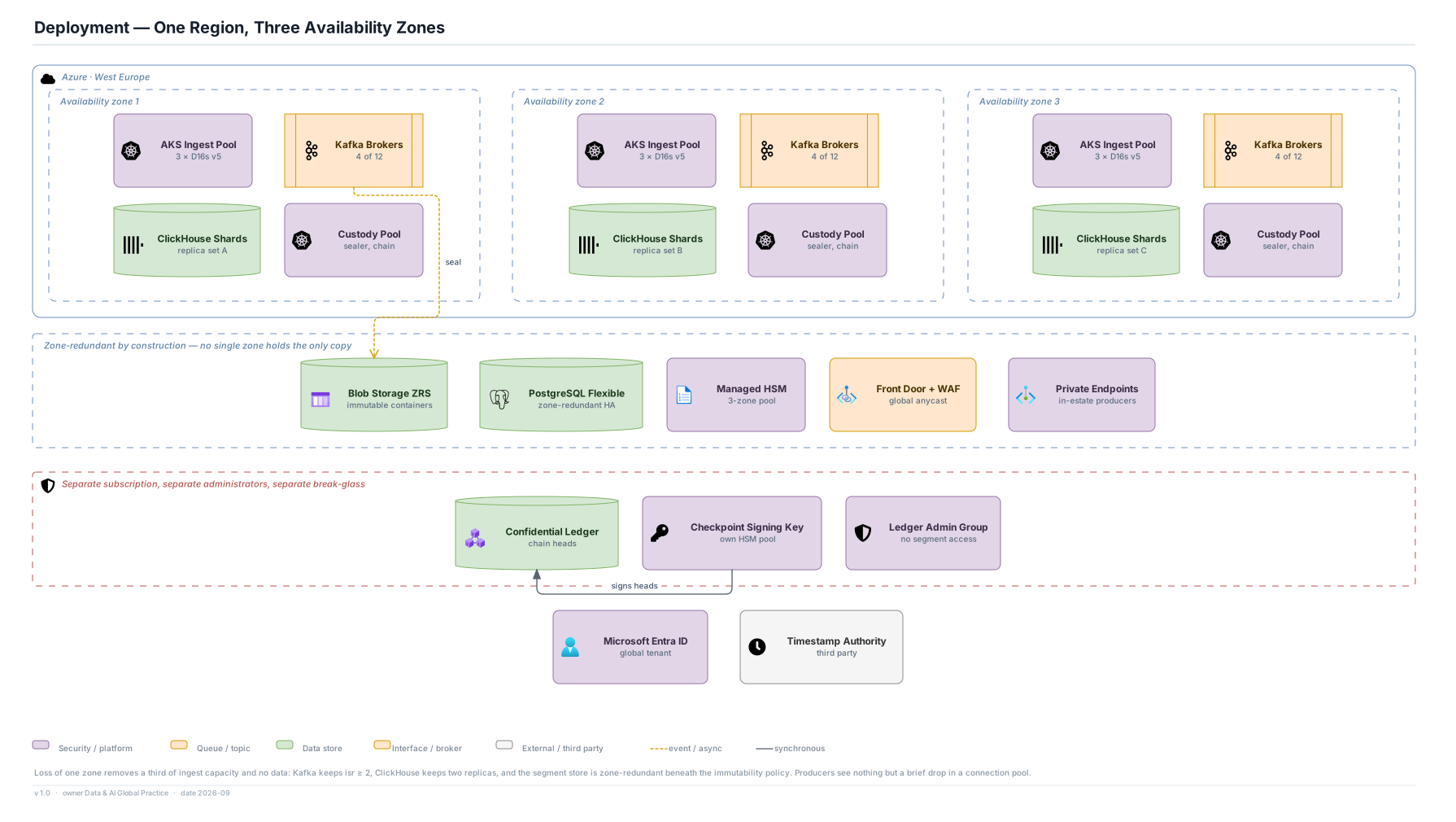
Azure · West Europe Availability zone 1 AKS Ingest Pool 3 × D16s v5 Kafka Brokers 4 of 12 ClickHouse Shards replica set A Custody Pool sealer, chain Availability zone 2 AKS Ingest Pool 3 × D16s v5 Kafka Brokers 4 of 12 ClickHouse Shards replica set B Custody Pool sealer, chain Availability zone 3 AKS Ingest Pool 3 × D16s v5 Kafka Brokers 4 of 12 ClickHouse Shards replica set C Custody Pool sealer, chain Zone-redundant by construction — no single zone holds the only copy Blob Storage ZRS immutable containers PostgreSQL Flexible zone-redundant HA Managed HSM 3-zone pool Front Door + WAF global anycast Private Endpoints in-estate producers Separate subscription, separate administrators, separate break-glass Confidential Ledger chain heads Checkpoint Signing Key own HSM pool Ledger Admin Group no segment access Microsoft Entra ID global tenant Timestamp Authority third party seal signs heads Deployment — One Region, Three Availability Zones Security / platform Queue / topic Data store Interface / broker External / third party event / async synchronous Loss of one zone removes a third of ingest capacity and no data: Kafka keeps isr ≥ 2, ClickHouse keeps two replicas, and the segment store is zone-redundant beneath the immutability policy. Producers see nothing but a brief drop in a connection pool. v 1.0 · owner Data & AI Global Practice · date 2026-09
Deployment — One Region, Three Zones
What runs where, what is zone-redundant by construction, and which subscription deliberately is not ours.
HTML page
SVG
draw.io
30
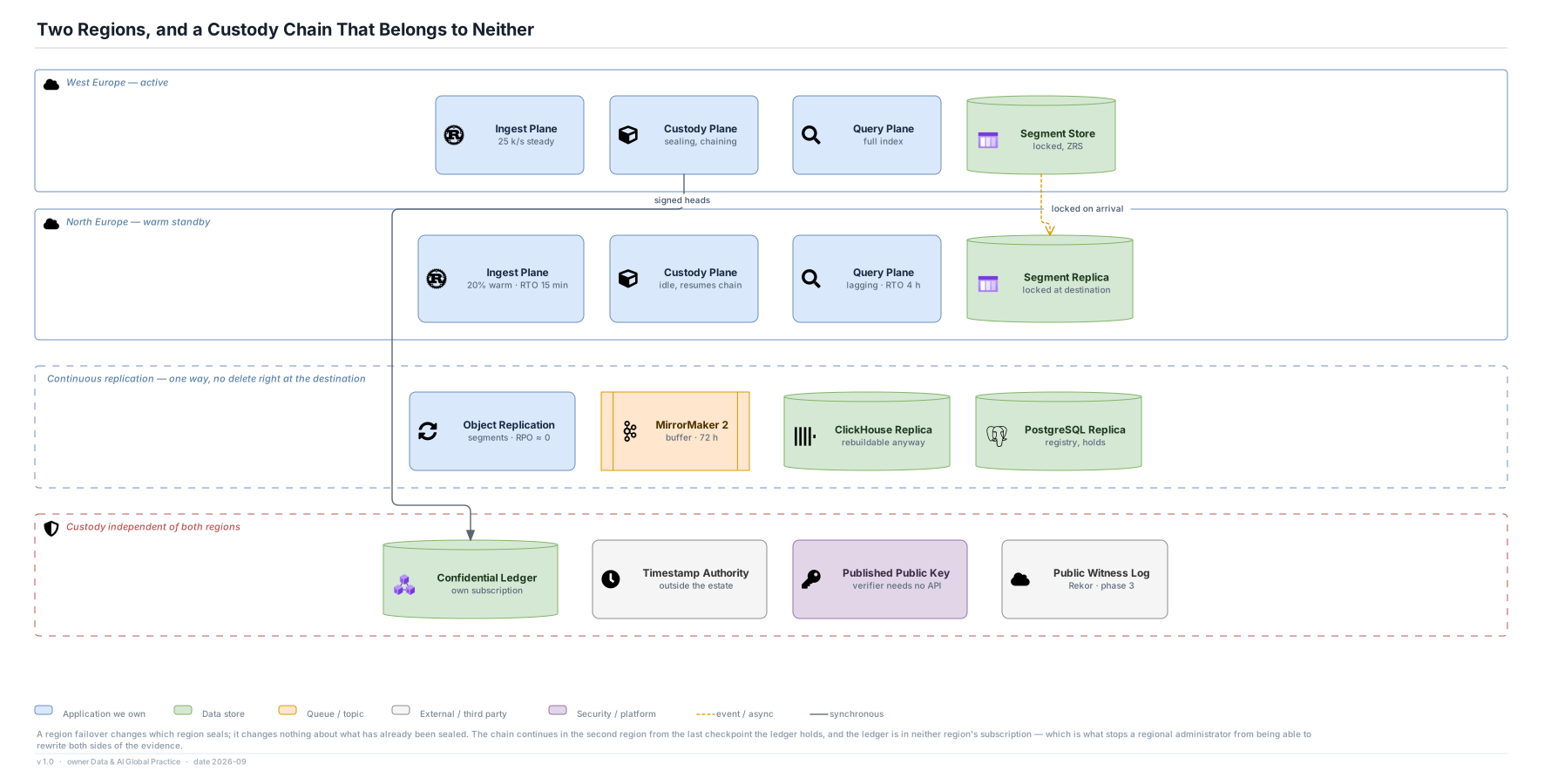
West Europe — active Ingest Plane 25 k/s steady Custody Plane sealing, chaining Query Plane full index Segment Store locked, ZRS North Europe — warm standby Ingest Plane 20% warm · RTO 15 min Custody Plane idle, resumes chain Query Plane lagging · RTO 4 h Segment Replica locked at destination Continuous replication — one way, no delete right at the destination Object Replication segments · RPO ≈ 0 MirrorMaker 2 buffer · 72 h ClickHouse Replica rebuildable anyway PostgreSQL Replica registry, holds Custody independent of both regions Confidential Ledger own subscription Timestamp Authority outside the estate Published Public Key verifier needs no API Public Witness Log Rekor · phase 3 locked on arrival signed heads Two Regions, and a Custody Chain That Belongs to Neither Application we own Data store Queue / topic External / third party Security / platform event / async synchronous A region failover changes which region seals; it changes nothing about what has already been sealed. The chain continues in the second region from the last checkpoint the ledger holds, and the ledger is in neither region's subscription — which is what stops a regional administrator from being able to rewrite both sides of the evidence. v 1.0 · owner Data & AI Global Practice · date 2026-09
Two Regions, and Custody That Belongs to Neither
Active-passive failover, one-way replication, and the reason the checkpoint ledger sits outside both regions.
HTML page
SVG
draw.io
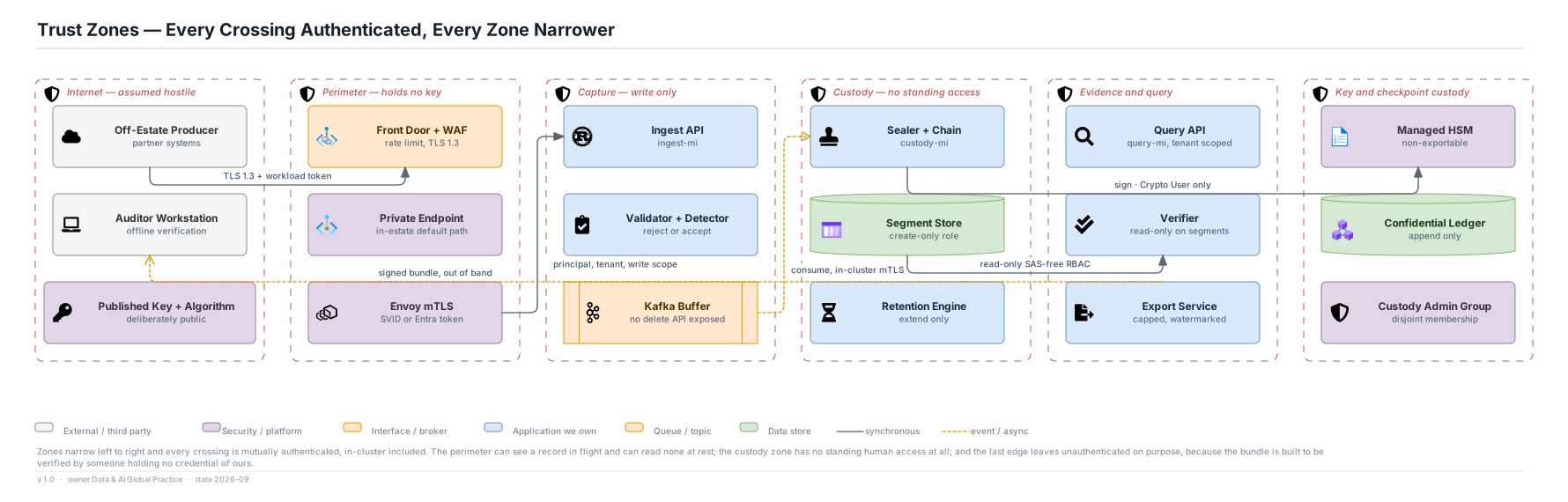
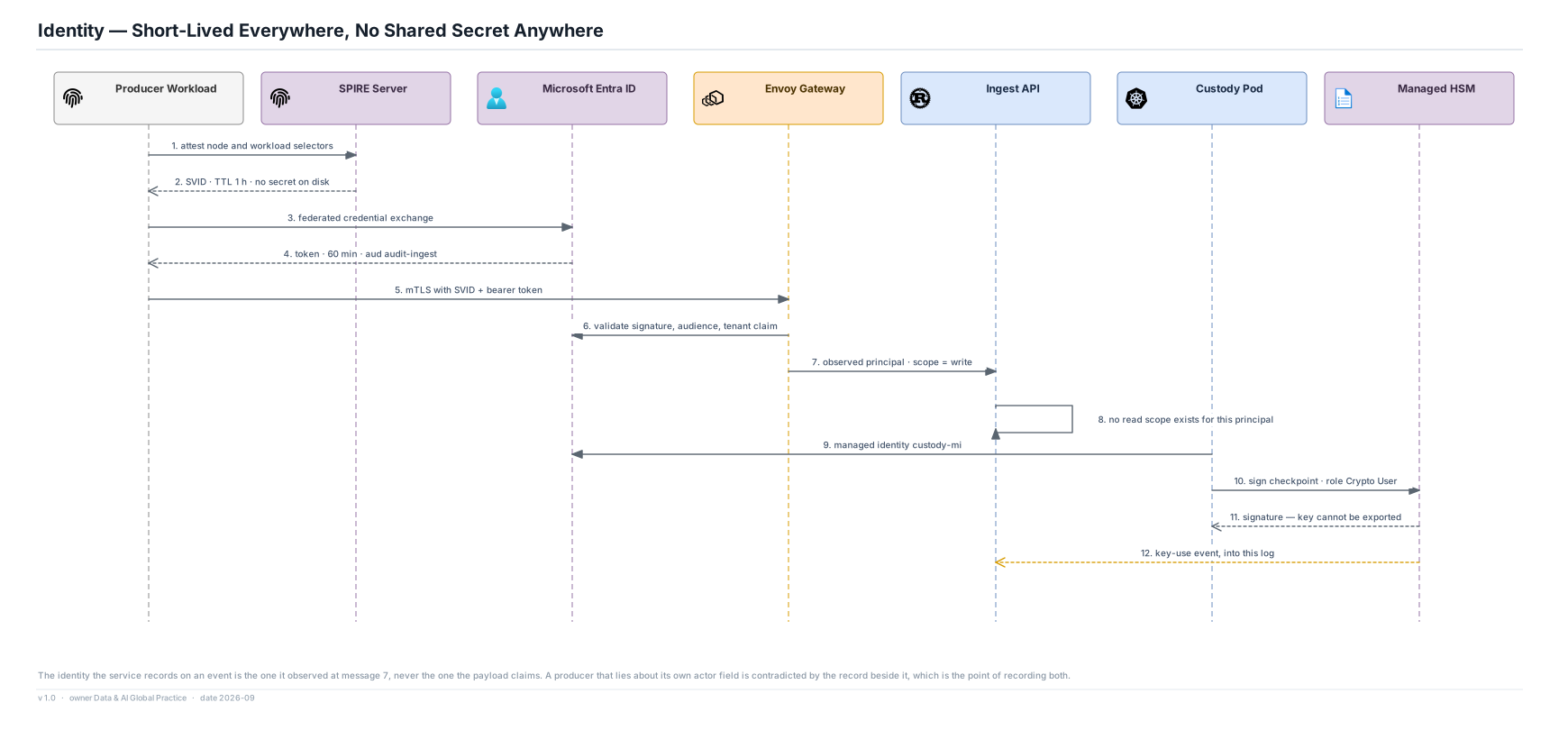
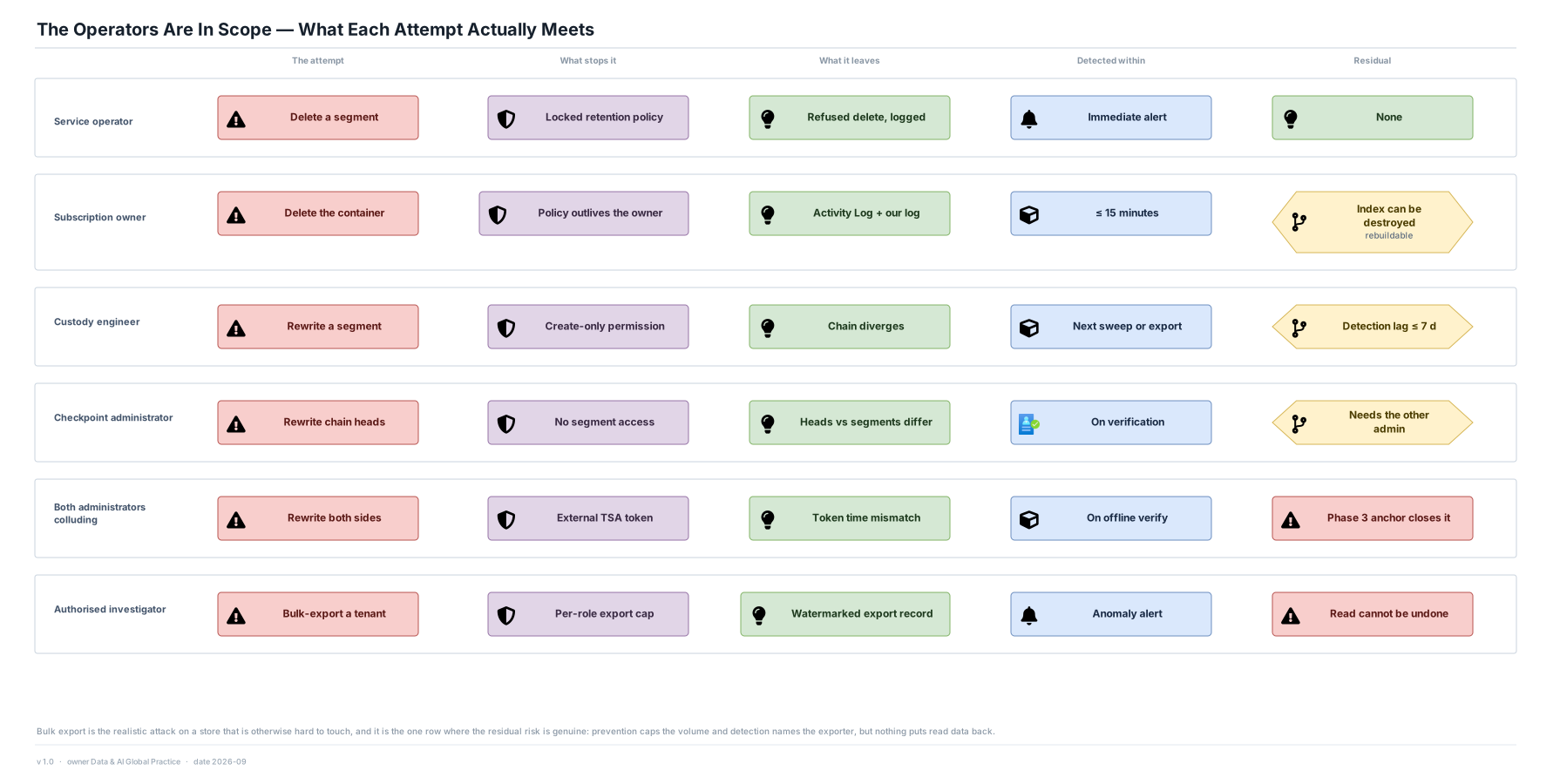
7 · Assurance Trust zones, identity, separation of duties, key custody, what each insider attempt actually meets, and every named failure mode with its required handling.
35
Internet — assumed hostile Off-Estate Producer partner systems Auditor Workstation offline verification Published Key + Algorithm deliberately public Perimeter — holds no key Front Door + WAF rate limit, TLS 1.3 Private Endpoint in-estate default path Envoy mTLS SVID or Entra token Capture — write only Ingest API ingest-mi Validator + Detector reject or accept Kafka Buffer no delete API exposed Custody — no standing access Sealer + Chain custody-mi Segment Store create-only role Retention Engine extend only Evidence and query Query API query-mi, tenant scoped Verifier read-only on segments Export Service capped, watermarked Key and checkpoint custody Managed HSM non-exportable Confidential Ledger append only Custody Admin Group disjoint membership TLS 1.3 + workload token principal, tenant, write scope consume, in-cluster mTLS read-only SAS-free RBAC sign · Crypto User only signed bundle, out of band Trust Zones — Every Crossing Authenticated, Every Zone Narrower External / third party Security / platform Interface / broker Application we own Queue / topic Data store synchronous event / async Zones narrow left to right and every crossing is mutually authenticated, in-cluster included. The perimeter can see a record in flight and can read none at rest; the custody zone has no standing human access at all; and the last edge leaves unauthenticated on purpose, because the bundle is built to be verified by someone holding no credential of ours. v 1.0 · owner Data & AI Global Practice · date 2026-09
Trust Zones
Six zones of decreasing exposure, every crossing authenticated — and the one edge that deliberately is not.
HTML page
SVG
draw.io
38
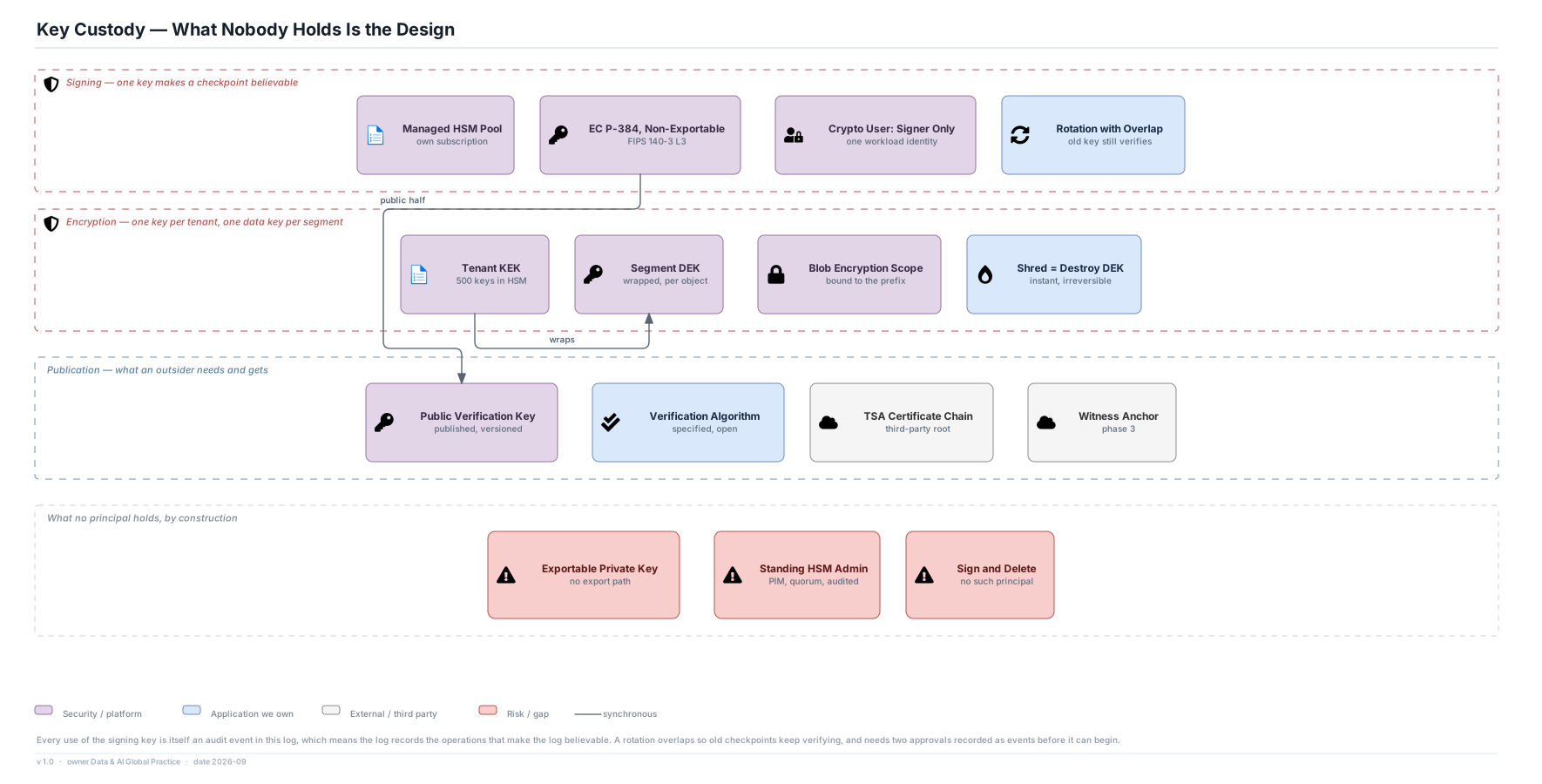
Signing — one key makes a checkpoint believable Managed HSM Pool own subscription EC P-384, Non-Exportable FIPS 140-3 L3 Crypto User: Signer Only one workload identity Rotation with Overlap old key still verifies Encryption — one key per tenant, one data key per segment Tenant KEK 500 keys in HSM Segment DEK wrapped, per object Blob Encryption Scope bound to the prefix Shred = Destroy DEK instant, irreversible Publication — what an outsider needs and gets Public Verification Key published, versioned Verification Algorithm specified, open TSA Certificate Chain third-party root Witness Anchor phase 3 What no principal holds, by construction Exportable Private Key no export path Standing HSM Admin PIM, quorum, audited Sign and Delete no such principal wraps public half Key Custody — What Nobody Holds Is the Design Security / platform Application we own External / third party Risk / gap synchronous Every use of the signing key is itself an audit event in this log, which means the log records the operations that make the log believable. A rotation overlaps so old checkpoints keep verifying, and needs two approvals recorded as events before it can begin. v 1.0 · owner Data & AI Global Practice · date 2026-09
Key Custody
Three kinds of key, what the outside world is given, and the combinations nobody holds.
HTML page
SVG
draw.io
40
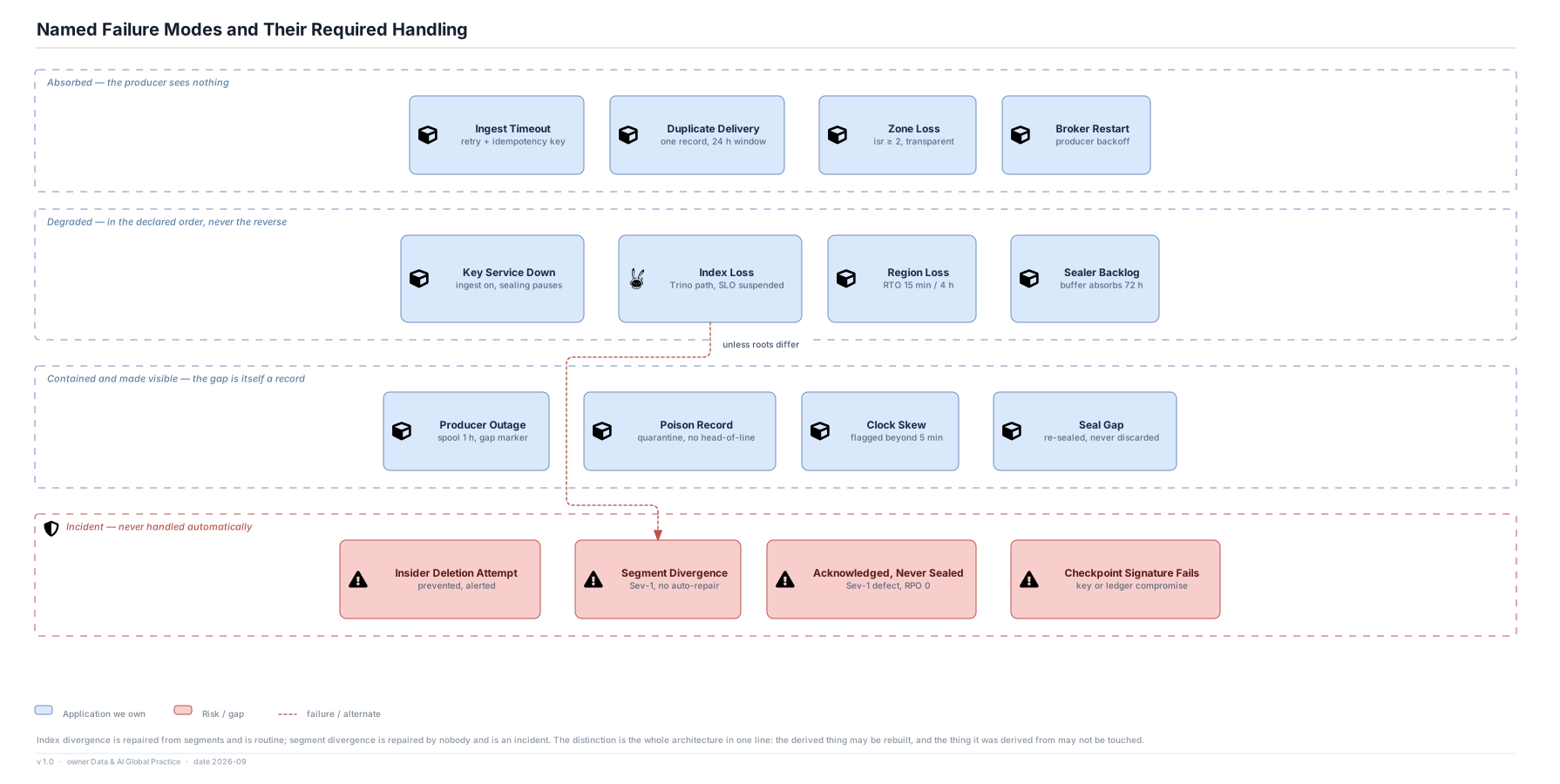
Absorbed — the producer sees nothing Ingest Timeout retry + idempotency key Duplicate Delivery one record, 24 h window Zone Loss isr ≥ 2, transparent Broker Restart producer backoff Degraded — in the declared order, never the reverse Key Service Down ingest on, sealing pauses Index Loss Trino path, SLO suspended Region Loss RTO 15 min / 4 h Sealer Backlog buffer absorbs 72 h Contained and made visible — the gap is itself a record Producer Outage spool 1 h, gap marker Poison Record quarantine, no head-of-line Clock Skew flagged beyond 5 min Seal Gap re-sealed, never discarded Incident — never handled automatically Insider Deletion Attempt prevented, alerted Segment Divergence Sev-1, no auto-repair Acknowledged, Never Sealed Sev-1 defect, RPO 0 Checkpoint Signature Fails key or ledger compromise unless roots differ Named Failure Modes and Their Required Handling Application we own Risk / gap failure / alternate Index divergence is repaired from segments and is routine; segment divergence is repaired by nobody and is an incident. The distinction is the whole architecture in one line: the derived thing may be rebuilt, and the thing it was derived from may not be touched. v 1.0 · owner Data & AI Global Practice · date 2026-09
Named Failure Modes
Sixteen failures in four categories, sorted by what the service is permitted to do about each.
HTML page
SVG
draw.io
Open svg/<view>.svg or drawio/<view>.drawio in draw.io Desktop or at app.diagrams.net to edit. The SVG carries the diagram inside it, so it is both the picture and the source. This folder is self-contained — copy it whole and every link still resolves.