Audit Log Service  ·  View 38 of 40  ·  7 · Assurance

Key Custody

Three kinds of key, what the outside world is given, and the combinations nobody holds.

Editable source SVG draw.io All views
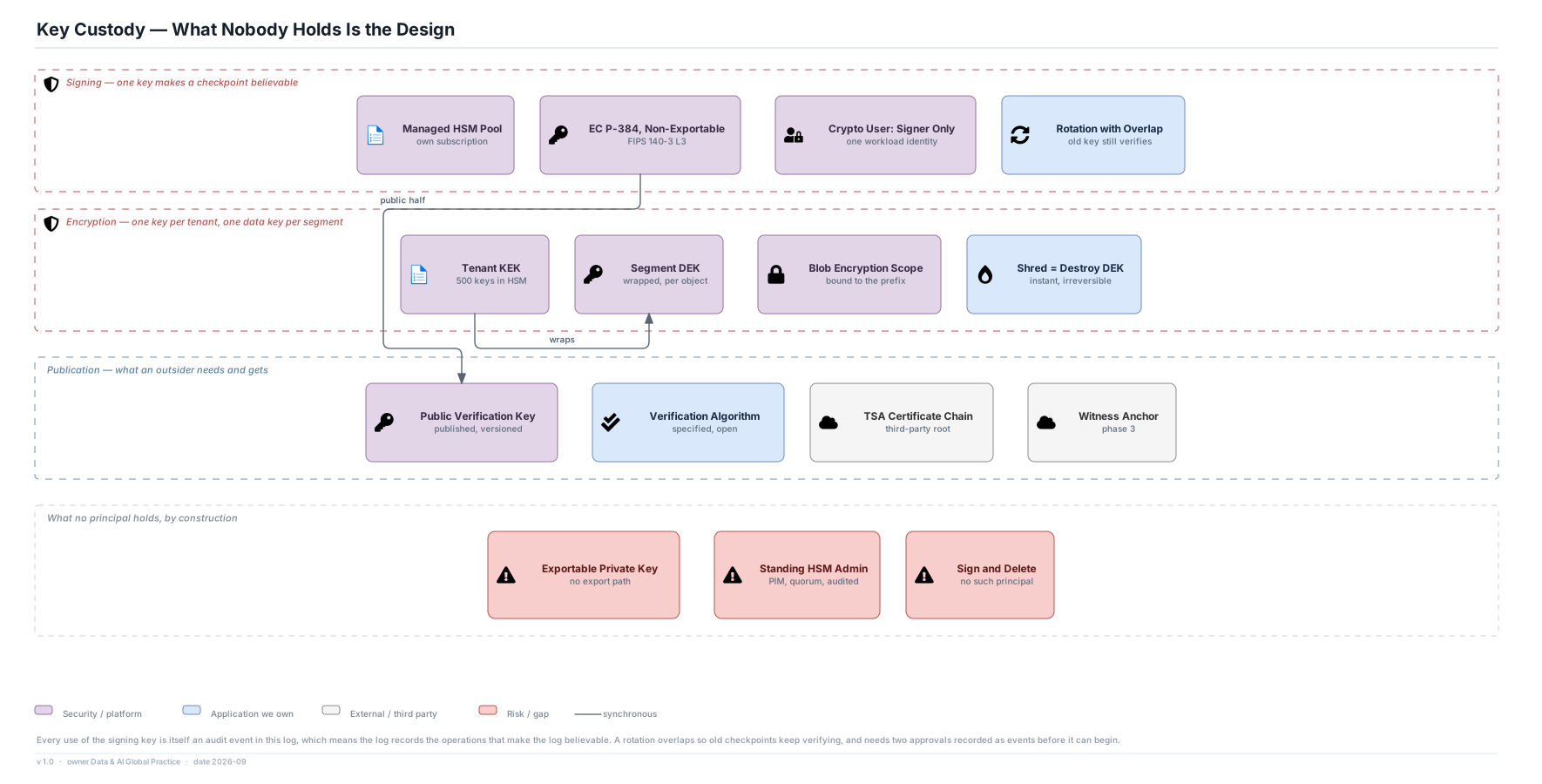
Signing — one key makes a checkpoint believable Managed HSM Pool own subscription EC P-384, Non-Exportable FIPS 140-3 L3 Crypto User: Signer Only one workload identity Rotation with Overlap old key still verifies Encryption — one key per tenant, one data key per segment Tenant KEK 500 keys in HSM Segment DEK wrapped, per object Blob Encryption Scope bound to the prefix Shred = Destroy DEK instant, irreversible Publication — what an outsider needs and gets Public Verification Key published, versioned Verification Algorithm specified, open TSA Certificate Chain third-party root Witness Anchor phase 3 What no principal holds, by construction Exportable Private Key no export path Standing HSM Admin PIM, quorum, audited Sign and Delete no such principal wraps public half Key Custody — What Nobody Holds Is the Design Security / platform Application we own External / third party Risk / gap synchronous Every use of the signing key is itself an audit event in this log, which means the log records the operations that make the log believable. A rotation overlaps so old checkpoints keep verifying, and needs two approvals recorded as events before it can begin. v 1.0 · owner Data & AI Global Practice · date 2026-09

Decisions

  • The checkpoint signing key is non-exportable, hardware-backed and usable by exactly one workload identity in a Crypto User role. Its every use is an audit event in this log.
  • Rotation overlaps: the retiring key remains valid for verification of everything it signed, forever. A checkpoint from 2027 must still verify in 2037, which makes key retirement a publication event rather than a deletion.
  • Encryption is a per-tenant KEK wrapping a per-segment DEK, which is what makes crypto-shredding granular enough to dispose of one segment without touching its neighbours.

What outsiders get

  • The public verification key, the verification algorithm, the TSA certificate chain, and in phase 3 a witness anchor — enough to check a bundle with no access to us and no trust in us.
  • Key versions are published as a transparency record so an auditor can tell which key was current when a checkpoint was signed.

Risks

  • Managed HSM purge protection and soft-delete configuration decides whether a crypto-shred is genuinely irreversible. This must be verified against the platform's own guarantees, and confirmed in writing, before the first disposal window.