Audit Log Service · View 20 of 40 · 5 · Runtime
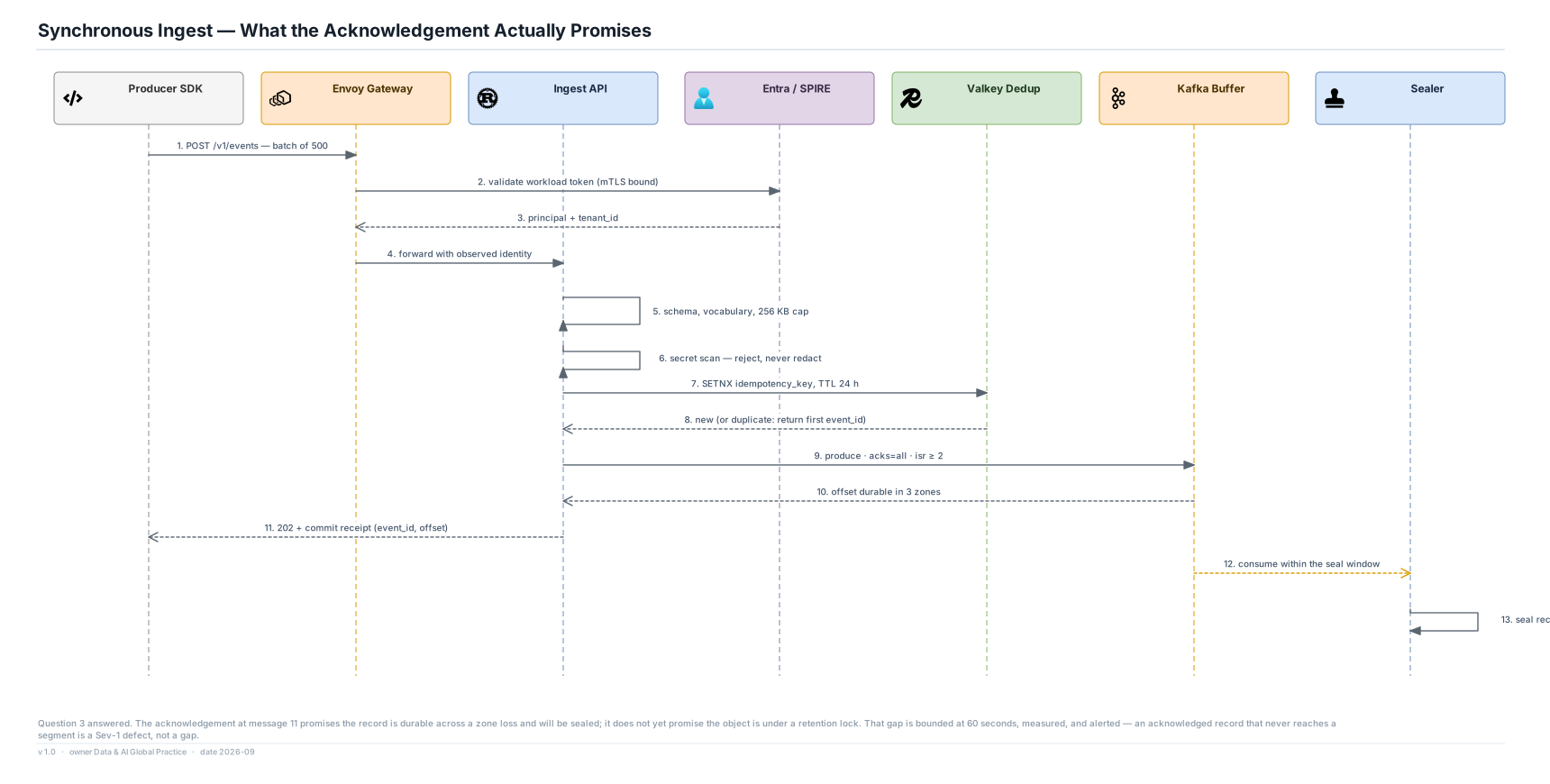
Question 3 answered
- The acknowledgement is given at the durable buffer. It promises the record survives the loss of an availability zone and will be sealed; it does not promise the object is already under a retention lock.
- Acknowledging only at object commit would make the promise exact and push ingest latency into seconds, breaking the 150 ms p99 and, with it, the fail-closed classes that depend on a synchronous answer.
- The gap is bounded, measured and alerted: sealing within 60 s, and an acknowledged record that never reaches a segment is a Sev-1 defect with RPO 0, not an accepted gap. Buffer administration carries no delete verb and no human standing access.
The receipt contract
- The commit receipt returns event_id and partition offset at acknowledgement; the seal receipt, queryable within 60 s, returns segment_id and the checkpoint that covers it.
- A producer that needs custody-grade certainty polls for the seal receipt. Most do not, and the two-stage receipt is what lets them make that choice knowingly.
- Duplicate submissions inside 24 h return the first event_id rather than creating a second record — a retry after a timeout is not a second account of one action.
Risks
- Between acknowledgement and seal there is a window in which a sufficiently privileged Kafka administrator could in principle destroy data. Mitigated by removing topic-delete from every role, PIM-gating broker administration and alerting on any use of it; the 60 s bound is what makes the exposure small rather than absent.