Audit Log Service · View 28 of 40 · 5 · Runtime
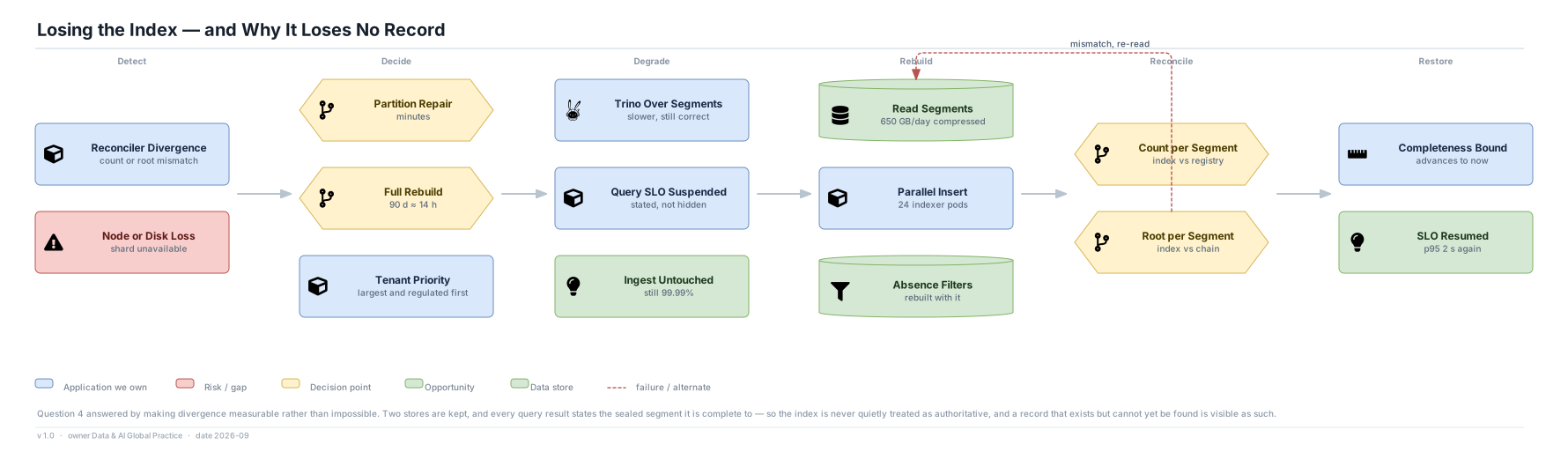
Question 4 answered
- Two stores, with divergence made measurable rather than impossible. A single ledger-style store would avoid reconciliation entirely and would not hold a 2-second point query or a 30-second thirteen-month aggregate.
- Divergence is detected by comparing per-segment record counts and Merkle roots against what the index holds. A record in a segment but missing from the index is repaired automatically; a record in the index but not in a segment is an incident.
- Every query result states the sealed segment it is complete to, so the index is never quietly treated as authoritative. To an auditor a record that exists but cannot be found is missing — the completeness bound is what turns that into a stated, bounded lag.
Rebuild economics
- A full 90-day rebuild reads roughly 58 TB compressed and takes about 14 h at 24 indexer pods; a 13-month rebuild is about four times that.
- Rebuild order is by tenant priority, largest and most regulated first, so the tenants who will ask are served first.
- Throughout, ingest is untouched and still meeting 99.99%. The query SLO is explicitly suspended and users are told, rather than quietly missed.
Risks
- A 13-month index rebuild takes over two days, during which investigative queries run on the archive path. If that is unacceptable to the business, the answer is a warm standby index in the second region — priced but not in the MVP.