Audit Log Service · View 40 of 40 · 7 · Assurance
The categories are the decision
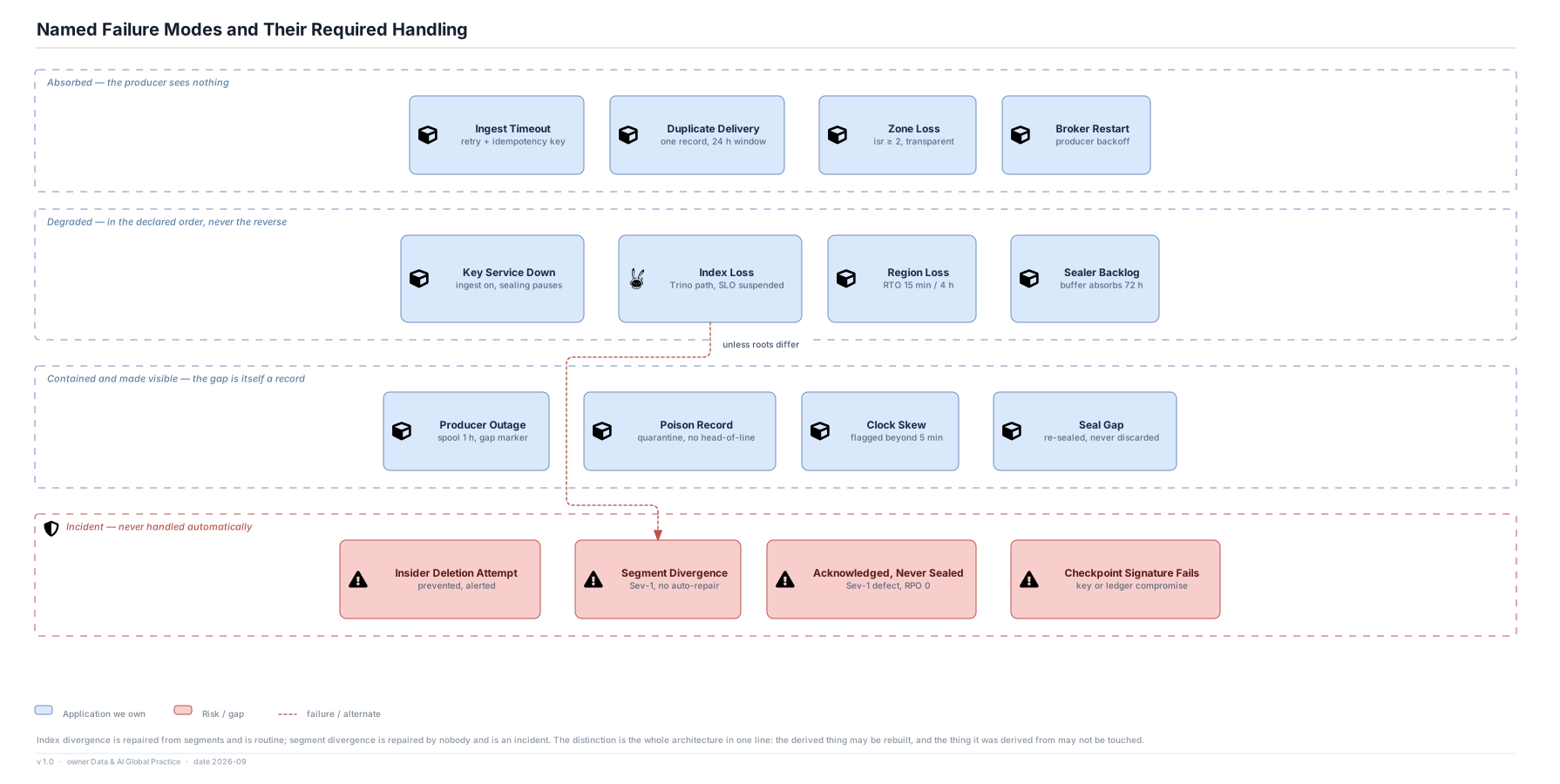
- Absorbed: the producer sees nothing. Retries, duplicates and a lost zone all fall here, which is what the durability contract was bought for.
- Degraded: in the declared order and never the reverse. A key service outage pauses sealing while ingest continues; an index loss suspends the query SLO while records keep landing.
- Contained and visible: a spool overflow, a poison record, a skewed clock or a seal gap all produce a record about themselves. The gap is never a silence.
- Incident: an attempted deletion, a segment divergence, an acknowledged record that never sealed, a checkpoint signature that will not verify. None of these is ever handled automatically.
The line that matters
- Index divergence is repaired from segments and is routine. Segment divergence is repaired by nobody and is a Sev-1.
- That one distinction is the whole architecture: the derived thing may be rebuilt, and the thing it was derived from may not be touched — by anyone, including the people repairing it.
Open questions for the sponsor
- Confirm the equivalence of Blob locked immutability to the erasure standard the applicable regulators accept, and whether crypto-shredding satisfies them or physical deletion is required.
- Agree the fail-closed event class list with the owners of the 410 producing services, because it changes their SLOs and not only ours.
- Renegotiate the $0.09 per million target, or agree explicitly which of DR, HSM-backed signing and the separately administered ledger is being given up to approach it.