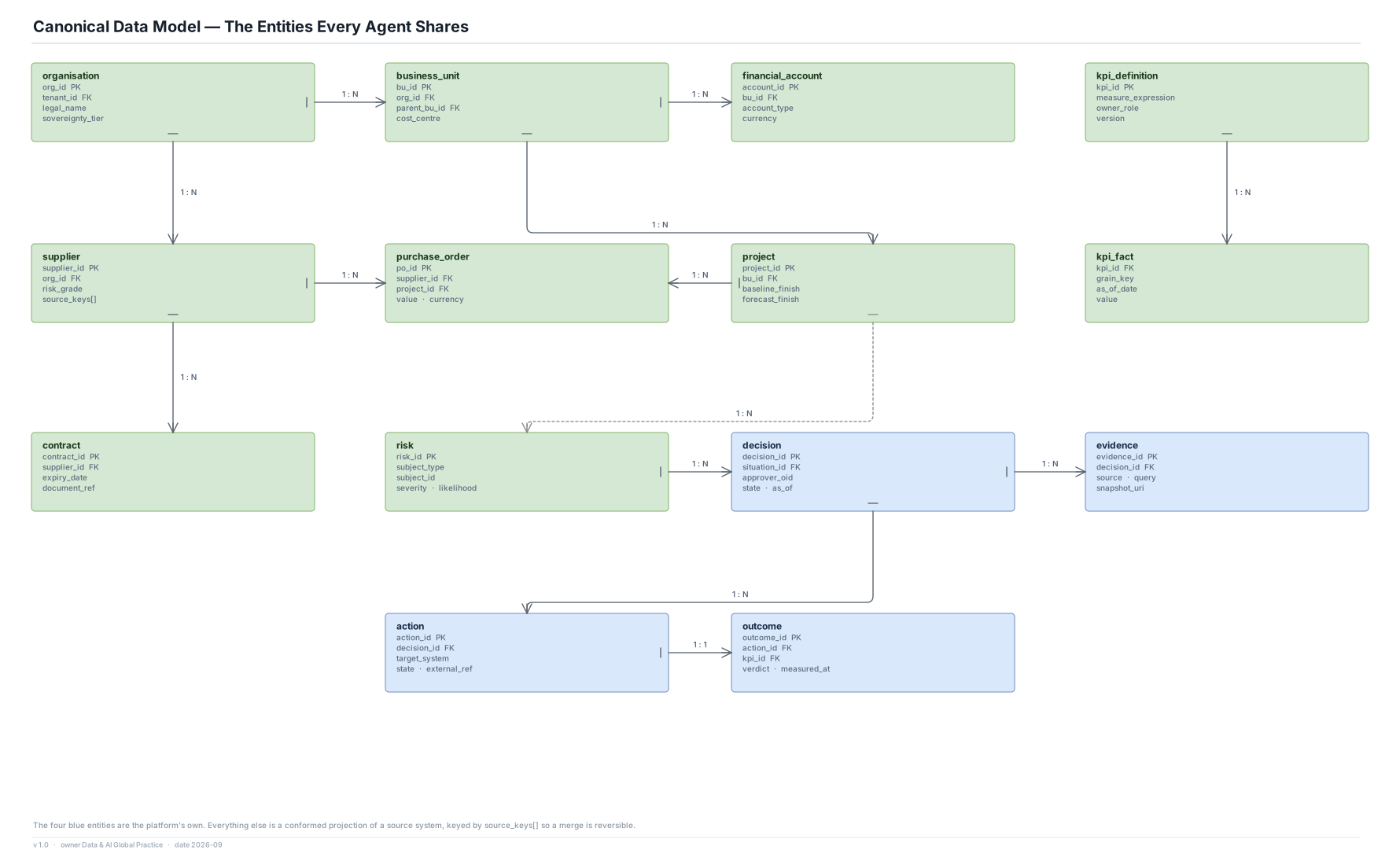
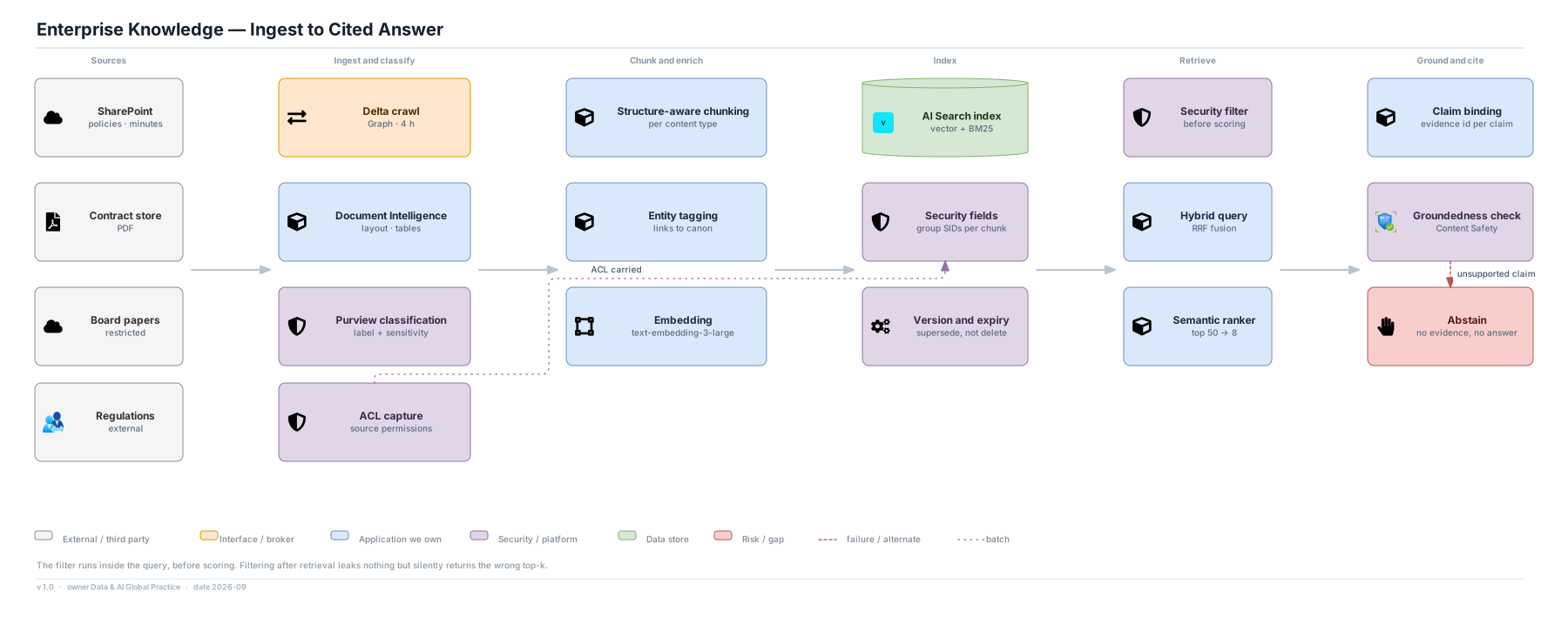
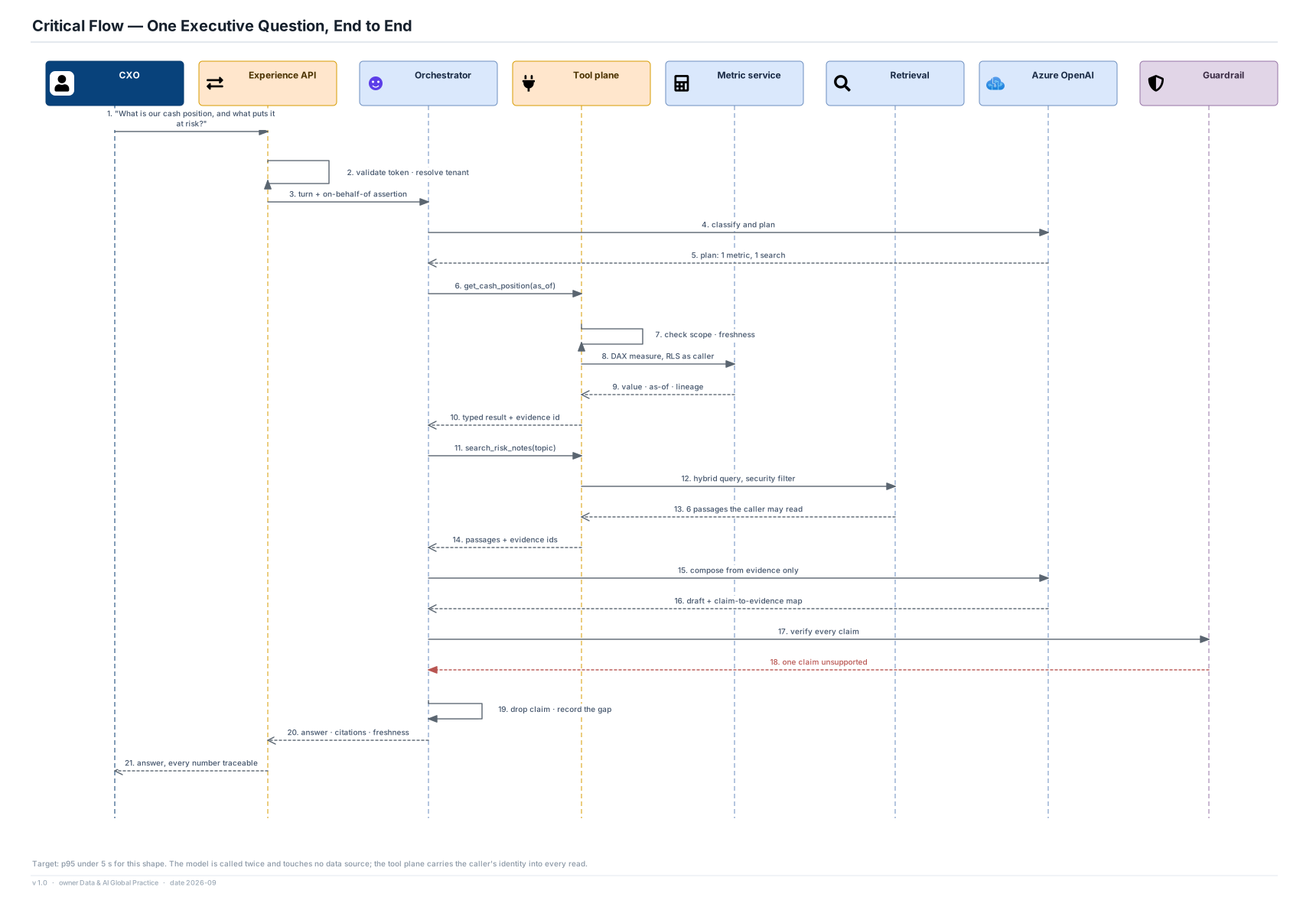
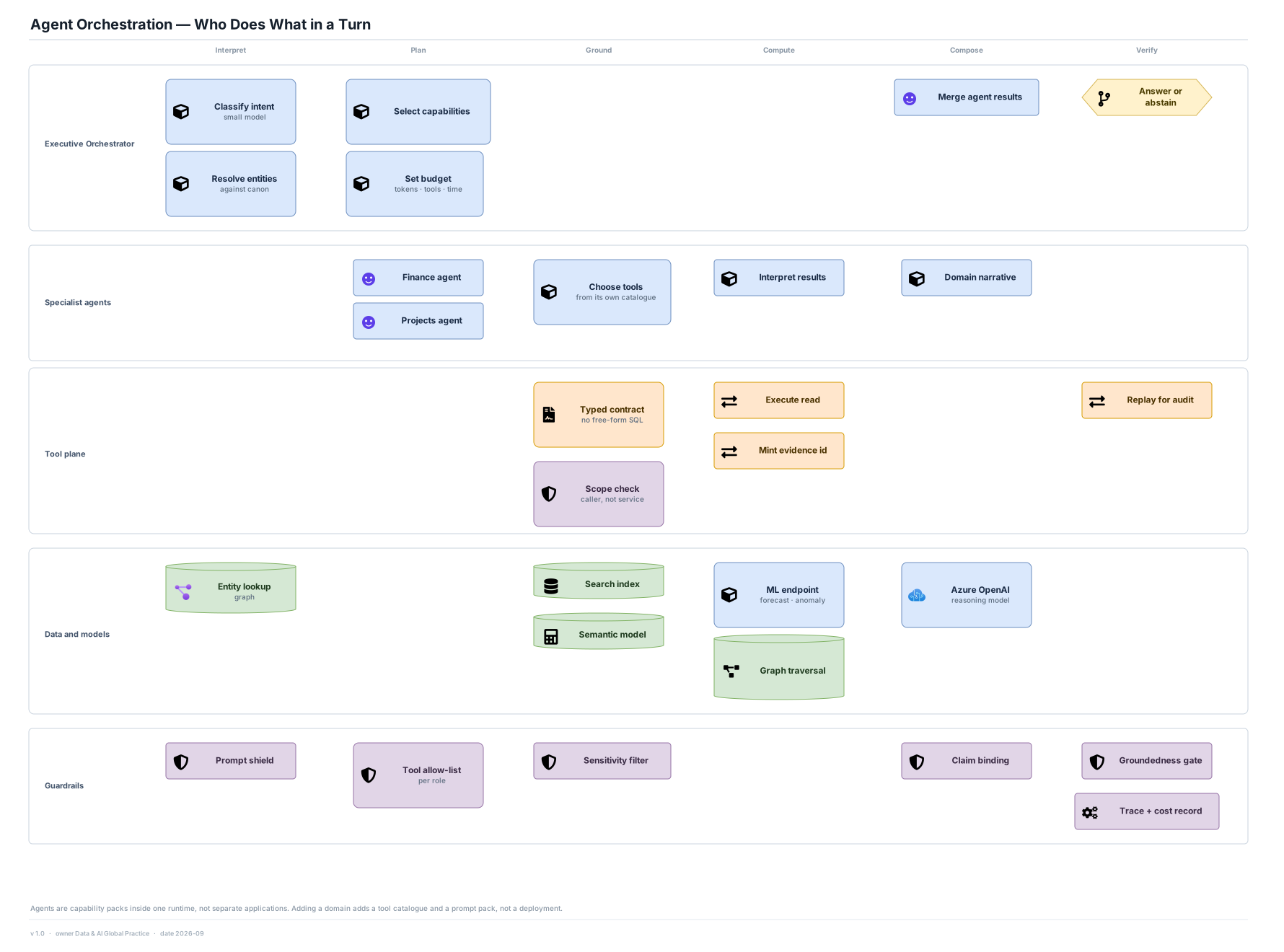
AI Executive Office — CXO Assistant Platform

Architecture Views

30 views, in reading order. Every view ships three ways: an HTML page, an SVG that re-opens in diagrams.net fully editable, and draw.io source.

Thirty views of a multi-tenant AI Executive Office on Azure: a governed conversational layer over enterprise data, specialist agents, decision intelligence and controlled execution — architected as a decision intelligence platform rather than a chatbot with company data. The set reads in seven acts: the boundary, the people, the structure, the data, the runtime, the operations and the assurance. Below the index sits the architecture one-pager and the full decision record: twenty-eight high-level decisions covering every component and technology on these views, each with the alternatives that lost, what the choice costs, and when you should choose differently.

1 · Context and scope

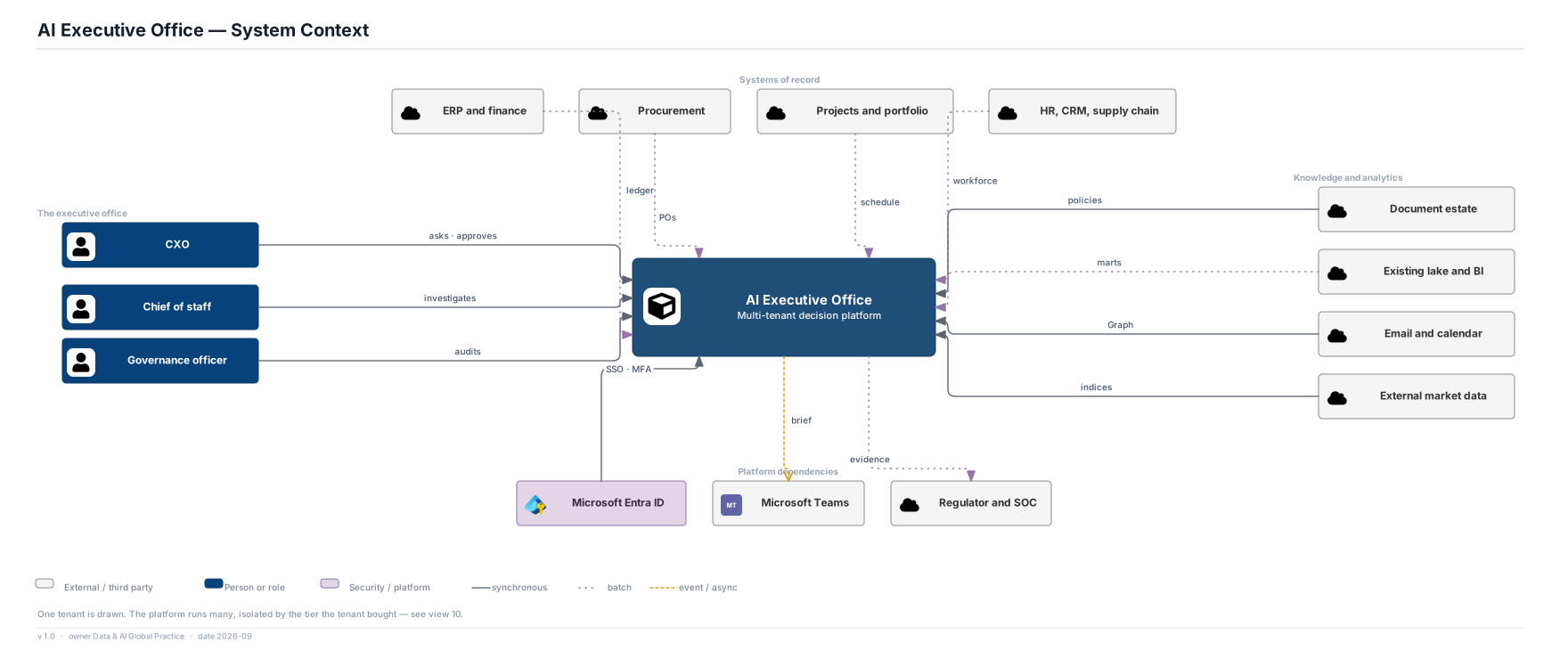
What sits inside the boundary, who and what touches it, and the shape of the whole platform in one picture.

2 · People and journeys

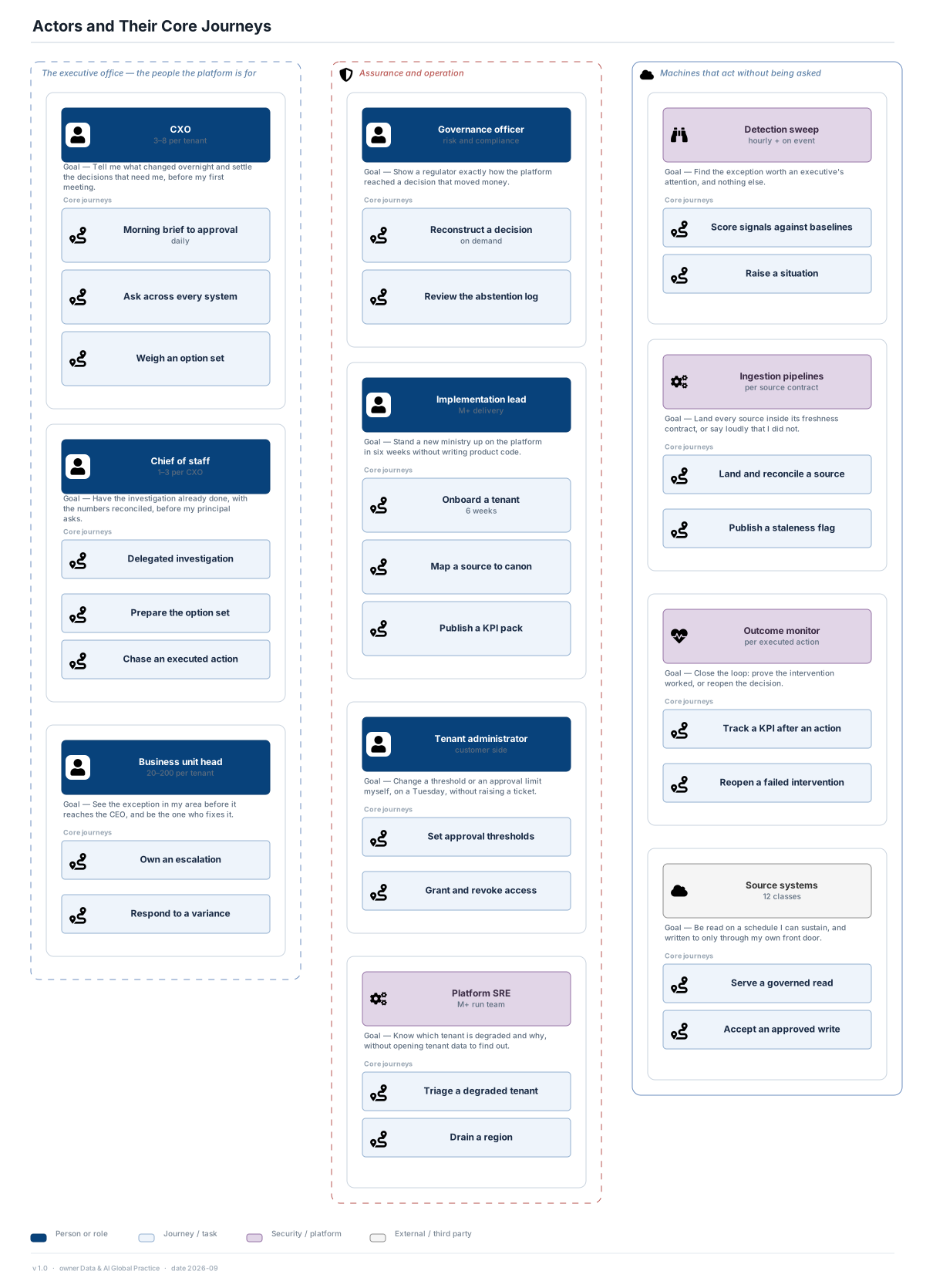
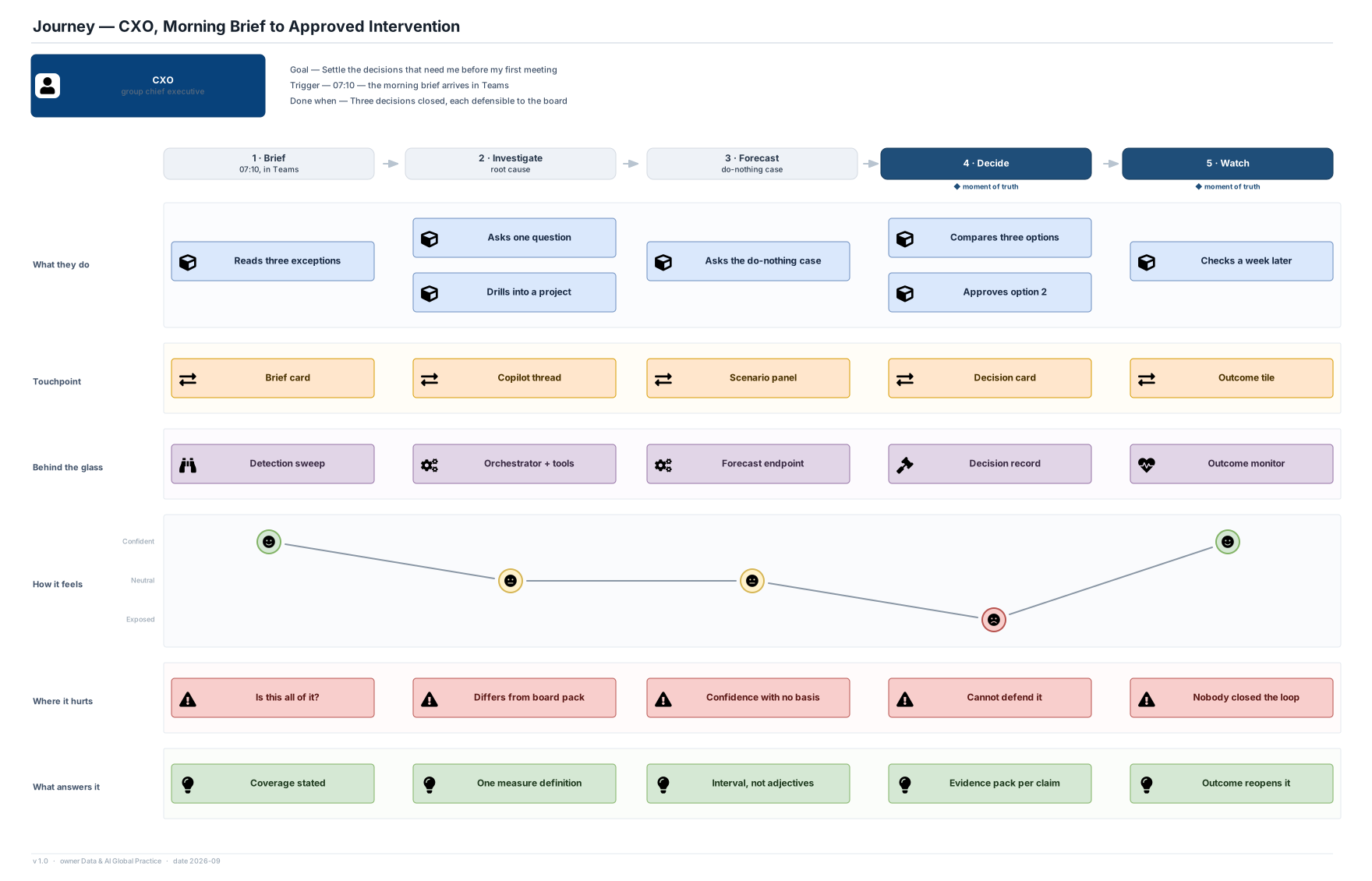
Who the platform is for, what each of them gets to do, and the three journeys whose worst moments the rest of the set has to answer.
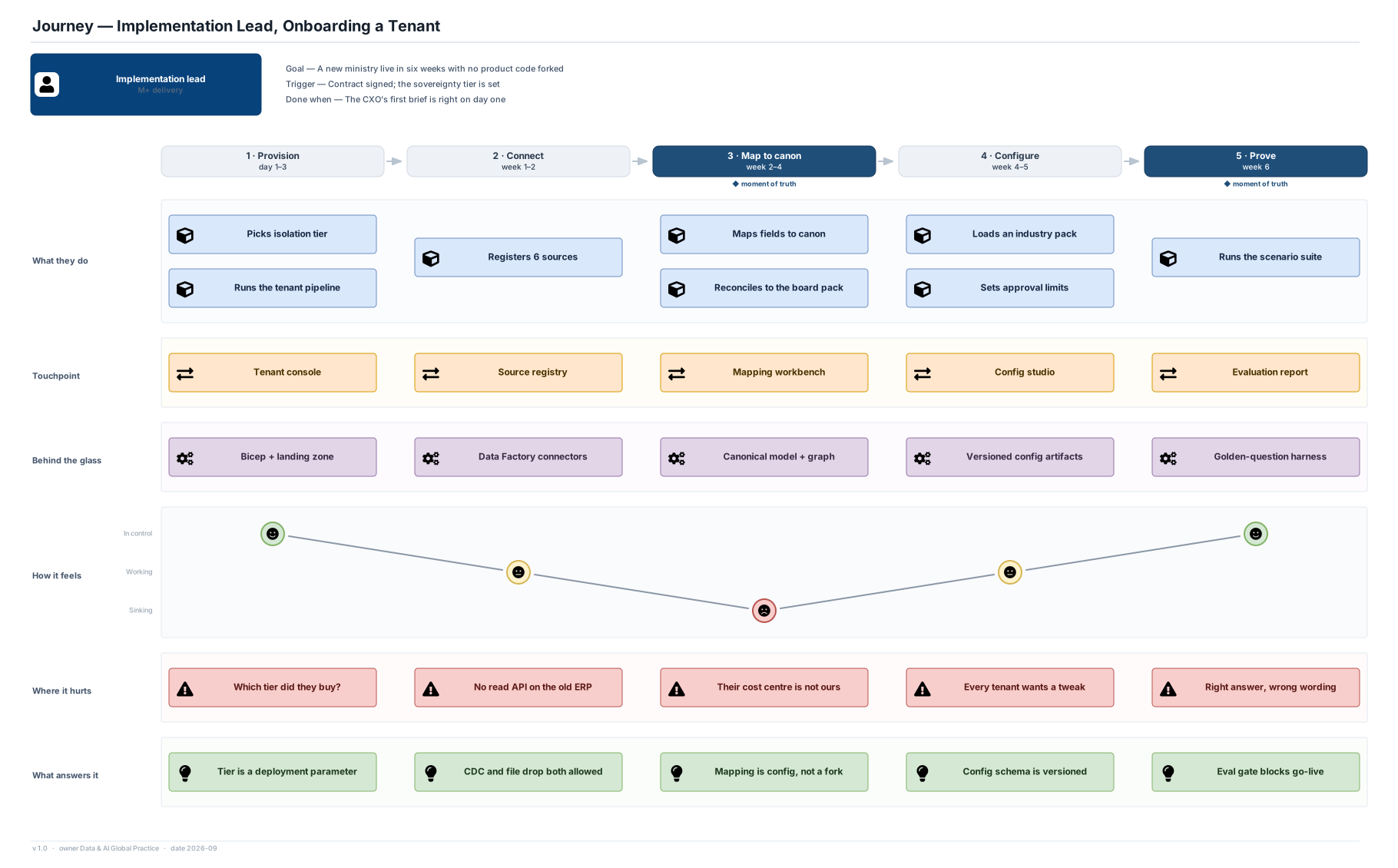
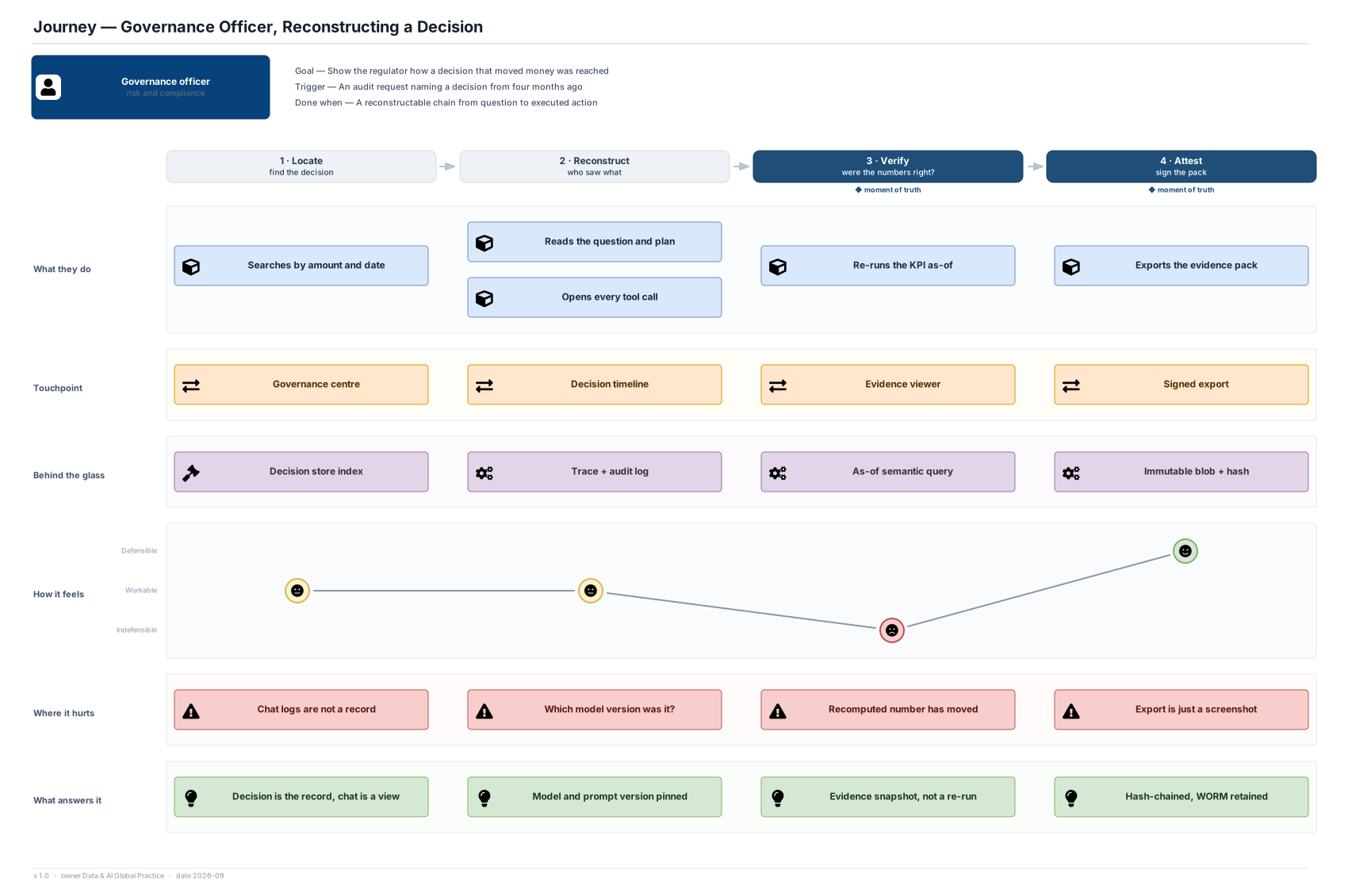
03 The executive office — the people the platform is for CXO 3–8 per tenant Goal — Tell me what changed overnight and settle the decisions that need me, before my first meeting. Core journeys Morning brief to approval daily Ask across every system Weigh an option set Chief of staff 1–3 per CXO Goal — Have the investigation already done, with the numbers reconciled, before my principal asks. Core journeys Delegated investigation Prepare the option set Chase an executed action Business unit head 20–200 per tenant Goal — See the exception in my area before it reaches the CEO, and be the one who fixes it. Core journeys Own an escalation Respond to a variance Assurance and operation Governance officer risk and compliance Goal — Show a regulator exactly how the platform reached a decision that moved money. Core journeys Reconstruct a decision on demand Review the abstention log Implementation lead M+ delivery Goal — Stand a new ministry up on the platform in six weeks without writing product code. Core journeys Onboard a tenant 6 weeks Map a source to canon Publish a KPI pack Tenant administrator customer side Goal — Change a threshold or an approval limit myself, on a Tuesday, without raising a ticket. Core journeys Set approval thresholds Grant and revoke access Platform SRE M+ run team Goal — Know which tenant is degraded and why, without opening tenant data to find out. Core journeys Triage a degraded tenant Drain a region Machines that act without being asked Detection sweep hourly + on event Goal — Find the exception worth an executive's attention, and nothing else. Core journeys Score signals against baselines Raise a situation Ingestion pipelines per source contract Goal — Land every source inside its freshness contract, or say loudly that I did not. Core journeys Land and reconcile a source Publish a staleness flag Outcome monitor per executed action Goal — Close the loop: prove the intervention worked, or reopen the decision. Core journeys Track a KPI after an action Reopen a failed intervention Source systems 12 classes Goal — Be read on a schedule I can sustain, and written to only through my own front door. Core journeys Serve a governed read Accept an approved write Actors and Their Core Journeys Person or role Journey / task Security / platform External / third party v 1.0 · owner Data & AI Global Practice · date 2026-09 Actors and Their Core Journeys Who the platform is for, in their own words, and the named things each of them gets to do with it. HTML page SVG draw.io

3 · Structure

The layering rule, the deployable units in one tenant, every interface in and out, and how one codebase serves many organisations.
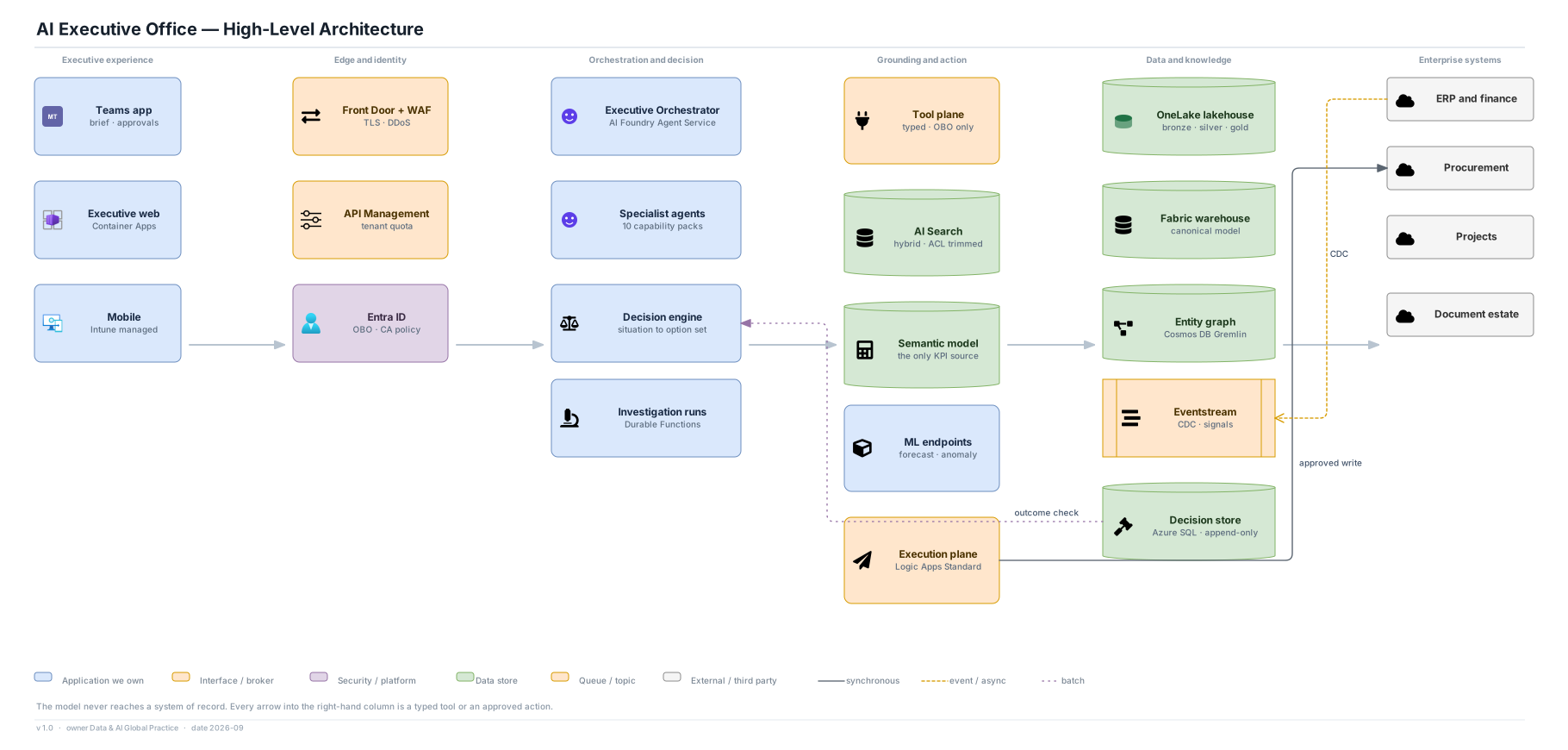
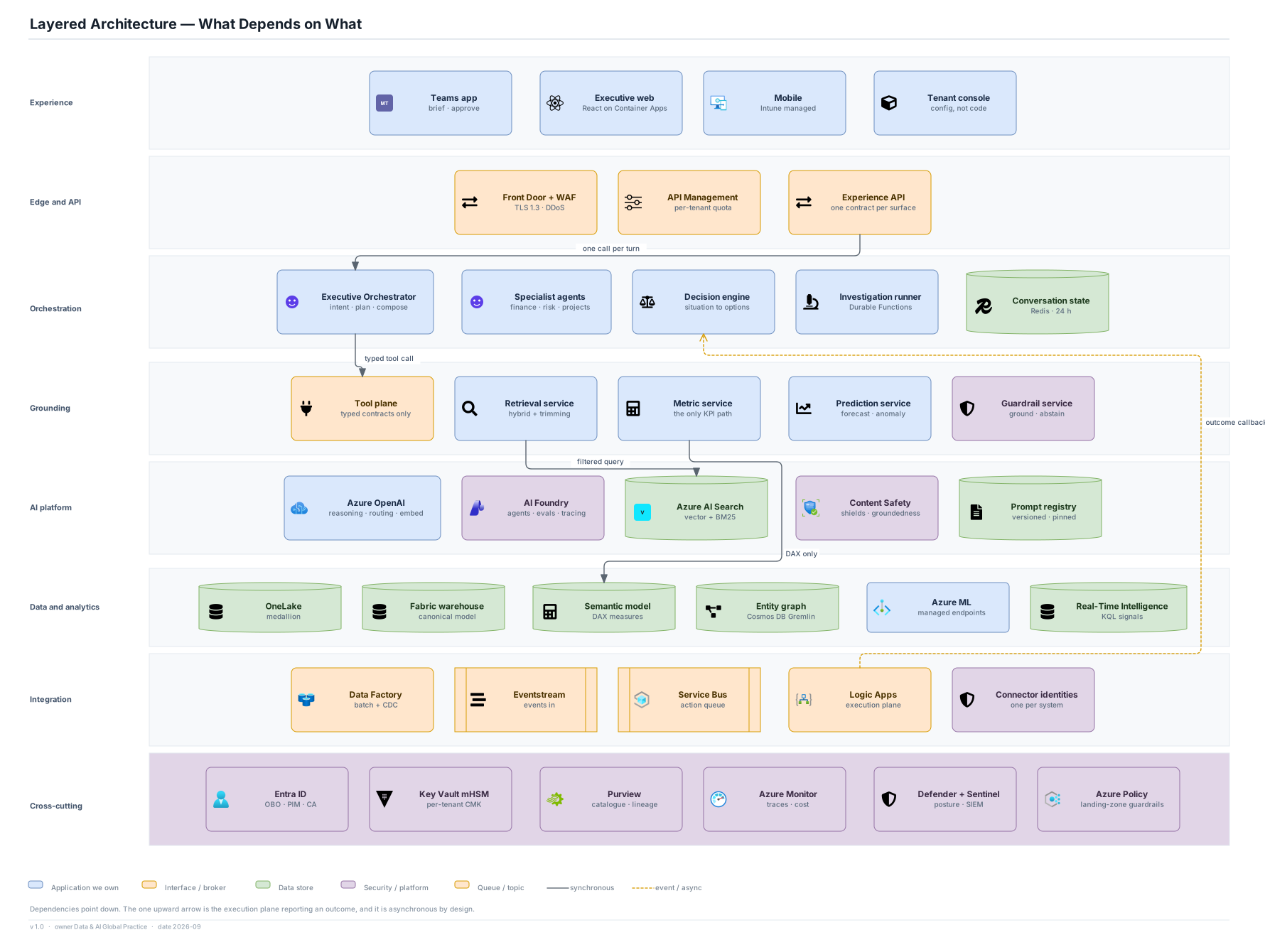
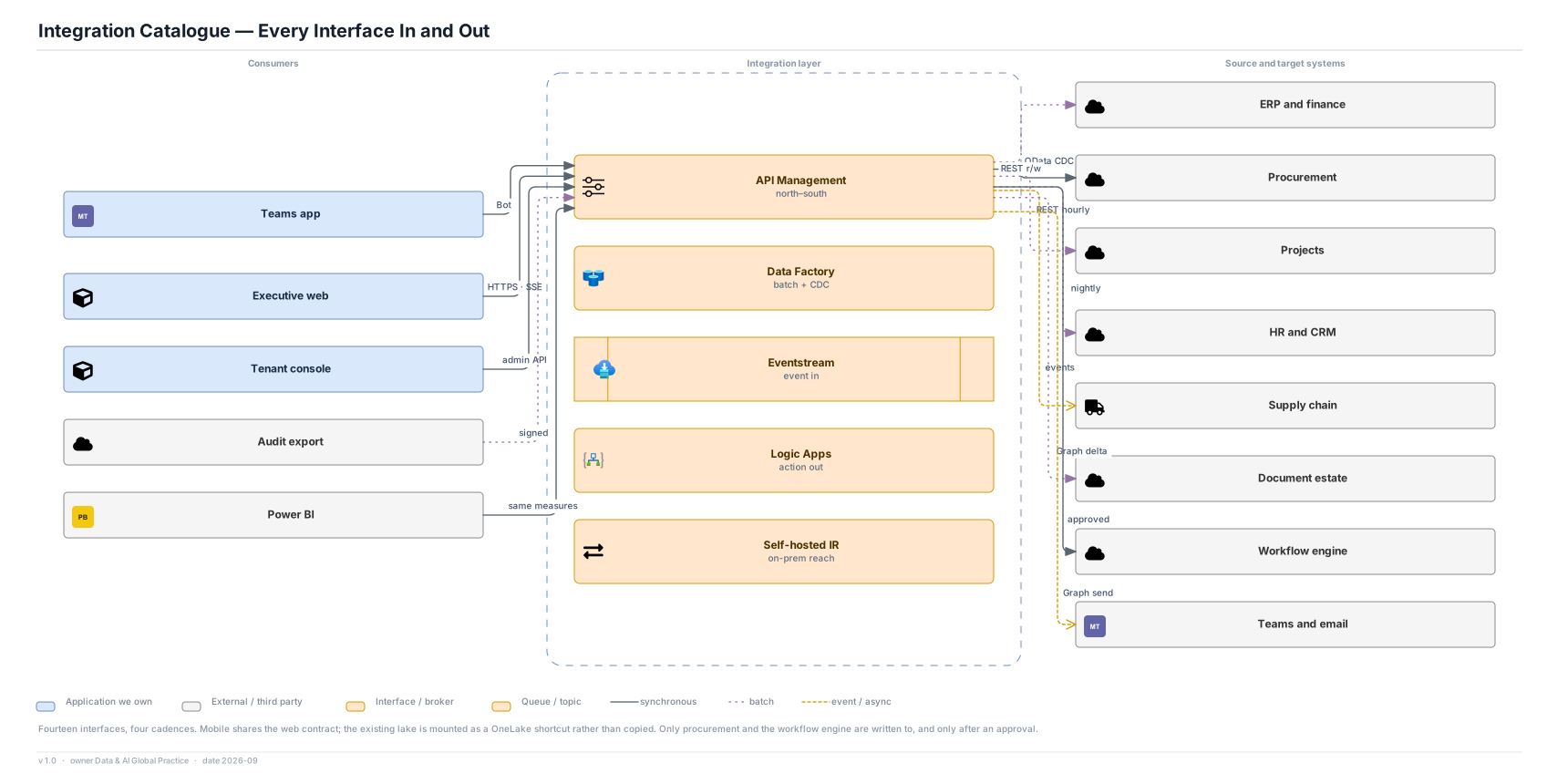
07 Experience Teams app brief · approve Executive web React on Container Apps Mobile Intune managed Tenant console config, not code Edge and API Front Door + WAF TLS 1.3 · DDoS API Management per-tenant quota Experience API one contract per surface Orchestration Executive Orchestrator intent · plan · compose Specialist agents finance · risk · projects Decision engine situation to options Investigation runner Durable Functions Conversation state Redis · 24 h Grounding Tool plane typed contracts only Retrieval service hybrid + trimming Metric service the only KPI path Prediction service forecast · anomaly Guardrail service ground · abstain AI platform Azure OpenAI reasoning · routing · embed AI Foundry agents · evals · tracing Azure AI Search vector + BM25 Content Safety shields · groundedness Prompt registry versioned · pinned Data and analytics OneLake medallion Fabric warehouse canonical model Semantic model DAX measures Entity graph Cosmos DB Gremlin Azure ML managed endpoints Real-Time Intelligence KQL signals Integration Data Factory batch + CDC Eventstream events in Service Bus action queue Logic Apps execution plane Connector identities one per system Cross-cutting Entra ID OBO · PIM · CA Key Vault mHSM per-tenant CMK Purview catalogue · lineage Azure Monitor traces · cost Defender + Sentinel posture · SIEM Azure Policy landing-zone guardrails one call per turn typed tool call DAX only filtered query outcome callback Layered Architecture — What Depends on What Application we own Interface / broker Data store Security / platform Queue / topic synchronous event / async Dependencies point down. The one upward arrow is the execution plane reporting an outcome, and it is asynchronous by design. v 1.0 · owner Data & AI Global Practice · date 2026-09 Layered Architecture What depends on what, and the one dependency that is deliberately allowed to point the other way. HTML page SVG draw.io
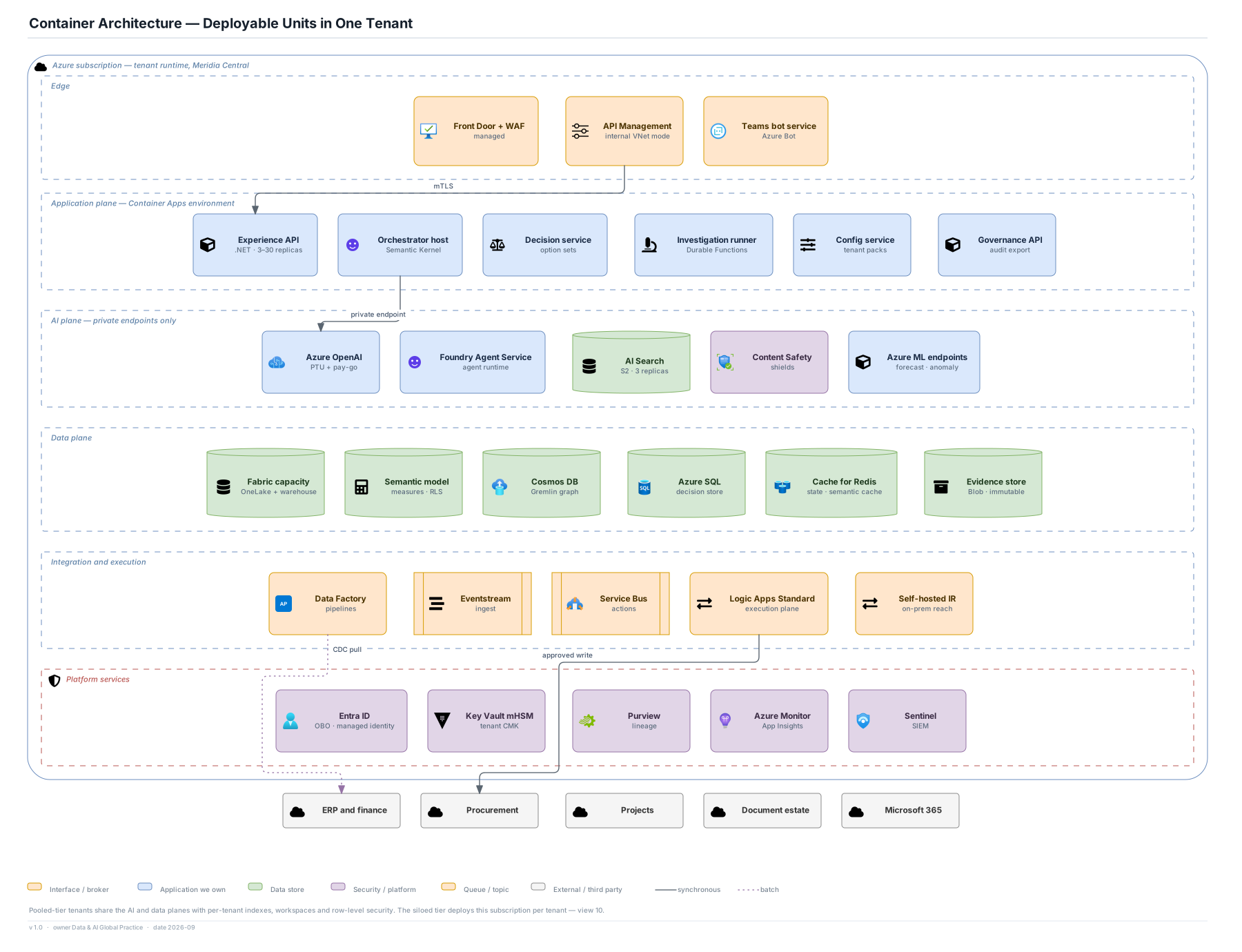
08 Azure subscription — tenant runtime, Meridia Central Edge Front Door + WAF managed API Management internal VNet mode Teams bot service Azure Bot Application plane — Container Apps environment Experience API .NET · 3–30 replicas Orchestrator host Semantic Kernel Decision service option sets Investigation runner Durable Functions Config service tenant packs Governance API audit export AI plane — private endpoints only Azure OpenAI PTU + pay-go Foundry Agent Service agent runtime AI Search S2 · 3 replicas Content Safety shields Azure ML endpoints forecast · anomaly Data plane Fabric capacity OneLake + warehouse Semantic model measures · RLS Cosmos DB Gremlin graph Azure SQL decision store Cache for Redis state · semantic cache Evidence store Blob · immutable Integration and execution Data Factory pipelines Eventstream ingest Service Bus actions Logic Apps Standard execution plane Self-hosted IR on-prem reach Platform services Entra ID OBO · managed identity Key Vault mHSM tenant CMK Purview lineage Azure Monitor App Insights Sentinel SIEM ERP and finance Procurement Projects Document estate Microsoft 365 mTLS private endpoint approved write CDC pull Container Architecture — Deployable Units in One Tenant Interface / broker Application we own Data store Security / platform Queue / topic External / third party synchronous batch Pooled-tier tenants share the AI and data planes with per-tenant indexes, workspaces and row-level security. The siloed tier deploys this subscription per tenant — view 10. v 1.0 · owner Data & AI Global Practice · date 2026-09 Container Architecture The deployable units inside one tenant, the technology behind each, and which of them holds a credential. HTML page SVG draw.io

4 · Data

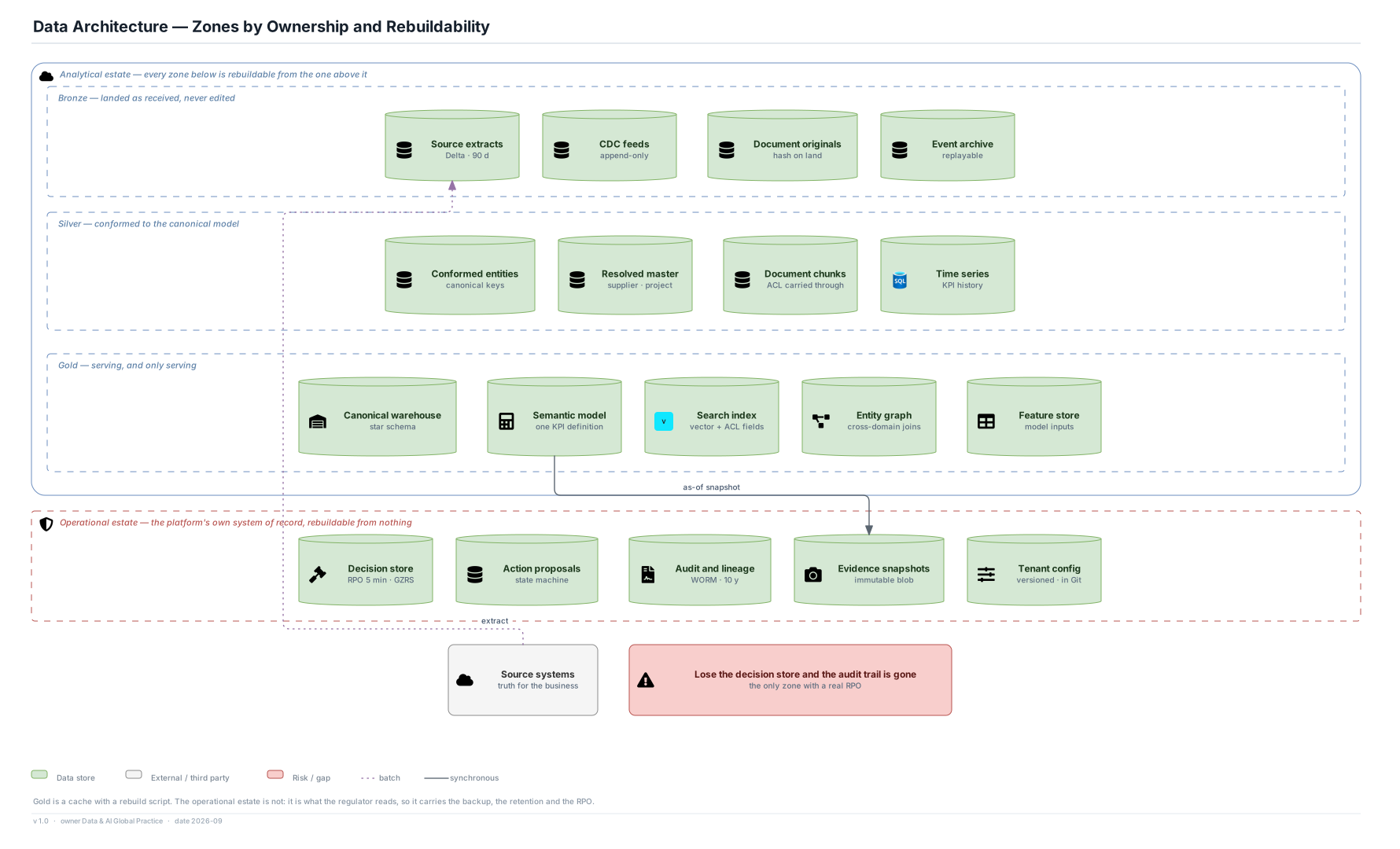
Which store owns what, what can be rebuilt and what cannot, the entities every agent shares, and how documents become citable evidence.

5 · Runtime

What actually happens on a question, who computes what, how an exception is found before anyone asks, and how an approval becomes a verified outcome.

6 · Operations

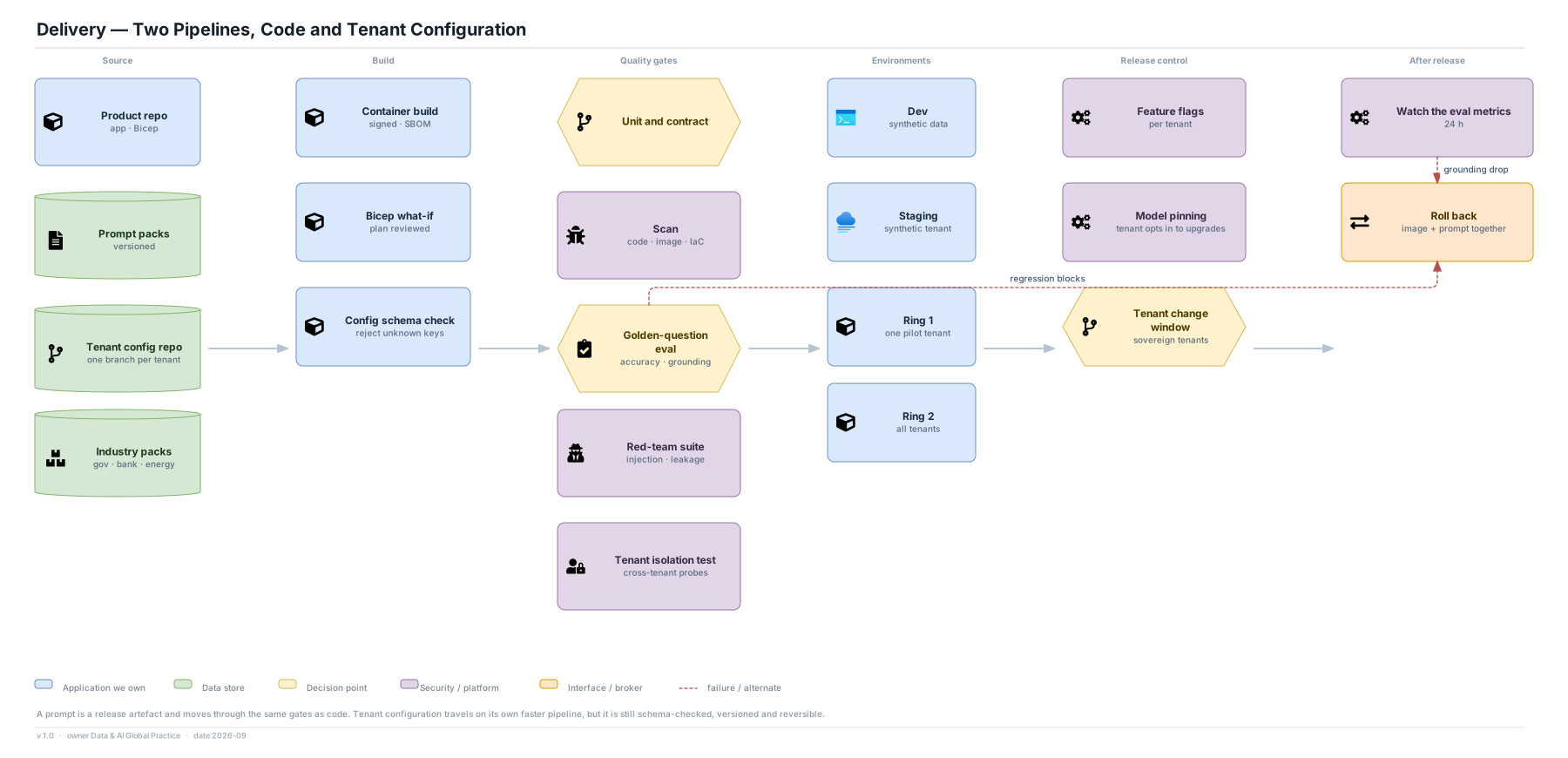
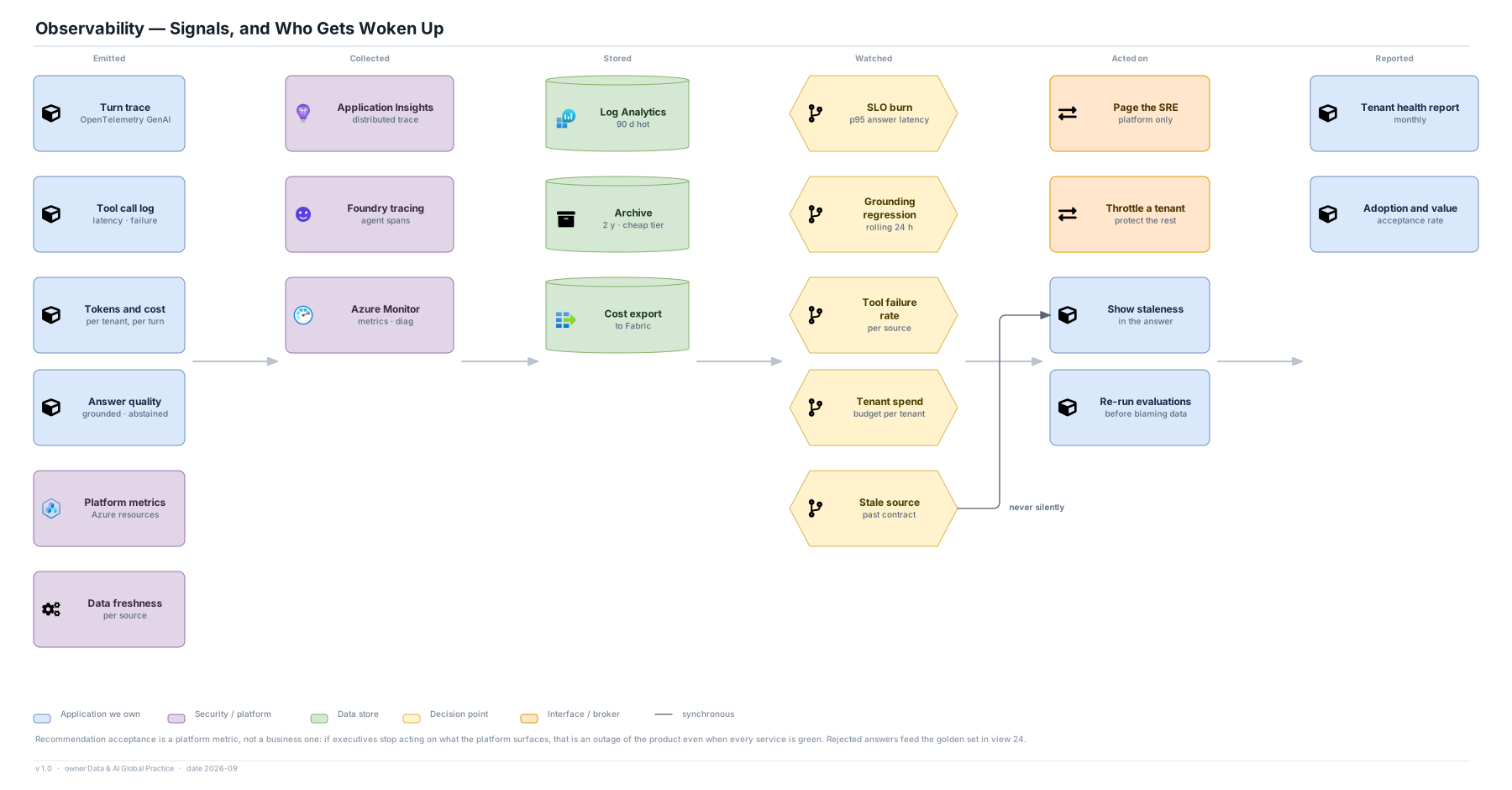
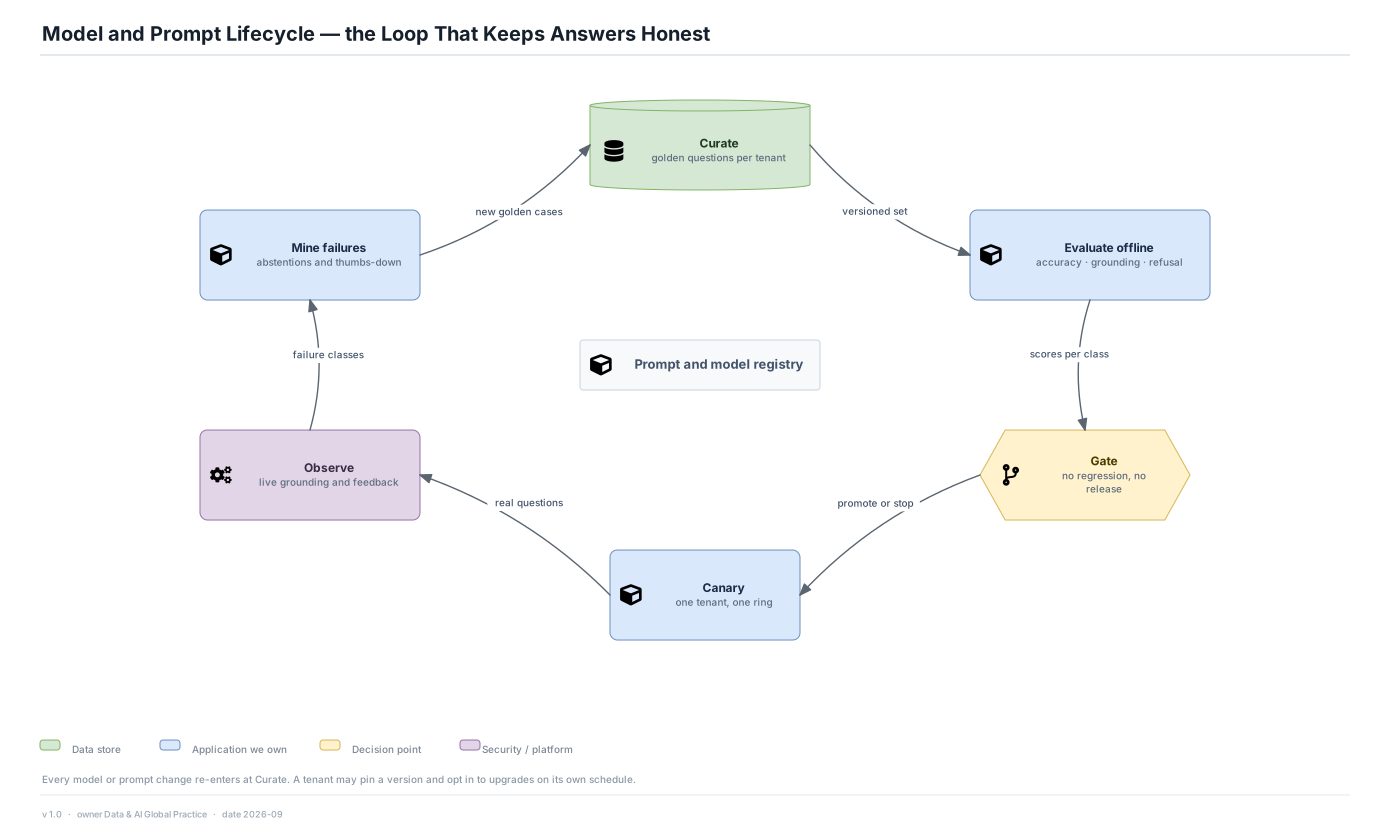
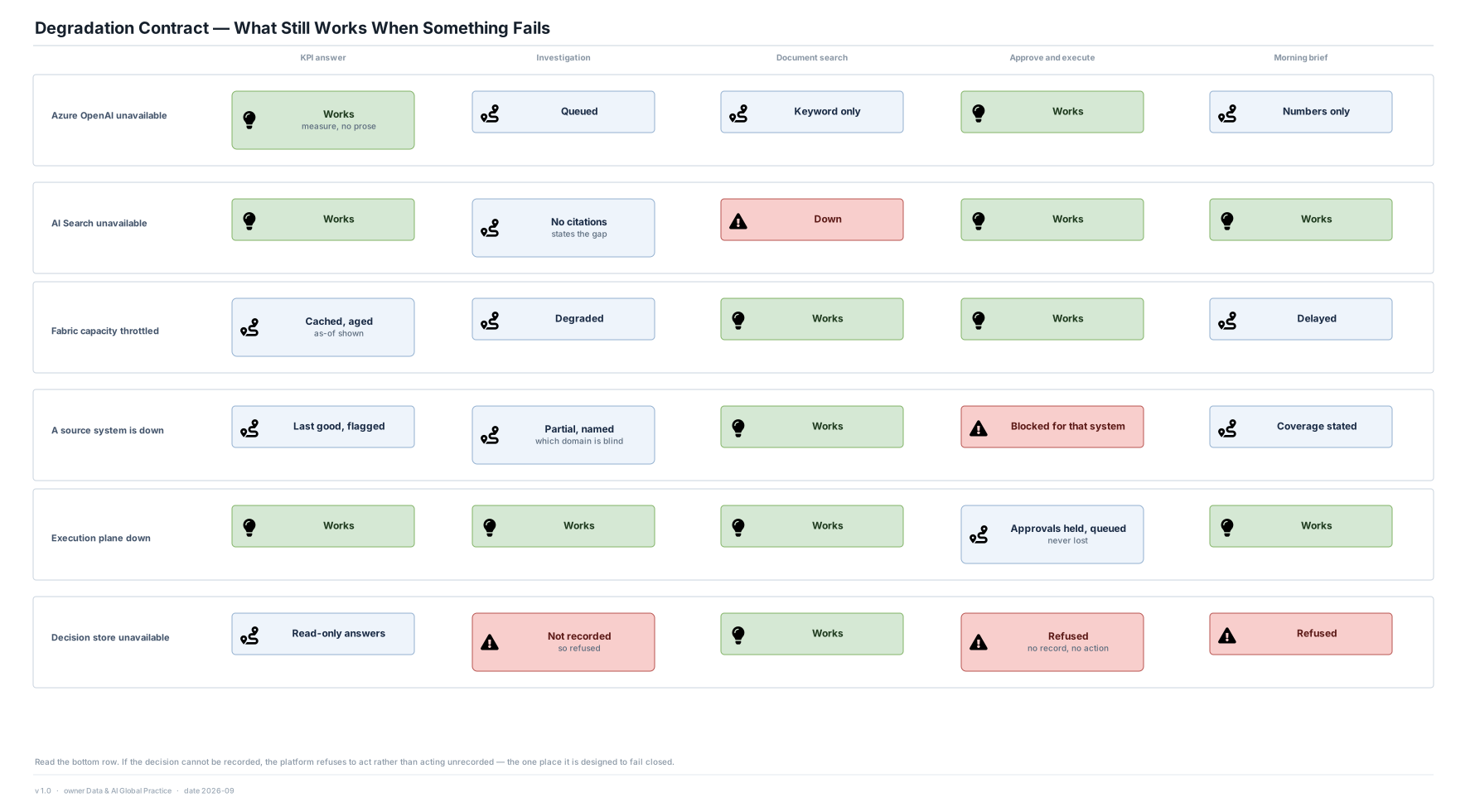
Where it runs, how a change reaches an executive, how anyone knows the answers are still good, and what is allowed to degrade.
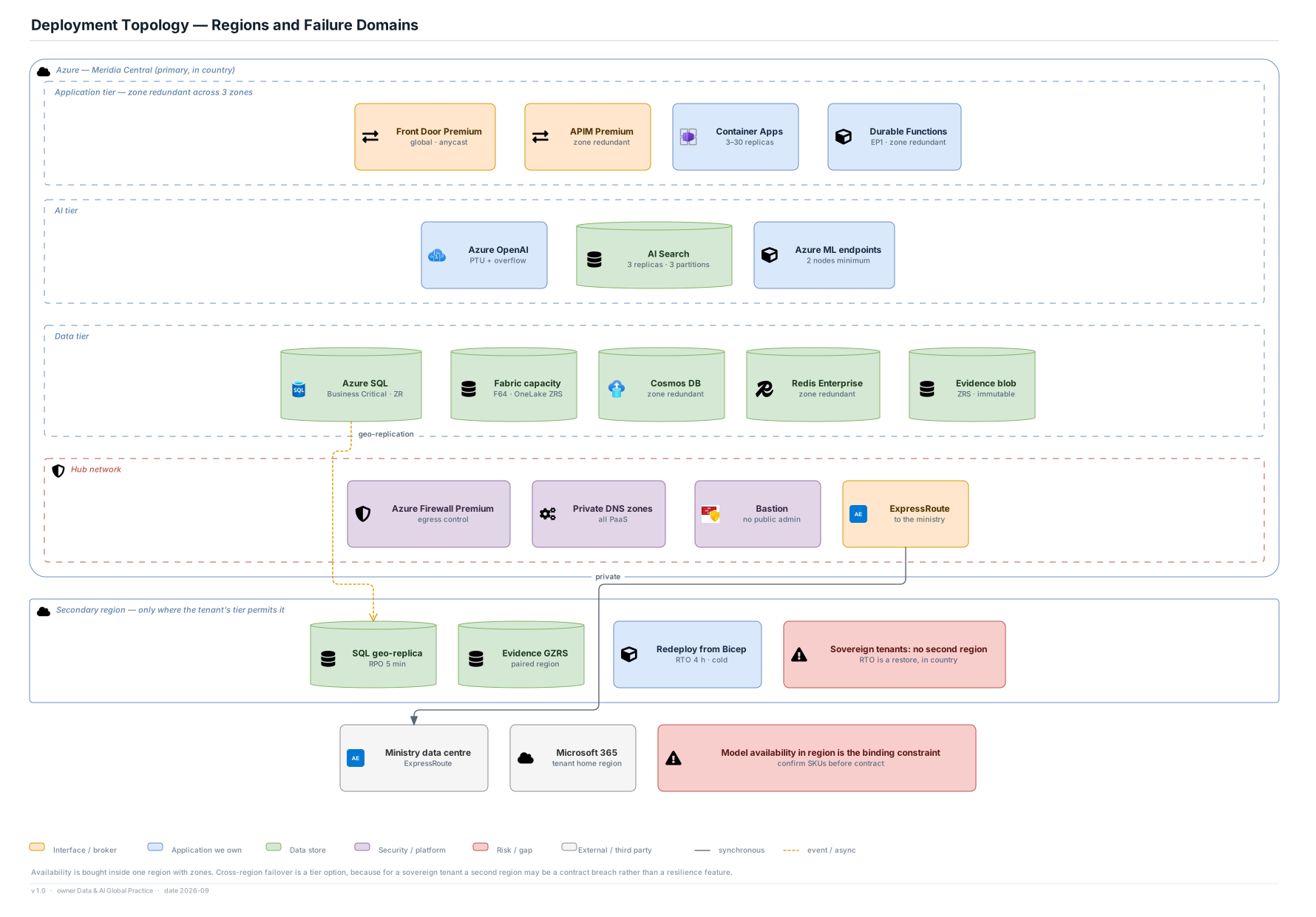
21 Azure — Meridia Central (primary, in country) Application tier — zone redundant across 3 zones Front Door Premium global · anycast APIM Premium zone redundant Container Apps 3–30 replicas Durable Functions EP1 · zone redundant AI tier Azure OpenAI PTU + overflow AI Search 3 replicas · 3 partitions Azure ML endpoints 2 nodes minimum Data tier Azure SQL Business Critical · ZR Fabric capacity F64 · OneLake ZRS Cosmos DB zone redundant Redis Enterprise zone redundant Evidence blob ZRS · immutable Hub network Azure Firewall Premium egress control Private DNS zones all PaaS Bastion no public admin ExpressRoute to the ministry Secondary region — only where the tenant's tier permits it SQL geo-replica RPO 5 min Evidence GZRS paired region Redeploy from Bicep RTO 4 h · cold Sovereign tenants: no second region RTO is a restore, in country Ministry data centre ExpressRoute Microsoft 365 tenant home region Model availability in region is the binding constraint confirm SKUs before contract private geo-replication Deployment Topology — Regions and Failure Domains Interface / broker Application we own Data store Security / platform Risk / gap External / third party synchronous event / async Availability is bought inside one region with zones. Cross-region failover is a tier option, because for a sovereign tenant a second region may be a contract breach rather than a resilience feature. v 1.0 · owner Data & AI Global Practice · date 2026-09 Deployment Topology Where it runs, what the failure domains are, and why a second region is a tier option rather than a default. HTML page SVG draw.io

7 · Assurance

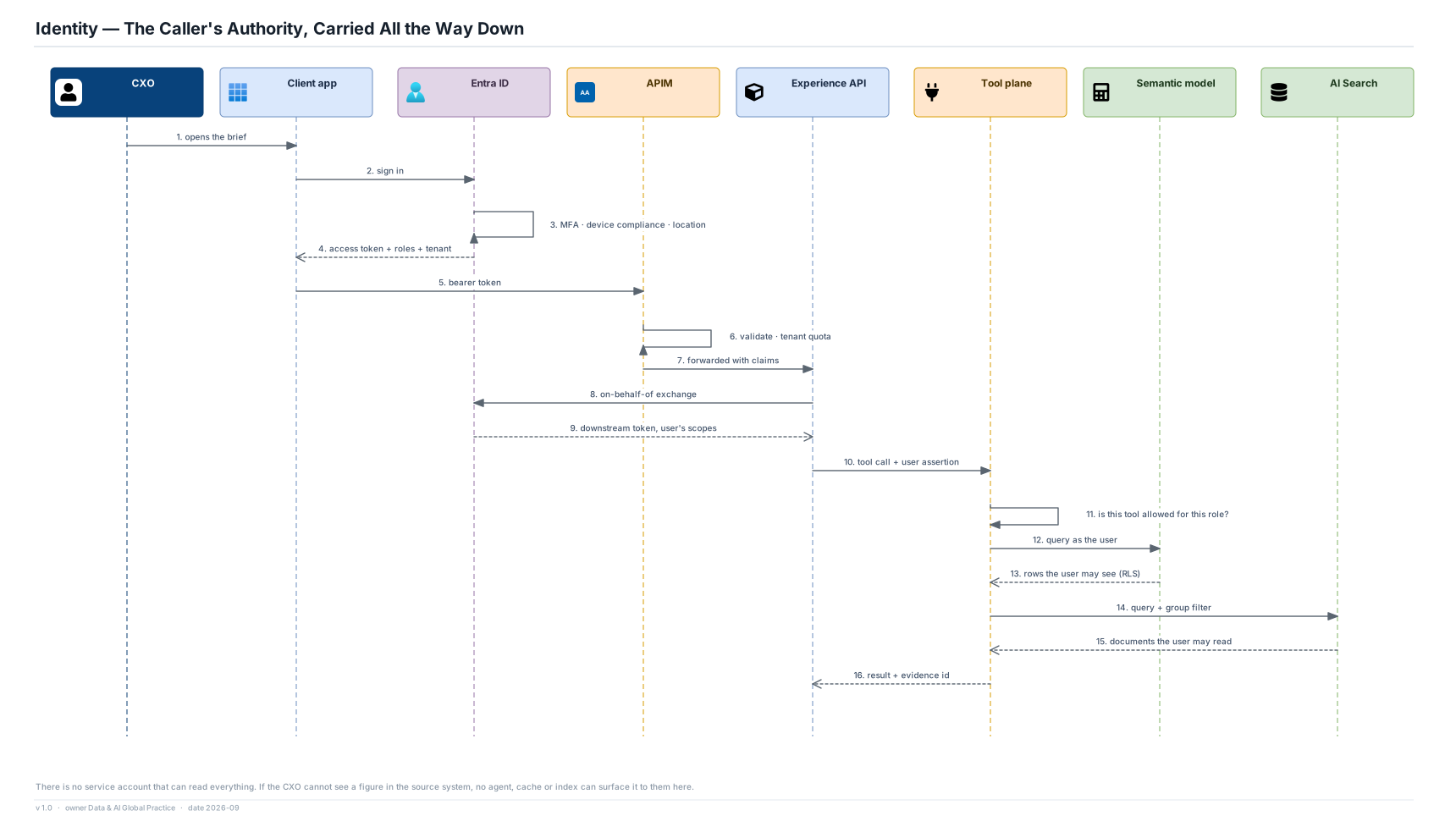
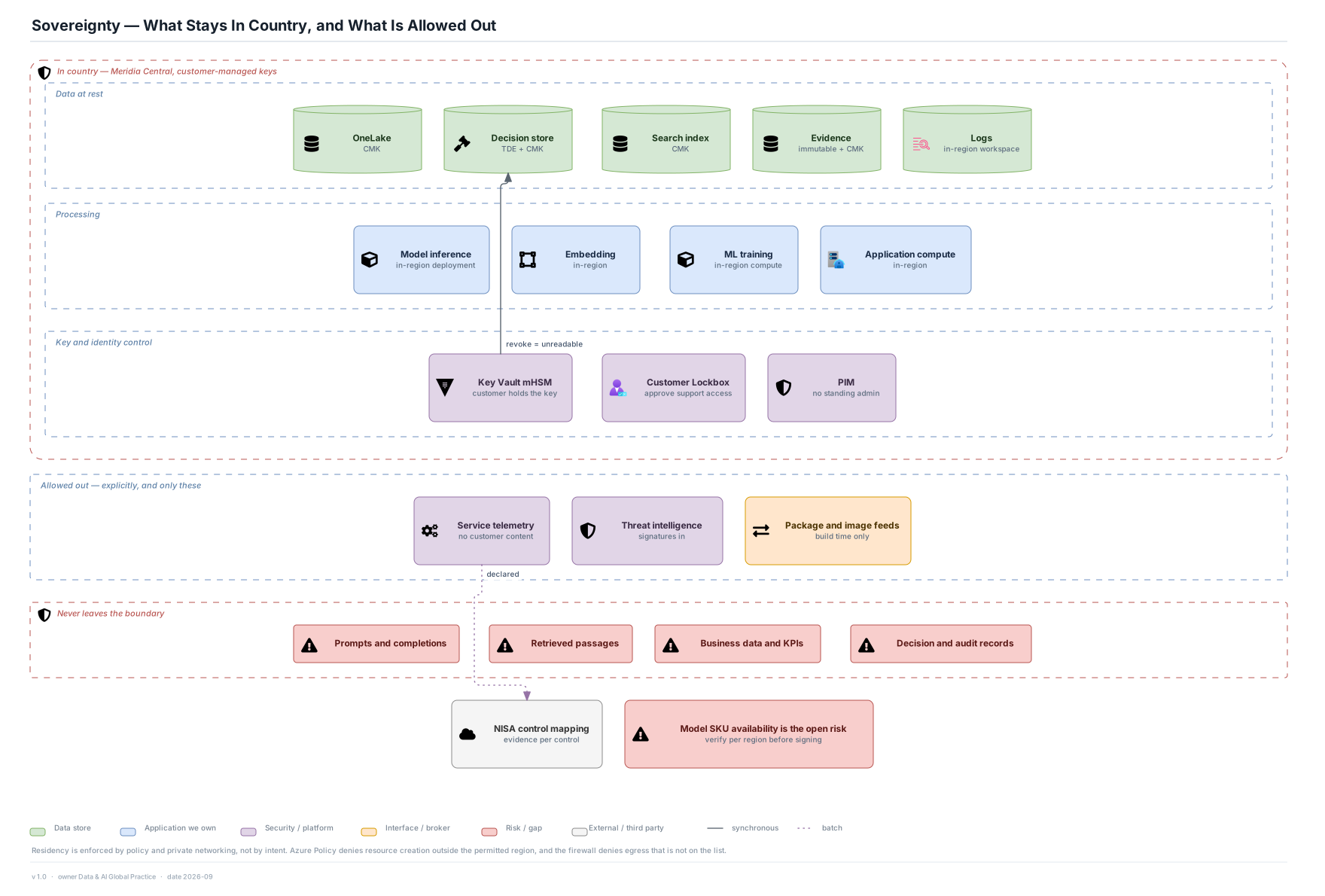
Where the trust boundaries are, how the caller's authority reaches the data, what never leaves the country, and how a decision is reconstructed months later.
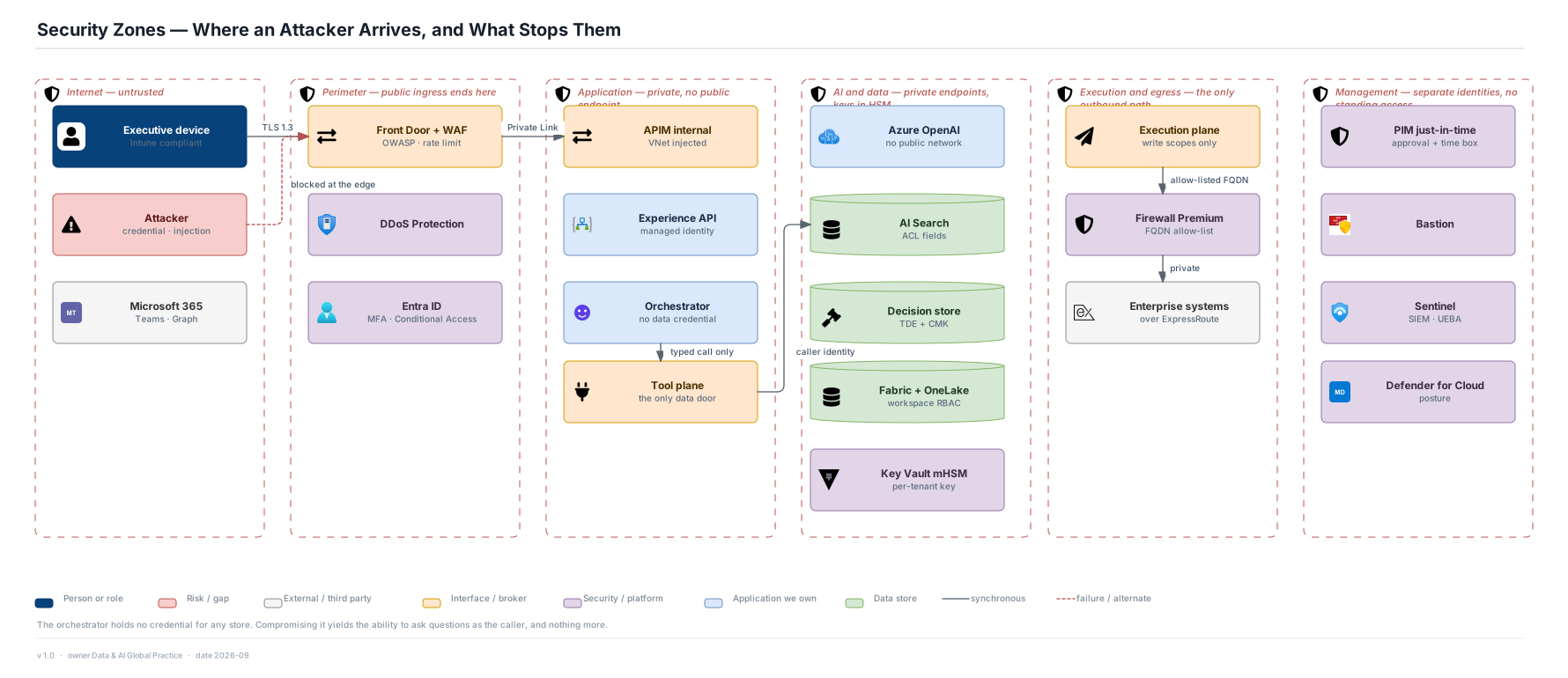
26 Internet — untrusted Executive device Intune compliant Attacker credential · injection Microsoft 365 Teams · Graph Perimeter — public ingress ends here Front Door + WAF OWASP · rate limit DDoS Protection Entra ID MFA · Conditional Access Application — private, no public endpoint APIM internal VNet injected Experience API managed identity Orchestrator no data credential Tool plane the only data door AI and data — private endpoints, keys in HSM Azure OpenAI no public network AI Search ACL fields Decision store TDE + CMK Fabric + OneLake workspace RBAC Key Vault mHSM per-tenant key Execution and egress — the only outbound path Execution plane write scopes only Firewall Premium FQDN allow-list Enterprise systems over ExpressRoute Management — separate identities, no standing access PIM just-in-time approval + time box Bastion Sentinel SIEM · UEBA Defender for Cloud posture TLS 1.3 blocked at the edge Private Link typed call only caller identity allow-listed FQDN private Security Zones — Where an Attacker Arrives, and What Stops Them Person or role Risk / gap External / third party Interface / broker Security / platform Application we own Data store synchronous failure / alternate The orchestrator holds no credential for any store. Compromising it yields the ability to ask questions as the caller, and nothing more. v 1.0 · owner Data & AI Global Practice · date 2026-09 Security Zones Where an attacker arrives, what stops them, and what they would actually get if they took the orchestrator. HTML page SVG draw.io

Architecture One-Pager

The whole argument on one page: the problem, the shape, the decisions that carry it, the numbers, and what is deliberately not being built.

A governed conversational layer over enterprise data, specialist AI agents, decision intelligence and controlled execution — delivered as one Azure-native product that many organisations can buy.

An executive's view of their organisation is assembled by people. A question such as "which suppliers are putting projects that are already financially at risk into further trouble?" crosses an ERP, a procurement system and a portfolio tool, and today it is answered by a chief of staff spending two days reconciling three exports. The information exists; the joins, the trust and the audit trail do not. The failure is not a missing dashboard — it is that no single component owns the relationship between a supplier, a contract, a project and a budget line, and nothing records why a decision was taken once it is.

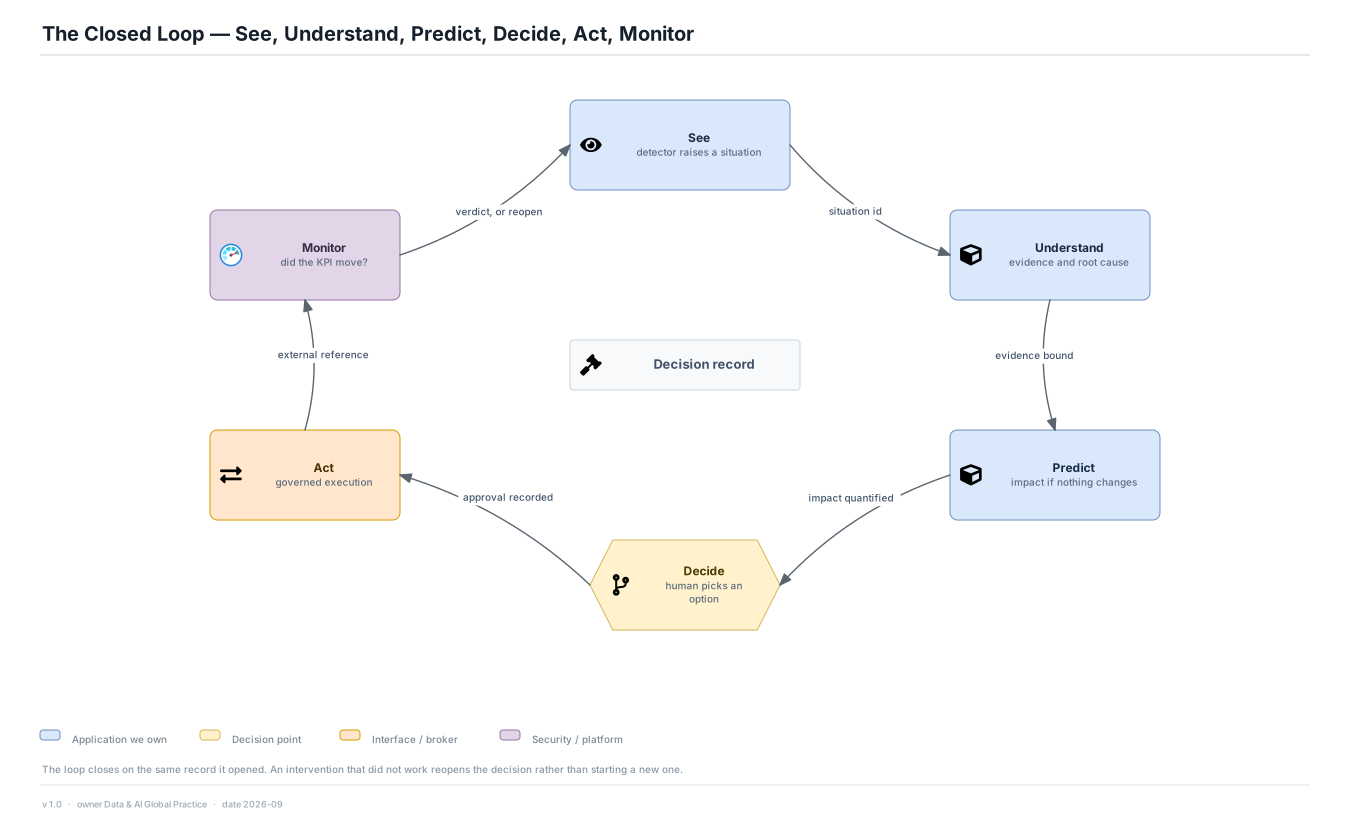
The platform puts a single conversational front door over that estate and makes four things structural. Numbers come from one governed semantic model and never from a language model. Every retrieval carries the caller's own permissions, so the AI can never see more than the person asking. Every claim in an answer is bound to an evidence identifier that is snapshotted, not re-queried. And the system may propose an action but never perform one — a separate execution plane, holding the only write credentials in the estate, acts after a human approves, and then watches whether the intervention worked. What the executive experiences is a morning brief and a conversation; what the architecture actually is, is a decision record with a loop closed around it.

What it is, and what it is not

A decision intelligence platforma chatbot with company data attached
A governed read layer plus one narrow write pathan agent with credentials to enterprise systems
One product configured per tenanta bespoke build repeated per customer
A semantic model that owns every KPIa model that calculates figures from retrieved text
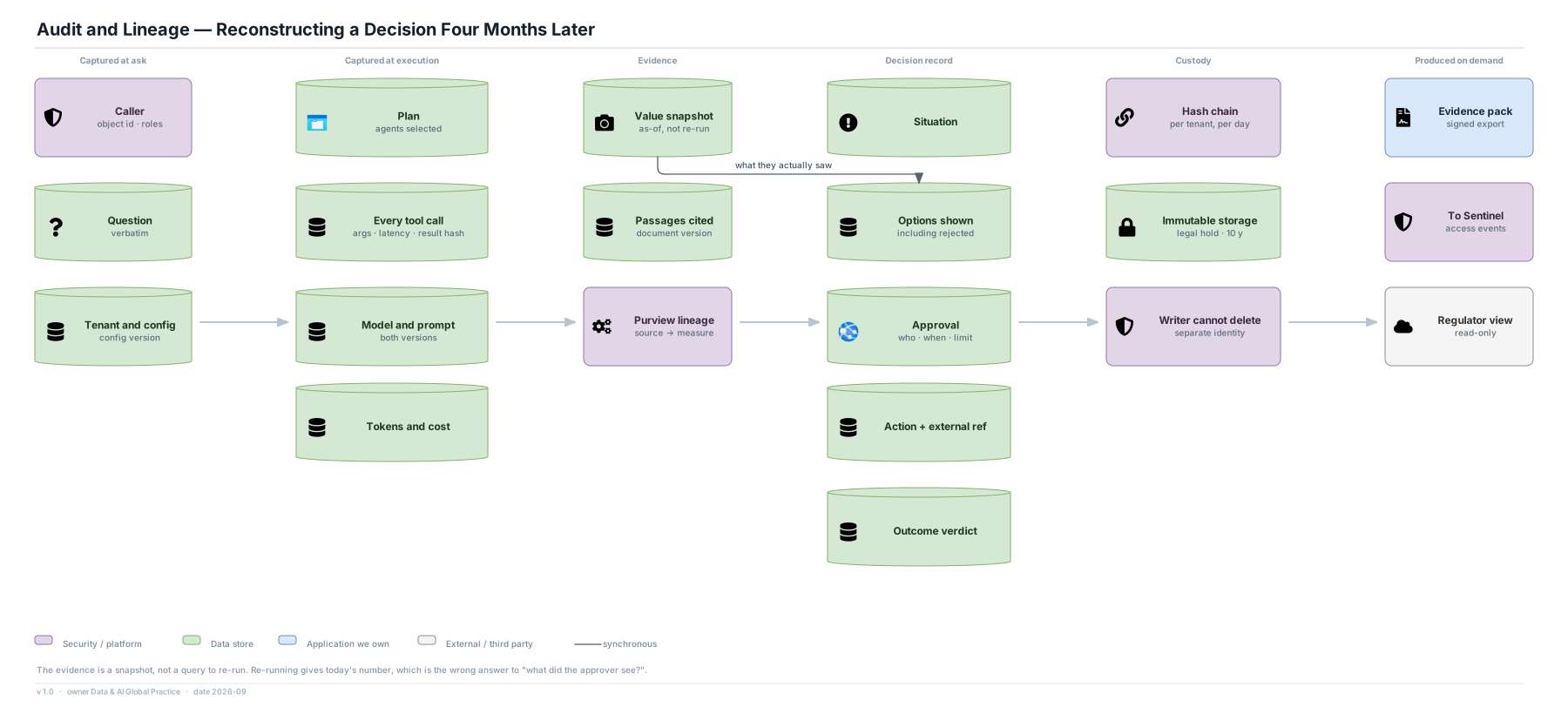
An audit trail that reconstructs what the approver sawa chat log with timestamps
Sovereign by policy, network and key custodysovereign by contractual assurance

The decisions that are the architecture

01The decision record is the system of record

Situation, evidence, options, approval, action and outcome are one durable entity. The conversation is a rendering of it. Everything about auditability, closed-loop monitoring and reopening a failed intervention follows from this one modelling choice.

ADR-01

02The model never touches data

All access is through a typed tool plane that carries the caller's on-behalf-of assertion. There is no text-to-SQL against production, and the orchestrator holds no credential for any store — so compromising it yields the ability to ask questions as the caller, and nothing more.

ADR-02

03Deterministic before generative

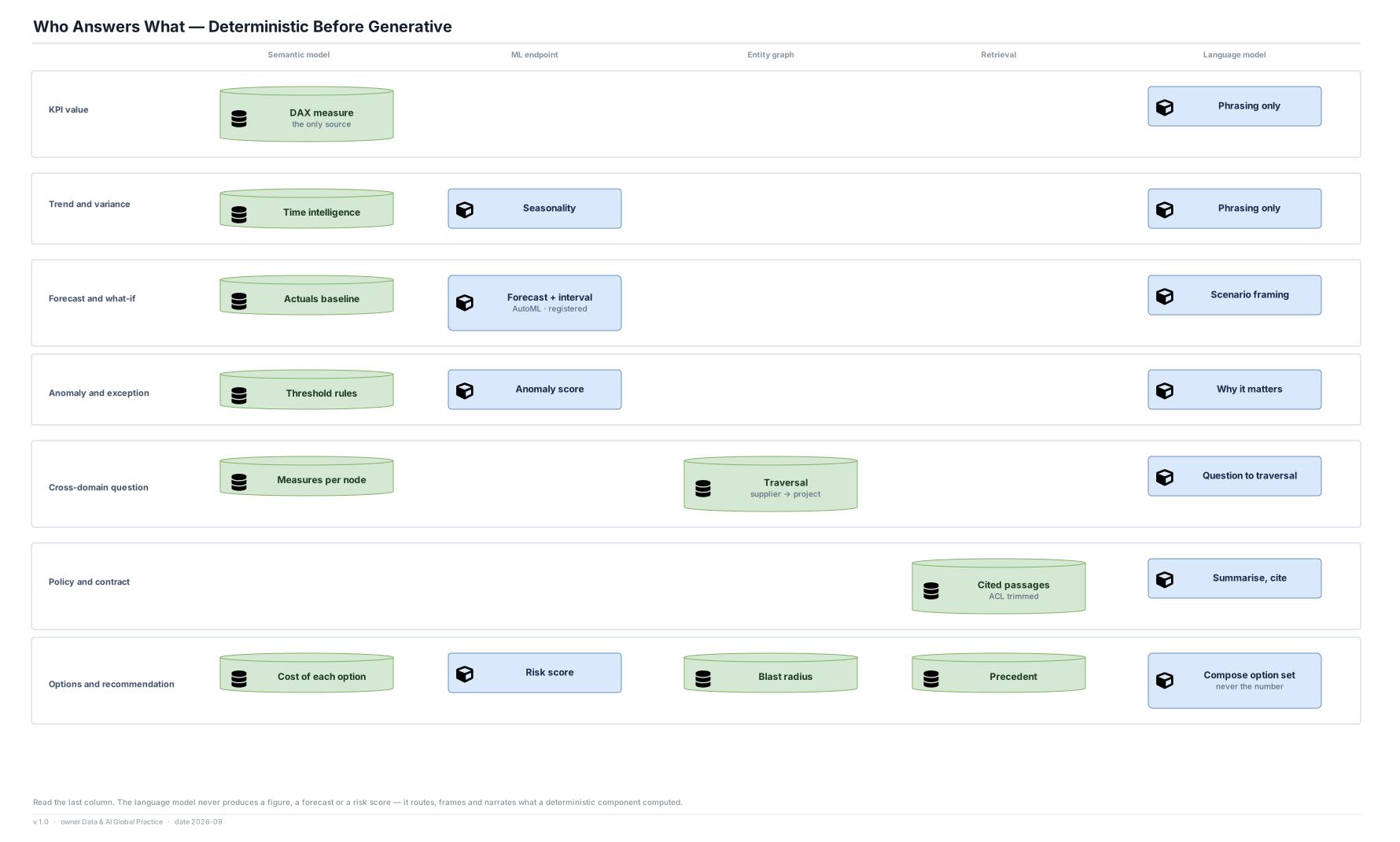
KPIs come from DAX measures in a governed semantic model; forecasts and anomaly scores from registered ML endpoints. The language model classifies, plans and narrates. It never produces a figure. This is both the trust control and the largest cost control.

ADR-03

04Abstention is a first-class outcome

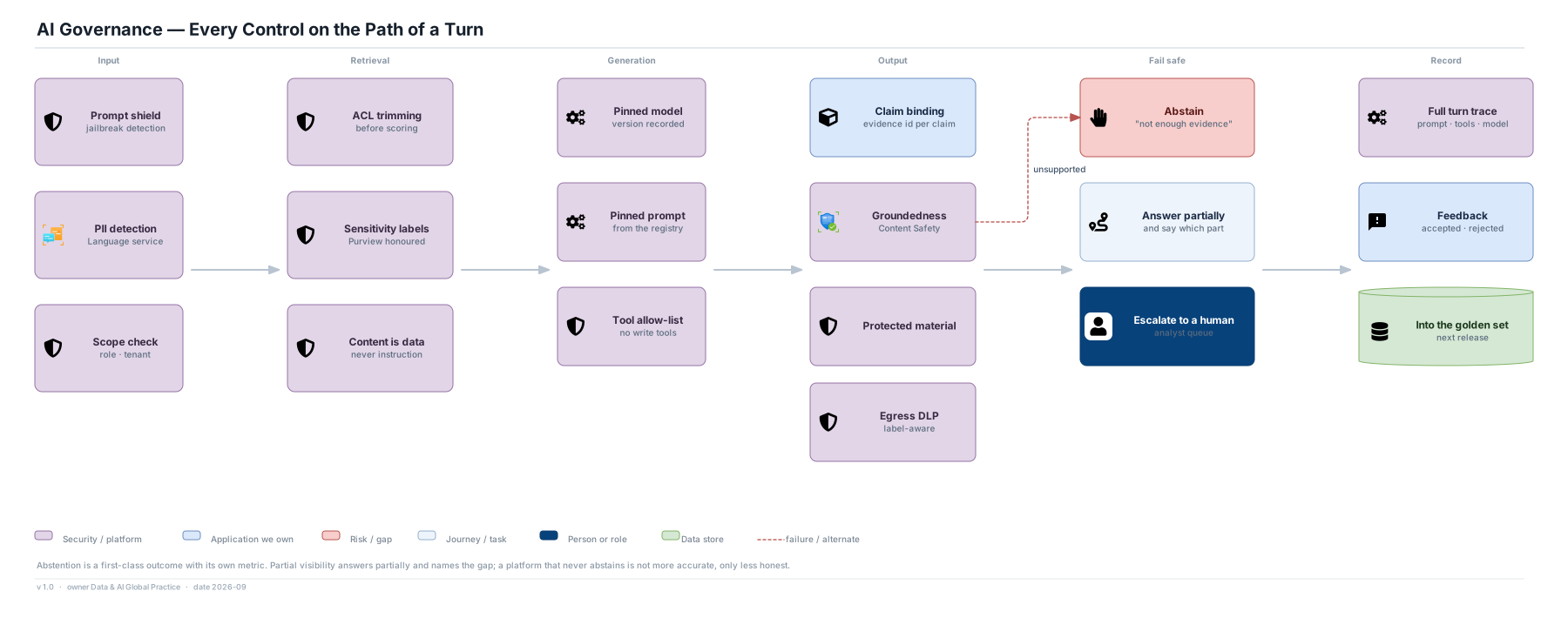
Every claim is bound to an evidence identifier and mechanically checked for groundedness. Unsupported claims are removed and the gap is stated. A platform that never says "I do not have sufficient evidence" is not more accurate, only less honest.

ADR-04

05Isolation is a purchased tier

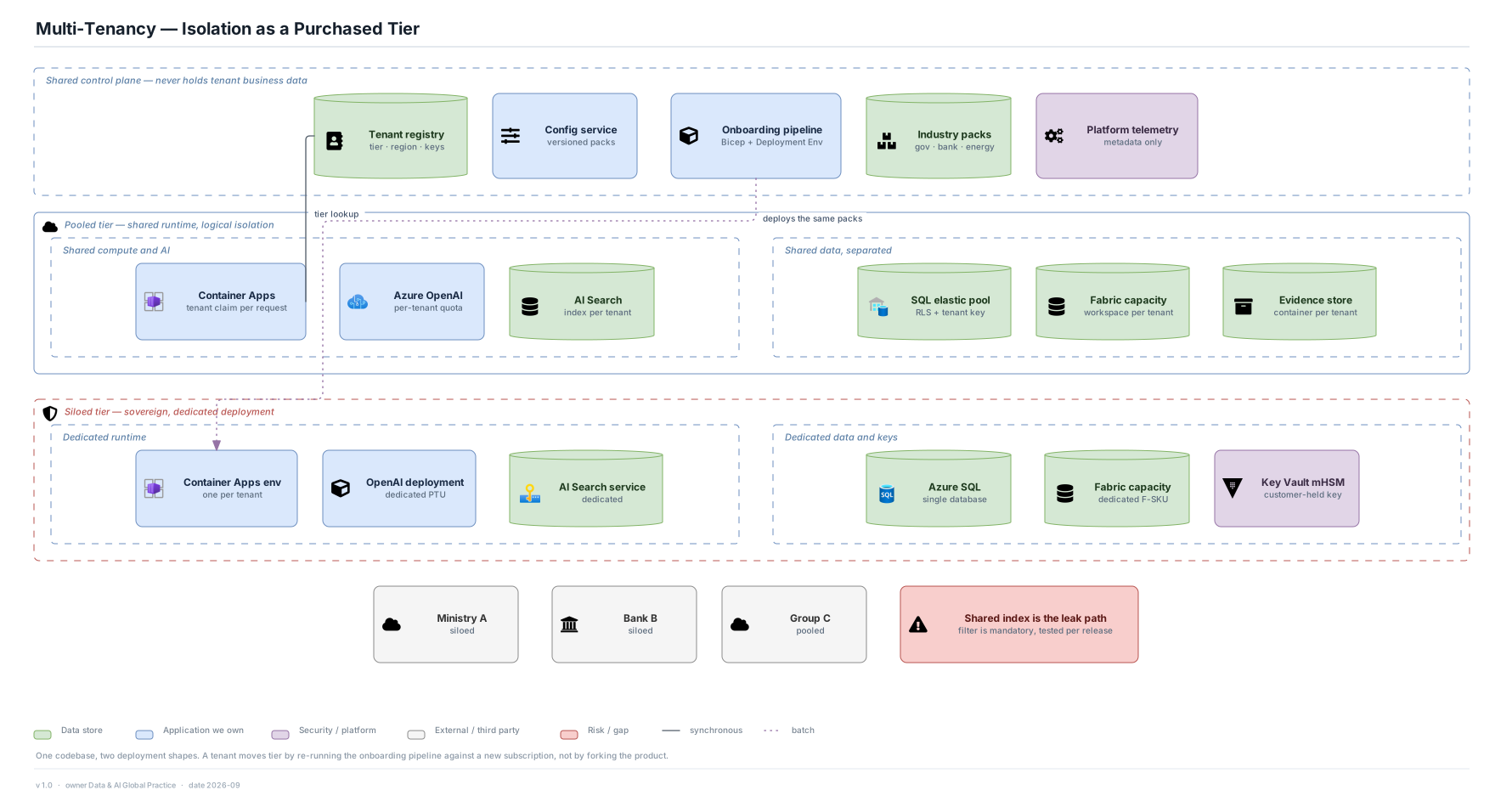
Pooled tenants share compute with per-tenant indexes, row-level security and per-tenant keys. Siloed tenants get a dedicated subscription from the same Bicep. One codebase, two deployment shapes, and a tier change is a migration rather than a fork.

ADR-25

06Execution is a proposal, never a write

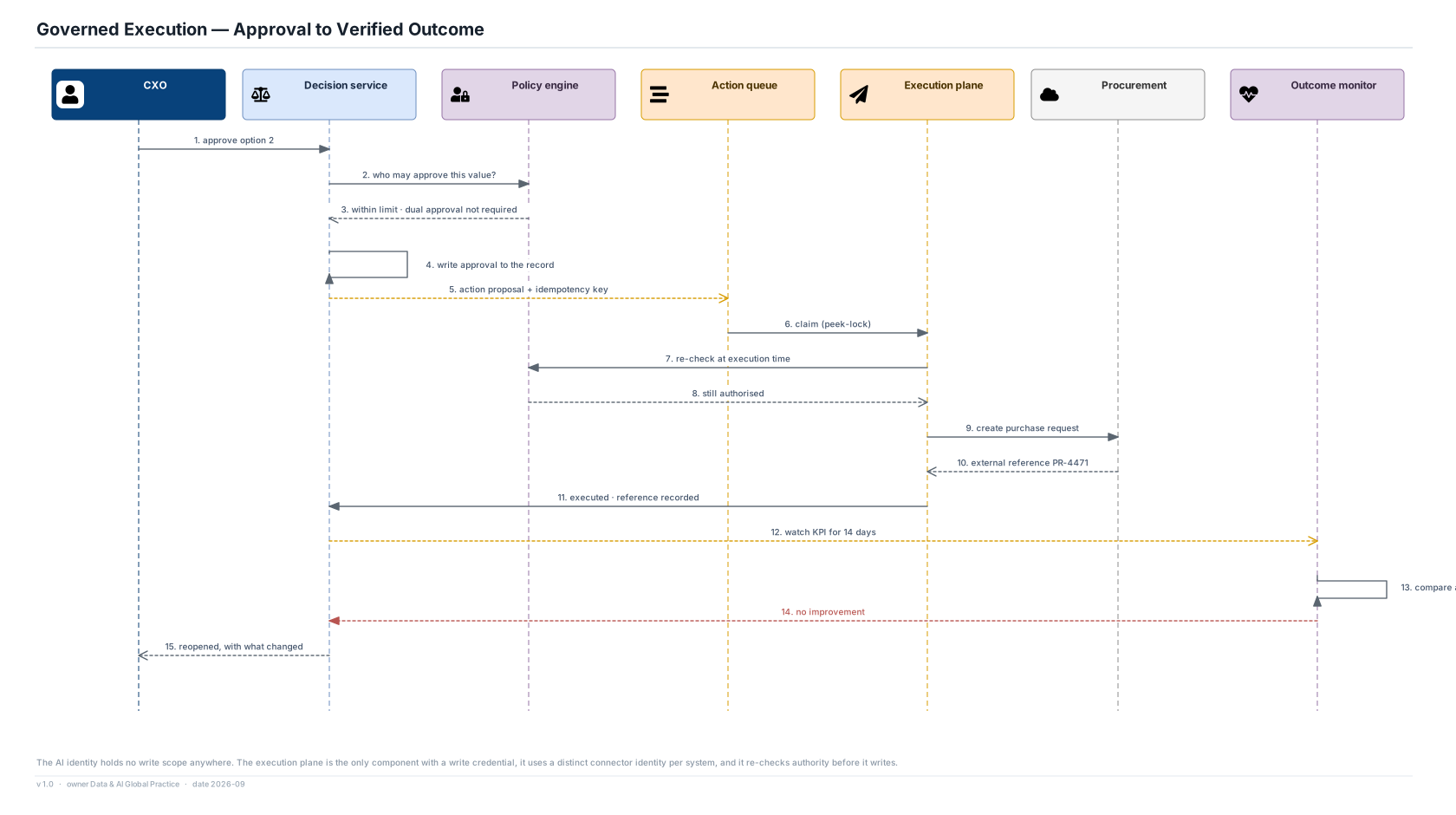
Approved actions go to a single execution plane holding a distinct connector identity per target system, with an idempotency key and an authority re-check at execution time. The AI identity holds no write scope anywhere in the estate.

ADR-21

07Sovereignty is enforced, not asserted

Azure Policy denies resource creation outside the permitted region, the firewall denies unlisted egress, and the customer holds the encryption key in a managed HSM. Revoking the key makes the data unreadable — which is a guarantee rather than a clause.

ADR-27

Non-functional targets

Targets are stated so they can be tested and argued with. Where a number is an assumption rather than a measurement it says so, because a target invented to fill a table is worse than an admitted gap.

QualityTargetHow it is metView
Simple KPI question p95 under 5 s One small-model classification, one DAX measure, one composition call. Semantic cache keyed on question, tenant and permission fingerprint. 15
Cross-system investigation 30–180 s, asynchronous Durable Functions orchestration with progressive disclosure. Anything needing more than four tool calls is promoted to this path rather than made to wait. 16
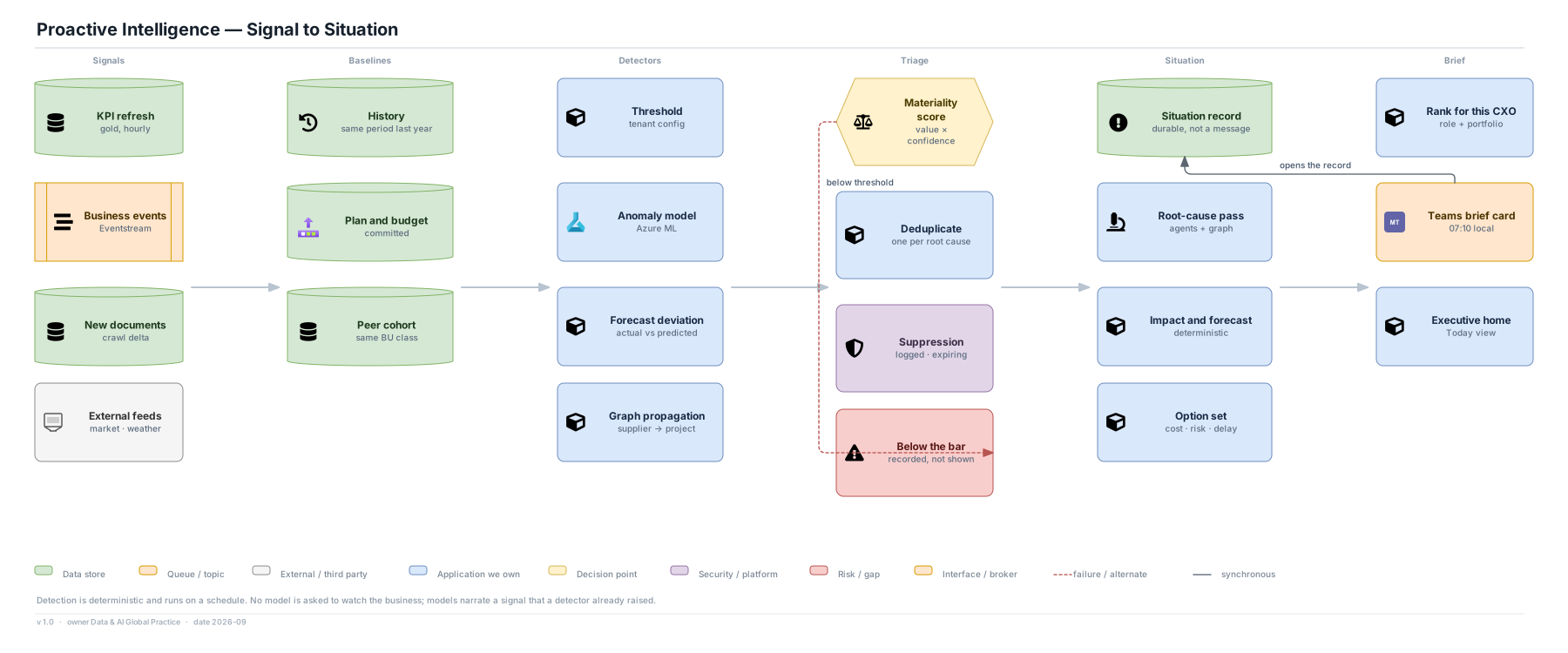
Morning brief Generated 06:30, delivered 07:10 local Hourly deterministic detection sweep; narration only for signals a detector already raised. 18
Platform availability 99.9% monthly Measured on the ability to answer a KPI question, not on resource health. Zone-redundant across three availability zones in one region. 21
Recovery — decision store RPO 5 min, RTO 4 h Geo-zone-redundant Azure SQL with point-in-time restore. Where the tenant forbids a second region, RTO is an in-country restore, targeted at 8 h and tested quarterly. 11
Approval to executed write Under 30 s Service Bus with peek-lock, Logic Apps Standard, idempotency key, authority re-checked at execution time. 20
Answer groundedness No unsupported claim released Claim-level binding verified against retrieved evidence before release; failures dropped and recorded. Rate monitored on a rolling 24 hours as a release-blocking signal. 29
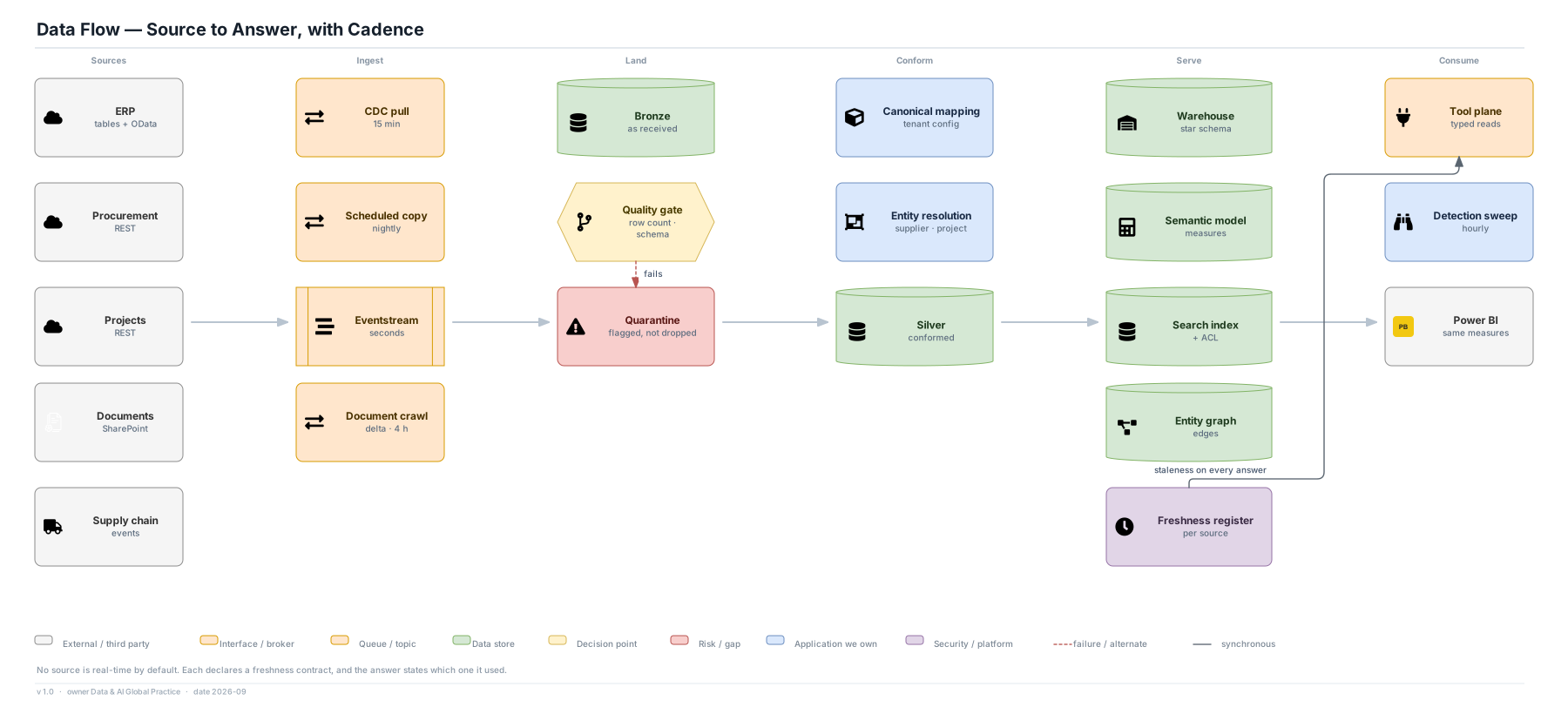
Data freshness Declared per source, shown per answer Finance CDC 15 min, projects hourly, documents 4 h, HR and CRM nightly. Staleness past contract is surfaced in the answer, never hidden. 12
Tenant scale Hundreds of concurrent users per tenant Sized for 3–8 executives and 20–200 business-unit heads per tenant. The load is briefing-time spiky rather than sustained, which is why provisioned model throughput matters more than replica count. 10
Audit retention 10 years, immutable Storage-enforced retention policy with legal hold, per-tenant daily hash chain, and a writer identity that cannot delete. 30

Scope

In scope

  • Conversational front door in Teams, web and mobile, with a role-aware executive Today view
  • Executive orchestrator plus ten specialist capability packs sharing one runtime
  • Governed tool plane over ERP, finance, procurement, projects, HR, CRM, supply chain and the document estate
  • Canonical semantic model, entity graph and enterprise retrieval with per-caller security trimming
  • Decision engine: situation, evidence, root cause, forecast, options, recommendation, confidence
  • Governed execution with human approval, plus closed-loop outcome monitoring
  • Multi-tenant control plane, industry packs, and a tenant configuration studio
  • Sovereignty, audit, lineage and AI governance as product capabilities rather than a later phase

Explicitly out of scope

  • Replacing any system of record. The platform reads them and, in two places, writes to them
  • Replacing the enterprise BI estate. Power BI reads the same semantic model rather than a parallel one
  • Autonomous action above a tenant-configured threshold. Low-risk automation is a later, opt-in capability
  • Master data management as a product. Entity resolution is performed for the platform's own model, not offered as an MDM service
  • Model training on tenant data. Grounding is retrieval and tools; no tenant corpus is used to fine-tune a shared model
  • Voice, and email and calendar where the tenant does not permit it — both are per-tenant switches, and the architecture must be correct with them off

The four-week prototype

Not a slice of the platform, and not twenty disconnected features. The prototype proves one thing: that the loop closes. A single executive scenario carried end to end — see, understand, predict, decide, act, monitor — is more convincing to a sponsor than any breadth demonstration, and it is the only way to discover early that entity resolution, not the AI, is the hard part.

  1. Three sources: ERP/finance, procurement, projects — chosen because they share the supplier and project keys the flagship question needs
  2. Three capability packs: finance, procurement risk, projects
  3. One orchestrator, one tool plane with roughly eight typed tools
  4. One semantic model with a dozen governed measures, reconciled against the customer's own board pack
  5. One entity graph joining supplier, contract, purchase order and project
  6. One executive Today view and one conversational surface, in Teams
  7. Decision record, approval and one governed write to procurement
  8. Golden-question suite written by the customer, run as the go-live gate
  • "What should I know this morning?" — the detection sweep surfaces a project delay
  • "Why is this happening?" — the investigation crosses ERP, procurement and project data
  • "What happens if we do nothing?" — a registered forecast endpoint, with an interval
  • "What are my options?" — three interventions with cost, risk and delay
  • "Proceed with option 2" — approval, governed write, external reference recorded
  • "Is the situation improving?" — the outcome monitor answers, or reopens the decision

Open risks, carried rather than hidden

RiskIf it landsResponse
AI service and model availability in the sovereign region The central premise — in-country inference — may be unavailable for the models the design assumes, invalidating the deployment topology Verify the region's current service and SKU list before contract. Three pre-agreed fallbacks: accept the models the region has and declare the capability gap; place inference in a customer-approved alternative region under a data-boundary commitment; or ship the data platform first and defer the AI layer. The choice belongs in the contract (ADR-29)
Entity resolution across ERP, procurement and projects The flagship cross-domain question is unanswerable until supplier and project identity is resolved. This is the most commonly underestimated item in the programme Treated as a first-class workstream with a human review queue, not a pipeline step. Reversible merges via retained source keys. Proven in the prototype on three sources before scope grows (ADR-16)
Executive adoption The real incumbent is a chief of staff. If the platform is slower or less trusted than a person, it becomes shelfware regardless of accuracy Design for the delegate as well as the principal. Recommendation acceptance is tracked as a platform metric with an alert, so disengagement is visible as an outage rather than discovered at renewal (view 23)
One number, two definitions A figure that differs from the board pack destroys trust faster than a wrong answer, because it is not obviously wrong A single semantic model owned by finance, shared with Power BI. Reconciliation against the customer's existing reporting is an explicit onboarding gate (ADR-17)
Cross-tenant leakage in the pooled tier A single incident ends the multi-tenant commercial model for public-sector customers Server-side mandatory tenant filter, per-tenant keys, and automated cross-tenant probes on every release. Sovereign tenants are siloed by default (ADR-25)
Integration breadth Fourteen interfaces is a programme risk that dwarfs the AI work; legacy public-sector ERPs often have no change-data capability Cadence is declared per source and a nightly full extract is an accepted pattern. The prototype takes three. What a slow source means for "what changed since yesterday?" is stated in the answer rather than papered over (ADR-20)
Guardrail latency against the 5-second target The first thing questioned when the target is missed will be the controls that protect trust Groundedness runs on the extracted claim set rather than full text, and the latency budget for guardrails is stated up front rather than discovered under pressure (ADR-04)
Cost per interaction A multi-agent platform with unbounded fan-out has unpredictable unit economics, which breaks per-tenant pricing Per-turn budgets for tokens, tool calls and wall-clock; routing that defaults to the cheapest sufficient path; cost per interaction tracked per tenant with a budget alert (ADR-10)

Architecture Decision Record

Why every component and every technology on these 30 views is what it is, and what each choice costs.

Thirty-two decisions that make up this architecture. Everything else on these thirty views is convention, and convention needs no defending. Each record is written to teach as well as to record: it opens with the forcing question and the context that makes it hard, states the decision so it can be checked, then shows the concrete Azure mechanism that realises it. It weighs the credible alternatives — some rejected, some genuinely right for an organisation with different constraints — and states what the choice buys, what it costs, the conditions that would flip it, and the principle that transfers to systems that are not this one. Decisions are grouped into nine areas; use the filter to read one area at a time.

Status of this document. This is a design, not a post-mortem of a running system. No figure in it is a measured production number: targets are engineering commitments to be tested, and volumes are stated assumptions drawn from the requirement. Azure service capabilities, SKU availability and regional service lists change, and several decisions here — most importantly the sovereign-region model availability in ADR-29 — must be re-verified against current Microsoft documentation for the target region before they are relied upon commercially. Where a decision rests on a customer fact not yet confirmed, the record says so rather than assuming in the platform's favour. The sovereign jurisdiction is anonymised throughout: “Meridia” and the region “Meridia Central” are placeholders for the customer’s actual country and Azure region, and “NISA” stands in for its national information-security authority. Substitute the real names, and re-check the real region’s service list, before this document is used commercially.

How to read a record

QuestionThe forcing question: why a decision was needed at all.
ContextThe requirement, the scale and the constraint that make it hard.
DecisionWhat this architecture does, stated so it can be checked.
How it works on AzureThe concrete mechanism: which service, configured how.
Options weighedChosen, rejected, deferred, or right elsewhere, with the reason for each.
ConsequencesWhat the choice buys and what it costs, both kept visible.
Choose differently whenThe conditions that would flip the decision for your system.
LessonThe principle that transfers beyond this platform.

Decision map

Foundations 4

The four commitments everything else is built on, and the ones a reviewer should attack first.

ADR-01The decision record is the system of record, not the conversation ADR-02The model never touches data; a typed tool plane does ADR-03Deterministic before generative: the model never produces a number ADR-04Every claim is bound to evidence, and abstention is a first-class outcome

Experience and access 3

Where an executive meets the platform, and how a request gets in.

ADR-05Teams is the primary surface; the web app is the deep surface ADR-06One front door: Front Door for the edge, API Management for the contract ADR-07Simple questions are synchronous; investigations are durable orchestrations

Orchestration and agents 4

What plans a turn, what runs it, and where it is hosted.

ADR-08Azure AI Foundry Agent Service for the runtime, with the plan owned in our code ADR-09Specialist agents are capability packs in one runtime, not separate applications ADR-10Two model classes, routed — and a budget on every turn ADR-11Azure Container Apps for hosting, with AKS as a documented exit

Grounding and knowledge 3

How documents become citable evidence without leaking.

ADR-12Hybrid retrieval with the security filter applied before scoring ADR-13Permissions and sensitivity are captured at ingestion and carried on the chunk ADR-14The semantic cache key includes the caller's permission fingerprint

Data and semantics 6

The analytical foundation, the shared model, and who is allowed to compute a number.

ADR-15Microsoft Fabric as the analytical foundation, with shortcuts instead of copies ADR-16A canonical model with resolved entities, not query federation ADR-17One measure definition, owned by finance, shared with Power BI ADR-18A property graph for cross-domain relationships ADR-19Forecasts and anomaly scores come from registered models, not prompts ADR-20Freshness is declared per source and published with every answer

Decision and execution 4

Turning a recommendation into a governed action, and knowing whether it worked.

ADR-21One execution plane holds every write credential in the estate ADR-22Options with cost, risk and delay — not a single recommendation ADR-23The loop closes on the record it opened ADR-24Proactive detection is deterministic and scheduled

Multi-tenancy 2

How one product serves many organisations without becoming many products.

ADR-25Isolation is a purchased tier, not an engineering compromise ADR-26Configuration, not custom code — but the configuration is engineered

Sovereignty and security 3

Residency, key custody, and the authority chain from person to row.

ADR-27Residency enforced by policy, network and key custody ADR-28The caller's authority reaches the row; no read-everything identity exists ADR-29Regional model availability is carried as a contracted risk, not an assumption

Operations and assurance 3

Releasing safely, degrading honestly, and proving it afterwards.

ADR-30Evaluation is a release gate, and a prompt is a release artefact ADR-31Evidence is snapshotted, and the writer cannot delete ADR-32A written degradation contract, and one place the platform fails closed

Technology by capability

What each capability is built from, the credible alternative, and why this one. Every row links to the record that argues it. Origin labels: Azure · platform is a general Azure service; Azure · AI is part of the AI platform; This design means the requirement is met by a pattern the team builds rather than a product it buys.

Azure · platform Azure · AI This design Third party
CapabilityChoiceOriginCredible alternativeWhy this oneRecord
Executive surface Teams app (Azure Bot Service) + React web on Container Apps Azure · platform Copilot Studio, standalone portal only Executives already live in Teams for approvals; the web app carries the depth Teams cards cannot. ADR-05
Global edge and WAF Azure Front Door Premium Azure · platform Application Gateway + Cloudflare Anycast edge, WAF and Private Link to an internal-mode gateway in one managed service. ADR-06
API gateway API Management Premium, internal VNet mode Azure · platform Container Apps ingress + custom middleware Per-tenant quota, token budgets and one enforced contract per surface, without writing a gateway. ADR-06
Application hosting Azure Container Apps Azure · platform AKS, App Service, Functions only A handful of stateless services with spiky, briefing-shaped load. AKS is a documented exit, not a rewrite. ADR-11
Long-running investigations Durable Functions Azure · platform Service Bus + custom state machine An investigation is a resumable orchestration with checkpoints, not a long HTTP request. ADR-07
Agent runtime Azure AI Foundry Agent Service with Semantic Kernel in the host Azure · AI LangGraph, AutoGen, a hand-rolled loop Managed threads, tool calling, tracing and evaluation in the same governance and network boundary as the models. ADR-08
Language models Azure OpenAI — a reasoning model for planning and composition, a small model for routing and classification Azure · AI One large model for everything; open-weight models on managed compute Most turns need routing, not reasoning. Two model classes is the single biggest lever on both latency and cost. ADR-10
Enterprise retrieval Azure AI Search — hybrid vector + BM25, semantic ranker, index-side security filters Azure · AI pgvector on PostgreSQL, Elasticsearch, a vector-only store Executive questions mix concepts with exact identifiers, and the security filter must run before scoring. ADR-12
Embeddings Azure OpenAI text-embedding-3-large Azure · AI A smaller embedding model, or a domain-tuned one In-region deployment alongside the other models, and no separate residency argument to make. ADR-12
Content safety and grounding Azure AI Content Safety — prompt shields, groundedness detection, protected material Azure · AI A second LLM as judge, or open-source guardrail libraries Managed, in-boundary, and versioned separately from the generating model, which is what makes the check independent. ADR-04
Analytical foundation Microsoft Fabric — OneLake, Lakehouse, Warehouse, Data Factory, Real-Time Intelligence Azure · platform Synapse + ADLS, Azure Databricks One capacity, one storage layer, one security model, and shortcuts to the customer's existing lake instead of copying it. ADR-15
KPI definitions Power BI semantic model with DAX measures and row-level security Azure · platform dbt metrics, a hand-built metric service over SQL The finance team already owns it, and the platform and existing BI must not disagree about a number. ADR-17
Cross-domain relationships Azure Cosmos DB for Apache Gremlin Azure · platform Recursive SQL, a triple store, no graph at all The flagship question is a multi-hop traversal over supplier, contract, purchase order and project. ADR-18
Forecasting and anomaly detection Azure Machine Learning managed online endpoints Azure · platform Asking the language model; Fabric Data Science notebooks in-line A forecast needs a registered, versioned, testable artefact with an interval — three things a prompt cannot provide. ADR-19
Decision and audit store Azure SQL Database — elastic pool when pooled, single database when siloed Azure · platform Cosmos DB NoSQL, PostgreSQL Flexible Server The decision record is relational, transactional and needs row-level security, point-in-time restore and a strong backup story. ADR-01
Evidence custody Azure Blob Storage with an immutability policy and legal hold Azure · platform Keeping evidence in the database; a third-party WORM archive Immutability enforced by the storage service, not by application logic, so an application compromise cannot rewrite history. ADR-31
Conversation state and semantic cache Azure Cache for Redis Enterprise Azure · platform State in the decision store; no cache Turn state is ephemeral and hot; the cache key includes the caller's permission fingerprint, which is what makes it safe. ADR-14
Batch and change-data ingestion Fabric Data Factory pipelines with a self-hosted integration runtime Azure · platform Azure Data Factory standalone, Logic Apps for ingestion, third-party ELT Same capacity, same lineage, and the self-hosted runtime is what reaches a ministry data centre. ADR-20
Event ingestion Fabric Eventstream over Event Hubs Azure · platform Event Grid, Service Bus topics High-throughput, replayable, and lands in the same lake as everything else. ADR-20
Action queue Azure Service Bus, peek-lock with dead-lettering Azure · platform Storage queues, a database-backed outbox An approved action must survive a crash exactly once. Peek-lock plus an idempotency key is what makes that true. ADR-21
Execution plane Logic Apps Standard, one connector identity per target system Azure · platform Custom connector services, direct calls from the agent Hundreds of enterprise connectors, and a blast radius bounded to one system per identity. ADR-21
Identity Microsoft Entra ID — OBO flow, Conditional Access, PIM, managed identities Azure · platform A privileged service principal with application-side filtering The AI must inherit the caller's authority. A read-everything identity makes every application bug a data breach. ADR-28
Keys and secrets Azure Key Vault Managed HSM, customer-managed keys per tenant Azure · platform Standard Key Vault, platform-managed keys The customer holding the key makes revocation a real control rather than a contractual promise. ADR-27
Catalogue, classification and lineage Microsoft Purview Azure · platform A spreadsheet, or lineage inferred from pipeline metadata Sensitivity labels captured at ingestion are what the retrieval filter and the egress DLP both act on. ADR-13
Networking Hub-and-spoke VNet, private endpoints on every PaaS service, Azure Firewall Premium, ExpressRoute Azure · platform Service endpoints, public endpoints with IP restrictions One controlled egress path is what makes an exfiltration claim defensible. ADR-27
Observability Azure Monitor, Application Insights, OpenTelemetry GenAI traces, Foundry tracing Azure · platform A third-party APM, or logs only A turn must be readable end to end — plan, tool calls, model version, grounding verdict — without leaving the boundary. ADR-32
Security posture and SIEM Microsoft Defender for Cloud and Microsoft Sentinel Azure · platform The customer's existing SIEM with log forwarding Native signal from the AI and data services, and reading a decision record is itself an audited event. ADR-31
Landing zone and governance Management groups, Azure Policy, Bicep, Azure Deployment Environments Azure · platform Terraform, manual subscription setup Residency and isolation are enforced by policy at the boundary, so a developer cannot deploy out of country. ADR-27
Tenant provisioning Bicep-driven onboarding pipeline reading a tenant registry This design Manual provisioning, or a per-tenant repository fork A tier is a deployment parameter. Onboarding tenant twelve must not cost what tenant two cost. ADR-25
Tool plane Typed tool contracts behind API Management, resolved per role This design Direct database access from the agent; generated SQL The one door between the model and the data, and therefore the one place authorisation can be audited. ADR-02
Decision engine Situation → evidence → root cause → forecast → options → recommendation, as a service This design Prompting the model to produce a recommendation directly Options with cost, risk and delay are what let an executive decide. A single recommendation asks them to trust instead. ADR-22
Proactive detection Scheduled deterministic detectors over gold-zone measures and the graph This design An agent that continuously monitors the business Repeatable, affordable and explainable. A model that watches is a model you cannot test. ADR-24
Tenant configuration Versioned, schema-checked configuration artefacts in Git, promoted through rings This design Configuration rows in a database edited through an admin UI "Configuration, not custom code" only holds if the configuration is engineered, reviewable and reversible. ADR-26
Evaluation Golden-question suites per tenant, run as a release gate in the pipeline This design Manual spot checks, or vendor benchmark scores Retrieval and generation are scored separately so a regression has a stage rather than a shrug. ADR-30

The decisions, and the alternatives that lost

FoundationsThe four commitments everything else is built on, and the ones a reviewer should attack first.

ADR-01

The decision record is the system of record, not the conversation

Accepted

When an executive approves an intervention through a conversational interface, what exactly has been created?

Context
The brief asks for auditability, closed-loop monitoring, and the ability to reconstruct why a decision was taken. A chat transcript satisfies none of these: it has no state machine, no outcome, no relationship to the KPI the intervention was meant to move, and no way to be reopened. The requirement also asks for a decision intelligence platform rather than a chatbot, and the difference has to be visible somewhere in the data model or it is only a slogan.
Decision
Situation, evidence, options, approval, action and outcome form one durable, append-only entity with an explicit state machine. The conversation is a projection of that entity, not the other way round. Every surface — Teams card, web thread, governance export — renders the same record.
How it works on Azure
Azure SQL Database holds the decision, evidence, action and outcome tables with row-level security by tenant and temporal history on state transitions. Evidence payloads are snapshotted to immutable Blob Storage and referenced by identifier. A decision is never updated in place: state changes are appended, which is what makes the timeline reconstructable four months later.
Options weighed
  • ChosenDecision record as the durable entity: Makes audit, reopening and outcome tracking properties of the model rather than features bolted on later.
  • RejectedChat thread with structured annotations: Cheaper to build and the default for conversational products, but there is no state machine, so "which decisions are awaiting me" becomes a search rather than a query.
  • RejectedRecords only for actions above a value threshold: The threshold is the argument. A decision not to act is exactly the one an auditor asks about.
  • Right elsewherePush the record into the customer's existing case system: Right where the customer already runs governance on a platform they trust. It costs the closed loop, because the outcome monitor then has no home.
Consequences
What it buys
  • Audit, closed-loop monitoring and reopening all fall out of one model rather than three subsystems
  • The Today view is a query, not an aggregation over chat history
  • A decision survives the conversation, the session and the user's departure
What it costs
  • A relational store with a real backup and retention obligation, which the analytical estate does not need
  • Every surface must write through the decision service rather than talking to the model directly
  • More upfront modelling before anything demonstrable exists
Choose differently when
Choose a lighter model when the assistant genuinely only answers questions and never proposes an action — an internal knowledge assistant with no execution path does not need this and should not pay for it.
LessonIn any assistant that leads to action, the durable artefact is the decision, not the dialogue. Get that wrong and auditability becomes log archaeology.
Shown on views06 13 19 30
ADR-02

The model never touches data; a typed tool plane does

Accepted

How does a language model get access to enterprise data without being given access to enterprise data?

Context
The requirement is explicit that AI must never have unrestricted access and must inherit the user's authorisation context. The tempting shortcut — give the model a database connection and let it write SQL — is fast to demonstrate and impossible to govern: the generated query is unbounded, the identity is the service's rather than the caller's, and nothing about the access is reviewable in advance.
Decision
All data access is through a catalogue of typed tools with declared inputs, outputs and required scopes. The model proposes which tool to call; the tool plane decides whether the caller may, executes the read, and mints an evidence identifier. The orchestrator holds no credential for any store.
How it works on Azure
Tools are published through API Management with a schema per operation and a policy that requires an on-behalf-of assertion. The tool implementation calls the semantic model, AI Search or the graph using the caller's exchanged token, so row-level security and index filters evaluate against the person rather than the service. Managed identity is used only for the platform's own stores, never for tenant business data.
Options weighed
  • ChosenTyped tool contracts, caller identity carried through: Authorisation becomes reviewable in advance, and every read is replayable for audit.
  • RejectedText-to-SQL against a read replica: Demonstrates in a day and fails review in an hour. Unbounded queries, no per-caller authority, and no way to know what a future prompt will produce.
  • DeferredModel Context Protocol servers per domain: A good fit for the same shape and worth adopting as the ecosystem matures; the governance argument here is about typing and identity, which MCP does not by itself supply.
  • Right elsewherePre-computed answer sets only: Right for a fixed executive dashboard with no drill-down, and considerably cheaper. It cannot answer a question nobody anticipated.
Consequences
What it buys
  • Compromising the orchestrator yields the ability to ask questions as the caller, and nothing more
  • Every read is typed, logged and replayable, which is what makes the audit trail meaningful
  • Tool latency and failure rate become measurable per source
What it costs
  • Every new question class may need a new tool, which is slower than a general query interface
  • The tool catalogue becomes a governed artefact with its own change process
  • Per-caller queries cache poorly, addressed in ADR-14
Choose differently when
Allow generated queries when the data is genuinely public within the organisation, the store is a disposable replica, and no answer leads to an action. Even then, budget for the query that scans everything.
LessonGive a model a capability, never a credential. The narrower the door, the easier it is to prove what came through it.
Shown on views02 15 16 26
ADR-03

Deterministic before generative: the model never produces a number

Accepted

When an executive asks for the cash position, what actually computes the figure?

Context
The requirement warns against asking the LLM to calculate financial KPIs when a deterministic engine can. The deeper problem is asymmetric consequence: a clumsy narrative is embarrassing and recoverable, whereas a wrong figure presented to a board is not. Executives also calibrate on the answers that turn out wrong, so a single fabricated number costs more trust than fifty good answers earn.
Decision
KPI values come from DAX measures in the governed semantic model. Forecasts, anomaly scores and risk scores come from registered ML endpoints with intervals. The language model classifies the question, plans the retrieval, frames the scenario and narrates the result. It never produces a figure, a forecast or a score.
How it works on Azure
The metric service is the only component permitted to query the Power BI semantic model, and it does so with the caller's identity so row-level security applies. Azure ML managed online endpoints serve forecasting and anomaly models as versioned artefacts. The routing table in view 17 is implemented as a classifier plus a dispatch map, and a test asserts that no other code path returns a numeric measure.
Options weighed
  • ChosenDeterministic computation, generative narration: Trust control and cost control in one decision: most questions route to a cheap path with a single small-model call.
  • RejectedLet the model compute from retrieved tables: Works impressively in a demo with small tables and fails silently on aggregation, currency, period boundaries and null handling.
  • RejectedModel computes, then a checker verifies: Two model calls to reach a number that a measure already defines, with a checker that shares the first model's blind spots.
  • DeferredCode interpreter in a sandbox: Genuinely useful for ad-hoc what-if analysis on data already retrieved, and a candidate for a later scenario-modelling capability under the same evidence rules.
Consequences
What it buys
  • Numbers are reproducible, testable against expected values and explainable without reference to a model version
  • The dominant cost path is avoided for most questions
  • A model upgrade cannot change a reported figure
What it costs
  • A question with no corresponding measure cannot be answered until the measure is built
  • Measure coverage becomes an onboarding workstream with its own backlog
  • The platform will sometimes abstain where a competitor confidently guesses
Choose differently when
Relax this for exploratory analysis clearly labelled as such, on data the user already has, where no figure leaves the session. Never relax it for anything that reaches a decision record.
LessonDecide which of your outputs are opinions and which are facts, and route them to different machinery. A system that blurs the two will eventually be wrong in the expensive direction.
Shown on views02 17 19
ADR-04

Every claim is bound to evidence, and abstention is a first-class outcome

Accepted

What does the platform do when it cannot support part of an answer?

Context
The brief asks the system to say "I don't have sufficient evidence to answer this reliably" rather than fabricate. That is easy to write and hard to build, because it requires knowing which parts of a generated answer are supported — which means the binding between claim and evidence must be mechanical rather than requested politely in a prompt.
Decision
The composition step returns a claim-to-evidence map alongside the prose. Each claim is verified against the retrieved evidence by an independent check. Unsupported claims are removed and the gap is stated. Where the whole answer fails, the platform abstains in those words. Abstention rate is a monitored metric and is deliberately not driven to zero.
How it works on Azure
Azure AI Content Safety groundedness detection performs the check, versioned independently of the generating model so the checker is not marking its own work. Evidence identifiers are minted by the tool plane at read time and carried through composition. The verdict, the dropped claims and the abstention are all written to the decision record and surface in view 30's evidence pack.
Options weighed
  • ChosenMechanical claim binding with an independent groundedness check: The only version of this that survives contact with a regulator, because the check does not depend on the model's own confidence.
  • RejectedPrompt the model to cite and to refuse when unsure: Improves the average case and fails exactly when it matters, since a confidently wrong model is also confidently cited.
  • RejectedShow the sources and let the reader judge: Transfers the verification burden to the person least able to carry it at 07:10.
  • Right elsewhereHuman review before every executive answer: Right in a small, very-high-stakes setting such as regulatory filings. It does not scale to a conversational front door and removes the reason to have one.
Consequences
What it buys
  • Trust is earned by the answers that are declined as much as by the ones given
  • The evidence pack in view 30 becomes producible, because binding already exists
  • Grounding rate is a release-blocking signal rather than a sentiment
What it costs
  • Added latency on every turn, which is the first thing challenged when the 5-second target is missed
  • Answers are shorter and occasionally less satisfying than an ungrounded competitor's
  • An additional service in the critical path and in the cost model
Choose differently when
A lower bar is reasonable for an internal brainstorming assistant where the reader is expected to verify. It is not reasonable anywhere an answer can become an approval.
Lesson"Do not hallucinate" is not a control. A control is a component that can fail the output, run by something other than the thing that produced it.
Shown on views04 15 29

Experience and accessWhere an executive meets the platform, and how a request gets in.

ADR-05

Teams is the primary surface; the web app is the deep surface

Accepted

Where does an executive actually meet this platform?

Context
Executive adoption is the largest product risk, and the real incumbent is a chief of staff rather than a competing tool. Anything requiring an executive to open a new application, remember a URL and learn a navigation model starts at a disadvantage that accuracy will not recover. Approvals in particular already happen in Teams for most Microsoft-estate customers.
Decision
The morning brief, notifications and approvals are delivered as Adaptive Cards in Teams. Investigation, option comparison, drill-down and the governance centre live in a web application that a card can deep-link into. Mobile shares the web contract rather than having its own.
How it works on Azure
Azure Bot Service fronts the Teams channel; Adaptive Cards carry the brief and the approval action, with the action posting to the same Experience API the web app uses. The web app runs on Container Apps behind Front Door. Single sign-on flows from the Teams identity, so an approval requires no second authentication.
Options weighed
  • ChosenTeams for brief and approval, web for depth: Meets the executive where approvals already happen without forcing a rich comparison view into a card.
  • RejectedStandalone portal only: Cleanest to build and the surface most likely to go unopened after week three.
  • RejectedEverything in Teams: An option set with cost, risk and delay, and a drill-down into evidence, do not fit an Adaptive Card without becoming unreadable.
  • Right elsewhereCopilot Studio as the front end: A strong choice for a customer standardising on Microsoft 365 Copilot with lighter governance needs. It cedes control of the orchestration and evidence contract, which is the product here.
Consequences
What it buys
  • Approvals happen where the executive already is, which is the difference between daily use and abandonment
  • One identity, one session, no second sign-in for an approval
  • Push and presence come free rather than being built
What it costs
  • Two front-end surfaces to maintain and to keep consistent
  • A dependency on the customer's Microsoft 365 estate and its policies
  • Adaptive Card capability limits constrain what the brief can show
Choose differently when
Lead with the web app where the customer is not a Teams organisation, or where a regulator objects to decision content transiting a collaboration platform — the brief then becomes an email deep-link.
LessonFor executive software, distribution beats features. The surface that is already open wins arguments that the better interface loses.
Shown on views01 02 04
ADR-06

One front door: Front Door for the edge, API Management for the contract

Accepted

What enforces tenant quota, contract and public exposure, and where?

Context
A multi-tenant platform needs per-tenant rate limits and token budgets, one enforced API contract per surface, and no public endpoint on anything behind the perimeter. Building that into the application means every service re-implements it and the sovereign tenants get a different answer from the pooled ones.
Decision
Azure Front Door Premium terminates TLS, provides WAF and DDoS protection, and reaches the platform over Private Link. API Management in internal VNet mode is the only ingress to the application, and is where tenant quota, token budgets and contract validation are enforced.
How it works on Azure
Front Door Premium origins connect by Private Link to an internal-mode APIM. APIM policies validate the Entra token, extract the tenant claim, apply per-tenant rate and token quotas, and forward with claims to Container Apps. No data or AI service has a public endpoint; all are reached through private endpoints with private DNS.
Options weighed
  • ChosenFront Door + internal APIM: Edge protection and contract enforcement as managed services, with quota policy in one place for every tenant.
  • RejectedApplication Gateway + custom middleware: Cheaper at one region and re-implements quota, versioning and developer contract in application code.
  • RejectedContainer Apps ingress directly: Adequate for a prototype and leaves per-tenant throttling — the control that protects one tenant from another — in the application.
  • Right elsewhereThird-party API gateway: Right where the customer already standardises on one and wants a single policy surface across their estate.
Consequences
What it buys
  • A noisy tenant is throttled before it reaches shared compute or shared model quota
  • One contract per surface, versioned, with the policy visible to security review
  • No public endpoint anywhere behind the perimeter
What it costs
  • APIM Premium is a material fixed cost, which weighs heavily on a small siloed tenant
  • Another hop in the latency budget
  • Two products to configure before the first request is served
Choose differently when
Drop APIM for a single-tenant deployment with no quota requirement and one client; the policy layer is then genuinely unearned cost.
LessonPut multi-tenant fairness controls in infrastructure, not in application code. The tenant you need to throttle is the one whose code path you are least keen to touch.
Shown on views02 08 21 26
ADR-07

Simple questions are synchronous; investigations are durable orchestrations

Accepted

What happens when a question genuinely takes ninety seconds to answer?

Context
The requirement distinguishes a simple KPI question, targeted under five seconds, from a complex investigation where an asynchronous experience is acceptable. Holding an HTTP request open for ninety seconds fails at every proxy, loses all work on a restart, and gives the user a spinner instead of progress.
Decision
Turns needing at most four tool calls run synchronously. Anything larger is promoted to a durable orchestration with checkpoints, progressive disclosure of intermediate findings, and a resumable identifier the executive can leave and return to.
How it works on Azure
Durable Functions runs the investigation as an orchestration with activity checkpoints in its own state store, so a host restart resumes rather than restarts. Findings stream to the client over Server-Sent Events as each stage completes, and the same identifier is addressable later from the Teams card or the web thread.
Options weighed
  • ChosenThreshold-based promotion to a durable orchestration: The user waits only when waiting is short, and long work is crash-safe and resumable.
  • RejectedEverything synchronous: Simple and correct until the first cross-system question, which is the question the product exists for.
  • RejectedEverything asynchronous: Uniform and honest, but a five-second question behind a job-status poll feels broken.
  • RejectedService Bus plus a hand-written state machine: The same design, built rather than bought, with retries and compensation to write and test.
Consequences
What it buys
  • Long investigations survive a deployment or a host failure
  • Progressive disclosure makes ninety seconds feel like work rather than a hang
  • The promotion threshold is a tuning knob rather than a rewrite
What it costs
  • Two execution paths to build, test and observe
  • The client must handle streaming and resumption
  • Orchestration state is another store to secure and to reason about for residency
Choose differently when
Stay synchronous throughout if every question in your domain is bounded by a single system call. Go fully asynchronous if none of them are.
LessonChoose the interaction model from the work's distribution, not its average. The tail is what the user remembers.
Shown on views02 15 16

Orchestration and agentsWhat plans a turn, what runs it, and where it is hosted.

ADR-08

Azure AI Foundry Agent Service for the runtime, with the plan owned in our code

Accepted

Build the agent runtime, or adopt one?

Context
Agent frameworks are abundant and change quickly. The parts that matter here — tool calling with the caller's identity, threads, tracing, evaluation, and staying inside a private network boundary in a sovereign region — are infrastructure. The part that is genuinely ours is the planning policy: which capability answers which question, under what budget, with what fallback.
Decision
Adopt Azure AI Foundry Agent Service for thread management, tool invocation, tracing and evaluation. Keep the planning policy, the budget enforcement and the tool authorisation in our own orchestrator host, so the platform's distinctive behaviour is not a framework's default.
How it works on Azure
The orchestrator runs on Container Apps using Semantic Kernel for plan composition and calls Foundry Agent Service for agent execution. Tracing follows OpenTelemetry GenAI conventions into Application Insights, and Foundry's evaluation harness is reused for the release gate in ADR-30. All of it sits behind private endpoints in the tenant's network.
Options weighed
  • ChosenFoundry Agent Service + our planner: Buys the plumbing and the governance surface; keeps the routing policy, which is where the product's judgement lives.
  • RejectedFully hand-rolled orchestration loop: Maximum control, and a year of building threads, tracing and evaluation that a managed service already provides in-boundary.
  • Right elsewhereLangGraph or AutoGen on Container Apps: Excellent frameworks and the right answer for a team already fluent in them or targeting more than one cloud. Here they add a residency and support argument for capability the platform already has.
  • RejectedCopilot Studio orchestration: Fast to a demonstration; cedes the tool authorisation and evidence contract that this platform is fundamentally about.
Consequences
What it buys
  • Tracing and evaluation exist from day one rather than being retrofitted
  • Everything stays inside one network and residency boundary
  • The routing policy is testable code we own
What it costs
  • A dependency on a fast-moving managed service, including its regional availability
  • Framework upgrades become a release concern
  • Some capability duplication between the framework and our planner
Choose differently when
Build your own when you need portability across clouds, or when your orchestration is genuinely unusual. Adopt more of the platform when your team is small and your governance needs are ordinary.
LessonBuy the plumbing, build the judgement. The framework is not your product; the routing policy might be.
Shown on views02 07 16
ADR-09

Specialist agents are capability packs in one runtime, not separate applications

Accepted

Is a finance agent a deployment, or a configuration?

Context
The requirement names ten specialist domains and describes them as modular capabilities rather than independent LLM applications. It also asks for an agent marketplace as a product module. Those two only reconcile if adding a capability is cheap, and it is only cheap if it is not a deployment.
Decision
A specialist agent is a prompt pack plus a tool catalogue plus an evaluation set, versioned with the tenant configuration and loaded into one shared runtime. Agents return structured results to the orchestrator and never call each other.
How it works on Azure
Packs are configuration artefacts in the tenant configuration repository, schema-checked in the pipeline and loaded by the orchestrator host at start-up and on change. The tool catalogue per pack resolves to API Management operations the caller's role permits. Foundry threads keep per-agent context without a per-agent deployment.
Options weighed
  • ChosenCapability packs in a shared runtime: Adding a domain is configuration, which is what makes a marketplace a feature rather than a programme.
  • RejectedOne microservice per agent: Attractive for team autonomy at large scale; here it multiplies deployments, network policy and cost by ten for no isolation benefit.
  • RejectedOne monolithic prompt covering every domain: Cheapest, and it degrades as domains are added because every question pays for every domain's instructions.
  • RejectedFree agent-to-agent negotiation: Where latency and cost hide. Structured returns to a single orchestrator keep a turn bounded and traceable.
Consequences
What it buys
  • A new domain is a configuration change with an evaluation set, not a release
  • A tenant can be behind on a pack without being behind on the platform
  • One runtime to secure, observe and scale
What it costs
  • Packs share a blast radius: a bad shared runtime release affects every domain
  • Per-domain resource limits must be enforced in the budget rather than by isolation
  • Pack versioning becomes its own governance surface
Choose differently when
Split into services when a domain needs genuinely different scaling, a different compliance boundary, or an independent team release cadence.
LessonModularity is a property of the configuration model, not of the deployment topology. Ten deployments are not ten modules; they are ten things to patch.
Shown on views02 07 16
ADR-10

Two model classes, routed — and a budget on every turn

Accepted

Which model answers, and what stops a single question costing a fortune?

Context
Most executive turns are routing and narration over a computed figure. A minority are genuine multi-step investigations. Sending everything to a reasoning model makes the common case slow and expensive, and an agentic system with unbounded fan-out has unpredictable unit economics — which breaks per-tenant pricing before it breaks the latency target.
Decision
A small, fast model performs intent classification, entity resolution and routing. A reasoning model is used only for planning an investigation and for final composition. Every turn carries an explicit budget for tokens, tool calls and wall-clock, set by the orchestrator before any agent runs.
How it works on Azure
Both deployments are Azure OpenAI in the tenant's region, with provisioned throughput sized for the briefing spike and pay-as-you-go overflow. API Management enforces the per-tenant token quota; the orchestrator enforces the per-turn budget and degrades to a narrower answer rather than exceeding it. Cost per interaction is exported to Fabric and alerted on per tenant.
Options weighed
  • ChosenRouted two-class models with per-turn budgets: The largest single lever on both latency and cost, and it makes unit economics predictable enough to price.
  • RejectedOne capable model for everything: Simplest to operate and reason about, and it pays reasoning-model prices for "what is our cash position?".
  • DeferredOpen-weight models on managed compute: Worth revisiting for the classification path where volume is high and the task is narrow; it adds an operational burden that is hard to justify at prototype scale.
  • RejectedNo budget, monitor and react: The first runaway investigation is discovered on the invoice, and by then a tenant has been affected.
Consequences
What it buys
  • Predictable cost per interaction, which a commercial model can be built on
  • The common path is fast because it never touches the expensive model
  • A runaway turn degrades gracefully instead of consuming the tenant's quota
What it costs
  • Two deployments to manage, evaluate and keep pinned
  • The router itself can be wrong, sending a hard question down a cheap path
  • Budget exhaustion is a user-visible state that must be explained well
Choose differently when
Use a single model when volume is low enough that operational simplicity beats unit cost, or when routing errors are more damaging than latency.
LessonIn an agentic system, cost is an architectural property, not an operational surprise. Decide the budget before the first token, or discover it on the invoice.
Shown on views16 17 23
ADR-11

Azure Container Apps for hosting, with AKS as a documented exit

Accepted

What runs the application, given a mid-size tenant and a small platform team?

Context
The workload is a handful of stateless HTTP services with a pronounced daily spike around the morning brief and long quiet periods. The platform team runs many tenants and cannot afford per-tenant cluster operations. The requirement lists Container Apps, AKS and App Service as candidates without choosing.
Decision
Azure Container Apps for all application services, with scale rules on concurrent requests. AKS is recorded as the migration target if per-tenant scale, custom networking or a service mesh becomes necessary, and services are kept container-native so that migration is a hosting change rather than a rewrite.
How it works on Azure
One Container Apps environment per tenant runtime, VNet-integrated, with managed identity per app and Dapr left off until something needs it. Scale from three replicas to thirty on concurrency. Durable Functions runs on an Elastic Premium plan for the orchestration workload, which Container Apps does not serve as well.
Options weighed
  • ChosenContainer Apps: Right-sized for the workload and the team; no cluster to operate per tenant.
  • Right elsewhereAKS: The correct answer at large scale, with mesh requirements or a platform team that already runs Kubernetes well. Here it is an operational burden per tenant with no matching benefit.
  • RejectedApp Service: Mature and familiar, with weaker container and scale-to-zero characteristics for a spiky, multi-service workload.
  • RejectedFunctions for everything: Excellent for the orchestration and event paths, which is where it is used. A poor fit for long-lived streaming connections to the client.
Consequences
What it buys
  • No Kubernetes operations per tenant, which is what makes twenty tenants affordable
  • Scale-to-low between briefings materially reduces the pooled-tier bill
  • Deployment is an image reference, which keeps the release pipeline simple
What it costs
  • Less control over networking and scheduling than AKS
  • Platform limits may eventually bind, hence the recorded exit
  • Two hosting models — Container Apps and Functions — to operate
Choose differently when
Start on AKS when you already run it well, when you need a service mesh or custom CNI, or when a single tenant's scale justifies a dedicated cluster.
LessonChoose the hosting platform for the team that will operate it at 3 a.m., not for the architecture diagram. Record the exit so the choice stays reversible.
Shown on views08 21

Grounding and knowledgeHow documents become citable evidence without leaking.

ADR-12

Hybrid retrieval with the security filter applied before scoring

Accepted

How is the document estate searched without returning something the caller may not read?

Context
Executive questions mix concepts with exact identifiers — a contract number, a project code, a supplier name. Vector search alone handles identifiers poorly. Separately, the obvious implementation of permissions — retrieve, then filter the results — leaks nothing but silently returns a worse top-k, because the documents the caller may read were crowded out before filtering and never scored.
Decision
Retrieval is hybrid: vector and keyword, fused, then reranked. The caller's group membership is applied as a filter inside the search query, evaluated before scoring, so the top-k is drawn only from documents the caller may read.
How it works on Azure
Azure AI Search with a vector field from text-embedding-3-large alongside a searchable text field, combined by reciprocal rank fusion and reranked by the semantic ranker. Security identifiers captured at ingestion are stored as a filterable field, and every query carries an OData filter built from the caller's Entra group claims. Retrieve fifty, rerank to eight.
Options weighed
  • ChosenHybrid retrieval, filter inside the query: Correct top-k and correct permissions, which are two problems that look like one.
  • RejectedVector-only retrieval: Fine for conceptual questions and weak exactly where executives are precise — contract numbers and project codes.
  • RejectedRetrieve then filter in the application: The failure nobody notices: no leak, and a quietly worse answer that looks fine.
  • RejectedAn index per security group: Correct and unmanageable; group membership changes daily and index count explodes.
Consequences
What it buys
  • Identifier-shaped queries work, which is most of what an executive types
  • Permissions cannot be bypassed by an application bug in the result-handling code
  • Top-k is honest, so citation quality is measurable
What it costs
  • Filter cardinality affects query performance on large indexes
  • The security field must be maintained accurately at ingestion, which ADR-13 addresses
  • Two retrieval modes and a reranker to tune and evaluate
Choose differently when
Vector-only is fine for a corpus with no access differentiation and no identifiers. Post-filtering is acceptable only when every user can read everything, which is rarely true and never true in government.
LessonAuthorisation belongs inside the query, not after it. A filter applied to results protects the data and corrupts the ranking.
Shown on views14 26 27
ADR-13

Permissions and sensitivity are captured at ingestion and carried on the chunk

Accepted

Where does the index learn who may read a document?

Context
Re-deriving permissions at query time means calling the source system for every candidate document, which is slow and creates a dependency on a system that may be down. Deriving them once and forgetting them means the index becomes wrong the moment a permission changes. Sensitivity labels have the same problem and additionally drive the egress controls.
Decision
Source access-control identifiers and Purview sensitivity labels are captured during ingestion and written as fields on every chunk. They are never re-derived at query time. Documents are superseded rather than deleted, so a citation made four months ago still resolves to the version that was cited.
How it works on Azure
The crawl reads permissions through Microsoft Graph for SharePoint content and the source API elsewhere, writing group identifiers into a filterable collection field on each chunk. Purview classification runs at landing and its label is stored alongside. Re-crawl every four hours; high-sensitivity libraries are crawled more often, and content labelled restricted is re-checked against the source at query time, at a stated latency cost.
Options weighed
  • ChosenCapture at ingestion, carry on the chunk: Fast queries and a bounded, stated exposure window rather than an unbounded unstated one.
  • RejectedRe-derive at query time for everything: Always correct, always slow, and it makes retrieval unavailable whenever the source is.
  • RejectedTrust a single-level document classification: Coarse enough to be either over-restrictive or wrong; executive material is precisely where per-document permissions matter.
  • DeferredPush-based permission change notifications: The right long-term answer where the source supports change subscriptions, and worth adopting per source as capability allows.
Consequences
What it buys
  • Query latency stays flat regardless of corpus size
  • Retrieval keeps working when the source system does not
  • Sensitivity is available to both the retrieval filter and the egress DLP
What it costs
  • A permission drift window of up to one crawl interval, which must be stated to the tenant rather than glossed
  • Ingestion becomes more complex and more failure-prone
  • Superseding rather than deleting increases storage
Choose differently when
Re-derive at query time when the corpus is small, permissions change constantly, or the exposure window is legally unacceptable — and accept the latency openly.
LessonCopying an authorisation decision creates a staleness window. You cannot remove it; you can only measure it, shorten it for the material that matters, and tell people it exists.
Shown on views14 26 30
ADR-14

The semantic cache key includes the caller's permission fingerprint

Accepted

How does a per-caller authorisation model coexist with a cache?

Context
ADR-27's rule — every read carries the caller's identity — makes results caller-specific, and caller-specific results cache badly. Caching on the question text alone is the obvious optimisation and is a data breach with a hit rate: two executives asking the same question are entitled to different answers.
Decision
Cached entries are keyed on the normalised question, the tenant, the model and prompt version, the data-freshness stamp, and a hash of the caller's effective permission set. Two callers share a cache entry only when they would have been entitled to identical results.
How it works on Azure
Azure Cache for Redis Enterprise holds the entries. The permission fingerprint is a stable hash of the caller's Entra group claims relevant to the sources involved, recomputed per session. Entries are invalidated on model or prompt version change and on the freshness stamp advancing, so a cached answer can never be stale in a way the answer does not admit.
Options weighed
  • ChosenPermission-fingerprint cache key: Keeps most of the benefit — executives in the same role do share entries — with no possibility of a cross-authority hit.
  • RejectedCache on question text only: The highest hit rate and an authorisation bypass, which is not a trade-off worth having.
  • RejectedNo cache at all: Safe and needlessly expensive during the morning briefing spike, when many executives ask overlapping questions.
  • DeferredCache only the retrieval, not the answer: A useful middle ground worth measuring once real query distributions exist.
Consequences
What it buys
  • Real hit rates during the briefing spike, where identical questions cluster
  • A permission change naturally invalidates by changing the fingerprint
  • Model and prompt version in the key means an upgrade cannot serve stale reasoning
What it costs
  • Lower hit rate than a naive cache, and highly variable by tenant
  • The fingerprint must be computed correctly or the whole guarantee is void
  • Another store inside the residency boundary
Choose differently when
Cache on content alone only where every user has identical entitlements — a public corpus, or a single-role deployment.
LessonA cache key is an authorisation statement. Anything the answer depended on belongs in the key, and permissions are the thing most often left out.
Shown on views15 27

Data and semanticsThe analytical foundation, the shared model, and who is allowed to compute a number.

ADR-15

Microsoft Fabric as the analytical foundation, with shortcuts instead of copies

Accepted

What holds the analytical data, given that most customers already have a lake?

Context
Every target customer has an existing warehouse, lake or BI estate. Copying it into the platform doubles the storage bill, creates a second version of the truth, and makes the platform responsible for data it did not produce. The requirement asks for integration with existing lakes and BI, not their replacement.
Decision
Microsoft Fabric provides OneLake, the lakehouse, the warehouse, pipelines and real-time ingestion on one capacity with one security model. The customer's existing lake is mounted as a OneLake shortcut wherever the storage supports it, rather than copied.
How it works on Azure
A Fabric capacity per tenant — dedicated F-SKU for siloed, a workspace on shared capacity for pooled. Medallion layout in OneLake, Data Factory pipelines for batch and change-data ingestion, Eventstream for events, and shortcuts to the customer's ADLS or supported external storage so their gold tables are readable without duplication.
Options weighed
  • ChosenFabric with shortcuts to existing storage: One capacity to size and secure, and the customer's lake stays theirs instead of being copied.
  • RejectedSynapse + ADLS + separate Power BI: More control over each component and three security models, three billing models and a lineage story to assemble by hand.
  • Right elsewhereAzure Databricks: The stronger choice where the customer already runs Databricks or the workload is engineering-heavy. Here the semantic model and Power BI integration are the centre of gravity.
  • RejectedRead the source systems directly at query time: No historical baseline, no cross-system joins, and every executive question becomes load on production ERP.
Consequences
What it buys
  • One capacity, one storage layer, one security model, one lineage graph
  • The customer's existing investment is read rather than duplicated
  • The semantic model sits natively beside the warehouse that feeds it
What it costs
  • Capacity sizing is a real per-tenant exercise and a real per-tenant cost floor
  • A significant dependency on one product's roadmap
  • Shortcut support varies by source storage, so some copies remain unavoidable
Choose differently when
Choose Databricks or a Synapse-style assembly where the customer's team already lives there, or where the engineering workload dominates the reporting workload.
LessonPrefer mounting to copying. A second copy of the truth is a second thing to reconcile, and reconciliation is where executive trust is lost.
Shown on views08 11 12
ADR-16

A canonical model with resolved entities, not query federation

Accepted

How does the platform answer a question that spans three systems that share no key?

Context
"Which suppliers are affecting projects that are already financially at risk?" requires supplier identity to be the same thing in the ERP, the procurement system and the portfolio tool. It is not: the same supplier is three records with three keys and often three spellings. Query federation joins tables; it does not resolve identity, and no amount of virtualisation supplies a key that does not exist.
Decision
A canonical model with explicit entity resolution for supplier, project, cost centre and contract. Conformed entities retain their source keys so a merge is reversible, and resolution runs as a pipeline stage with a human review queue for low-confidence matches.
How it works on Azure
Silver-layer notebooks in Fabric perform deterministic matching on identifiers and probabilistic matching on names and addresses, writing a crosswalk table with confidence scores. Matches below threshold enter a review queue surfaced in the tenant console. The crosswalk is the one table that is never cached downstream, because a merge is correct on approval and wrong for every consumer until they agree.
Options weighed
  • ChosenCanonical model with entity resolution: The only approach that makes the flagship cross-domain question answerable at all.
  • RejectedQuery federation over source systems: Avoids copying data and cannot join on a key that does not exist. It also puts executive queries onto production ERP.
  • RejectedAsk the language model to match entities: Plausible-looking matches with no confidence score, no review path and no reversibility — the worst possible property for a supplier merge.
  • Right elsewhereBuy a master data management platform: Right where the organisation needs MDM as an enterprise capability. It is a programme of its own, and this platform needs resolution only for its own model.
Consequences
What it buys
  • Cross-domain questions become answerable, which is the product's central claim
  • Reversible merges, because entity resolution is a judgement and judgements get revised
  • Match confidence is visible, so an answer can state that identity is uncertain
What it costs
  • The hardest and most underestimated workstream in the programme, and it is not an AI problem
  • A human review queue means an operational process, not just a pipeline
  • A bad merge propagates into every answer until it is corrected
Choose differently when
Federate when the systems already share a reliable enterprise key. Buy MDM when several programmes need resolution and this one would be building it for everyone.
LessonCross-system intelligence is an identity problem wearing an integration costume. Solve identity first, or the joins will be confidently wrong.
Shown on views11 12 13
ADR-17

One measure definition, owned by finance, shared with Power BI

Accepted

Who owns the definition of a KPI the platform reports?

Context
The fastest way to destroy executive trust is a figure that differs from the board pack, because it is not obviously wrong — it just makes both numbers suspect. Building a metric layer inside the platform guarantees this happens, since two definitions of gross margin will diverge within a quarter no matter how carefully they start.
Decision
KPI definitions live once, as measures in the governed semantic model, owned by the customer's finance function. The platform reads them; it does not restate them. Where the customer already owns a definition in their BI estate, the platform adopts it rather than writing its own.
How it works on Azure
A Power BI semantic model over the Fabric warehouse holds DAX measures with row-level security. The platform's metric service is the only component that queries it, using the caller's identity. Power BI reports read the same model, so a report and an answer cannot disagree. Measure changes go through the same versioned promotion as any other artefact.
Options weighed
  • ChosenOne semantic model, shared with the customer's BI: Makes disagreement structurally impossible rather than a thing to police.
  • RejectedA metric service over SQL, owned by the platform: More portable and it recreates the exact divergence the platform exists to eliminate.
  • Right elsewheredbt metrics or a similar semantic layer: A good choice where the customer's stack is already dbt-centred and Power BI is not the reporting front end.
  • RejectedLet each agent compute its domain's measures: Ten definitions of headcount within a year, and no way to say which is right.
Consequences
What it buys
  • A platform answer and a board pack cannot disagree
  • Finance owns the definition, which is both correct and politically necessary
  • Row-level security is defined once and inherited by every consumer
What it costs
  • A hard dependency on the semantic model's availability and refresh schedule
  • Measure coverage becomes an onboarding gate, and gaps are visible as abstentions
  • Change control on measures is slower than the platform team would like
Choose differently when
Build your own metric layer when there is no incumbent BI estate to align with, or when the incumbent's definitions are known to be wrong and replacing them is in scope.
LessonNever own a second definition of a number someone else already owns. The reconciliation meeting costs more than the integration.
Shown on views11 12 17
ADR-18

A property graph for cross-domain relationships

Accepted

What answers a question that is three relationship hops deep?

Context
The flagship question traverses supplier to contract to purchase order to project to budget line, then asks which of those projects are already at financial risk. In a star schema that is a chain of joins that must be written in advance; in a graph it is a traversal that can be composed at query time. Detection also needs to propagate a supplier signal outward to the projects it affects, which is the same traversal in reverse.
Decision
A property graph holds the canonical entities and the relationships between them, rebuilt from the gold layer. It holds relationships and identifiers, never measures — figures always come from the semantic model.
How it works on Azure
Azure Cosmos DB for Apache Gremlin, rebuilt from the Fabric gold layer on each refresh, zone-redundant. Vertices carry canonical identifiers and a small set of attributes used for traversal; every numeric answer is fetched from the semantic model by identifier after the traversal returns. The graph is therefore fully rebuildable and carries no independent recovery objective.
Options weighed
  • ChosenProperty graph alongside the warehouse: Multi-hop traversal and signal propagation become natural rather than a generated join chain.
  • RejectedRecursive SQL over the warehouse: Avoids another store and becomes unreadable and slow past two or three hops, which is where the interesting questions start.
  • Right elsewhereA dedicated graph database product: Stronger graph capability, and it adds a product outside the Azure managed estate with its own residency and support argument.
  • RejectedNo graph; pre-compute the known paths: Workable for a fixed question set and precisely wrong for a platform whose promise is questions nobody anticipated.
Consequences
What it buys
  • Multi-hop questions are composable at query time rather than pre-written
  • Detection can propagate a signal along real relationships
  • Fully rebuildable, so it needs no backup story of its own
What it costs
  • Another store to secure, size and keep in step with the warehouse
  • Gremlin is a skill the team must actually have
  • A rebuild lag means the graph can briefly disagree with the warehouse, which must be stated
Choose differently when
Skip the graph when relationships are shallow and stable — two hops over a well-modelled star schema does not need one.
LessonAdd a graph when the questions are about relationships rather than aggregates. Keep the measures out of it, or you now have two places a number can come from.
Shown on views11 13 17 18
ADR-19

Forecasts and anomaly scores come from registered models, not prompts

Accepted

What produces the forecast behind "what happens if we do nothing?"

Context
The requirement asks for forecasting, anomaly detection, risk scoring and scenario analysis, and explicitly separates LLM reasoning from statistical calculation. A forecast presented to an executive needs an interval, a method that can be described, and reproducibility — a language model asked to project a trend supplies a number with the appearance of all three and none of the substance.
Decision
Forecasting, anomaly detection and risk scoring are registered, versioned models served behind managed endpoints. Every prediction returns an interval and the model version. The language model frames the scenario and explains the result; it never generates the projection.
How it works on Azure
Azure Machine Learning holds the registry and serves managed online endpoints with at least two nodes. Features come from the gold layer's feature store. Model version accompanies every prediction into the decision record, so a forecast shown four months ago can be attributed to the model that made it.
Options weighed
  • ChosenRegistered models behind managed endpoints: Versioned, testable, reproducible, and able to express uncertainty honestly.
  • RejectedAsk the language model to project the trend: Fast and plausible, with no interval, no method and no reproducibility — three properties an executive forecast cannot do without.
  • RejectedForecasting inside the semantic model: Fine for simple time intelligence and unable to carry anomaly detection or multivariate risk scoring.
  • Right elsewhereFabric Data Science notebooks in-line: Right for exploration and for a prototype. It lacks the endpoint versioning and serving guarantees the record needs.
Consequences
What it buys
  • Every projection carries an interval, which is what makes "confidence" a number rather than an adjective
  • Model version is auditable alongside the decision that used it
  • Statistical quality can be improved without touching the conversational layer
What it costs
  • An ML lifecycle to run — training, registration, drift monitoring — alongside the AI lifecycle
  • Endpoint cost even at low utilisation
  • Cold-start models for a new tenant with no history, which must be declared rather than hidden
Choose differently when
Use simple statistical baselines in the semantic model when the forecast horizon is short and the series is well behaved. Do not use a language model either way.
LessonA forecast without an interval is an opinion with a decimal point. If the component cannot express uncertainty, it should not be producing the number.
Shown on views17 18
ADR-20

Freshness is declared per source and published with every answer

Accepted

What does "current" mean when twelve source systems refresh at twelve different rates?

Context
The requirement notes that not every source needs real-time integration, which is true and incomplete: the consequence is that "what changed since yesterday?" means something different for a source on fifteen-minute change capture than for one on a nightly extract. Silence about that difference is the failure mode that destroys trust fastest, because the answer looks authoritative either way.
Decision
Every source declares a freshness contract at registration. The platform records the actual as-of timestamp per source, publishes it with every answer that used the source, and raises an alert when a source falls behind its contract. Zones are organised by rebuildability, so only the operational estate carries a real recovery objective.
How it works on Azure
Data Factory pipelines write an as-of watermark per source into a freshness register in the gold layer. The tool plane reads it and attaches it to every result, so the composition step can state it. Azure Monitor alerts when a watermark exceeds its contract, and view 25's degradation contract says what the answer does in that case: serve the last good value with the date shown, up to 24 hours, then withhold.
Options weighed
  • ChosenDeclared contracts, published as-of, alert on breach: Makes staleness a visible property of an answer rather than an invisible property of the platform.
  • RejectedPresent everything as current: The default in most BI, and the reason executives quietly stop believing dashboards.
  • RejectedReal-time integration everywhere: Unaffordable and unnecessary; several source systems cannot support it at all.
  • RejectedRefuse to answer whenever anything is stale: Honest and useless — one late nightly feed would silence the whole morning brief.
Consequences
What it buys
  • An executive can tell how much weight to put on a figure
  • Stale-source incidents are detected by the platform rather than reported by the user
  • Ingestion cost is spent where freshness is actually needed
What it costs
  • Every answer carries more qualification, which takes design work to keep readable
  • A freshness register to maintain per source and per tenant
  • Some questions become unanswerable rather than answered approximately
Choose differently when
A single global freshness statement is enough when all sources genuinely refresh together. That is rare outside a single-system deployment.
LessonPublish the age of your data. An answer that hides how old it is has substituted confidence for accuracy.
Shown on views09 11 12 25

Decision and executionTurning a recommendation into a governed action, and knowing whether it worked.

ADR-21

One execution plane holds every write credential in the estate

Accepted

What is actually permitted to change a record in an enterprise system?

Context
The requirement states that AI must never have unrestricted write access. The weaker reading — give the agent a write tool and guard it with a prompt — fails to the first prompt injection through a retrieved document. The strong reading is that the AI identity should hold no write scope at all, so that there is nothing to be talked into using.
Decision
Agents may only create action proposals. A separate execution plane, holding a distinct connector identity per target system, performs the write after a human approval, with an idempotency key and an authority re-check at execution time.
How it works on Azure
Approved proposals go to Azure Service Bus with peek-lock and dead-lettering. Logic Apps Standard workflows claim them and call the target system through its connector, each workflow running under its own user-assigned managed identity scoped to one system and one operation set. The external reference returned by the target system is written back to the decision record. The Azure OpenAI and orchestrator identities have no write role assignment anywhere.
Options weighed
  • ChosenSeparate execution plane, connector identity per system: Prompt injection cannot reach a write path that the model has no credential for.
  • RejectedWrite tools in the agent's catalogue, guarded by policy: One identity away from a very bad afternoon, and the guard is code the model is trying to reason around.
  • RejectedOne shared service principal for all writes: Simpler to operate and makes the blast radius of one compromise the entire estate.
  • Right elsewhereEmit a task for a human to perform manually: Right for a first release into a very conservative customer, and it forfeits the closed loop and most of the value.
Consequences
What it buys
  • The AI's blast radius on write is exactly zero by construction, not by policy
  • A compromise of one connector identity is bounded to one system
  • Idempotency and retry are solved once, in one place
What it costs
  • Another component in the path from approval to effect
  • Connector identities and their scopes are a real ongoing governance burden
  • Terminal-unknown outcomes must be reconciled against the target system rather than retried
Choose differently when
Collapse the plane into the application only where writes are to a system you fully own and a compromise is contained anyway. Never collapse it where the model can read untrusted content.
LessonThe safest way to stop a model misusing a credential is not to give it one. Separate the thing that decides from the thing that acts.
Shown on views02 20 26
ADR-22

Options with cost, risk and delay — not a single recommendation

Accepted

What should the platform put in front of an executive at the moment of decision?

Context
The requirement is explicit: the executive should decide with evidence rather than simply receive an AI-generated recommendation. This is a product decision as much as an architectural one. A single recommendation asks for trust the platform has not earned and gives the executive nothing to reason with; three options with their trade-offs give them the thing they are actually paid to do.
Decision
The decision engine produces a situation summary, evidence, root cause, forecast, impact and an option set — each option carrying cost, risk and expected delay — plus a recommended option and its confidence. The executive may approve, reject, request more information, delegate or escalate, and a rejection is recorded as evidence too.
How it works on Azure
The decision service composes the option set from deterministic inputs: cost from the semantic model, risk from the ML risk endpoint, blast radius from the graph, precedent from retrieval. The language model orders and narrates them. Approval thresholds and dual-approval rules are tenant configuration evaluated by the policy engine, not code.
Options weighed
  • ChosenOption set with quantified trade-offs: Gives the executive something to decide with, and makes the platform's reasoning inspectable.
  • RejectedSingle recommendation with a confidence score: Simpler to present and asks for trust rather than earning it; a rejected recommendation also teaches the platform nothing.
  • RejectedRaw evidence, no recommendation: Defensible and unhelpful — it recreates the problem of reconciling exports, which is what the platform is replacing.
  • DeferredAutomatic execution below a threshold: Explicitly anticipated in the requirement for low-risk actions, and correct once acceptance data exists to set the threshold honestly.
Consequences
What it buys
  • The executive's judgement is supported rather than replaced, which is what gets the platform adopted
  • Rejected options are retained, so an audit sees the alternatives too
  • Confidence becomes a computed property of the inputs rather than a tone of voice
What it costs
  • Generating credible options is much harder than generating a recommendation
  • Cost, risk and delay must each come from somewhere defensible
  • More screen space and more executive reading time per decision
Choose differently when
A single recommendation is right for high-volume, low-stakes decisions where the cost of reading three options exceeds the cost of being wrong.
LessonDecision support means supplying the trade-off, not the conclusion. The conclusion is the part the executive is accountable for.
Shown on views04 19 20
ADR-23

The loop closes on the record it opened

Accepted

How does anyone find out whether an intervention worked?

Context
The requirement asks for closed-loop monitoring — decision, action, outcome, KPI monitoring, escalate or recommend next. Most platforms stop at the action, which means the organisation learns nothing and the same intervention is proposed again next quarter with the same result.
Decision
Every executed action schedules an outcome watch on the KPI it was meant to move, over a window set per action class. The verdict — improved, unchanged, worsened or inconclusive — is written to the same decision record, and a failed intervention reopens that decision rather than starting a new one.
How it works on Azure
The decision service schedules the watch on execution. A Fabric job compares the KPI against the forecast that justified the action and writes the verdict. Reopening posts a new Teams card that links to the original record, so the executive sees what changed rather than a fresh, contextless alert.
Options weighed
  • ChosenOutcome watch on the same record, with reopening: The organisation accumulates evidence about which interventions actually work.
  • RejectedStop at execution: The common implementation, and it makes the platform an expensive way to send instructions.
  • RejectedA separate outcomes dashboard: Data without a loop; nobody opens it, and it cannot reopen a decision.
  • Right elsewhereAsk the executive afterwards whether it worked: Useful as a supplementary signal and worth capturing, but it is a memory, not a measurement.
Consequences
What it buys
  • Recommendation quality becomes measurable rather than asserted
  • A failed intervention escalates instead of being quietly forgotten
  • Precedent for the option set in ADR-22 accumulates naturally
What it costs
  • Attribution is genuinely hard — many things move a KPI in fourteen days
  • Slow-moving public-sector outcomes will often return inconclusive
  • A scheduling and state-management burden per executed action
Choose differently when
Skip the loop only where actions have no measurable effect on any tracked metric — in which case, ask why the action was recommended.
Lesson"Inconclusive" must be a permitted verdict. A closed loop that can only report success is not measuring anything.
Shown on views19 20 23
ADR-24

Proactive detection is deterministic and scheduled

Accepted

What actually notices that something is going wrong?

Context
The requirement asks the platform to proactively surface exceptions, emerging risks, KPI deterioration and anomalies. The obvious implementation — an agent that continuously monitors the business — is unaffordable at any real data volume, non-deterministic, and impossible to test. The harder truth is that detection is not the difficult part: triage is. A brief with forty exceptions has surfaced none.
Decision
Detection is a scheduled deterministic pipeline: thresholds from tenant configuration, anomaly models, forecast deviation, and graph propagation from one domain's signal to another's entities. Language models narrate a signal a detector has already raised. Triage — materiality scoring, deduplication to one item per root cause, and expiring logged suppressions — decides what reaches the brief.
How it works on Azure
An hourly Fabric job scores gold-layer measures against baselines and calls the Azure ML anomaly endpoint; supply-chain and financial-anomaly classes are additionally event-triggered through Eventstream. Signals below the materiality bar are recorded rather than discarded, so a missed exception can be traced to the threshold that hid it. Suppressions are attributed, expiring records — never silent.
Options weighed
  • ChosenDeterministic scheduled detection, generative narration: Repeatable, testable, affordable, and explainable when an executive asks why they were not told.
  • RejectedAn agent that continuously monitors: Compelling in a demonstration; unbounded cost, no reproducibility, and no way to test that it would have caught something.
  • RejectedAlert on every threshold breach: Detection without triage, which is how a brief becomes forty items and then zero readers.
  • Right elsewhereLet executives configure their own alerts: A reasonable supplement for a power user, and it puts the burden of knowing what to watch on the person who hired the platform to know.
Consequences
What it buys
  • Detection is testable against historical data — you can ask whether it would have caught last year's overrun
  • Cost is a function of data volume rather than of model calls
  • Suppression is visible and expiring, so it cannot quietly become a repealed control
What it costs
  • Detectors must be authored and tuned per tenant, which is onboarding effort
  • Novel failure modes nobody wrote a detector for are missed
  • Threshold tuning is a recurring operational task, not a one-off
Choose differently when
Use a model-driven exploratory sweep where the failure modes are genuinely unknown and volumes are small enough to afford it — as a supplement to deterministic detection, never as a replacement.
LessonDetection is cheap and triage is the product. The measure of a proactive system is what it decided not to tell you.
Shown on views17 18 23

Multi-tenancyHow one product serves many organisations without becoming many products.

ADR-25

Isolation is a purchased tier, not an engineering compromise

Accepted

How isolated is one customer from another?

Context
The requirement asks for logical or physical isolation appropriate to each customer's security tier, and names a sovereign public-sector scenario. A single answer cannot serve both a commercial group that wants a low price and a ministry that will not share a database server with anyone. Choosing pooled-only loses the sovereign customers; choosing siloed-only makes the product unaffordable for everyone else.
Decision
Two tiers from one codebase. Pooled tenants share compute with a per-tenant search index, row-level security, per-tenant encryption keys and a per-tenant Fabric workspace. Siloed tenants get a dedicated subscription deployed from the same templates. Sovereign public-sector tenants are siloed by default. Changing tier is re-running the onboarding pipeline against a new subscription.
How it works on Azure
A shared control plane holds the tenant registry — tier, region, key references, configuration version — and never tenant business data. Bicep templates parameterised by tier deploy either a workspace in shared capacity or a full dedicated subscription. Pooled data separation is Azure SQL row-level security plus per-tenant customer-managed keys; siloed is a separate database, capacity and key vault.
Options weighed
  • ChosenTwo tiers, one codebase, tier as a deployment parameter: Serves both commercial economics and sovereign requirements without maintaining two products.
  • RejectedPooled only: Best unit economics and it disqualifies the platform from the public-sector deals it was designed for.
  • RejectedSiloed only: Simplest isolation story, and the fixed cost floor per tenant makes mid-market customers unsellable.
  • Right elsewhereSeparate Entra tenant per customer: Maximum separation, appropriate for the most sensitive deployments, at a significant operational cost the tier model already largely achieves.
Consequences
What it buys
  • One product, one release, two shapes — so tenant twelve costs materially less than tenant two
  • Sovereign requirements are met without special-casing the code
  • The control plane can be operated by one team without access to any tenant's data
What it costs
  • Every feature must be tested in both shapes, which roughly doubles the release matrix
  • The pooled tier's shared index is a real leak path requiring automated proof, not review
  • Two cost models and two capacity-planning exercises
Choose differently when
Pooled-only is right for a purely commercial product with no regulated customers. Siloed-only is right when every customer is regulated and the price supports it.
LessonMake isolation a product tier with a price, not an engineering promise. Then the customer chooses the trade-off, and the architecture stops pretending it can avoid one.
Shown on views08 10 21
ADR-26

Configuration, not custom code — but the configuration is engineered

Accepted

What changes when a new customer wants a different KPI, threshold or approval limit?

Context
The requirement lists eleven things each tenant must be able to configure. "Configuration, not custom code" is the right principle and is routinely undermined in practice, because the configuration is stored as untyped rows in a database, edited live through an admin screen, unversioned, unreviewed and impossible to roll back. That is custom code with worse tooling.
Decision
Tenant configuration — KPI packs, hierarchy, agent packs, data sources, policies, approval thresholds, workflows, dashboards, risk models, terminology and prompts — is a set of versioned, schema-checked artefacts in a repository, promoted through the same rings as code. Industry packs for government, banking, energy and conglomerate are the reusable starting points.
How it works on Azure
One branch per tenant in a configuration repository. The pipeline validates against a JSON schema and rejects unknown keys, so a typo fails the build rather than silently disabling a threshold. Azure Deployment Environments applies configuration alongside the image. The tenant console writes through the same pipeline, so a customer's Tuesday change is still versioned and reversible.
Options weighed
  • ChosenVersioned, schema-checked artefacts in Git: Configuration gets the review, diff, rollback and audit that its blast radius deserves.
  • RejectedDatabase rows edited through an admin UI: The usual approach, and the one where nobody can say what changed last Tuesday or put it back.
  • RejectedPer-tenant code branches: Honest about the divergence and fatal to the product economics by tenant five.
  • DeferredA no-code rules engine: Attractive for the workflow and threshold subset once the schema has stabilised in production.
Consequences
What it buys
  • A misconfiguration is diffable, attributable and revertible
  • Industry packs make each successive tenant cheaper, which is the commercial thesis
  • The same promotion path for code and configuration means one release process
What it costs
  • Slower than editing a row, and customers will notice
  • A schema to maintain, version and migrate as the product evolves
  • The tenant console must write through the pipeline, which is more work than writing to a table
Choose differently when
Direct database configuration is fine for genuinely cosmetic settings with no blast radius. Anything that can change what an executive is told, or what may be approved, belongs in the pipeline.
LessonIf configuration can break production, it deserves the same rigour as code. "It is only config" is how outages are introduced by people who thought they were being careful.
Shown on views05 10 22

Sovereignty and securityResidency, key custody, and the authority chain from person to row.

ADR-27

Residency enforced by policy, network and key custody

Accepted

What makes a data-residency claim true rather than merely stated?

Context
Public-sector customers in the target jurisdiction require data residency and sovereign hosting with nationally mandated information-assurance controls. A contractual assurance is not a control: it cannot stop a developer creating a resource in the wrong region, and it cannot stop a compromised service sending data somewhere else. The claim has to be enforced by something that fails closed.
Decision
Residency is enforced at three layers. Azure Policy at the management-group level denies resource creation outside the permitted region. All PaaS services are reachable only through private endpoints, and the single egress path is an Azure Firewall with an FQDN allow-list. The customer holds the encryption key in a managed HSM, so revocation makes the data unreadable.
How it works on Azure
A management group per sovereignty class carries deny-effect policies on location and on public network access. Hub-and-spoke networking with private endpoints and private DNS for every data and AI service; Azure Firewall Premium is the only route out, with an explicit allow-list. Key Vault Managed HSM holds customer-managed keys for the lake, the decision store, the search index and the evidence store. Customer Lockbox governs vendor support access, and PIM removes standing administrative privilege.
Options weighed
  • ChosenPolicy deny, private-only networking, customer-held keys: Three independent controls, each of which fails closed, and one of which the customer holds themselves.
  • RejectedContractual and configuration assurance: Cheap, common, and unable to survive the question "what stops it happening?".
  • RejectedPlatform-managed keys: Operationally simpler and removes the customer's ability to make revocation meaningful.
  • Right elsewhereOn-premises or sovereign-partner hosting: Sometimes the only acceptable answer, and it forfeits the managed AI services this design is built on. It should be priced as a different product.
Consequences
What it buys
  • A residency claim that can be demonstrated to an auditor rather than asserted
  • Key revocation is a real customer-held control
  • A misconfiguration cannot deploy out of region, because the platform refuses
What it costs
  • Private networking makes development and diagnosis materially harder
  • Customer-managed keys introduce a customer-caused outage mode that must be understood on both sides
  • Policy exceptions become a governed process with expiry dates
Choose differently when
Lighter controls are proportionate for a commercial tenant with no residency obligation — and the tier model in ADR-25 is what lets them have that without a second product.
LessonA sovereignty claim is only as strong as the control that fails closed when someone tries to break it. Everything else is a sentence in a contract.
Shown on views21 26 28
ADR-28

The caller's authority reaches the row; no read-everything identity exists

Accepted

Whose permissions apply when an agent reads a table?

Context
The requirement is explicit that the AI must inherit the user's authorisation context, and contrasts it with the pattern where a privileged identity reads freely and the application filters afterwards. The second pattern is far easier to build and turns every application bug into a data breach, because the only thing between one executive and another's data is a correct WHERE clause in code nobody reviews as a security control.
Decision
The caller's identity is exchanged on behalf of and carried into every downstream read. Row-level security in the semantic model and group filters in the search index are evaluated as the caller. No service identity exists that can read all tenant business data.
How it works on Azure
Entra ID on-behalf-of exchange at the Experience API produces a downstream token with the user's scopes. The tool plane passes it to the semantic model, where row-level security applies, and builds the search filter from the caller's group claims. Managed identities are used only for the platform's own operational stores. Conditional Access, device compliance and MFA gate the original sign-in.
Options weighed
  • ChosenEnd-to-end on-behalf-of: If the person cannot see it in the source system, nothing here can surface it to them.
  • RejectedPrivileged read identity with application-side filtering: Simpler, faster, cacheable — and every filtering bug becomes a breach.
  • RejectedCopy permissions into the platform and evaluate locally: A second permissions system to keep in step with the first, which it will not stay in step with.
  • Right elsewherePer-tenant service identity with coarse role mapping: Workable where the source system genuinely cannot express per-user permissions — and then that source is limited to aggregates with no drill-down, and the limitation is stated.
Consequences
What it buys
  • Authorisation correctness is inherited from systems that already got it right
  • No privileged identity exists to be stolen
  • The security story is one sentence a CISO can check
What it costs
  • Caching becomes hard, which ADR-14 addresses at the cost of hit rate
  • Scheduled work has no user to act as and needs its own constrained pattern
  • A source that cannot express permissions constrains what the platform can offer over it
Choose differently when
A service identity is acceptable where all data is uniformly accessible to all users of the platform. In an executive context spanning HR, finance and procurement, it never is.
LessonInherit authorisation; do not re-implement it. The second implementation is the one that will be wrong, and nobody will notice until it matters.
Shown on views26 27
ADR-29

Regional model availability is carried as a contracted risk, not an assumption

Accepted

What happens if the models this design assumes are not available in the sovereign region?

Context
The design places inference in country, which is what makes the sovereignty argument work. AI service and model availability varies by Azure region, changes over time, and is outside the programme's control. Quietly assuming availability is the most likely way for this architecture to be invalidated after signature, and it is precisely the kind of assumption that architecture documents bury.
Decision
Regional model and service availability is treated as an explicit, named risk with three pre-agreed fallbacks, verified against the region's current service list before contract and re-verified at each major release. The choice of fallback belongs to the customer and is recorded in the contract rather than decided by the platform team.
How it works on Azure
The tenant registry records the permitted inference region per tenant, and the orchestrator routes model calls accordingly, so a fallback is a configuration change rather than a redeployment. Azure Policy still denies data-at-rest outside the permitted region regardless of where inference runs, which keeps the residency claim intact under fallback two.
Options weighed
  • ChosenNamed risk with three contracted fallbacks: The honest position: the platform team cannot control this, so the customer decides the trade-off with the facts in front of them.
  • RejectedAssume availability and design around it later: The common approach, and it converts a known constraint into a post-signature crisis.
  • DeferredDeploy only the models the region has today: Fallback one. Correct where the capability gap is acceptable, and it should be a decision rather than a default.
  • Right elsewhereSelf-host open-weight models in region: A genuine answer to the sovereignty constraint, and it trades managed-service economics and quality for control. Worth costing properly if the region's service list stays thin.
Consequences
What it buys
  • The largest external dependency is visible to the sponsor before commitment rather than after
  • Routing per tenant means a fallback does not require re-architecture
  • Data residency survives fallback two, because storage location is enforced separately from inference location
What it costs
  • A commercial conversation that is easier to postpone than to have
  • Fallback two weakens the strongest version of the sovereignty claim and must be described accurately
  • Re-verification is recurring work at every major release
Choose differently when
Where the target region's AI service list is mature and stable, this becomes a routine dependency check rather than a headline risk — but it remains a check.
LessonName the dependency that could invalidate your design, and price its alternatives before signature. An architecture document that hides its biggest assumption is marketing.
Shown on views21 28

Operations and assuranceReleasing safely, degrading honestly, and proving it afterwards.

ADR-30

Evaluation is a release gate, and a prompt is a release artefact

Accepted

What stops a prompt change quietly degrading every tenant's answers?

Context
A prompt change can break accuracy as thoroughly as a code change and is far easier to make casually, often by someone improving a phrase. Model upgrades have the same property and arrive on the vendor's schedule rather than ours. Without a gate, quality regression is discovered by an executive, which is the most expensive possible detection mechanism.
Decision
Prompts are versioned artefacts released with the container image and rolled back with it. Every release runs a golden-question suite, scoring retrieval and generation separately, with a no-regression rule. Tenants may pin a model version and opt in to upgrades on their own schedule. Production failures are mined back into the suite.
How it works on Azure
The prompt registry is versioned configuration. Azure AI Foundry's evaluation harness runs the suite in the pipeline against a staging deployment; retrieval metrics and generation metrics are gated separately so a regression has a stage. Ring deployment sends the change to one pilot tenant before all tenants, and view 23's grounding-rate signal is watched for twenty-four hours afterwards.
Options weighed
  • ChosenEvaluation as a pipeline gate, prompts as artefacts: Quality regression is caught by the pipeline rather than by a chief executive.
  • RejectedManual spot checks before release: Works for the first three releases and silently stops working around release ten.
  • RejectedPrompts editable in production configuration: Fast to fix a phrasing problem, and it makes every answer's provenance unknowable.
  • RejectedVendor benchmark scores as the gate: Measures the model on someone else's questions, not the platform on this tenant's.
Consequences
What it buys
  • A regression has a stage and an owner rather than a shrug
  • A tenant's own questions become the acceptance criteria, which is also a good sales artefact
  • Model deprecation becomes a scheduled migration instead of an emergency
What it costs
  • Evaluation runs cost real money on every release and will be the first target of a cost exercise
  • Golden sets rot and must be actively maintained from production failures
  • Release cadence slows, which the team will feel before the customer feels the benefit
Choose differently when
Lighter evaluation is proportionate for an internal assistant where a wrong answer costs a few minutes. It is not proportionate anywhere an answer becomes an approval.
LessonAnything that changes the output is a release artefact. If it can be edited in production without a gate, it will be, on a Friday.
Shown on views22 24
ADR-31

Evidence is snapshotted, and the writer cannot delete

Accepted

What does an auditor see when they ask what the approver saw?

Context
Re-running the query that produced a figure gives today's number. Four months later the underlying data has been restated, a mapping has been corrected, or a period has closed — so a decision that was correct at the time looks negligent. Separately, an audit trail that the application can delete from is not an audit trail; it is a log.
Decision
Evidence is a snapshot taken at the moment of the answer and stored immutably, never re-derived. The identity that writes the audit trail has no delete permission, and immutability is enforced by the storage service rather than by application logic. Options that were shown and rejected are retained.
How it works on Azure
Evidence payloads are written to Azure Blob Storage under a time-based immutability policy with legal hold, and referenced from the decision record by identifier. A per-tenant, per-day hash chain covers the record set. The writing identity holds a write-only role assignment; deletion requires a separate, PIM-elevated identity that cannot write. Access events flow to Sentinel, so reading a decision record is itself audited.
Options weighed
  • ChosenImmutable snapshots, writer cannot delete: The record survives both the passage of time and a compromise of the application that wrote it.
  • RejectedRe-run the query at audit time: The intuitive approach, and it answers a different question from the one being asked.
  • RejectedStore the query and the parameters only: Compact, and it depends on the data being unchanged, which is exactly what cannot be relied on.
  • DeferredExternal notarisation of the hash chain: Worth adding where an auditor must verify without trusting the operator at all; the internal chain plus storage immutability meets the stated requirement today.
Consequences
What it buys
  • A decision can be judged on what was known at the time, which is the only fair basis
  • An application compromise cannot rewrite history
  • The evidence pack in view 30 is a mechanical export rather than a reconstruction
What it costs
  • Storage grows with every answer, and ten-year retention makes that a real, ongoing cost
  • Immutability means mistakes are permanent, including accidentally captured sensitive content
  • A separate deletion identity is operational friction, deliberately
Choose differently when
Storing the query alone is acceptable where the underlying data is genuinely immutable — an append-only event log, for instance. Very little enterprise finance data qualifies.
LessonAn audit answers "what did they know then?", not "what is true now?". Systems that re-query at audit time are answering the wrong question confidently.
Shown on views06 11 30
ADR-32

A written degradation contract, and one place the platform fails closed

Accepted

What does an executive get at 07:10 when a dependency is down?

Context
The requirement asks for graceful degradation when an enterprise system is unavailable. That is only real if it is written down per dependency and per capability, agreed with the tenant and exercised — otherwise it resolves to a 500 during the morning brief, which is when the platform's reputation is actually set.
Decision
A degradation matrix states, per dependency and per capability, what still works, what degrades and what stops. Every degraded state names itself in the answer. The platform fails open with a stated caveat everywhere except one case: if the decision cannot be recorded, it refuses to act rather than acting unrecorded.
How it works on Azure
Health of each dependency is evaluated by the tool plane before composition, and the resulting capability state is attached to the answer. Cached KPI values are served up to twenty-four hours with the as-of date shown, then withheld. Approvals queue in Service Bus when the execution plane is unavailable and are re-authorised on return. Degradation states are exercised in a quarterly game day per tenant tier.
Options weighed
  • ChosenWritten matrix, fail open with a caveat, fail closed on the record: Every state is a decision someone made, and the one exception is where an unrecorded action would be worse than no action.
  • RejectedFail closed everywhere: Safest and it makes a single stale nightly feed silence the entire morning brief.
  • RejectedFail open silently: The worst option: a confidently partial answer is more dangerous than an error, because nothing signals the gap.
  • RejectedBest-effort, undocumented: The default when nobody writes the matrix, and it means the behaviour is discovered during an incident.
Consequences
What it buys
  • Degradation is a designed behaviour with an owner rather than an emergent one
  • The tenant knows in advance what an outage looks like, which is a contractual conversation had calmly
  • The one fail-closed case is defensible precisely because it is the only one
What it costs
  • Every capability needs a degraded path built and tested, which is real engineering
  • Game days cost time per tenant tier
  • More states in the user interface to design and explain
Choose differently when
Fail closed more broadly where a partial answer carries regulatory consequence — clinical or safety-critical contexts, for instance, where a caveat is not sufficient protection.
LessonDecide where you fail open and where you fail closed, write it down, and test it. A system without a degradation contract has one anyway; it just has not been reviewed.
Shown on views23 25

The Azure services used, in one table

Every Azure service on these thirty views, what it is, and what it is doing here. The last column names what was considered instead, so the table doubles as a shortlist for anyone adapting this design to a different estate.

ServiceWhat it isWhat it does hereConsidered instead
Azure Front Door Premium Global anycast edge with WAF and DDoS protection TLS termination and the only public ingress; reaches the platform over Private Link Application Gateway, Cloudflare, Akamai
Azure API Management API gateway with policy, quota and contract enforcement Per-tenant rate and token quotas, contract validation, and the tool plane's front door Container Apps ingress with custom middleware
Azure Container Apps Managed serverless container platform Runs the experience API, orchestrator host, decision, config and governance services AKS, App Service
Azure Functions (Durable) Serverless compute with durable orchestration Long-running investigations with checkpoints, resumable across a host restart Service Bus with a hand-built state machine
Azure Bot Service Managed bot hosting with channel connectors Delivers the morning brief and approvals as Adaptive Cards in Teams Direct Microsoft Graph integration, Copilot Studio
Azure AI Foundry The AI platform: agent runtime, model catalogue, evaluation and tracing Agent threads, tool invocation, OpenTelemetry traces and the evaluation harness used as a release gate LangGraph, AutoGen, a hand-rolled loop
Azure OpenAI Managed OpenAI models with enterprise networking and residency A reasoning model for planning and composition, a small model for routing, plus embeddings Open-weight models on managed compute
Azure AI Search Search service with vector, keyword and semantic ranking Enterprise retrieval with hybrid queries and index-side security trimming pgvector on PostgreSQL, Elasticsearch
Azure AI Content Safety Safety services including prompt shields and groundedness detection Independent verification that every claim is supported by retrieved evidence A second LLM as judge, open-source guardrails
Azure AI Document Intelligence Document layout and structure extraction Turns PDFs, contracts and board papers into structured, chunkable content Open-source PDF parsing
Microsoft Fabric Unified analytics platform: OneLake, lakehouse, warehouse, pipelines, real-time The analytical foundation, with shortcuts to the customer's existing lake instead of copies Synapse + ADLS, Azure Databricks
Power BI semantic model Tabular model with DAX measures and row-level security The single definition of every KPI, shared with the customer's own reporting dbt metrics, a bespoke metric service
Azure Cosmos DB (Gremlin) Distributed database with a property-graph API Canonical entity graph for multi-hop questions and signal propagation Recursive SQL, a dedicated graph product
Azure SQL Database Managed relational database The decision, evidence, action and outcome record, with row-level security and point-in-time restore Cosmos DB NoSQL, PostgreSQL Flexible Server
Azure Machine Learning Model registry, training and managed online endpoints Forecasting, anomaly detection and risk scoring as versioned, served artefacts Fabric Data Science notebooks in-line
Azure Cache for Redis Managed in-memory cache Conversation state and a semantic cache keyed on the caller's permission fingerprint State in the decision store, no cache
Azure Service Bus Enterprise message broker with peek-lock and dead-lettering The approved-action queue between the decision service and the execution plane Storage queues, a database outbox
Azure Logic Apps Standard Workflow engine with a large enterprise connector library The execution plane: the only component holding write credentials, one identity per target system Custom connector services
Azure Blob Storage Object storage with immutability policies and legal hold Immutable evidence snapshots and the audit archive, written by an identity that cannot delete Evidence in the database, a third-party WORM archive
Microsoft Entra ID Identity platform with OAuth, OBO, Conditional Access and PIM Sign-in, and the on-behalf-of chain that carries the caller's authority to the row A privileged service principal with application-side filtering
Azure Key Vault Managed HSM FIPS-validated hardware security module as a service Customer-held encryption keys per tenant, making revocation a real control Standard Key Vault, platform-managed keys
Microsoft Purview Data governance: catalogue, classification, lineage Sensitivity labels captured at ingestion, and source-to-measure lineage in the evidence pack Manual cataloguing, pipeline-inferred lineage
Azure Monitor and Application Insights Metrics, logs and distributed tracing End-to-end turn traces following OpenTelemetry GenAI conventions, plus cost per interaction A third-party APM
Microsoft Sentinel Cloud-native SIEM and SOAR Security analytics over access events, including reads of decision records The customer's existing SIEM with forwarding
Microsoft Defender for Cloud Cloud security posture management and workload protection Posture assessment across the tenant subscriptions and the control plane Third-party CSPM
Azure Firewall Premium Managed network firewall with TLS inspection and FQDN filtering The single controlled egress path; everything not on the allow-list is denied NSG rules alone, a network virtual appliance
Azure Policy and management groups Governance controls applied above the subscription Deny resource creation outside the permitted region and deny public network access Review-based governance, Terraform Sentinel
Azure Bicep and Deployment Environments Declarative infrastructure as code, and governed environment provisioning Tenant onboarding, with the isolation tier as a deployment parameter Terraform, manual provisioning
Open svg/<view>.svg or drawio/<view>.drawio in draw.io Desktop or at app.diagrams.net to edit. The SVG carries the diagram inside it, so it is both the picture and the source. This folder is self-contained — copy it whole and every link still resolves.