Edge Cache and CDN Platform

Architecture Views

29 views, in reading order. Every view ships three ways: an HTML page, an SVG that re-opens in diagrams.net fully editable, and draw.io source.

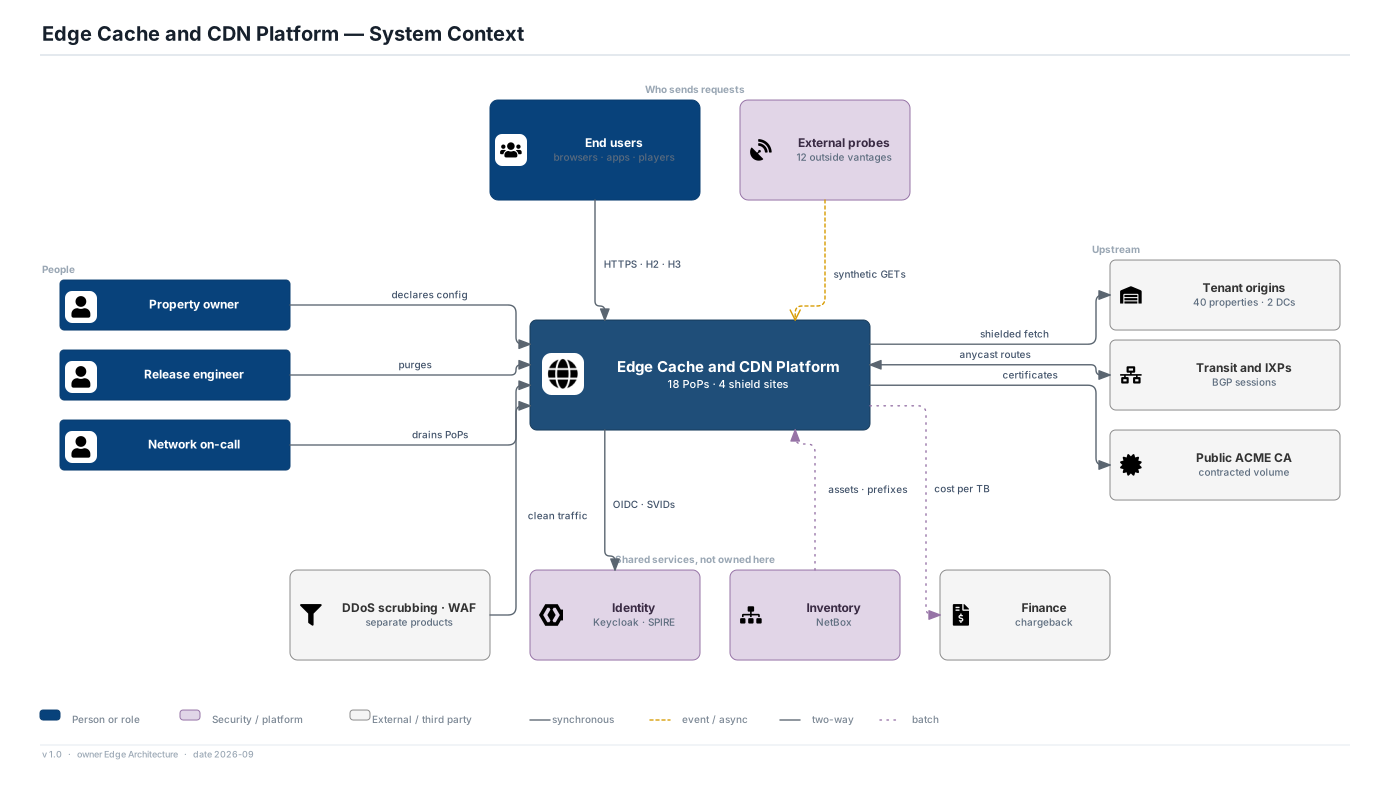
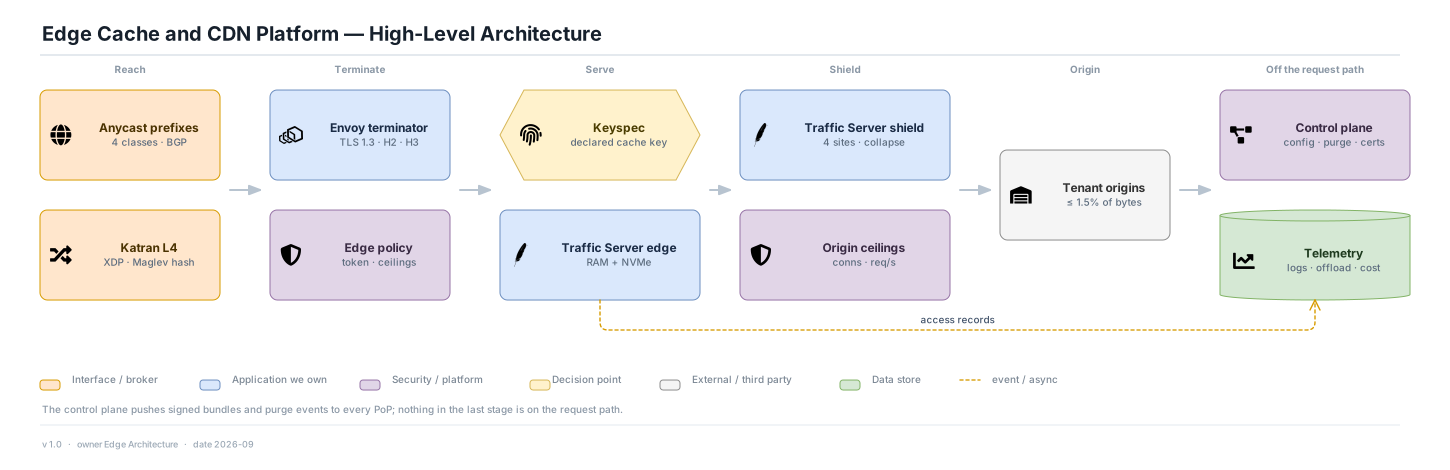
A content delivery platform built from open-source software on hardware the organisation owns: 18 points of presence announcing anycast prefixes, Envoy terminating TLS and HTTP/3, Apache Traffic Server caching in memory and on NVMe, four shield pools in front of the origins, and a control plane in two core data centres that is never on the request path. Read the set in order. Acts 1 and 2 fix the boundary and the people who depend on it. Act 3 shows the parts and the path of one request. Act 4 separates the four kinds of data and shows the cache key being built. Act 5 walks a flash crowd, a two-million-object purge, a returning PoP and a bad configuration. Acts 6 and 7 cover how it is run, what it costs and why it is safe to leave eighteen sites unattended. One decision governs every page: the cache key is a security boundary, declared by the property owner and never inferred from the origin.

1 · Context and scope

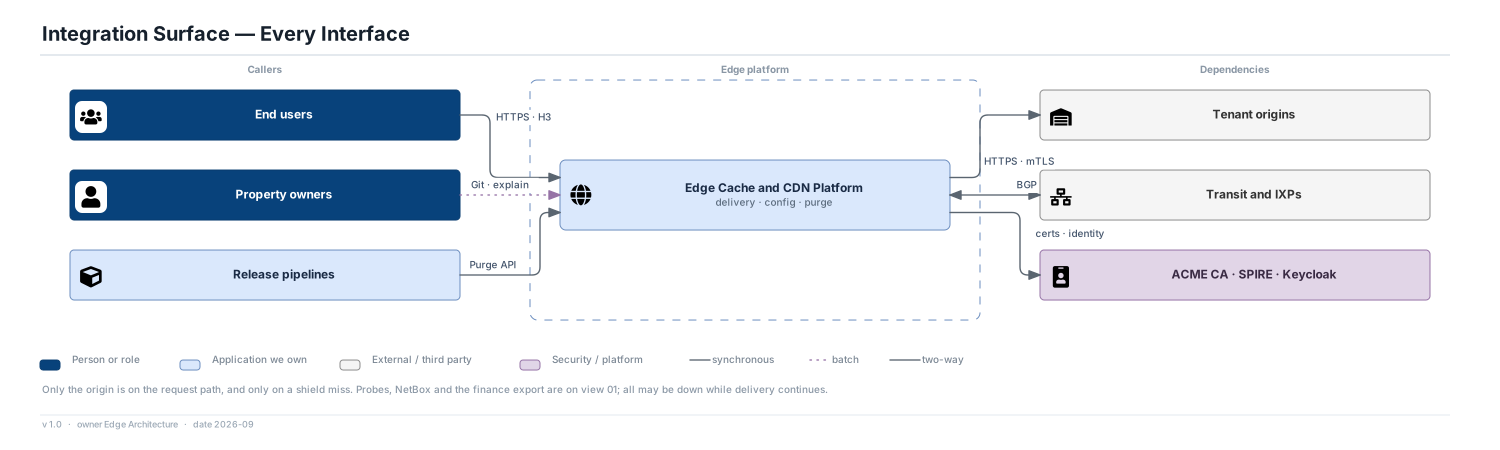
What the platform serves, what it sits between, and the shared services it uses but does not own.

2 · People and journeys

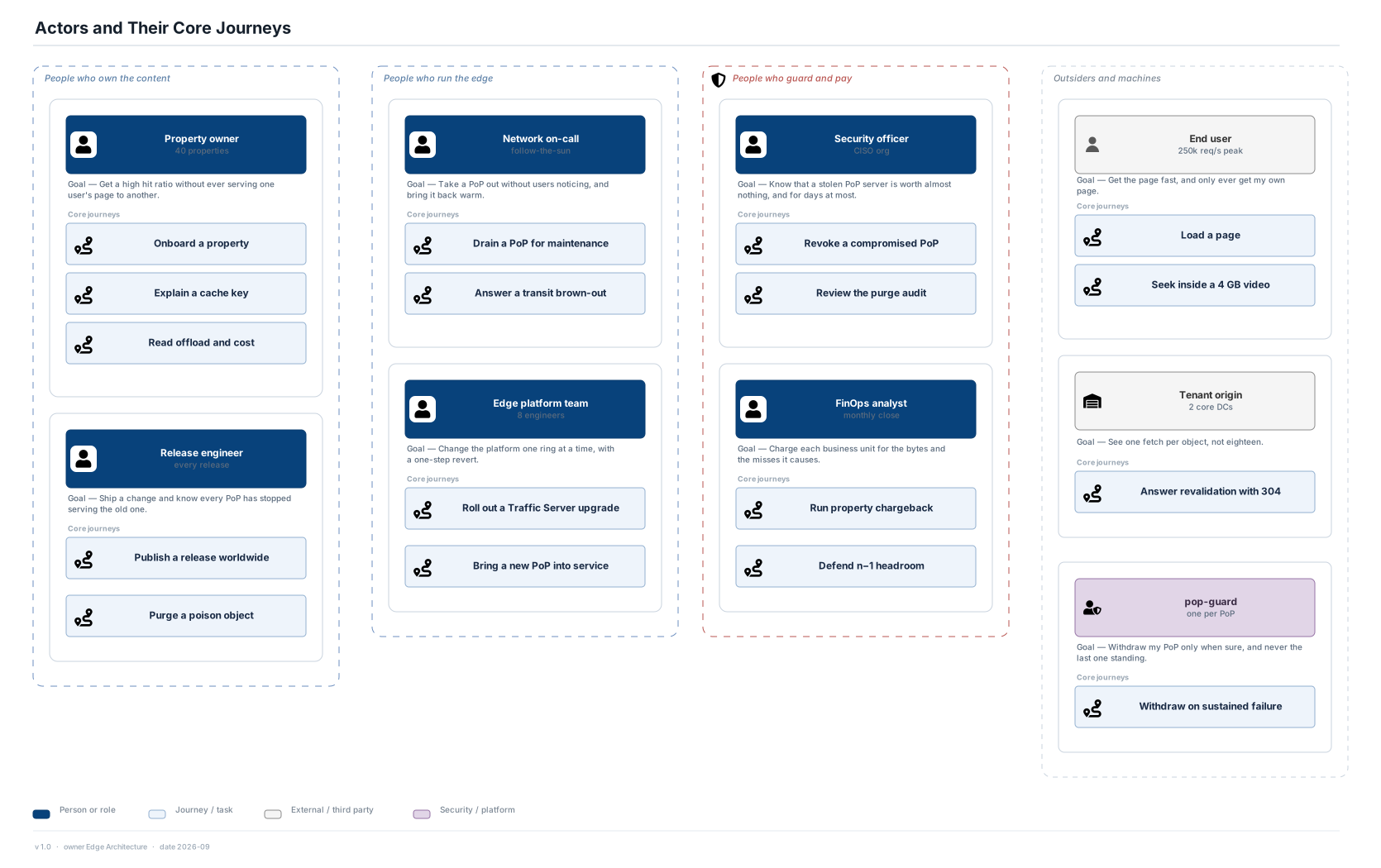
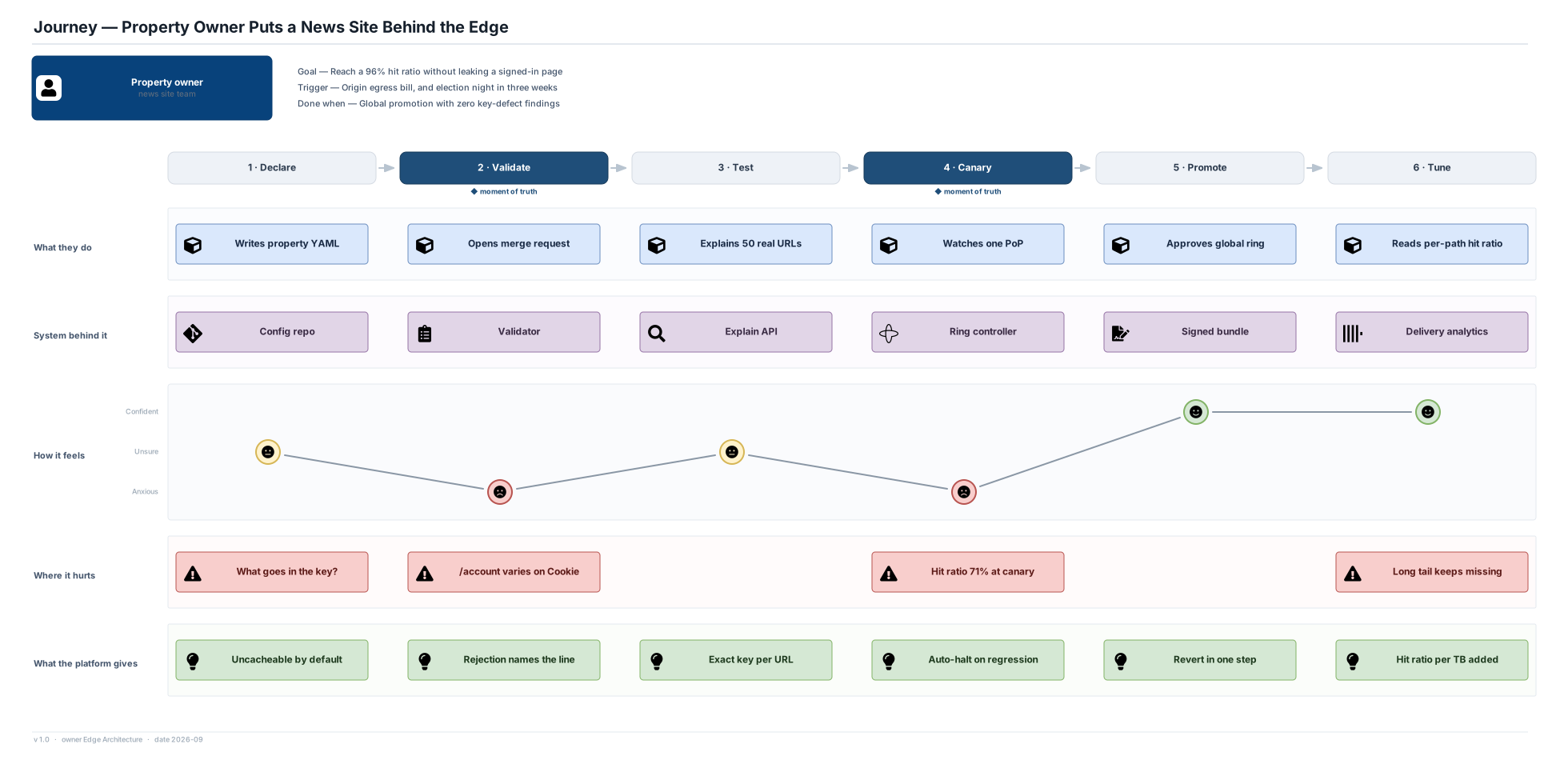
Who depends on the edge, what each of them needs from it, and the three moments where a CDN earns trust or loses it.
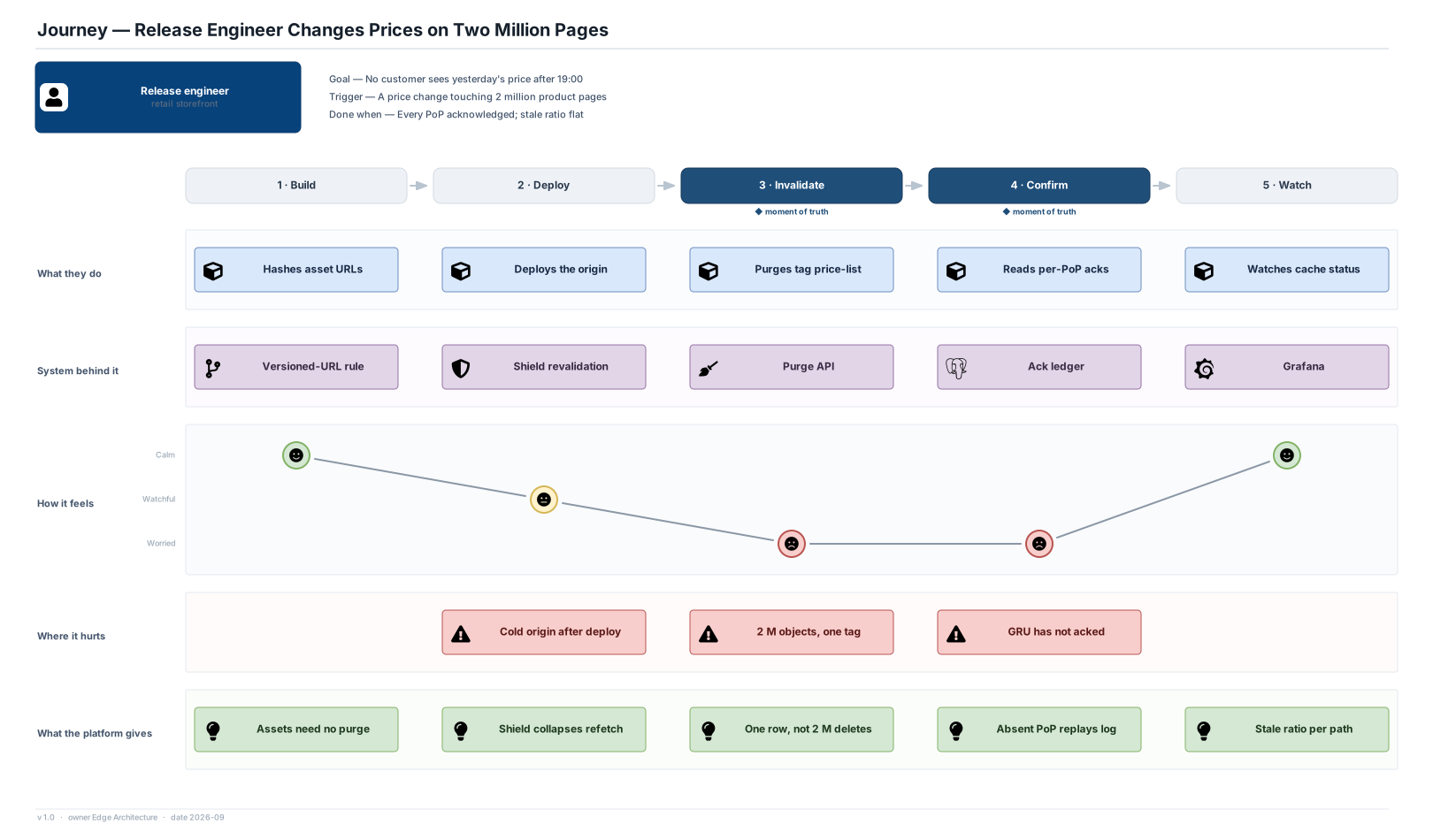
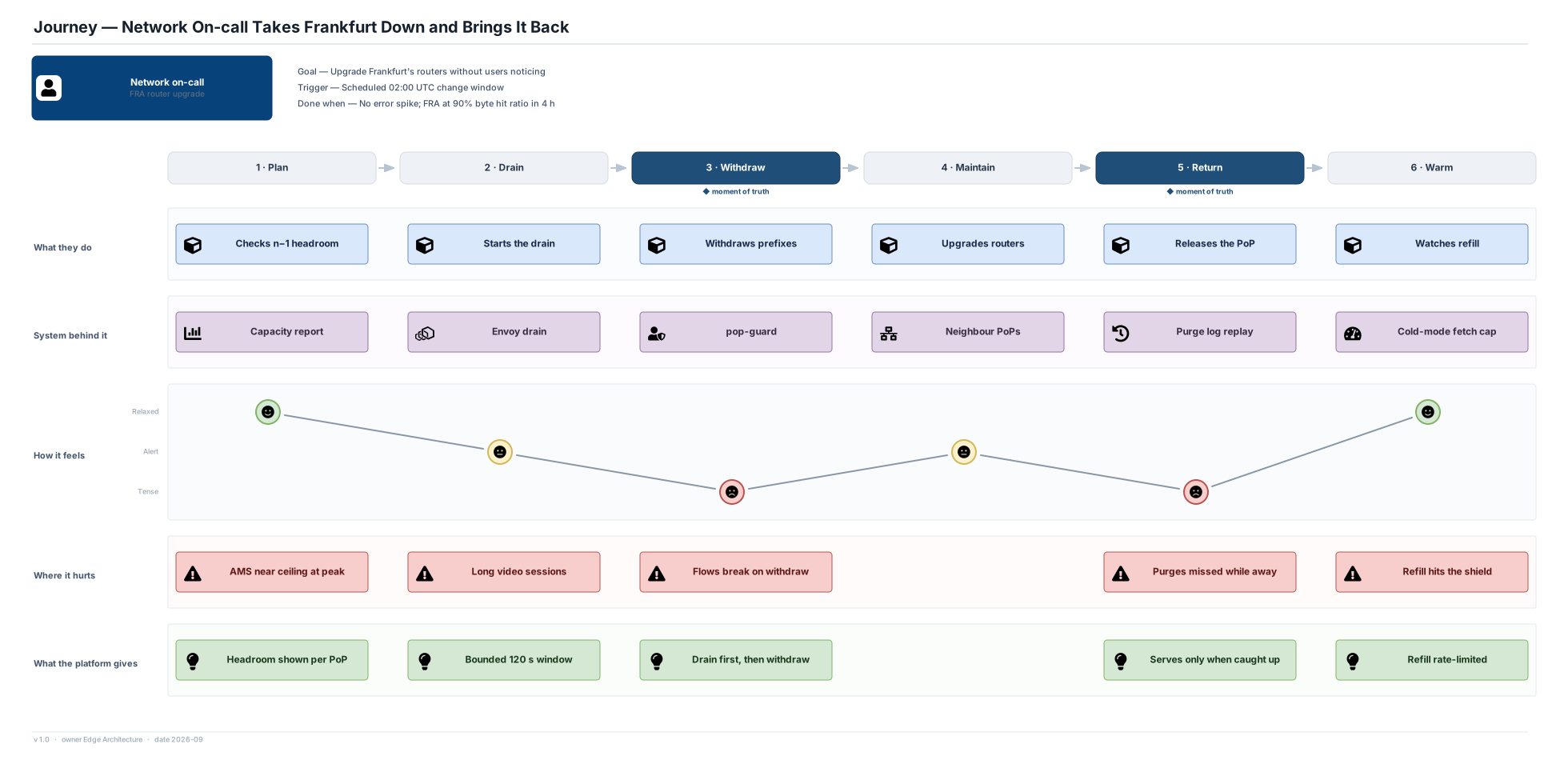
03 People who own the content Property owner 40 properties Goal — Get a high hit ratio without ever serving one user's page to another. Core journeys Onboard a property Explain a cache key Read offload and cost Release engineer every release Goal — Ship a change and know every PoP has stopped serving the old one. Core journeys Publish a release worldwide Purge a poison object People who run the edge Network on-call follow-the-sun Goal — Take a PoP out without users noticing, and bring it back warm. Core journeys Drain a PoP for maintenance Answer a transit brown-out Edge platform team 8 engineers Goal — Change the platform one ring at a time, with a one-step revert. Core journeys Roll out a Traffic Server upgrade Bring a new PoP into service People who guard and pay Security officer CISO org Goal — Know that a stolen PoP server is worth almost nothing, and for days at most. Core journeys Revoke a compromised PoP Review the purge audit FinOps analyst monthly close Goal — Charge each business unit for the bytes and the misses it causes. Core journeys Run property chargeback Defend n−1 headroom Outsiders and machines End user 250k req/s peak Goal — Get the page fast, and only ever get my own page. Core journeys Load a page Seek inside a 4 GB video Tenant origin 2 core DCs Goal — See one fetch per object, not eighteen. Core journeys Answer revalidation with 304 pop-guard one per PoP Goal — Withdraw my PoP only when sure, and never the last one standing. Core journeys Withdraw on sustained failure Actors and Their Core Journeys Person or role Journey / task External / third party Security / platform v 1.0 · owner Edge Architecture · date 2026-09 Actors and Their Core Journeys Nine actors in four groups, each with the one thing they need from the edge, and the journeys that need the most care. HTML page SVG draw.io

3 · Structure

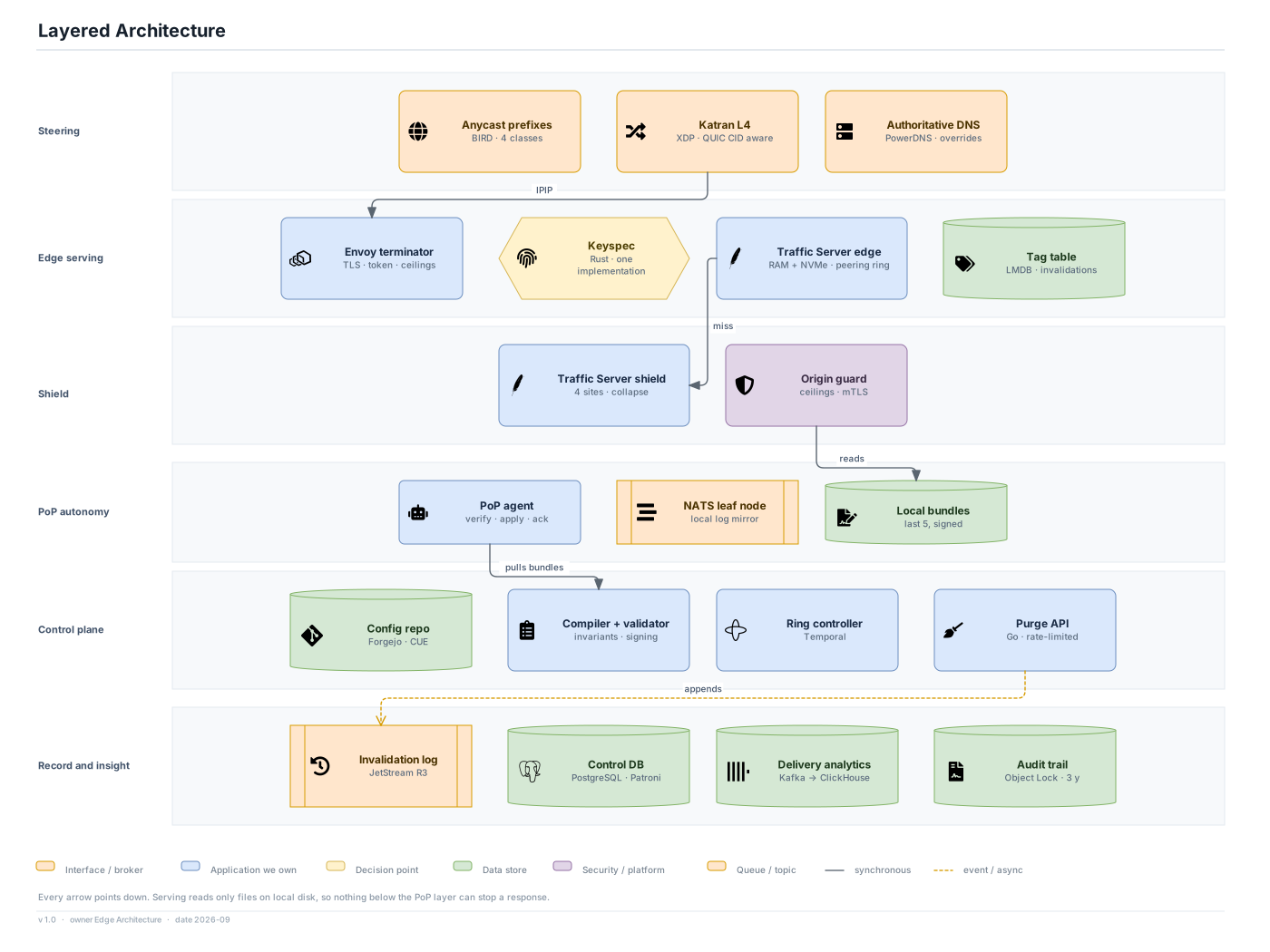
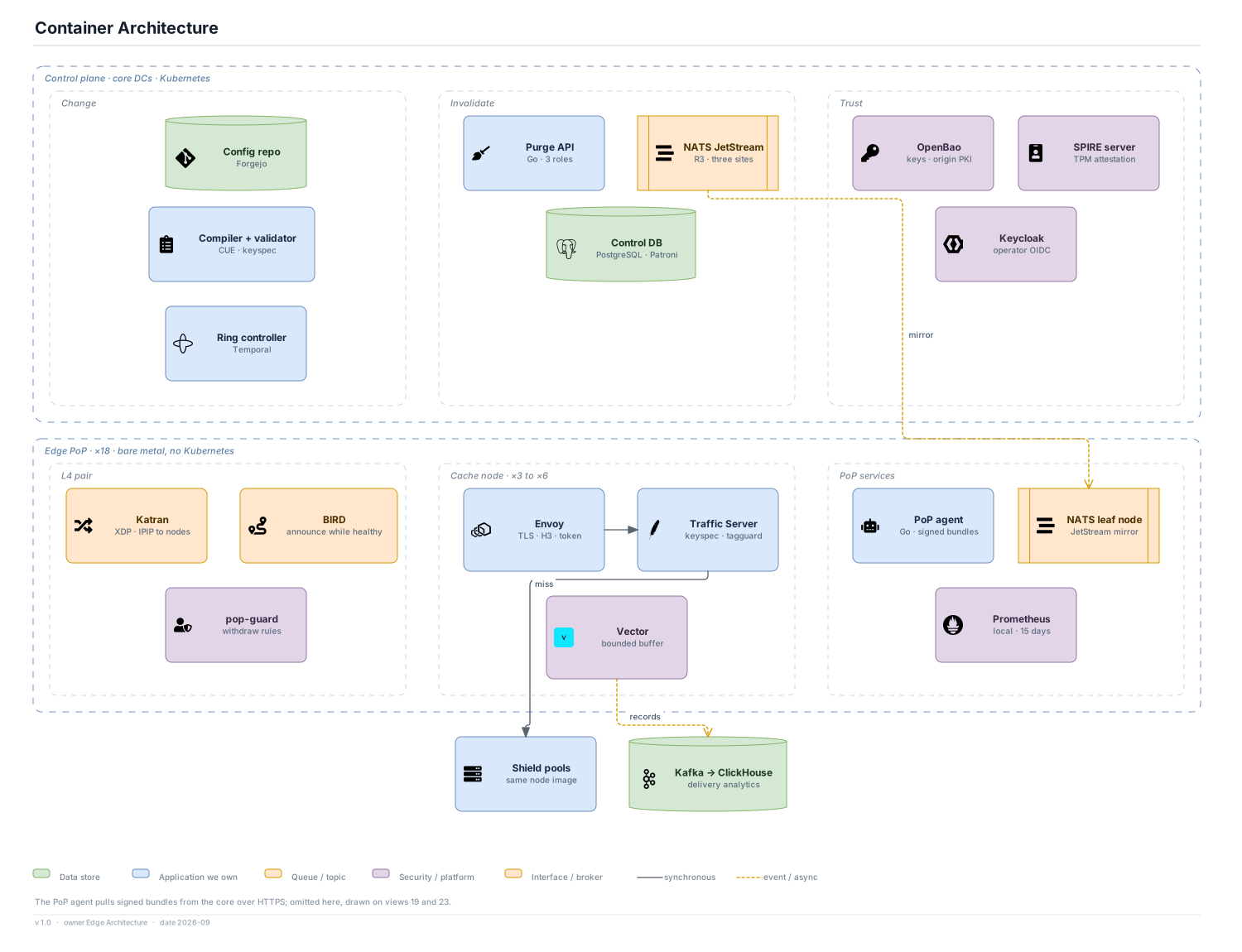
The layers, the processes on a PoP and in the core, the path of one request through one node, and every interface.

4 · Data

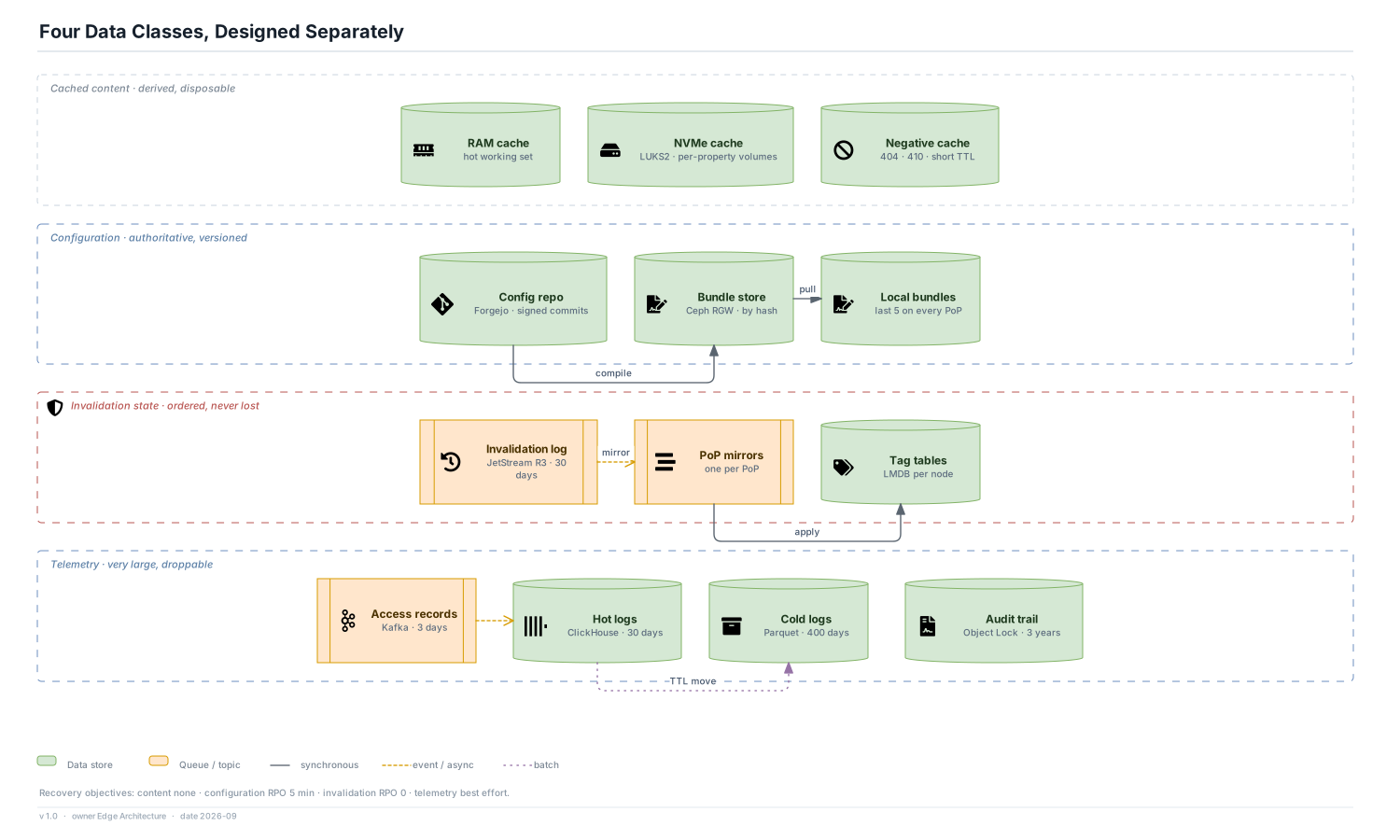
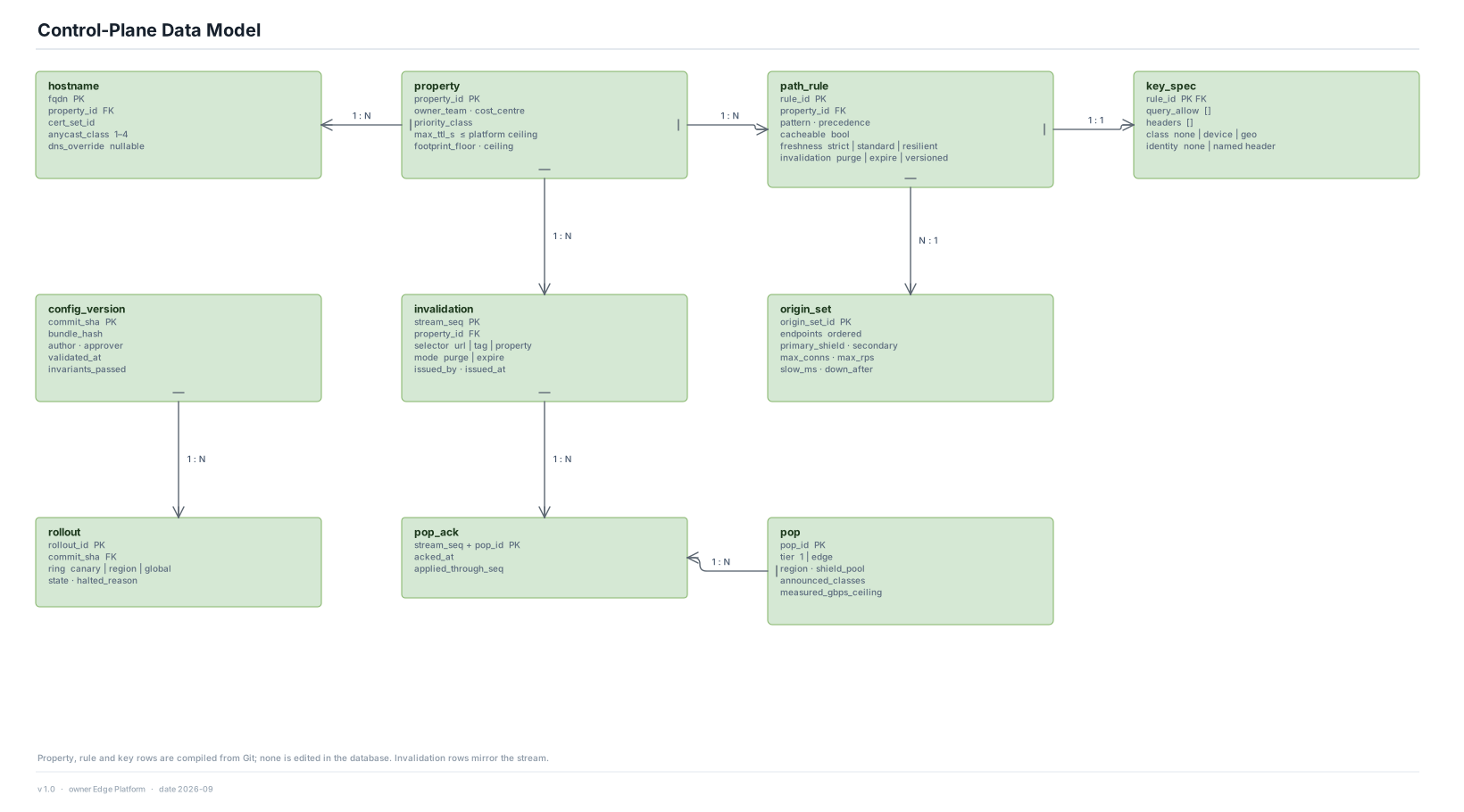
Four data classes with four different recovery objectives, the control-plane model, how a request becomes a key, and where the access records go.

5 · Runtime

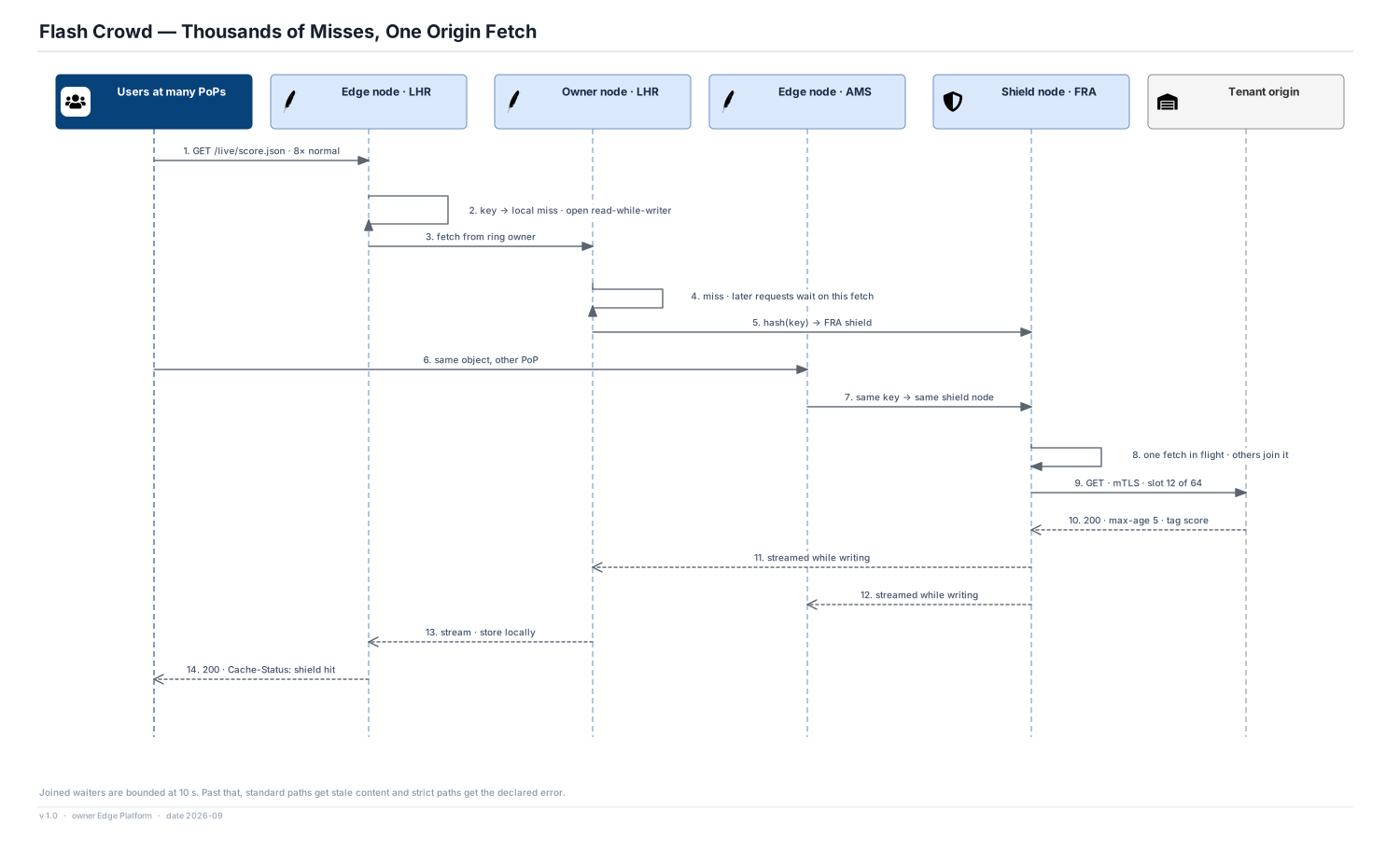
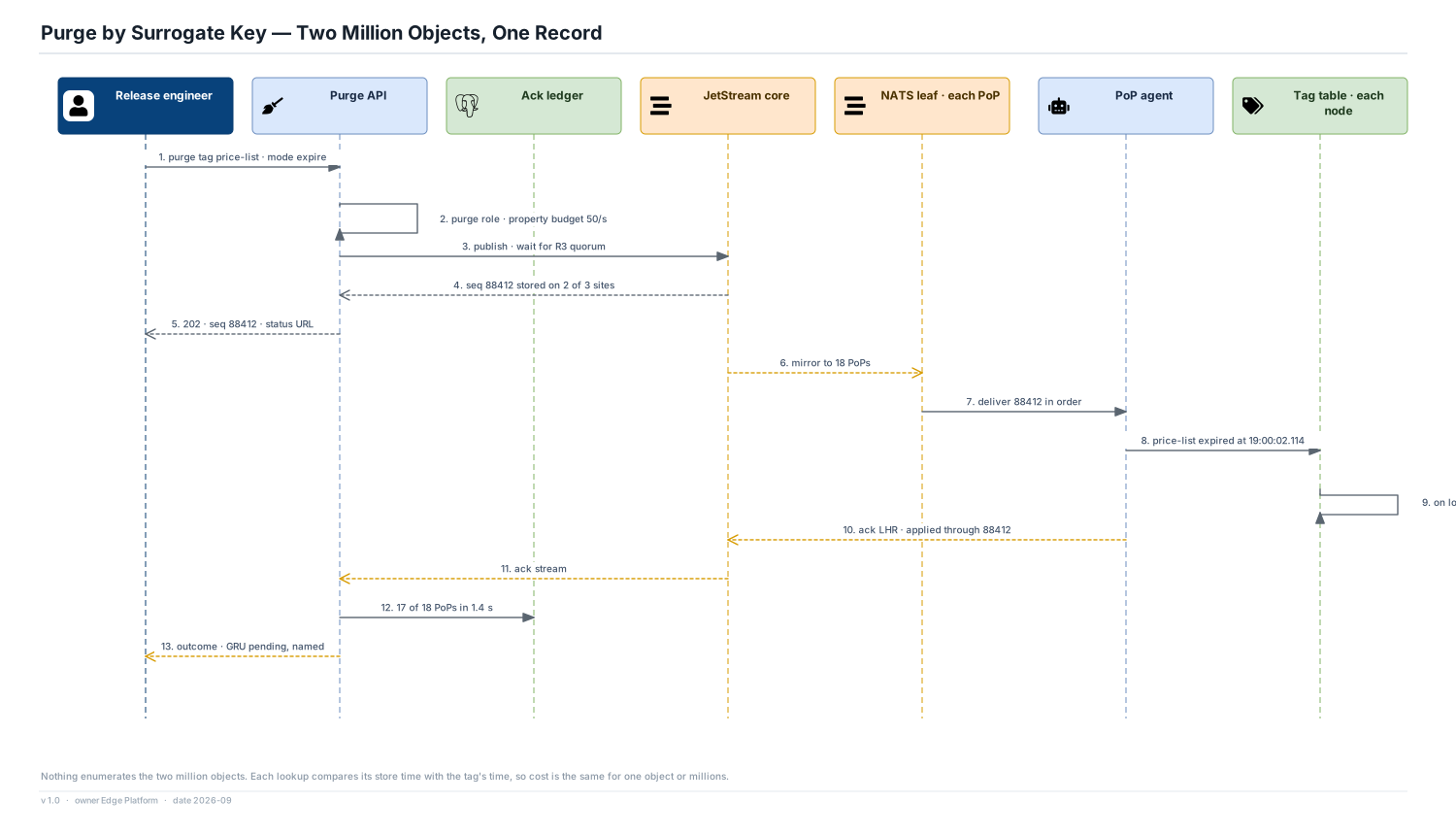
A flash crowd, a purge of two million objects, a PoP that was away, what each freshness class serves, and a configuration change that gets halted.

6 · Operations

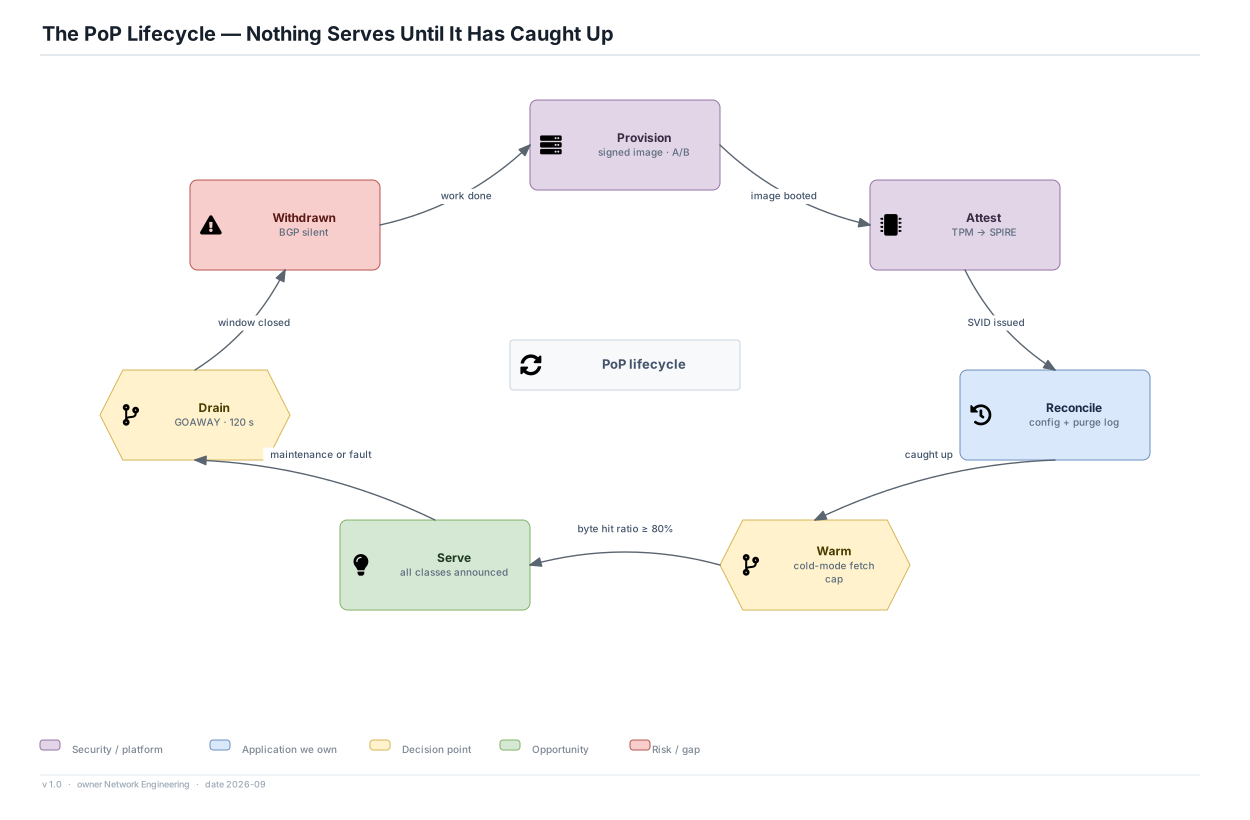
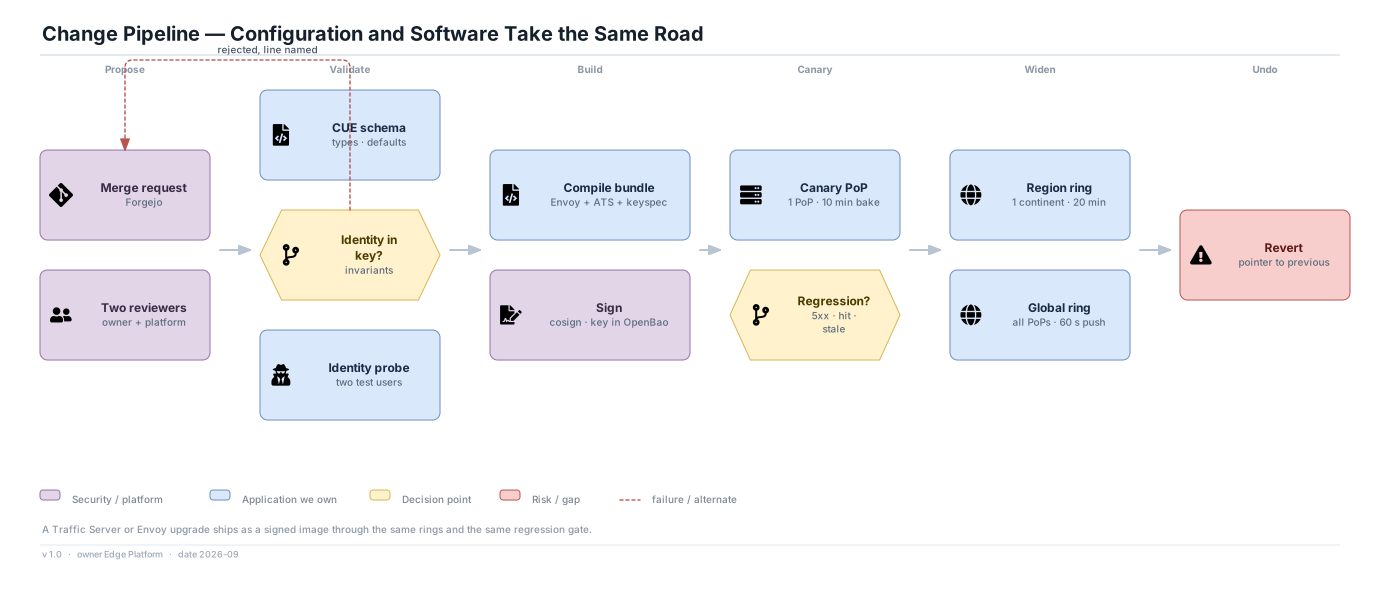
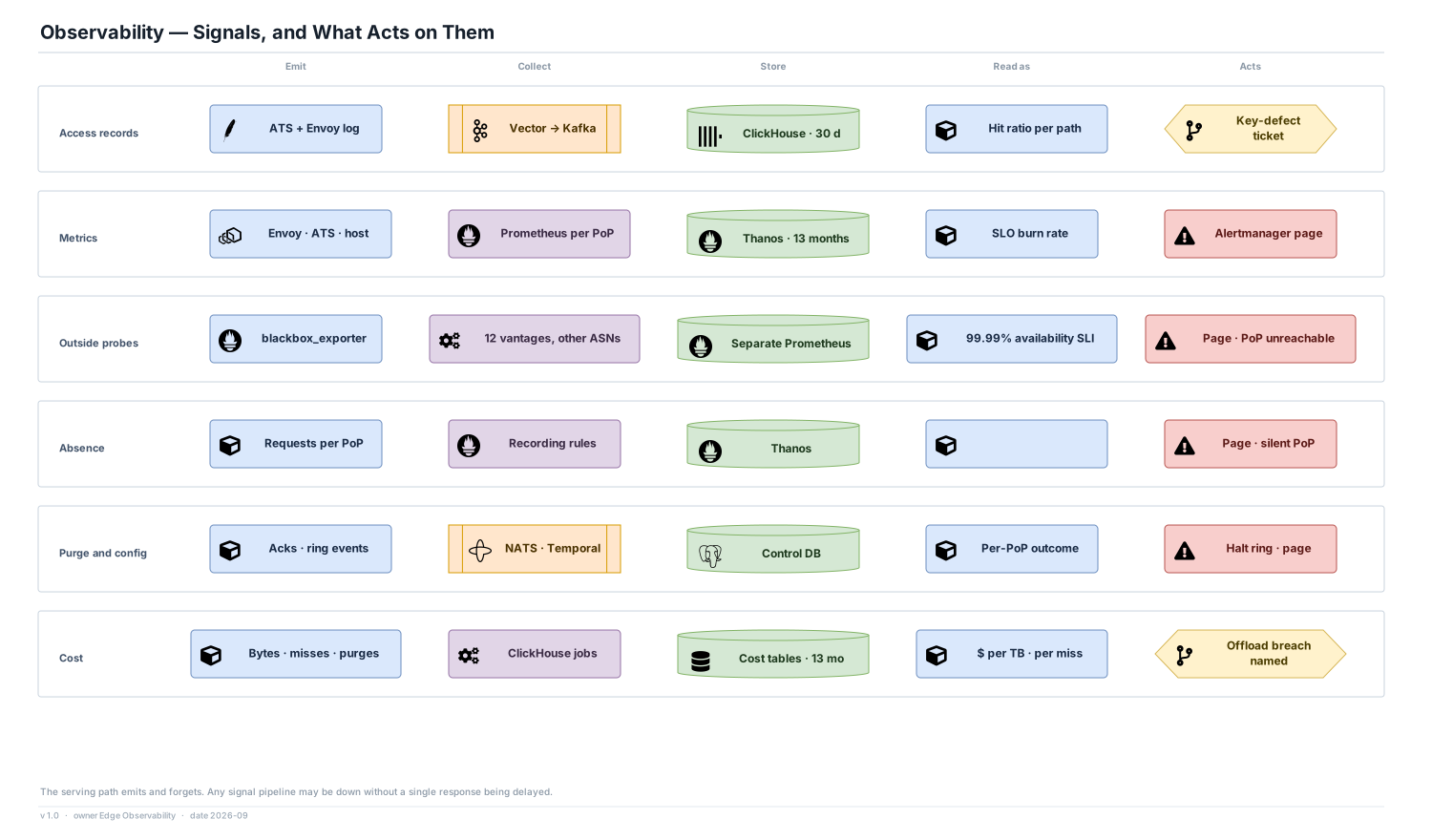
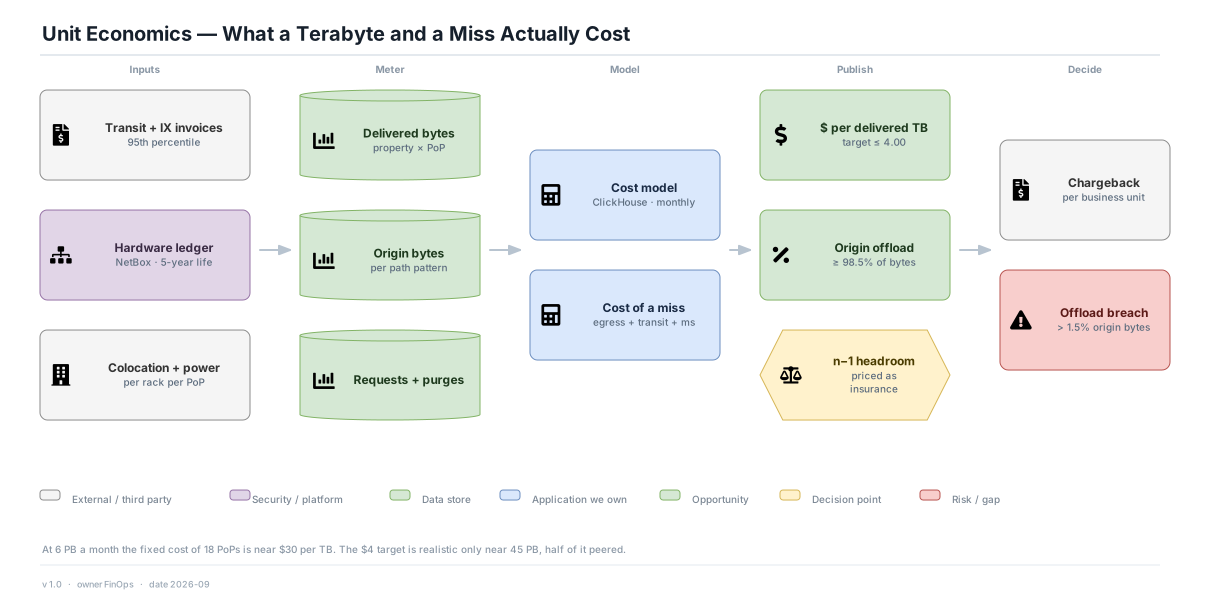
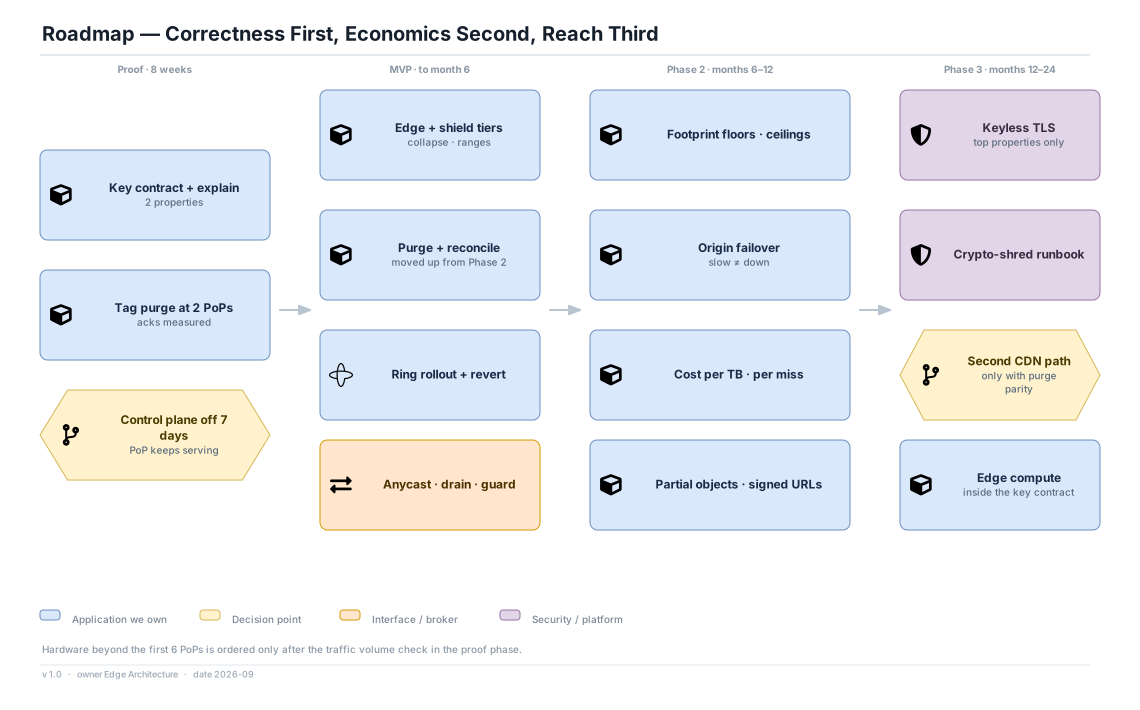
Where it runs, how traffic is steered, the life of a PoP, how changes ship, what is watched, what a terabyte costs, and the build order.

7 · Assurance

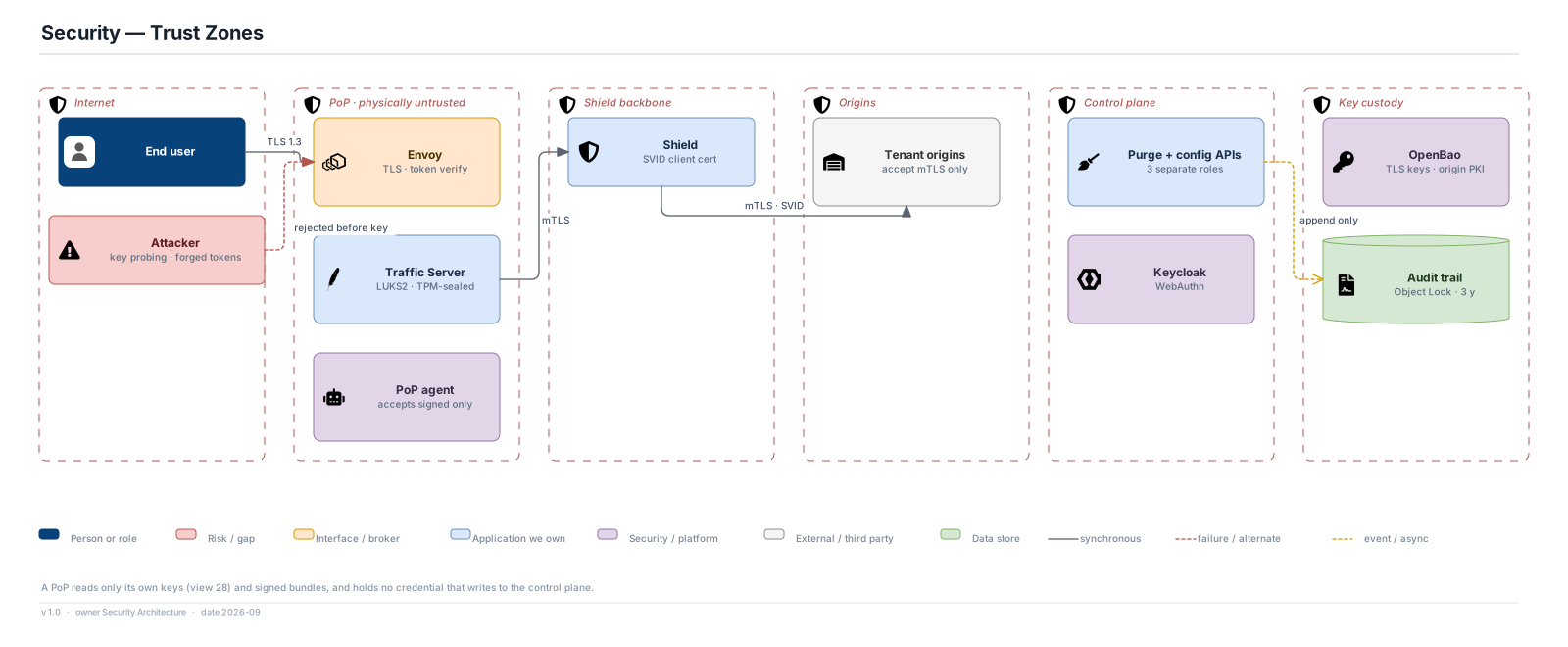
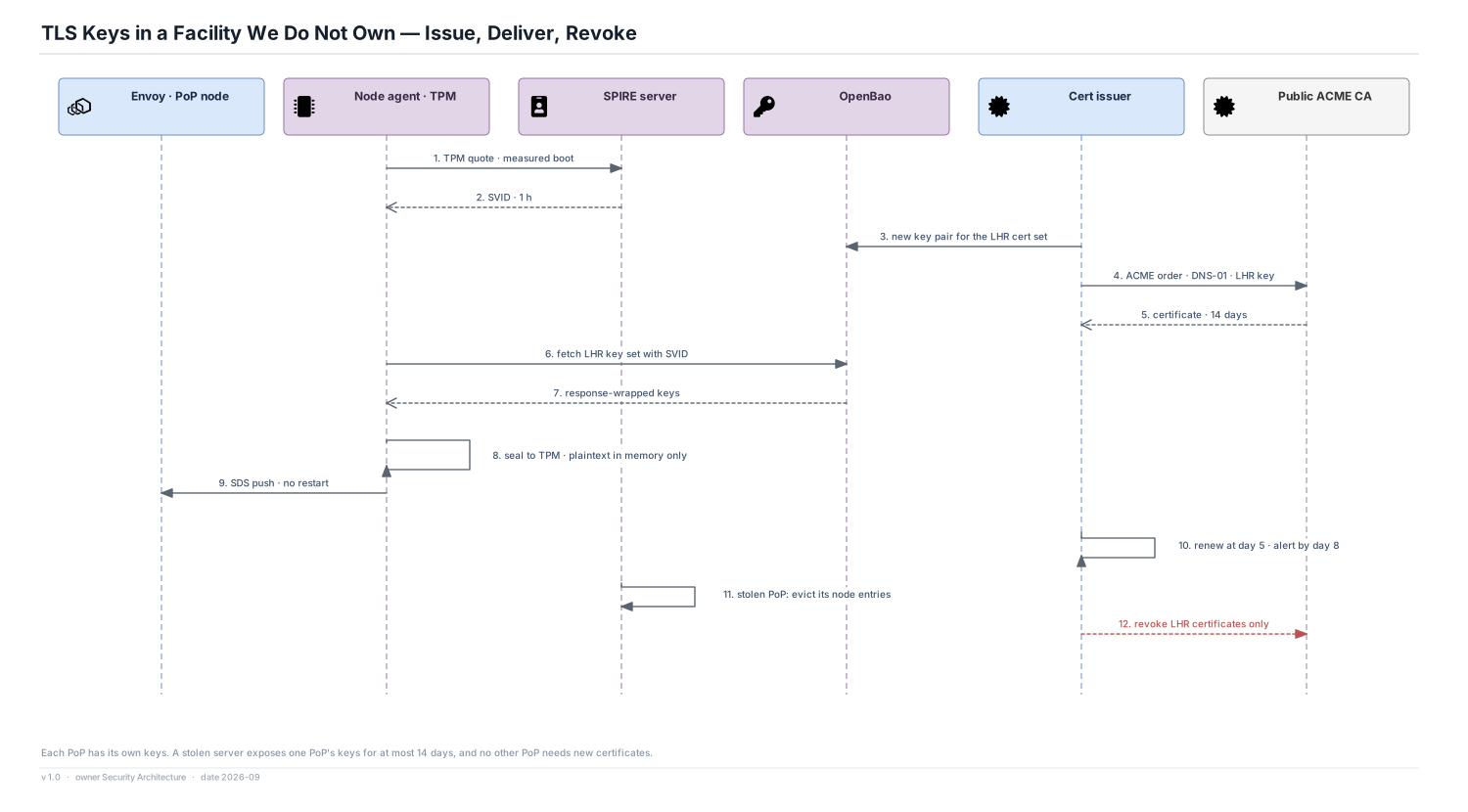
Trust zones, private keys in facilities the organisation does not own, and every named failure with what contains it.
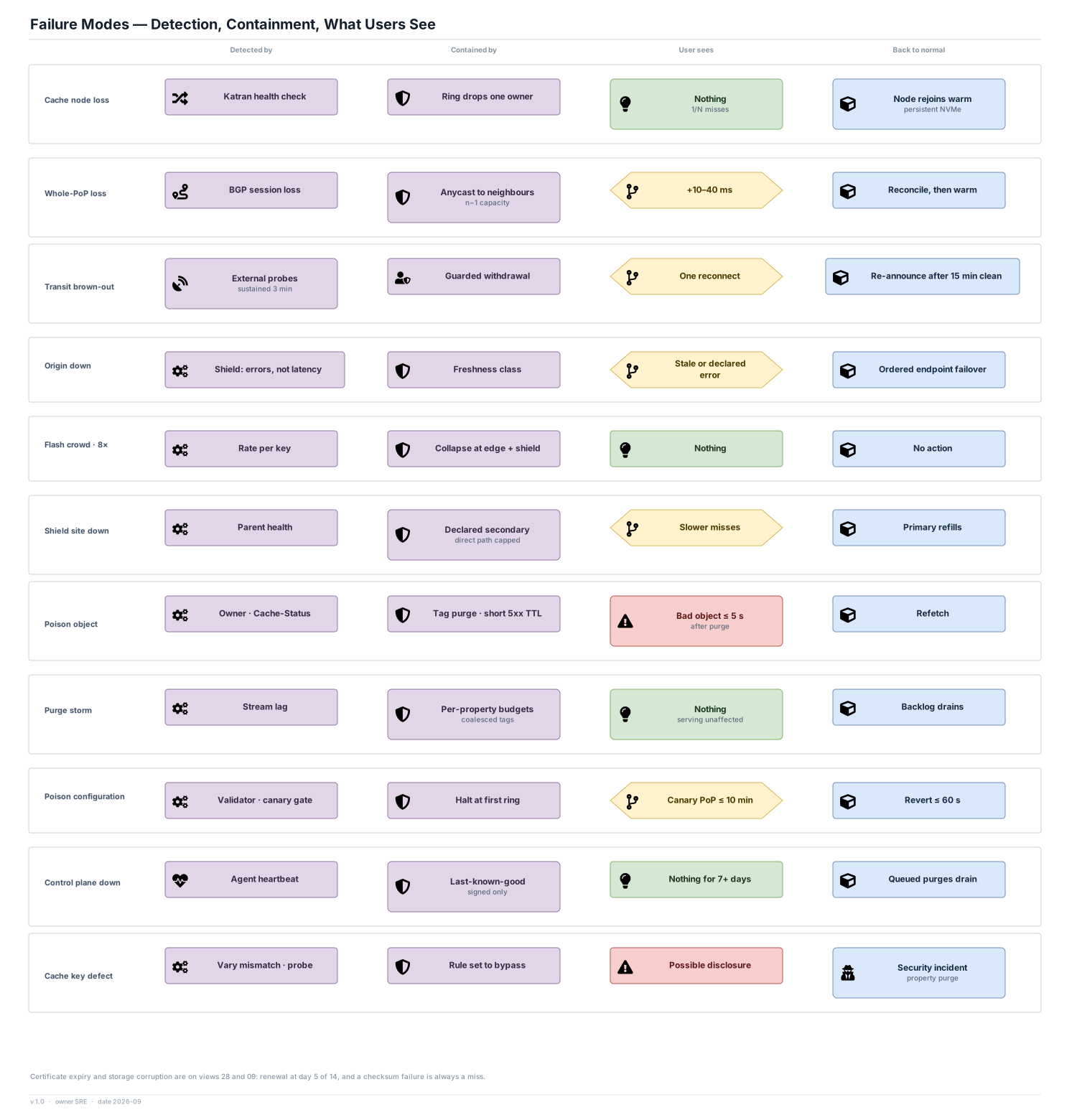
29 Detected by Contained by User sees Back to normal Cache node loss Katran health check Ring drops one owner Nothing 1/N misses Node rejoins warm persistent NVMe Whole-PoP loss BGP session loss Anycast to neighbours n−1 capacity +10–40 ms Reconcile, then warm Transit brown-out External probes sustained 3 min Guarded withdrawal One reconnect Re-announce after 15 min clean Origin down Shield: errors, not latency Freshness class Stale or declared error Ordered endpoint failover Flash crowd · 8× Rate per key Collapse at edge + shield Nothing No action Shield site down Parent health Declared secondary direct path capped Slower misses Primary refills Poison object Owner · Cache-Status Tag purge · short 5xx TTL Bad object ≤ 5 s after purge Refetch Purge storm Stream lag Per-property budgets coalesced tags Nothing serving unaffected Backlog drains Poison configuration Validator · canary gate Halt at first ring Canary PoP ≤ 10 min Revert ≤ 60 s Control plane down Agent heartbeat Last-known-good signed only Nothing for 7+ days Queued purges drain Cache key defect Vary mismatch · probe Rule set to bypass Possible disclosure Security incident property purge Failure Modes — Detection, Containment, What Users See Certificate expiry and storage corruption are on views 28 and 09: renewal at day 5 of 14, and a checksum failure is always a miss. v 1.0 · owner SRE · date 2026-09 Failure Modes The requirement's named failures: how each is detected, what contains it, what a user sees and how service returns to normal. HTML page SVG draw.io

Architecture One-Pager

The problem, the shape of the answer, the decisions that carry it, and why it should still be the right shape in ten years.

A cache hit is a claim that a stored response is the correct answer for this request. The cache key is the whole content of that claim. This architecture is built around getting the key right, and around everything that becomes cheap once it is.

Delivery platforms are sold on latency, but what they are worth is the origin traffic they prevent. Both come from the same mechanism: a request answered from a nearby cache instead of a distant origin. The failure that matters most does not show up on a latency graph. It is a hit on the wrong key: one user's signed-in page served to thousands of strangers, from cache, at line rate, with every metric green. The estate here is 18 points of presence on four continents, 40 properties belonging to business units of one organisation, 250,000 requests per second at peak and 900 million cacheable objects, all on open-source software and hardware the organisation operates itself. The job is not only to serve bytes quickly. It is to serve only correct bytes, make the origin see a small and predictable fraction of the traffic, make a content change visible everywhere within seconds with proof, and keep working when anything outside the PoP is down.

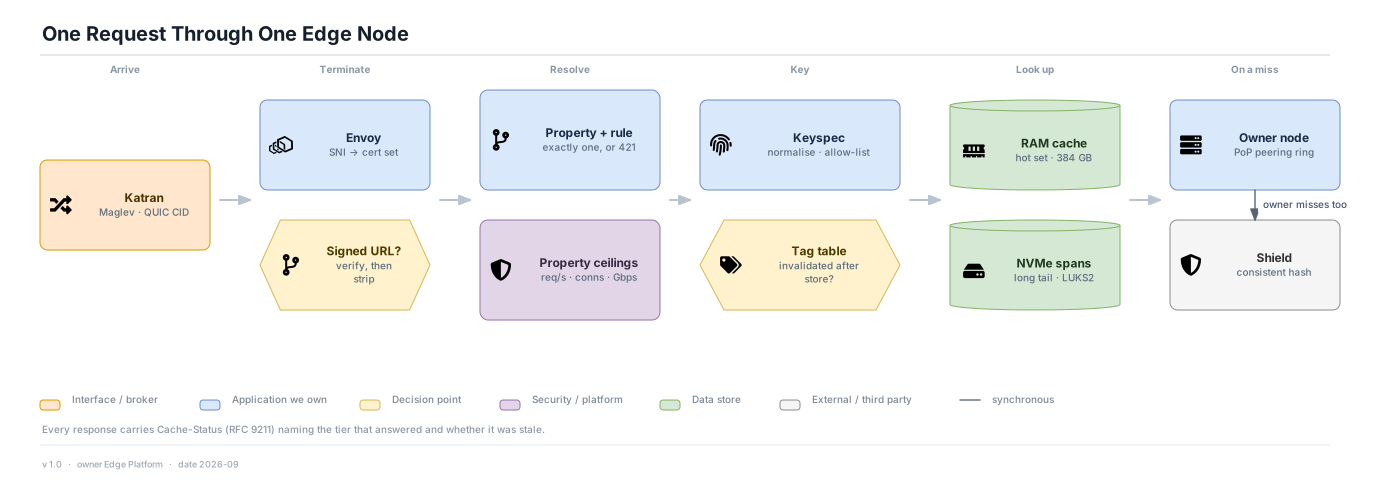
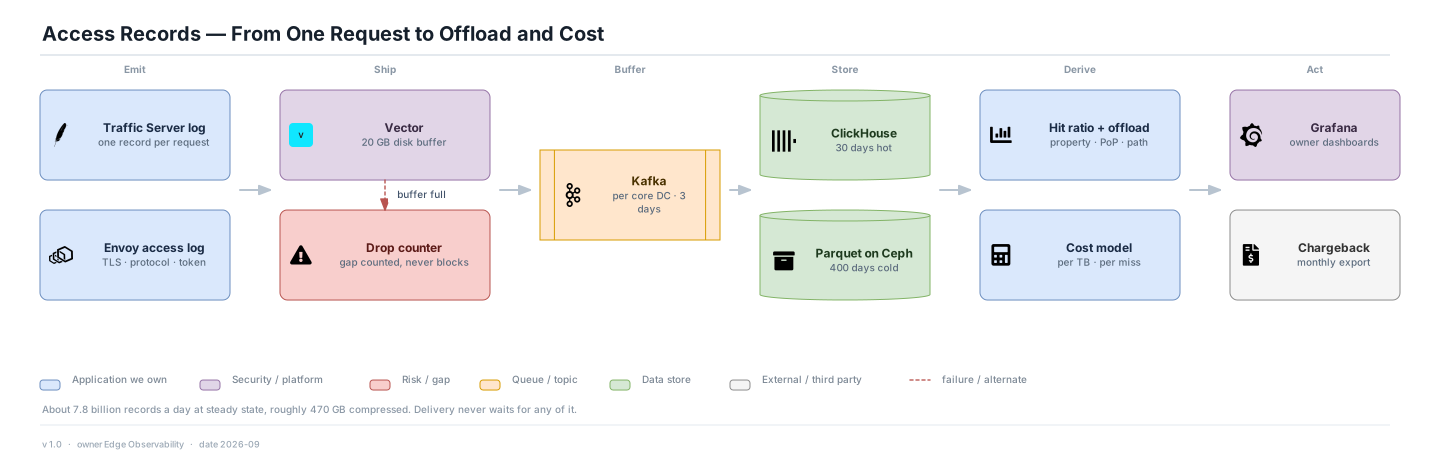
Each PoP announces four anycast prefix classes through BIRD. Katran spreads connections across cache nodes using consistent hashing that understands QUIC. On each node, Envoy terminates TLS 1.3, HTTP/2 and HTTP/3, verifies signed URLs and enforces per-property ceilings, then passes the request over loopback to Apache Traffic Server. Traffic Server builds the key with keyspec, a small Rust library that follows the property's declared rules and nothing else. It checks the tag table for invalidations, then serves from memory or NVMe. A miss goes to the node that owns the key in the PoP's ring, then to one of four shield pools placed next to the origins, where concurrent fetches collapse into one and per-origin ceilings are enforced. Property configuration lives in Git, is validated with CUE, invariant checks and a two-user identity probe, compiled into signed bundles and rolled out one ring at a time by a Temporal workflow that halts itself on a regression. Purges are records in a NATS JetStream log mirrored into every PoP. A purge is applied by timestamp comparison, so it costs the same for one object or two million, and each PoP's acknowledgement is recorded. Access records go through Vector and Kafka into ClickHouse, where hit ratio, offload and cost per terabyte are computed per property and per path pattern. None of the control or telemetry systems is on the request path.

What it is, and what it is not

A cache whose key is declared per path and checked before releasea cache that trusts whatever Vary header the origin happens to send.
A platform that measures itself by origin bytes avoideda platform that measures itself by bytes served or requests answered.
Eighteen PoPs that hold nothing authoritativeeighteen sites with data to back up, replicate or recover.
A purge that reports which PoPs applied ita purge API that returns 200 and hopes.
PoPs that keep serving for weeks with the control plane gonean edge that needs its control plane to answer a request.
Edge caching, shielding, invalidation and steeringWAF, DDoS scrubbing, video packaging or edge compute, which are separate products or later phases.

The decisions that are the architecture

01The key is declared, not inferred

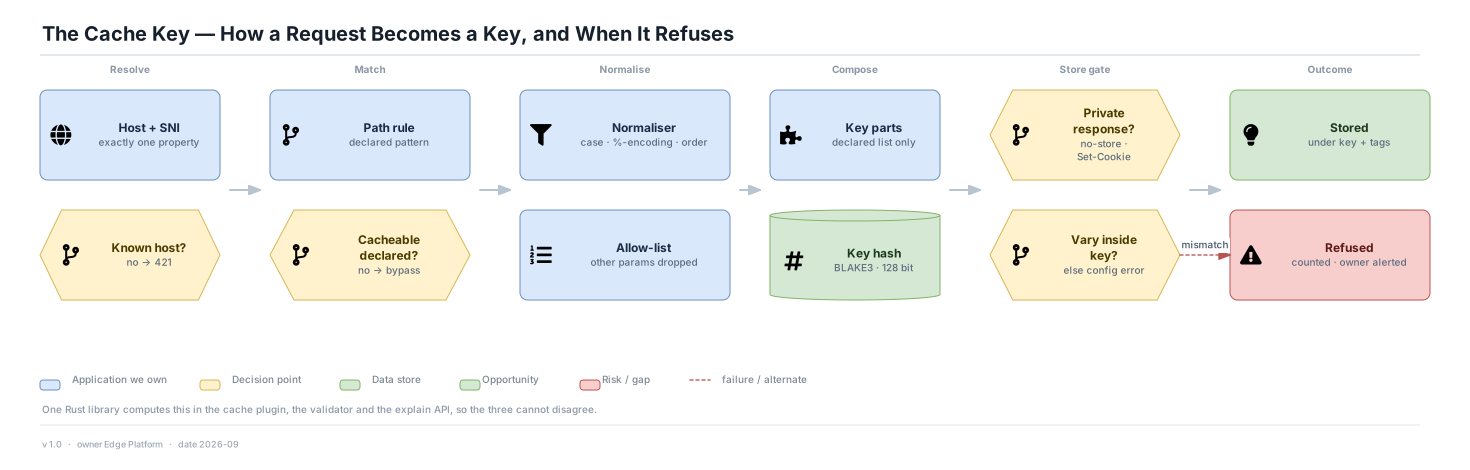
Every path pattern declares exactly what enters its key. Nothing is cacheable until declared, and an origin Vary outside the declared key stops the object being stored and alerts the owner.

ADR-01

02One key implementation

The same Rust library computes the key in the cache plugin, the validator and the explain API. The tool an owner uses to check a key cannot disagree with production.

ADR-02

03Prove identity before release

Validation fetches declared test URLs as two users. A path whose response changes with the user cannot become cacheable under a key that leaves the user out.

ADR-04

04Invalidate by time, not by enumeration

A purge is one row: tag, time, mode. A lookup compares the object's store time with it. Two million objects cost the same as one, and serving never waits for a purge.

ADR-13

05A purge has an outcome

Invalidations are an ordered, replicated log mirrored into every PoP. Each PoP records how far it has applied, and a returning PoP catches up before it announces.

ADR-14

06One fetch per object per shield

Misses hash to a shield node next to the origin, and requests collapse at the node, the PoP and the shield. Origin load follows how often content changes, not how many users arrive.

ADR-10

07The PoP depends on nothing beyond itself

PoPs apply only signed bundles, keep the last five on disk and serve on the last good one indefinitely. Control plane, logs and analytics may all be down while delivery continues.

ADR-21

08Keys that expire before they matter

Each PoP holds its own 14-day certificates, sealed to its TPM. A stolen server is revoked alone, and its keys are useless within days whatever happens to revocation.

ADR-24

Why this holds up over time

Delivery platforms usually age badly in one of four ways. The cache engine is replaced and every property's behaviour quietly changes with it. The organisation decides to buy the edge instead of running it, and the configuration and purge semantics turn out to be tied to one product. The object count grows past what the purge or index design assumed. Or a vendor changes its licence and a core component has to be replaced under pressure. The design defends against each of these on purpose.

The central rule comes from HTTP, not from a product

A declared key, not-cacheable by default, and refusing private responses are expressed in HTTP caching semantics (RFC 9111), Cache-Status (RFC 9211) and surrogate keys. They were right for proxy caches twenty years ago and will be right for whatever replaces Traffic Server. The property owner's declaration is the lasting asset, not the engine that reads it.

Configuration is compiled, so the engine can change underneath it

Owners write engine-neutral YAML. A compiler turns it into Envoy and Traffic Server configuration today. Moving to another engine, or to a commercial CDN's configuration API, means writing a new compiler back end and replaying the ring rollout, not rewriting 40 properties by hand.

The key is pinned by tests, not by memory

Because one library computes the key everywhere, its behaviour is fixed by a corpus of real requests and expected keys. A new engine or a new team inherits the exact key semantics by linking the library or passing the corpus.

Nothing at the edge needs migrating

Cached content is derived and disposable, so hardware generations, storage technologies and even the cache engine can be changed one PoP at a time with a cold start as the only cost. There is no data to move and no recovery objective to protect during a migration.

Costs that do not grow with object count

Invalidation by timestamp comparison, per-node LMDB tables bounded by the TTL ceiling and hashed ownership inside a PoP mean that going from 900 million to 2 billion objects lowers the hit ratio at the margin but does not change a single design element.

Standard protocols at every seam

BGP, HTTP/3 and QUIC, ACME, SPIFFE, OIDC, the S3 API, the Kafka protocol and Prometheus exposition sit between the components. Any single product can be replaced without its neighbours noticing, which is what keeps a ten-year platform from becoming a ten-year dependency.

Governance risk is named, with an exit for each

Components are chosen for open governance where it exists: Apache, CNCF, Linux Foundation. OpenBao was chosen over Vault after Vault's licence change showed what a single-vendor project can do. Where one company leads, such as Katran, NATS, Temporal, ClickHouse and Vector, the record names the fallback: IPVS with Maglev, Kafka, plain workers with PostgreSQL, Parquet on Ceph, Fluent Bit.

The platform carries its own evidence

Per-node capacity, hit ratio per path, cost per terabyte, cost per miss and the cost of n−1 headroom are published every month. Whoever re-decides these choices in five years starts from measurements, not from this document.

Non-functional targets

Targets from the requirement, and the mechanism that meets each one. Every latency, throughput and cost figure is replaced by a measured value in the proof phase and republished monthly.

QualityTargetHow it is metView
Delivery availability ≥ 99.99% monthly, measured from outside Anycast across 18 PoPs with n−1 regional capacity; guarded automatic withdrawal; success rate measured by probes in 12 external networks 24
Purge API · control plane ≥ 99.95% · ≥ 99.9% Purge API on Kubernetes in two core DCs behind a JetStream quorum across three sites; configuration pipeline allowed to be slower to recover because PoPs keep serving 20
Cache-hit TTFB p50 ≤ 15 ms · p95 ≤ 45 ms · p99 ≤ 120 ms Hot set in 384 GB of RAM per node, NVMe long tail, loopback hop between Envoy and Traffic Server, PoPs within the latency radius of most users 09
Shield hit ≤ 60 ms p95 added, same continent Shield pools at IAD, DFW, FRA and LHR next to the origins; Asia and South America over budget by construction and reported separately 02
TLS handshake p95 ≤ 25 ms resumed · ≤ 80 ms full TLS 1.3 and QUIC terminated at the PoP with local keys; hourly session-ticket key rotation per PoP; no keyless round trip on the handshake path 28
Cache effectiveness ≥ 96% requests · ≥ 92% bytes · offload ≥ 98.5% bytes Declared allow-lists, intra-PoP ownership ring, shield convergence, conditional revalidation end to end, hit ratio published per path pattern 13
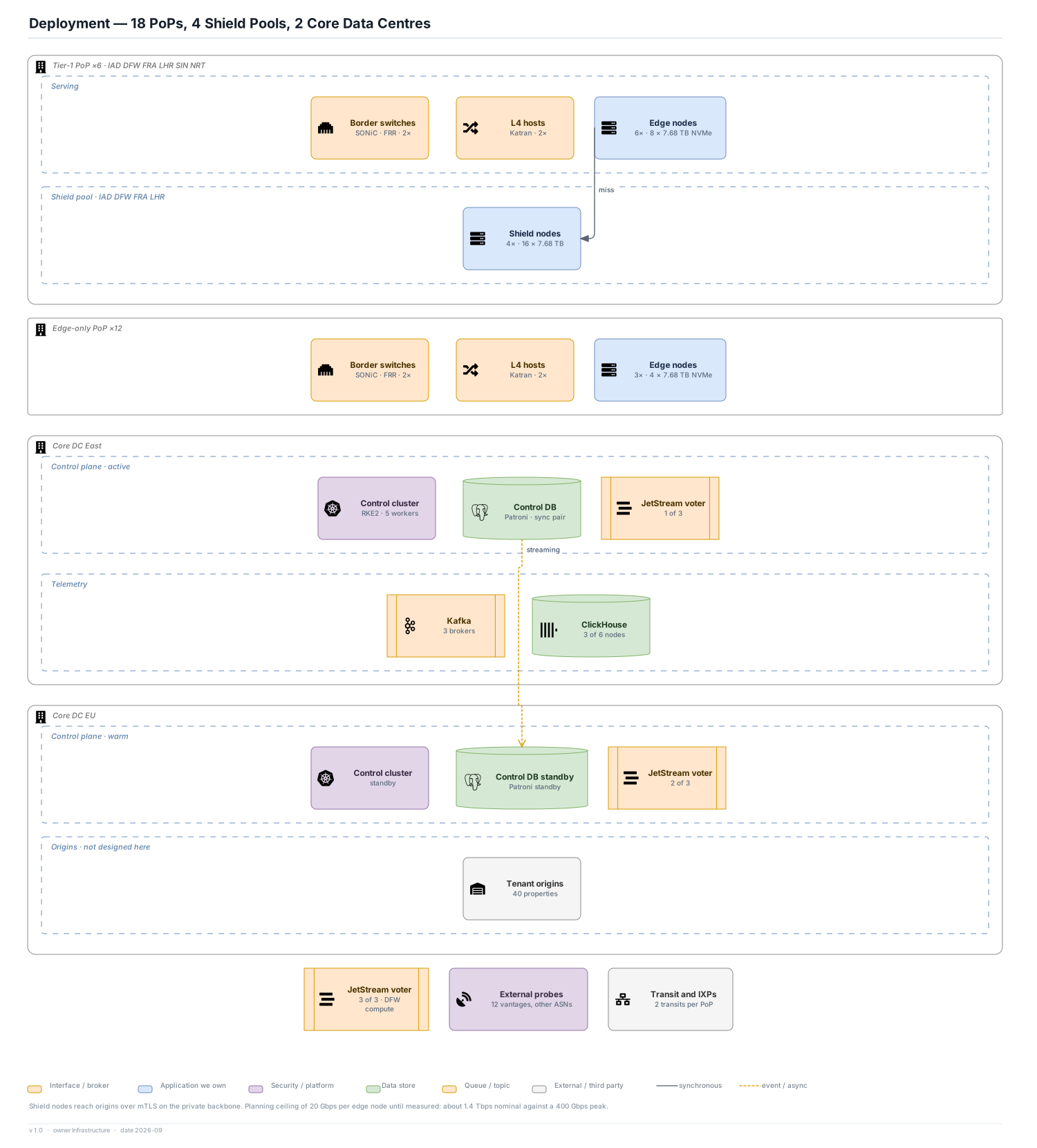
Throughput 250k req/s · 400 Gbps peak · 2× without redesign 72 edge nodes at a 20 Gbps planning ceiling (about 1.4 Tbps nominal), added a node or a PoP at a time; per-node ceiling measured before capacity plans use it 20
Flash crowd 8× one property for 90 s, no origin impact Read-while-writer collapsing at node, PoP ring and shield; TTL jitter; per-origin connection ceilings at the shield 15
Invalidation 99% of PoPs ≤ 5 s p95 · ≤ 30 s p99, including 2 M objects One JetStream record per purge, mirrored to leaf nodes, applied as a timestamp in LMDB, acknowledged per PoP 16
Configuration All PoPs ≤ 60 s p95 per ring · halt ≤ 30 s · revert ≤ 60 s Signed bundles pulled on notification; Temporal ring controller watching per-path hit ratio; revert switches to a bundle already on disk 19
Control-plane loss No delivery effect for ≥ 7 days Last-known-good bundles on disk; 14-day certificates renewed at day 5; purges queue in JetStream and drain on recovery 29
Cold start ≥ 90% of steady byte hit ratio within 4 h Persistent NVMe cache survives restarts; cold mode caps shield fetch concurrency at 25% until 80% byte hit ratio 22
Recovery objectives Content: none · config RPO 5 min, RTO 30 min · invalidation RPO 0 Content is derived; configuration in Git plus Patroni with a streaming standby; invalidations acknowledged only after quorum on two of three sites 11
Correctness Zero responses under a key that omits a varying dimension Declared keys, refusal of private responses, Vary mismatch blocks storage, identity probe before release, key defect handled as a security incident 13
Cost ≤ $4.00 per delivered TB · origin bytes ≤ 1.5% Cost model per property and PoP; offload breaches named by path pattern; hardware beyond six PoPs gated on measured volume, since the target only holds near 45 PB a month 25

Scope

In scope

  • Anycast addressing, L4 balancing and steering for 18 PoPs on four continents
  • TLS, HTTP/2 and HTTP/3 termination with per-property certificates and per-PoP keys
  • Declared cache keys, validation, the explain tool and the test path
  • Edge caching in memory and on NVMe, partial objects and range requests
  • Four shield pools with collapsing, per-origin ceilings and origin mTLS
  • Purge by URL, surrogate key and property, with per-PoP acknowledgement and reconciliation
  • Versioned configuration, ring rollout, automatic halt and revert
  • Access records, hit ratio and offload per path pattern, external probes, cost per terabyte

Explicitly out of scope

  • Origin application design, beyond the conditional-request and mTLS contract they are asked to meet
  • WAF, bot management and DDoS scrubbing as products; the edge enforces its own ceilings only
  • Edge compute and personalisation, which are Phase 3 and must extend the key contract when they come
  • Video packaging, transcoding and DRM
  • Peering and transit commercials, beyond consuming their measured cost

The eight-week proof

The proof does not try out every feature. It tests the properties everything else depends on: a key that cannot leak, a purge whose outcome is known, a PoP that keeps serving when everything else is gone, and a monthly traffic volume that justifies running the edge at all.

  1. Two real properties onboarded with declared keys, the explain API and the identity probe, reviewed by a security engineer trying to make one leak
  2. Two PoPs (FRA and IAD) with Katran, Envoy and Traffic Server, one shield pool, measured per-node Gbps ceiling at TLS
  3. Tag table plugin with JetStream mirror, measured purge acknowledgement across the Atlantic
  4. Signed bundles with a ring controller that halts on a staged hit-ratio regression
  5. Traffic mirrored from the current delivery path for four weeks to measure real monthly volume and peak-to-average ratio
  • Switch the control plane off for seven days; the PoPs keep serving, certificates stay valid, purges queue and then drain
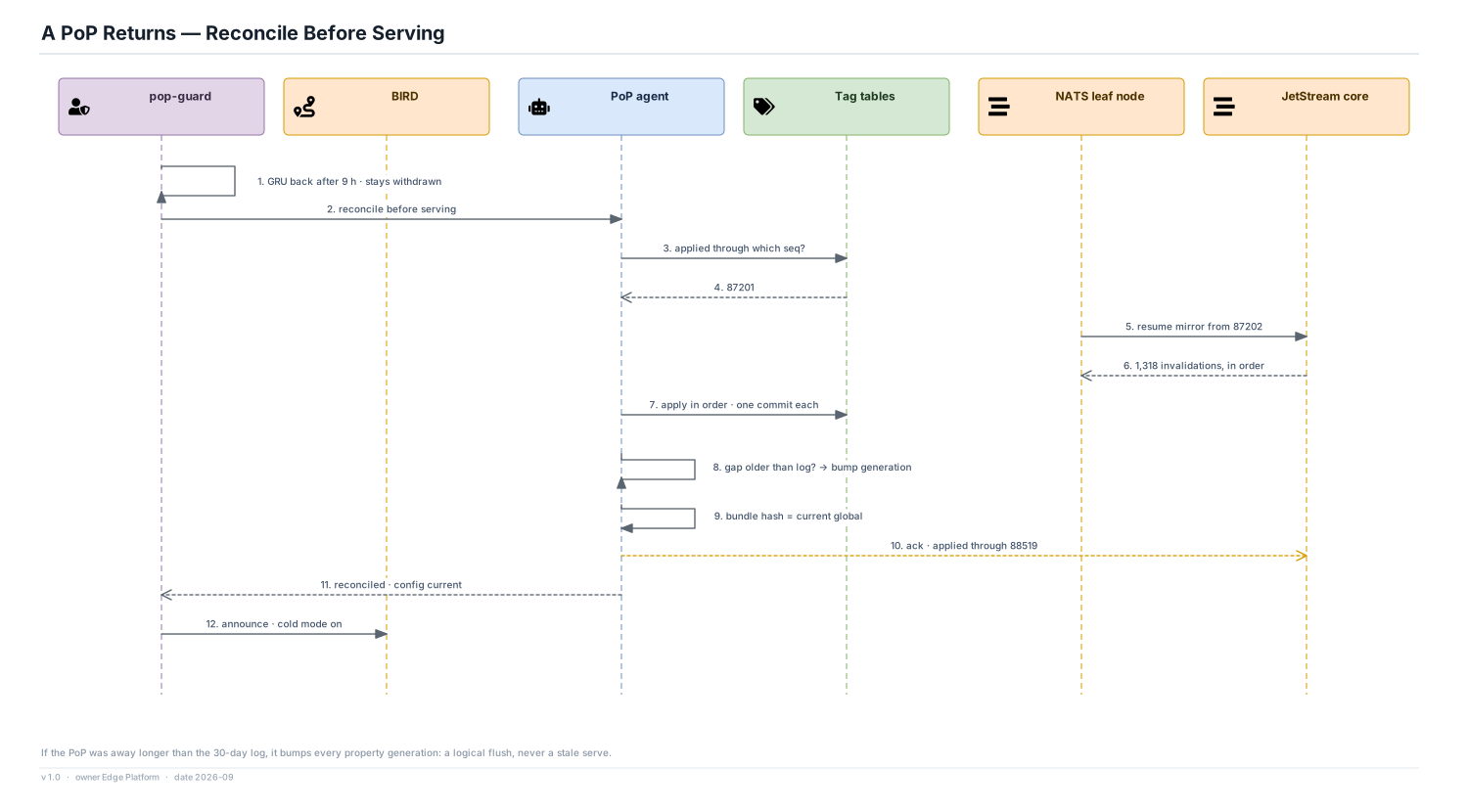
  • Withdraw one PoP for nine hours, issue 1,000 purges, bring it back and prove it serves nothing stale
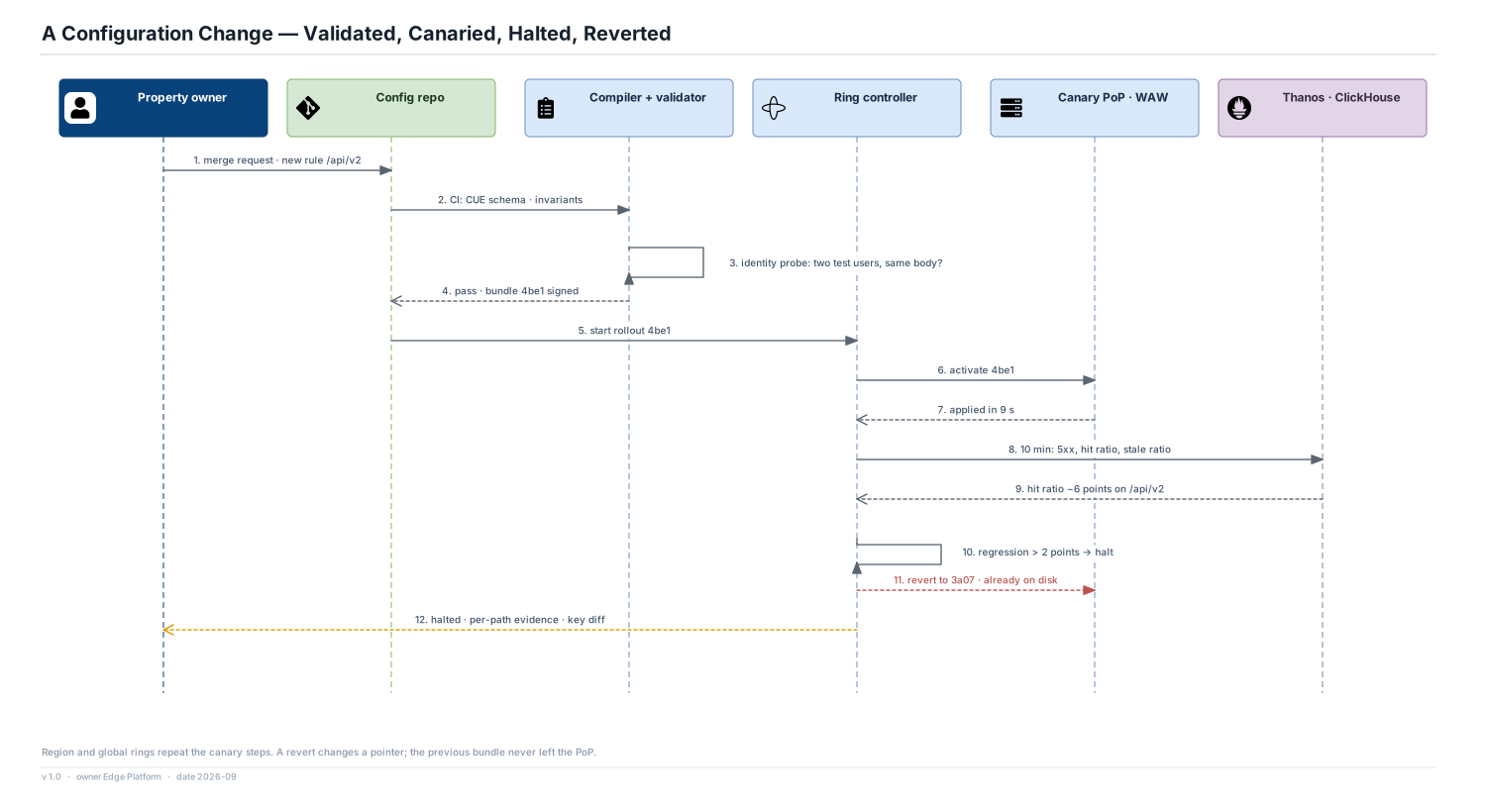
  • Push a rule that fragments the cache; the canary halts and reverts without a person deciding
  • Send Vary: Cookie from an origin whose rule excludes cookies; the object is refused and the owner alerted

Open risks, carried rather than hidden

RiskIf it landsResponse
The traffic figures in the requirement are inconsistent At 6 PB a month the estate costs about $30 per TB, not $4, and a commercial CDN is cheaper Measure real volume in the proof phase; order hardware beyond six PoPs only after that; treat buying the edge as a valid outcome (ADR-28, ADR-29)
Asia and South America shield hits exceed 60 ms Slower misses for those edges; p95 TTFB unaffected while their miss share stays low Reported separately; a regional shield pool at SIN is prepared and triggered by measured miss share (ADR-10)
Five product behaviours are unconfirmed Peering ring, lookup status override, QUIC-LB IDs, 14-day leaf replay or ACME volume may not work as assumed Each is a named proof-phase test with a fallback: full replication per node, native purge with longer budget, ECMP without QUIC stickiness, full flush on return, commercial CA contract
Identity probe coverage depends on owners' test URLs A property with poor test URLs gets weaker pre-release protection Minimum test URL count per rule enforced by CUE; Vary-mismatch and Set-Cookie refusal alerts in production as the second line (ADR-04)
Running BGP at 18 sites needs network engineering on call A misconfigured announcement can withdraw or hijack traffic at internet scale Steering intent compiled and ringed like property config; pop-guard's never-the-last-PoP rule; RPKI ROAs for every prefix; network on-call staffed before go-live (ADR-18, ADR-19)
Several components have single-company governance A licence change could force a replacement under time pressure Fallback named per component in the glossary; seams kept to standard protocols so a swap is local (longevity section)

Architecture Decision Record

Why every component and every technology on these 29 views is what it is, and what each choice costs.

Twenty-nine decisions make up this architecture. Everything else on the twenty-nine views is convention, and convention needs no defence. Each record starts with the question that forced a decision, says what was chosen and how it is built on hardware the organisation owns, lists the options that lost and why, and states what the choice costs. It then gives the conditions under which a different organisation should choose differently, and explains why the choice should still be right after the products, the hardware and the team have all changed. Read the one-pager first. Read a record when you want to argue with it.

Status of this document. This is a design, not a report on a running system. Latency, throughput, hit-ratio and cost figures are targets and stated assumptions taken from the requirement or from planning prices, and each is replaced by a measured value in the proof phase. Five product behaviours are relied on and must be confirmed before production depends on them: Traffic Server next-hop strategies in peering-ring mode for intra-PoP ownership; a Traffic Server plugin overriding the cache lookup status after the lookup completes, which the tag table needs; Envoy's QUIC-LB connection ID generator working with Katran's QUIC server-ID routing; NATS JetStream mirrors on leaf nodes replaying correctly after a 14-day disconnection; and the public ACME CA's issuance limits accommodating per-PoP certificates renewed every five days.

How to read a record

QuestionThe forcing question: why a decision was needed at all.
ContextThe requirement, the scale and the constraint that make it hard.
DecisionWhat this architecture does, stated so it can be checked.
How it works on-premiseThe concrete mechanism: which package, configured how, on whose hardware.
Options weighedChosen, rejected, deferred, or right elsewhere, with the reason for each.
ConsequencesWhat the choice buys and what it costs, both kept visible.
Choose differently whenThe conditions that would flip the decision for your system.
Why it holds up over timeWhat keeps the decision right as scale, staff and technology change.
LessonThe principle that transfers beyond this platform.

Decision map

The cache key 4

What a cache hit is allowed to mean, who decides it, and how the platform stops a wrong decision from reaching users.

ADR-01The cache key is declared per path pattern, and nothing is cacheable until declared ADR-02One Rust library computes the key in the cache, the validator and the explain API ADR-03Private responses are refused whatever the rule says, and an unexpected Vary is a configuration error ADR-04Validation proves identity is in the key with invariants and a two-user probe

Serving path 5

The software on a PoP node, how a PoP behaves as one cache, how tenants share it, and what gets served when things go wrong.

ADR-05Apache Traffic Server is the cache engine ADR-06Envoy terminates TLS and HTTP/3 in a separate process from the cache ADR-07Inside a PoP, every node keeps its own hot set and the long tail has one owner on a peering ring ADR-08Memory and NVMe tiers, with per-property cache volumes that set a floor and a ceiling ADR-09Freshness is declared per path as strict, standard or resilient, and overload sheds in a fixed order

Shield and origins 3

Where misses go, how an origin is protected from the edge, and how an origin tells the platform apart from everyone else.

ADR-10Shield pools sit next to the origins, in continental pairs, with each key converging on one shield node ADR-11Origin protection is enforced at the shield, slow is distinguished from down, and the direct path is capped ADR-12Origins authenticate the platform with mTLS from workload identities

Invalidation 4

How content changes everywhere within seconds, how the platform knows it did, and when not to purge at all.

ADR-13Invalidation compares timestamps at lookup instead of deleting objects ADR-14NATS JetStream is the invalidation log, mirrored into every PoP, with acknowledgement per PoP ADR-15A returning PoP reconciles before serving, and this ships in the MVP ADR-16Versioned URLs first, purge second, short TTLs last, with the strategy declared per path

Topology and steering 4

How users reach a PoP, how traffic is moved, when a PoP removes itself, and how much spare capacity is carried.

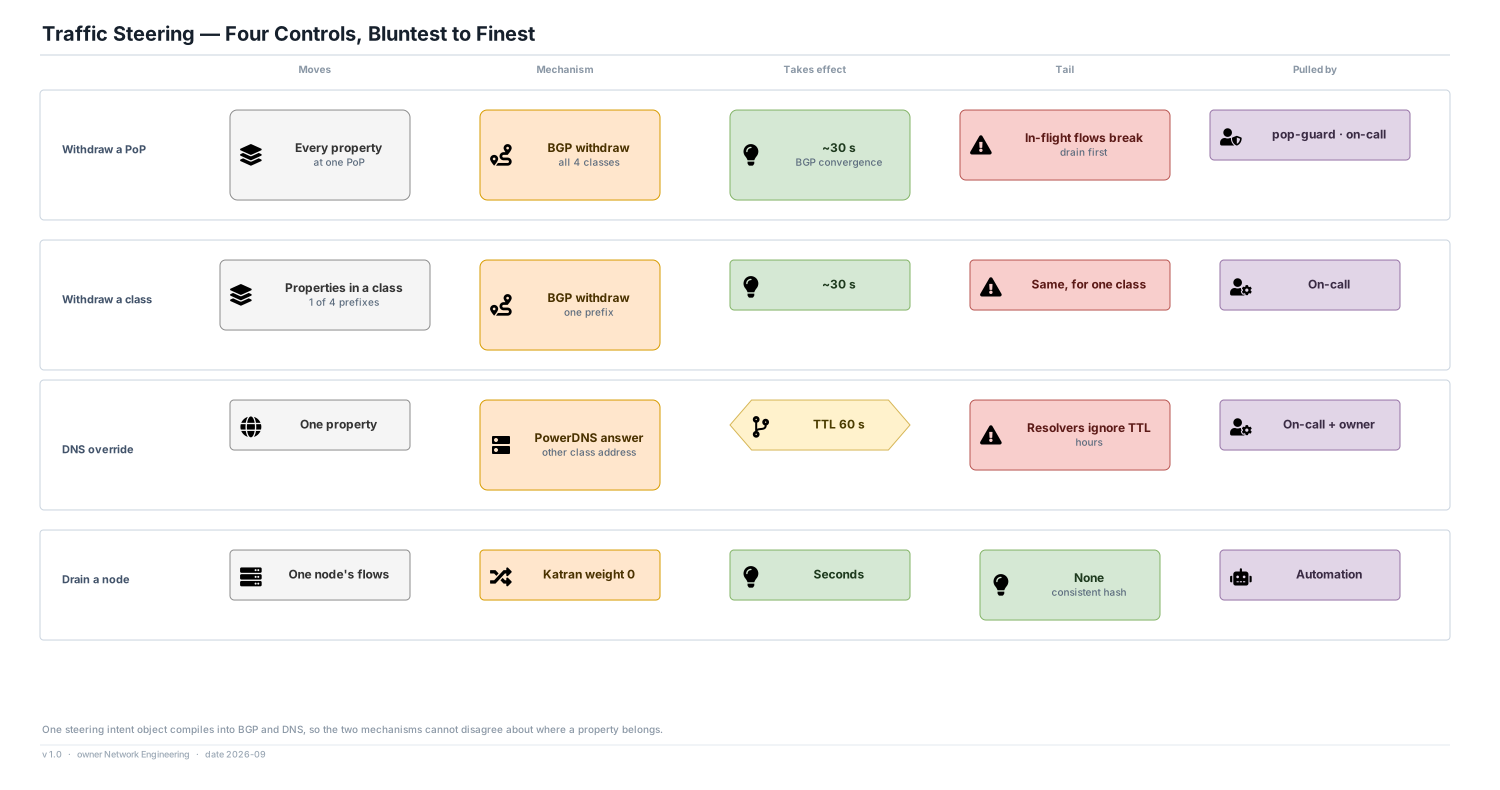
ADR-17Anycast from every PoP, with Katran on dedicated hosts for QUIC-aware L4 balancing ADR-18Four anycast prefix classes for fine steering, and DNS as a manual per-property override from one intent ADR-19Automatic withdrawal needs sustained evidence, drains first, and never removes the last PoP ADR-20Capacity is planned to n−1 per region from measured per-node ceilings, and cold PoPs refill under a cap

Configuration and control 3

Where configuration is authoritative, how it reaches 18 sites safely, and where the control plane runs.

ADR-21Git is the configuration authority, and PoPs apply only signed bundles and keep the last known good ADR-22Rollout is a Temporal workflow through canary, region and global rings, halting on regressions without a person ADR-23PoPs run a signed image on bare metal; the control plane runs on Kubernetes in two core data centres and a witness

Security 2

Private keys in buildings the organisation does not own, separated privileges, and a record nobody can quietly edit.

ADR-24Each PoP has its own short-lived certificates, with keys sealed to its TPM; keyless termination only later and only for a few properties ADR-25Three separated privileges, encrypted caches that can be destroyed by key, and an audit trail its writer cannot delete

Telemetry and economics 4

What is measured, from where, what it costs, and whether running the edge is the right call at all.

ADR-26Access records are droppable: Vector at the node, Kafka in the core, ClickHouse for analysis ADR-27Availability is measured from outside, and silence at a PoP is an alert ADR-28Offload and the cost of a miss are financial metrics, and the traffic assumptions are checked before scaling out ADR-29One self-operated delivery path for now, with configuration and purge semantics kept portable

Technology by capability

Every capability on the views, the package that provides it, a credible alternative, and the record that justifies the choice. Everything runs on hardware the organisation owns, with no managed service and no external dependency on the request path.

Open source This design
CapabilityChoiceOriginCredible alternativeWhy this oneRecord
Cache key and refusal rules keyspec (Rust, C ABI) with a request corpus This design Traffic Server cachekey plugin; Varnish VCL One implementation shared by cache, validator and explain tool ADR-02
Configuration schema and validation CUE plus Go invariant checks and a two-user identity probe Open source JSON Schema; OPA with Rego Types, defaults and constraints in one language; the probe tests actual origin behaviour ADR-04
Cache engine, edge and shield Apache Traffic Server 10 Open source Varnish Cache; NGINX Persistent NVMe cache, parent strategies, read-while-writer, lookup-level plugin API ADR-05
TLS, HTTP/3 and edge policy Envoy Open source HAProxy; NGINX SDS certificate delivery, QUIC-LB connection IDs, local limits, precise draining ADR-06
Intra-PoP ownership Traffic Server next-hop strategies, peering ring Open source Full replication per node Near N-times effective cache and PoP-wide collapsing ADR-07
Tenant isolation Traffic Server cache volumes plus Envoy per-property limits Open source Shared LRU One property cannot evict another ADR-08
Stale serving Traffic Server stale_response plugin, declared classes Open source Origin headers only Owner-declared, platform-capped behaviour during failures ADR-09
Shield tier Traffic Server shield pools at IAD, DFW, FRA, LHR Open source Regional shields; hashed mid-tier Highest offload for origins in two data centres ADR-10
Origin authentication mTLS with SPIFFE SVIDs from SPIRE Open source HTTP message signatures; IP allow-lists Proven caller identity, automatic rotation ADR-12
Invalidation at the node tagguard plugin with LMDB tag tables This design Tag index with deletion; regex revalidation Purge cost independent of object count ADR-13
Invalidation log NATS JetStream, R3 core with leaf-node mirrors Open source Apache Kafka; HTTP fan-out Durable, ordered, replayable and light enough for every PoP ADR-14
L4 load balancing Katran (XDP, Maglev) Open source IPVS with Maglev; switch ECMP Consistent hashing with QUIC connection-ID routing ADR-17
Anycast announcement BIRD 2 on L4 hosts; SONiC with FRRouting on border switches Open source GoBGP; ExaBGP; vendor routers Proven BGP daemons controllable by pop-guard ADR-17
Per-property DNS steering PowerDNS Authoritative with dnsdist Open source Knot DNS; NSD Scriptable answers generated from steering intent ADR-18
Withdrawal control pop-guard (Go) This design BIRD health scripts Sustained evidence, drain and the never-last-PoP rule in one place ADR-19
Configuration authority Forgejo with signed commits Open source Gitea; GitLab CE Reviewed changes and history as the audit record, community governance ADR-21
Bundle signing and storage cosign with key in OpenBao; Ceph RGW Open source GPG signatures; MinIO PoPs verify origin of every bundle ADR-21
Ring rollout Temporal workflows Open source Plain workers on PostgreSQL; CI stages Durable timers and state across restarts ADR-22
Control-plane runtime RKE2 Kubernetes with Argo CD; PostgreSQL with Patroni Open source Nomad; plain VMs Standard operations in the core only ADR-23
Node provisioning and image Tinkerbell; mkosi images; NetBox inventory Open source MAAS; PXE with Ansible Remote, image-based, drift-free PoP nodes ADR-23
Keys, PKI and certificates OpenBao; public ACME CA via DNS-01 Open source HashiCorp Vault; HSMs Per-PoP keys, 14-day certificates, community governance after Vault's licence change ADR-24
Node identity SPIRE with TPM attestation Open source Static client certificates A tampered or reimaged node cannot fetch keys or bundles ADR-24
Operator identity and roles Keycloak with WebAuthn Open source Authentik; Dex Three separated privileges with strong authentication ADR-25
Encryption at rest and audit LUKS2 with TPM-sealed keys; Ceph RGW Object Lock Open source Self-encrypting drives; immudb Destroy a cache by destroying a key; audit its writer cannot delete ADR-25
Access record pipeline Vector, Apache Kafka, ClickHouse, Parquet on Ceph Open source Fluent Bit; OpenSearch Droppable at the node, replayable in the core, fast analytics ADR-26
Metrics, probes and alerting Prometheus, Thanos, blackbox_exporter, Alertmanager, Grafana Open source VictoriaMetrics; commercial synthetic monitoring Local collection that survives WAN loss, global view, outside-in SLI ADR-27
Cost model ClickHouse cost tables with NetBox asset data This design Spreadsheet model Cost per TB and per miss computed from the same records as hit ratio ADR-28

The decisions, and the alternatives that lost

The cache keyWhat a cache hit is allowed to mean, who decides it, and how the platform stops a wrong decision from reaching users.

ADR-01

The cache key is declared per path pattern, and nothing is cacheable until declared

Accepted

Who decides what makes two requests the same request?

Context
A key of scheme, host and path gives the best hit ratio and is wrong for anything that varies. A key built from the origin's Vary header is correct only if forty origin teams always send the right headers, and it hands cache fragmentation, and therefore cost, to whoever writes those headers. The catastrophic failure of a CDN is not a miss or an outage but a hit on the wrong key, which produces no error anywhere.
Decision
Each path pattern declares its key as an explicit list: scheme, host, path, a named allow-list of query parameters, named request headers, an optional device or geography class, and an identity field that is either none or the header carrying identity. Anything not listed never enters the key. A path with no declaration is not cacheable. The platform applies its own maximum TTL per property and a 30-day ceiling overall, whatever the origin sends.
How it works on-premise
Owners write the declaration as YAML in the property's directory in Forgejo. The CUE schema requires the identity field on every cacheable rule, with no default. The compiler turns rules into a compact table that the keyspec plugin in Traffic Server loads from the signed bundle, indexed by the rule ID that Envoy stamps on the request after matching the property.
Options weighed
  • ChosenDeclared per-path key, not cacheable by default: Explicit, reviewable and testable before release. The owner has to understand their content, which is the point.
  • RejectedMinimal key plus origin Vary: Correct only while every origin sends perfect headers. A single missing Vary: Cookie becomes a disclosure.
  • RejectedCache everything, bypass on cookies or Authorization: The common default. It leaks as soon as identity travels in a header or parameter nobody thought of.
  • Right elsewhereOrigin-controlled keys through a surrogate header: Reasonable for a single team that owns both edge and origin. Here forty teams would each hold a security boundary.
Consequences
What it buys
  • A cache hit means what the owner declared it means
  • Keys can be reviewed, diffed and tested before traffic sees them
  • Fragmentation has a named owner and a visible cost
What it costs
  • Lower hit ratio than a permissive platform, visible in cost per TB
  • Onboarding requires every owner to do the work before getting any benefit
  • Owners need an explain tool and good defaults to succeed
Choose differently when
A single-tenant platform where the same team owns every origin and the edge, and has a tested Vary discipline, can safely let the origin drive the key and take the higher hit ratio.
Why it holds up over time
What makes two requests equivalent is a property of the content, not of the cache engine, so the declaration survives any change of engine, hardware or provider. If the organisation later buys its delivery, the declarations become the specification the vendor is configured against.
LessonWhen a mistake is silent and irreversible, make the risky choice explicit and opt-in rather than inferred.
Shown on views04 12 13
ADR-02

One Rust library computes the key in the cache, the validator and the explain API

Accepted

How does an owner check a key and trust that production computes the same one?

Context
A key is computed in at least three places: the cache on every request, the validator before release, and a tool owners use to understand their configuration. If each has its own implementation, they drift. Percent-encoding, parameter ordering and header folding are exactly the details where two implementations disagree, and the disagreement is invisible until a user reports someone else's content.
Decision
Key computation, normalisation and the refusal rules live in one library, keyspec, with a C interface. The Traffic Server plugin, the validator and the explain API all link the same build. Its behaviour is fixed by a corpus of real requests and expected keys that must pass before any bundle is built.
How it works on-premise
keyspec is written in Rust with no allocation on the request path and exposes a small C ABI that the Traffic Server plugin calls. The explain API runs as a service in the core and on an internal-only listener at each PoP, so an owner can ask a PoP running a specific bundle version what key it would compute. Hashes use BLAKE3 truncated to 128 bits.
Options weighed
  • ChosenOne shared library in Rust with a C ABI: Memory-safe code on the hottest and most security-critical path, callable from C and C++ without a runtime.
  • RejectedNative Traffic Server cachekey plugin plus a separate validator: Good plugin, but the validator and explain tool would reimplement its rules and eventually disagree.
  • RejectedLua or Wasm key logic: Flexible, but slower per request and makes the key easy to change in ways the validator does not see.
  • DeferredKey computed in Envoy before the cache: Possible if the cache engine changes; the library would move with it unchanged.
Consequences
What it buys
  • The explain tool is correct by construction
  • A regression in normalisation fails CI, not production
  • Engine changes keep identical key semantics
What it costs
  • A Rust toolchain and FFI boundary to maintain
  • Plugin upgrades must be tested against each Traffic Server major version
  • Owners must accept a truncated hash in logs rather than the key itself
Choose differently when
If the platform uses only a managed CDN's key configuration, there is no plugin to share and the corpus becomes a conformance test run against the vendor's staging endpoint instead.
Why it holds up over time
The library and its corpus hold the platform's most important behaviour in a form that outlives the engine around it. Rust with a C ABI can be linked from any likely successor to Traffic Server.
LessonWhen a rule has to hold in several places, build it once and link it everywhere; do not rely on keeping several copies in step.
Shown on views09 13
ADR-03

Private responses are refused whatever the rule says, and an unexpected Vary is a configuration error

Accepted

What happens when the origin's response contradicts the owner's declaration?

Context
Declarations are made in advance; responses arrive at run time. An origin deploy can start setting a session cookie on a path declared cacheable, or send Vary: Cookie on a path whose key excludes cookies. Honouring the Vary silently fragments the cache; ignoring it can leak. Both hide the contradiction from the owner.
Decision
A response with Cache-Control private or no-store, a session Set-Cookie, or credentials is never stored, regardless of the rule. A Vary naming a header outside the declared key stops the object being stored and raises an owner alert with the path pattern. Accept-Encoding is the one normalised exception, stored as up to three declared variants. Every refusal is counted per path pattern.
How it works on-premise
The keyspec plugin checks responses at the Traffic Server read-response hook and marks refusals as uncacheable. Refusal counters go to Prometheus, and the access record carries a refusal reason. Alertmanager routes Vary-mismatch alerts to the owning team using the property's owner metadata.
Options weighed
  • ChosenRefuse and alert: The contradiction is surfaced to the person who can fix it, and nothing unsafe is stored meanwhile.
  • RejectedHonour Vary silently: Correct but quietly destroys hit ratio, and the owner never learns why.
  • RejectedIgnore Vary, trust the declaration: Keeps the hit ratio and risks a disclosure the moment the origin is right and the declaration is wrong.
  • RejectedAuto-extend the key with the Vary header: Lets origin headers change the key, which ADR-01 exists to prevent.
Consequences
What it buys
  • Origin drift cannot turn into a leak
  • Refusals are measurable per path
  • Owners learn about header bugs from an alert, not an incident
What it costs
  • A bad origin deploy drops the hit ratio on that path until fixed
  • Alert noise if an owner ignores refusals
  • Some legitimate Vary use must be declared explicitly
Choose differently when
For a public, anonymous-only property with no cookies at all, an organisation might accept honouring Vary to save owners effort. It remains unsafe the day anyone adds authentication.
Why it holds up over time
HTTP will keep letting origins say one thing and configuration say another. Refusing on contradiction is a rule about trust, not about a product, and it applies equally to any future engine or vendor.
LessonWhen two sources of truth disagree on a safety question, fail closed and tell the owner; do not quietly pick one.
Shown on views13 29
ADR-04

Validation proves identity is in the key with invariants and a two-user probe

Accepted

How does the platform reject a change that would make a user-specific path cacheable without the user in the key?

Context
Schema validation catches malformed configuration but not a well-formed wrong one. The requirement asks for a validator that rejects any change making an identity-varying path cacheable under a key that omits identity. The platform cannot know from configuration alone which paths vary by identity; it has to either trust the owner's declaration or check the origin.
Decision
Three layers run on every merge request. CUE checks types, required fields and defaults. Invariant checks enforce cross-rule rules, for example that a rule marked identity-varying names its identity header, and that no cacheable rule overlaps a pattern another rule marks private. A differential probe fetches each rule's declared test URLs from the origin as two test users and fails the change if the bodies differ while the key omits identity.
How it works on-premise
Forgejo Actions runners in the core run CUE and the invariant checks, written in Go against the compiled rule table. The probe runs from the core through the origin's mTLS path using two test identities per property held in OpenBao, and ignores declared volatile fields such as timestamps and CSRF tokens. CUE also requires at least three test URLs per cacheable rule.
Options weighed
  • ChosenSchema, invariants and differential probe: Checks the declaration and the origin's actual behaviour, before any user is exposed.
  • RejectedSchema validation only: Catches typos, not a correct-looking key on a user-specific path.
  • RejectedManual security review of every change: Does not scale to forty teams and weekly changes, and reviewers miss what a test would catch.
  • DeferredShadow traffic comparison at the canary: Stronger, but mirrors real user traffic including personal data; considered for Phase 2 with privacy review.
Consequences
What it buys
  • The most dangerous class of change is caught before release
  • Owners get a failing check that names the rule
  • Test identities make leaks reproducible
What it costs
  • Owners must maintain test URLs and identities
  • Probe coverage is only as good as the declared URLs
  • Volatile fields need declaring or the probe is noisy
Choose differently when
If properties are entirely anonymous, such as software downloads or public media, the probe adds little and schema plus invariants are enough.
Why it holds up over time
Pre-release checks tied to observable origin behaviour do not depend on the engine, and the probe is the same whether the edge is self-operated or bought. As origins change over years, the probe keeps testing what they do now, not what they did at onboarding.
LessonValidate what the system will actually do, not only what the configuration says it will do.
Shown on views04 19 23

Serving pathThe software on a PoP node, how a PoP behaves as one cache, how tenants share it, and what gets served when things go wrong.

ADR-05

Apache Traffic Server is the cache engine

Accepted

Which open-source cache engine can meet the key, storage and shielding requirements on hardware we run?

Context
The requirement names Traffic Server or Varnish. The engine must keep a cache across restarts so a node rejoins warm, stream in-flight fetches to waiters, serve ranges from partially cached large objects, route misses by consistent hash to parents, and support a plugin that can override lookup results. It will hold hundreds of terabytes per PoP on NVMe.
Decision
Apache Traffic Server 10 on every edge and shield node, with a raw-device NVMe cache that persists across restarts, a RAM cache for the hot set, read-while-writer collapsing, the slice and cache_range_requests plugins for large objects, next-hop strategies for peers and shields, stale_response for stale-while-revalidate and stale-if-error, and three platform plugins: keyspec, tagguard and cache-status.
How it works on-premise
Traffic Server runs as a systemd service from the signed node image. Cache spans are the raw NVMe devices opened through LUKS2 mappings. Configuration files (remap, strategies, volumes, plugin tables) come only from the active bundle directory, and changes are applied with a configuration reload, not a restart.
Options weighed
  • ChosenApache Traffic Server: Persistent disk cache, parent selection and a lookup-level plugin API; long history as a CDN engine at large operators; Apache governance.
  • RejectedVarnish Cache (open source): Excellent collapsing and VCL, but the open-source storage does not persist across restarts and it needs a separate TLS terminator; persistence is in the commercial edition.
  • RejectedNGINX proxy_cache: Simple and familiar, but file-per-object storage struggles at hundreds of millions of objects and advanced collapsing and purge features are commercial.
  • RejectedBuild a cache on a key-value store: Years of work to reach what Traffic Server already does.
Consequences
What it buys
  • Node restarts and upgrades rejoin warm
  • Shield routing and intra-PoP ownership use built-in strategies
  • One engine for edge and shield roles
What it costs
  • Smaller community and fewer engineers who know it than NGINX or Varnish
  • Plugin code in C++ against a changing API
  • Configuration is spread across several files, which the compiler has to own
Choose differently when
A platform mostly caching APIs with small objects and frequent logic changes, and where warm restarts matter less, may prefer Varnish for VCL's expressiveness.
Why it holds up over time
Traffic Server is chosen for capabilities, not its configuration language, and the compiler (ADR-21) and keyspec (ADR-02) keep the rest of the platform independent of it. If it stops being the right engine, a replacement is a new compiler back end and a plugin port, rolled out one ring at a time.
LessonChoose the engine for the properties that are hardest to add later, such as persistence and parent routing, not for the ones that are easy to configure.
Shown on views07 08 09
ADR-06

Envoy terminates TLS and HTTP/3 in a separate process from the cache

Accepted

Where do TLS termination, token checks and per-property limits run?

Context
The edge must terminate HTTP/1.1, HTTP/2 and HTTP/3 with TLS 1.2 and 1.3 and per-property certificates, verify signed URLs before lookup, enforce per-property rate, connection and bandwidth ceilings, and drain gracefully. Private keys sit in facilities the organisation does not control, and the process that parses untrusted origin responses is the one most likely to have a memory-safety bug.
Decision
Envoy runs on every cache node in front of Traffic Server, connected over loopback. It holds TLS keys and does termination, HTTP/3, SNI-based certificate selection, signed URL verification, token stripping, local rate limits and drain. Traffic Server holds no private keys.
How it works on-premise
Envoy loads listeners, routes and limits from files in the active bundle and receives certificates through SDS from the node agent (ADR-24). Signed URLs follow the CDNI URI Signing shape (RFC 9246) and are verified with the jwt_authn filter against keys in the bundle. Limits use the local rate-limit filter, sized per node from the property ceiling divided by node count. QUIC connection IDs carry a server ID so Katran keeps QUIC flows on the same node.
Options weighed
  • ChosenEnvoy in front of Traffic Server: Mature HTTP/3, hot certificate updates, draining and local limits, and key material isolated from the cache process.
  • RejectedTraffic Server terminating TLS itself: One process fewer, but keys would live in the process that parses origin responses, and its HTTP/3 support is less mature.
  • Right elsewhereNGINX or HAProxy as terminator: Both are sound; Envoy is chosen for SDS certificate delivery and QUIC-LB connection IDs.
  • RejectedGlobal rate-limit service: Accurate across nodes, but puts a network dependency on the request path.
Consequences
What it buys
  • A cache bug cannot read TLS keys
  • Certificates rotate without restarts
  • Drain behaviour is precise and testable
What it costs
  • Two proxies per node to operate and upgrade
  • A loopback hop and some CPU on every request
  • Local limits are approximate across nodes
Choose differently when
On small edge nodes where CPU is scarce and physical security is good, letting the cache terminate TLS saves a hop and a process.
Why it holds up over time
Splitting the key-holding terminator from the content-handling cache is a security boundary that holds whatever the products are. Either side can be replaced independently because the seam between them is plain HTTP over loopback.
LessonKeep secrets in the smallest process that needs them, and away from the code that parses untrusted input.
Shown on views08 09 27
ADR-07

Inside a PoP, every node keeps its own hot set and the long tail has one owner on a peering ring

Accepted

Does every node in a PoP hold everything, or does the PoP shard its cache?

Context
Replicating the working set on every node wastes storage in proportion to node count and makes node loss trivial. Consistent hashing across nodes multiplies effective PoP cache size but adds a hop and turns node changes into redistribution. The working set is around 150 TB of distinct bytes, larger than one node's NVMe, and collapsing only works when requests for one key reach one process (view 15).
Decision
Each node serves its own RAM and NVMe cache. On a local miss, the node asks the key's owner on the PoP's consistent-hash ring before going to the shield. The owner fetches from the shield and both nodes store the object. Popular objects therefore end up on many nodes, and long-tail objects on roughly one.
How it works on-premise
Traffic Server next-hop strategies in peering-ring mode define the PoP's edge nodes as a ring with virtual nodes. The ring is generated from NetBox inventory into each PoP's bundle. Katran health checks remove a failed node from connection balancing, and the ring skips it to the next owner.
Options weighed
  • ChosenLocal hot set plus owner ring for the tail: Near N times the effective cache for the long tail, one owner fetch per key per PoP, and only 1/N of the tail lost with a node.
  • RejectedFull replication on every node: Simple, but the long tail would be fetched from the shield once per node and PoP capacity would equal one node's disk.
  • RejectedPure sharding with no local hot set: Popular objects would always take an extra hop and concentrate load on their owners.
  • RejectedA separate storage tier inside the PoP: More hardware and a new dependency inside the site.
Consequences
What it buys
  • Effective PoP cache size close to the sum of its nodes
  • Node loss costs 1/N of the tail, never a PoP flush
  • Collapsing works across the PoP, not only per node
What it costs
  • An extra intra-PoP hop on tail misses, under 1 ms
  • Adding or removing a node moves about 1/N of ownership
  • Intra-PoP fabric must carry owner traffic
Choose differently when
When a working set fits comfortably on one node, or nodes are replaced very often, full replication is simpler and the extra shield fetches are cheap.
Why it holds up over time
The principle, which is to converge each key on one owner so collapsing works while keeping hot objects local, holds however large disks become. When disks outgrow the working set the ring still helps collapsing and costs almost nothing.
LessonRequest collapsing only works if the requests for a key arrive at the same process, so plan where they converge.
Shown on views09 15 29
ADR-08

Memory and NVMe tiers, with per-property cache volumes that set a floor and a ceiling

Accepted

How does one property's traffic avoid evicting another property's cache?

Context
Forty properties share every PoP. A large property publishing a video catalogue can fill NVMe and evict a smaller property's long tail, dropping its hit ratio without any change of its own. The requirement asks for a per-property footprint floor and ceiling at each PoP and for per-property accounting.
Decision
Each node has a RAM cache for the hot set and NVMe for the long tail. NVMe is divided into Traffic Server cache volumes: large properties get a dedicated volume sized between their declared floor and ceiling, and small properties share a pooled volume with a combined floor. Eviction happens inside a volume, so one property cannot evict another's objects. Per-property request, connection and bandwidth ceilings are enforced by Envoy.
How it works on-premise
Volume layout per PoP is compiled from property declarations and PoP disk inventory into Traffic Server's volume and hosting configuration. Changing a volume layout reinitialises that volume, so it is rolled out one node at a time, like a node restart. Per-volume fill and eviction rates are exported to Prometheus.
Options weighed
  • ChosenDedicated volumes for large properties, pooled volume for the rest: Hard isolation where it matters, without fragmenting disk into forty small partitions.
  • RejectedOne shared cache with global LRU: Best total hit ratio, no isolation; one release can wreck a neighbour.
  • RejectedOne volume per property: Strong isolation but wastes space in small volumes and hits volume count limits.
  • DeferredSoft quotas by eviction weighting: Would give finer control but needs engine changes.
Consequences
What it buys
  • A property's hit ratio depends on its own traffic
  • Storage cost per property is directly measurable
  • Floors protect small, important properties
What it costs
  • Total hit ratio slightly below a shared cache
  • Resizing a volume costs that slice of cache on each node
  • Owners must estimate a footprint, revised quarterly from measurements
Choose differently when
A single-tenant platform, or tenants with no internal chargeback, gets more from one shared cache.
Why it holds up over time
Isolating tenants by storage allocation works with any storage medium and any engine that can partition its cache. The declarations are in engine-neutral configuration, so the policy survives an engine change even if the mechanism differs.
LessonIn shared caches, isolation is a capacity decision: give each tenant space its neighbours cannot take.
Shown on views09 11
ADR-09

Freshness is declared per path as strict, standard or resilient, and overload sheds in a fixed order

Accepted

When the origin fails or the PoP is overloaded, what does a user get?

Context
Serving stale content during an origin outage keeps a news site up and would show a wrong balance on a banking page. That is a product decision, not a platform default. The platform also needs a declared order for shedding load, so overload degrades service predictably rather than randomly.
Decision
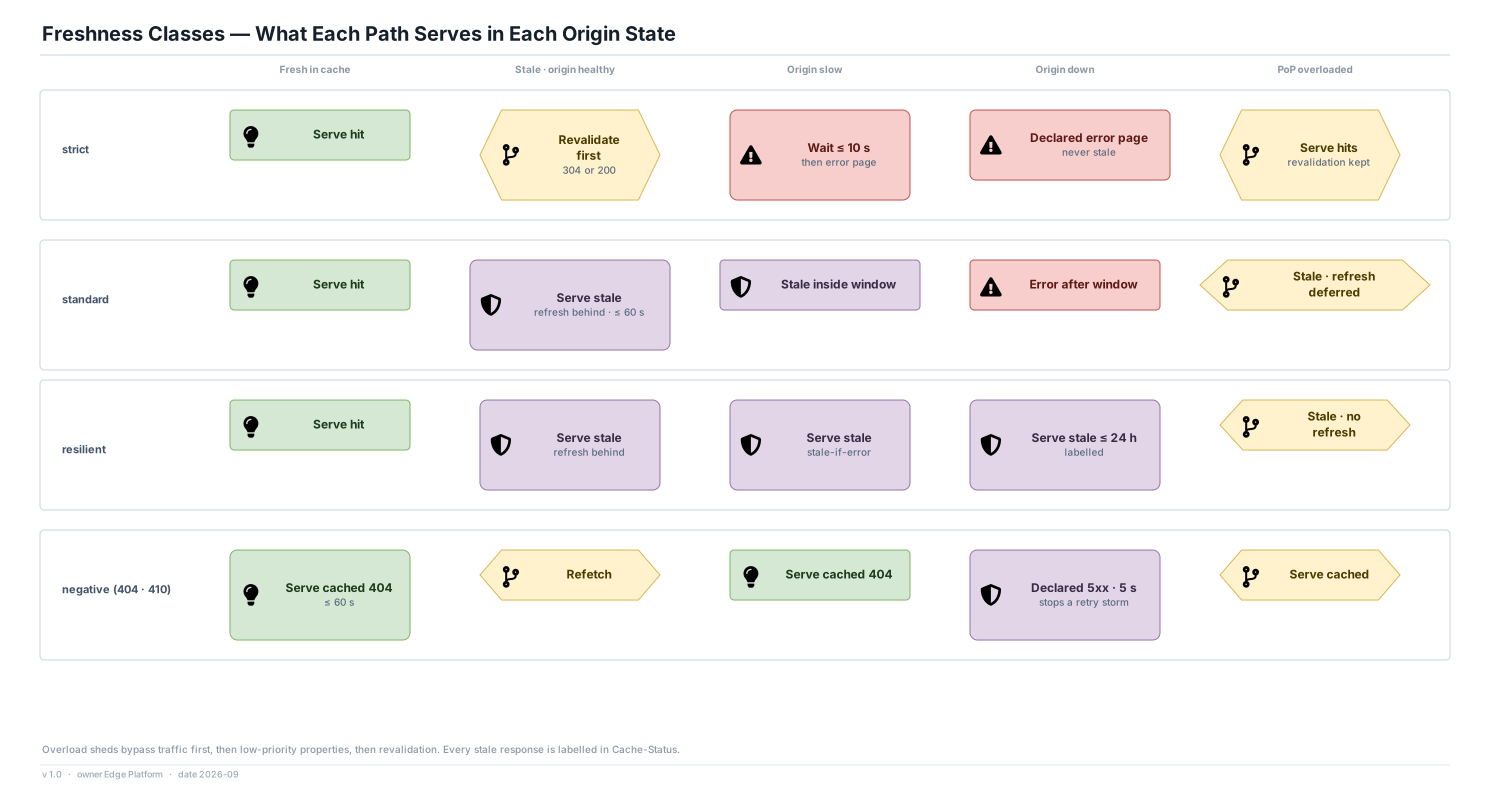
Each path declares a freshness class. Strict revalidates before serving once stale and returns the declared error page if the origin cannot answer. Standard serves stale while revalidating for a declared window, 60 seconds by default. Resilient also serves stale on origin error, for up to 24 hours. The platform caps all windows whatever the origin sends. Under overload the edge sheds bypass and uncacheable traffic first, then low-priority properties, then revalidation, and cache hits last. Every stale response is labelled in Cache-Status.
How it works on-premise
The compiler turns classes into Traffic Server stale_response plugin settings and revalidation behaviour per rule. Envoy's overload manager and route priorities implement shedding by rule class and property priority. Stale-served ratio per path pattern is computed in ClickHouse and alerted in Prometheus.
Options weighed
  • ChosenThree declared classes with platform caps: Owners choose in advance; the platform keeps the choice bounded and measurable.
  • RejectedFollow origin Cache-Control extensions only: Puts outage behaviour in origin headers that nobody reviews.
  • RejectedAlways serve stale on error: Right for media, wrong for prices, balances and security-sensitive pages.
  • RejectedPer-request stale decisions in code: Flexible and impossible to reason about during an incident.
Consequences
What it buys
  • Incident behaviour is known before the incident
  • Stale content is visible and countable
  • Overload hits the cheapest traffic first
What it costs
  • Owners must classify every path
  • Strict paths show errors during origin outages, by design
  • Shedding low-priority properties needs agreed priorities
Choose differently when
A platform serving one kind of content, such as only static software packages, can use one class everywhere.
Why it holds up over time
Stale-while-revalidate and stale-if-error are standard HTTP extensions, and the classes are expressed as policy, not engine settings. Whether wrong or missing is worse is a business question that stays with the owner however the technology changes.
LessonDecide in advance whether a wrong answer or no answer is worse, and write it down per path.
Shown on views18 29

Shield and originsWhere misses go, how an origin is protected from the edge, and how an origin tells the platform apart from everyone else.

ADR-10

Shield pools sit next to the origins, in continental pairs, with each key converging on one shield node

Accepted

What shape should the shield tier be?

Context
One global shield per origin maximises offload and concentrates failure. A shield per region shortens miss paths and multiplies origin fetches by the number of regions. A hashed mid-tier across tier-1 PoPs couples origin protection to PoP membership changes. Origins are in two data centres, one in the eastern US and one in Frankfurt, and origin egress is the largest avoidable cost.
Decision
Four shield pools run on dedicated nodes in four tier-1 sites: IAD and DFW for origins in the eastern data centre, FRA and LHR for origins in Frankfurt. Each origin set declares a primary and a secondary shield on the same continent. Every miss is hashed to one node within the primary shield pool, so an object converges on one node and one fetch. Asia and South America edges use the same shields and accept higher miss latency.
How it works on-premise
Edge strategies use a consistent-hash parent group whose members are the primary pool's nodes, with the secondary pool as the failover group. Shield nodes run the same image as edge nodes with shield role configuration and 16 NVMe drives each. A regional shield pool at SIN is defined in configuration but not enabled.
Options weighed
  • ChosenOrigin-adjacent shields in continental pairs: Highest offload for this origin placement, short failover distance, no dependence on edge PoP membership.
  • RejectedOne global shield per origin: Similar offload, but one site's failure sends full miss volume to a secondary or the origin.
  • DeferredRegional shields on every continent: Better miss latency for Asia and South America, and one origin fetch per region. Enabled if measured miss share there justifies it.
  • RejectedConsistent-hash mid-tier across all tier-1 PoPs: No dedicated nodes, but a PoP withdrawal reshuffles origin load.
Consequences
What it buys
  • Origin sees fetches from a small, known set of addresses
  • One fetch per object per shield per TTL
  • Shield tier scales with miss volume, independently of edges
What it costs
  • Asia and South America shield hits exceed the 60 ms budget
  • Sixteen dedicated nodes carry no user traffic directly
  • Shield failover changes miss latency
Choose differently when
If origins become multi-region, or Asian traffic grows so that its miss share drives p95, move to regional shields and accept one origin fetch per region.
Why it holds up over time
Shield placement follows origin placement. When origins move, shields are reassigned by editing origin sets, not by redesigning the tier. The convergence rule, one key per shield node, holds at any size.
LessonPut the shield where the expensive bytes are, which is next to the origin, not next to the users.
Shown on views02 15 20
ADR-11

Origin protection is enforced at the shield, slow is distinguished from down, and the direct path is capped

Accepted

How is an origin protected from the edge, including when the shield itself fails?

Context
An origin's protection must not depend on the origin behaving well. A flash crowd, a cold PoP refilling or an expired popular object can all send more requests than an origin can take. When a shield fails, falling back to direct edge-to-origin fetches at full miss volume causes the origin outage the shield exists to prevent.
Decision
Each origin set declares a concurrency and request-rate ceiling, a slow threshold and a down threshold. Shields queue up to the ceiling and then serve stale or shed according to the freshness class. Slow origins are handled by waiting within bounds; down origins trigger ordered endpoint failover. If both shields are unavailable, edges may fetch directly from origins only under a per-origin rate cap of 5% of normal miss volume.
How it works on-premise
Traffic Server per-origin connection limits with queueing enforce concurrency at the shield. Health is judged on error rate and connect failures for down, and on time to first byte against the declared threshold for slow. Endpoint order and thresholds come from the origin set in the bundle. The direct-path cap is an Envoy rate limit on a separate origin cluster that is active only while shields are marked down.
Options weighed
  • ChosenCeilings at the shield, slow and down treated differently, capped direct path: The origin is protected by the platform, and failures degrade without cascading.
  • RejectedRely on origin autoscaling and rate limits: Moves protection to forty teams and fails the first time one is under-provisioned.
  • RejectedFree direct fallback when shields fail: An unshielded fallback at full miss volume is an origin outage with extra steps.
  • RejectedNo direct path at all: Safer for origins, but a double shield failure would stop all misses including for strict paths.
Consequences
What it buys
  • Origin load is bounded and predictable
  • Slow origins do not trigger unnecessary failovers
  • Shield failure degrades gracefully
What it costs
  • Owners must declare realistic ceilings
  • Queued requests add latency at peaks
  • Capped direct path means some misses fail during double shield failure
Choose differently when
Origins that are themselves large object stores with effectively unlimited capacity may need only generous ceilings, but should still have them.
Why it holds up over time
Protecting a dependency from its callers with ceilings and bounded fallback is standard reliability practice and does not depend on the engine. Thresholds are data in origin sets that owners revise as origins change.
LessonProtect a dependency at the point you control, and make every fallback smaller than the failure it replaces.
Shown on views15 18 29
ADR-12

Origins authenticate the platform with mTLS from workload identities

Accepted

How can an origin refuse traffic that did not come through the platform?

Context
An origin reachable directly lets attackers skip edge limits, token checks and caching. IP allow-lists break when shields are added and do not prove which service is calling. The requirement asks for mTLS or signed requests from shield to origin.
Decision
Shields call origins over mTLS with a short-lived client certificate that carries the shield's SPIFFE identity. Origins accept only that identity for platform traffic. The edge-to-origin direct path uses a separate, distinguishable identity, so an origin can see and alert on its use.
How it works on-premise
SPIRE issues X.509 SVIDs to shield nodes after TPM attestation, rotated hourly. The SPIRE trust bundle is published to origin teams, who configure their ingress (for example Envoy or NGINX) to require it. OpenBao's PKI serves as the upstream CA for SPIRE.
Options weighed
  • ChosenmTLS with SPIFFE identities: Proves which platform component is calling, rotates automatically, standard for origin ingress to verify.
  • RejectedIP allow-lists: Brittle, and proves only an address.
  • RejectedShared secret header: Easy to leak and hard to rotate across forty origins.
  • DeferredHTTP message signatures (RFC 9421): Useful for origins behind TLS-terminating load balancers that cannot see client certificates.
Consequences
What it buys
  • Origins can close their public exposure
  • Direct-path use is visible to the origin
  • No long-lived secrets to rotate
What it costs
  • Origin teams must configure client certificate validation
  • SPIRE becomes a dependency of shield-to-origin fetches, cached for an hour
  • Debugging from outside the platform needs a test identity
Choose differently when
Origins that are public object stores serving public content may skip mTLS and use signed URLs instead.
Why it holds up over time
SPIFFE is an open standard with several implementations, and mTLS is supported by every origin stack. Changing identity providers does not change the origin contract.
LessonAuthenticate the caller with an identity it proves at connection time, not with an address or a shared secret.
Shown on views10 27

InvalidationHow content changes everywhere within seconds, how the platform knows it did, and when not to purge at all.

ADR-13

Invalidation compares timestamps at lookup instead of deleting objects

Accepted

How can a purge of two million objects reach 18 PoPs in seconds without affecting serving?

Context
The requirement asks for purge by URL, surrogate key and property, 99% of PoPs acknowledging within 5 seconds p95 for a two-million-object surrogate key purge, and purge storms that never block serving. Deleting matching objects means finding them: an index of tags on every node, and millions of delete operations competing with serving I/O.
Decision
An invalidation is a record of selector, time and mode. Selectors are a key hash, a surrogate key or a property generation. Each node keeps a table from selector to latest invalidation time. On lookup, an object whose store time is earlier than any of its selectors' invalidation times is a miss (purge) or stale (expire). Entries are dropped after the TTL ceiling, which bounds the table. Nothing is deleted; invalidated objects are overwritten on refetch or evicted normally.
How it works on-premise
The table is an LMDB file on each node's NVMe, written only by the PoP agent and memory-mapped read-only by the tagguard plugin in Traffic Server. Surrogate keys come from an origin header or configuration and are stored with the object. tagguard runs after cache lookup and changes the lookup result. A property-wide purge advances the property generation, a selector every stored object carries, so the same comparison invalidates everything the property has stored without touching the key.
Options weighed
  • ChosenTimestamp comparison at lookup: Cost independent of object count, no I/O storm, serving only reads a memory-mapped table.
  • RejectedTag index with active deletion: Accurate and familiar, but two million deletes on each of 90 nodes compete with serving.
  • RejectedRegex invalidation: Evaluated per lookup against a growing list, and a single broad regex can invalidate far more than intended.
  • RejectedOnly versioned URLs, no purge: Ideal where possible (ADR-16), impossible for URLs the publisher does not control.
Consequences
What it buys
  • Purge cost does not depend on how many objects match
  • Purge storms never touch serving I/O
  • Returning PoPs replay a small log instead of scanning caches
What it costs
  • Invalidated objects occupy disk until evicted or refetched
  • Lookup reads a table on every request, microseconds
  • Depends on a plugin changing lookup status, to be confirmed
Choose differently when
A platform with few objects per tag and rare purges can use active deletion, which frees disk immediately.
Why it holds up over time
Timestamp comparison is independent of object count, storage medium and engine, so it keeps working at 2 billion objects. It relies only on objects recording when they were stored, which every cache does.
LessonWhen an operation's cost grows with the data, see whether a comparison at read time can replace the write.
Shown on views05 09 16
ADR-14

NATS JetStream is the invalidation log, mirrored into every PoP, with acknowledgement per PoP

Accepted

What carries invalidations so that none acknowledged is lost and every PoP's outcome is known?

Context
Invalidation state is small, ordered, must not be lost (RPO 0) and must reach 18 PoPs across continents in seconds. PoPs are sometimes unreachable for hours. A purge whose outcome is unknown has not happened, so each PoP's position must be known, and a returning PoP must be able to replay what it missed.
Decision
Purges are published to a NATS JetStream stream replicated three times across the two core data centres and a witness site. The purge API returns only after quorum. Each PoP runs a leaf node with a local mirror of the stream, so delivery survives WAN interruptions and replay is local. The PoP agent applies records in order and publishes an acknowledgement with the highest sequence applied. The purge API records acknowledgements per PoP and reports which PoPs are pending. The stream keeps 30 days.
How it works on-premise
Three JetStream servers form the core cluster (DC East, DC EU, DFW compute). Each PoP's leaf node connects to the nearest core server with credentials that allow subscribing to the invalidation stream and publishing only on that PoP's acknowledgement subject. Per-property publish budgets are enforced in the purge API; JetStream flow control provides back-pressure during purge storms.
Options weighed
  • ChosenNATS JetStream with leaf-node mirrors: Designed for edge topologies: a small footprint per PoP, local durable mirrors, quorum replication in the core.
  • RejectedApache Kafka with MirrorMaker to each PoP: Proven, but running Kafka in 18 PoPs is heavy, and it is already used for telemetry where different trade-offs apply.
  • RejectedHTTP fan-out from the purge API to each PoP: Simple until a PoP is down: then the API has to own retries, ordering and replay.
  • Rejectedetcd or PostgreSQL as the log: Strong consistency, but not built for fan-out streaming to remote sites.
Consequences
What it buys
  • Acknowledged purges survive any single site loss
  • PoPs catch up locally after an outage
  • Per-PoP outcome is a recorded fact
What it costs
  • A second messaging system alongside Kafka
  • Operators must learn JetStream operations
  • NATS is led by one company, with Kafka as the named fallback
Choose differently when
An organisation already running Kafka at the edge with strong operational skills might use it for both logs and invalidations and accept the heavier footprint.
Why it holds up over time
The design depends on an ordered, replicated, replayable log with per-consumer positions, which several products provide. The records are small and product-neutral, so moving to Kafka or another log is a transport change, not a redesign.
LessonIf the outcome of an action matters, record it per recipient; do not assume delivery from a successful call.
Shown on views11 16 17
ADR-15

A returning PoP reconciles before serving, and this ships in the MVP

Accepted

What stops a PoP that missed purges while away from serving stale content when it returns?

Context
The requirement puts reconciliation in Phase 2 but also says no acknowledged invalidation may be lost to an absent PoP. Without reconciliation, a PoP back from a nine-hour transit outage would serve old prices immediately. With a replayable log already in place (ADR-14), reconciliation is small.
Decision
A PoP that has been withdrawn stays withdrawn until the agent confirms that its tag tables have applied every invalidation up to the current stream head and that its configuration bundle matches the current ring version. If the gap is older than the log's retention, or a tag table is missing, the agent bumps every property generation, which turns every stored object into a miss. Only then does pop-guard announce, starting in cold mode.
How it works on-premise
The agent reads applied_through_seq from LMDB, resumes the leaf mirror from the next sequence and applies records in order. pop-guard queries the agent's readiness endpoint before instructing BIRD to announce. The 30-day stream retention exceeds the declared 14-day maximum absence.
Options weighed
  • ChosenReconcile before announcing, in MVP: Makes purge correct from day one at little extra cost.
  • RejectedDefer to Phase 2 as the requirement suggests: Ships a purge that can silently not happen for any PoP that was down.
  • RejectedFlush every returning PoP: Correct but turns every short outage into a cold start and a shield refill.
  • RejectedReconcile while serving: Faster return, but serves stale content during the replay.
Consequences
What it buys
  • No stale serving after an outage
  • Short outages return warm
  • Long outages are handled safely
What it costs
  • Return takes seconds longer
  • Missing tag tables force a full logical flush
  • pop-guard depends on the agent being healthy to announce
Choose differently when
A platform that uses only versioned URLs and never purges has nothing to reconcile.
Why it holds up over time
Catching up from a log before serving is how replicas, databases and caches have safely rejoined for decades. It remains correct at any purge volume or PoP count.
LessonA replica that was away must catch up before it answers; being reachable is not the same as being current.
Shown on views06 17 22
ADR-16

Versioned URLs first, purge second, short TTLs last, with the strategy declared per path

Accepted

Should content change be handled by purge, by versioned URLs or by short TTLs with revalidation?

Context
Purge gives immediate control but needs reliable global fan-out. Versioned URLs make invalidation unnecessary and long TTLs safe, but only work where the publisher controls URL generation. Short TTLs need no invalidation machinery and put permanent revalidation load on origins. Mixing strategies silently is how a stale asset survives a release, because nobody knows which path relies on which.
Decision
Each path declares an invalidation strategy: versioned, purge or expire. Versioned paths get the property's maximum TTL and are rejected by the purge API, so a mistaken purge is visible. Purge and expire paths must carry surrogate keys. Short TTLs with conditional revalidation are allowed for content that genuinely changes every few seconds, such as live scores, and are never a substitute for a missing purge.
How it works on-premise
The strategy is a field on path_rule, compiled into the bundle and into the purge API's rule index. Asset pipelines hash file contents into file names and set long Cache-Control; the edge still applies its 30-day ceiling. Revalidation uses ETag and If-None-Match end to end from edge through shield to origin, so an unchanged large object costs a 304.
Options weighed
  • ChosenDeclared per path, versioned preferred: Uses the cheapest safe mechanism where possible and makes the choice explicit everywhere.
  • RejectedPurge everything on release: Works, costs a refill after every release, and hides which paths needed it.
  • RejectedShort TTLs everywhere: No invalidation machinery, but permanent origin load and a hit ratio ceiling set by TTL.
  • RejectedVersioned URLs only: Impossible for HTML, APIs and user-generated content whose URLs are fixed.
Consequences
What it buys
  • Most bytes, the assets, never need invalidation
  • Purge volume falls to the paths that really need it
  • A release's invalidation plan can be read from configuration
What it costs
  • Owners must change asset pipelines to hash names
  • The purge API must know rule strategies
  • Declaring strategy is one more field to get right
Choose differently when
A property whose content is entirely third-party URLs has no versioning option and must rely on purge and TTLs.
Why it holds up over time
Content-addressed URLs are the most durable invalidation strategy there is: they need no infrastructure and work identically on any CDN. Declaring strategy per path keeps the platform honest as properties change over the years.
LessonThe cheapest invalidation is a new name for new content; use purge only where names cannot change.
Shown on views05 12

Topology and steeringHow users reach a PoP, how traffic is moved, when a PoP removes itself, and how much spare capacity is carried.

ADR-17

Anycast from every PoP, with Katran on dedicated hosts for QUIC-aware L4 balancing

Accepted

How do users reach a PoP, and how are connections spread across its nodes?

Context
Anycast addresses reach the topologically nearest healthy PoP and converge quickly on withdrawal. Inside a PoP, connections must be spread across nodes so that a node change does not break existing flows. HTTP/3 over QUIC complicates this because a client's address can change during a connection, so plain five-tuple hashing drops migrated flows.
Decision
Every PoP announces the service prefixes through BGP. Two dedicated L4 hosts per PoP run Katran, an XDP load balancer using Maglev consistent hashing, forwarding to cache nodes over IP-in-IP. QUIC connection IDs carry a server identifier, so Katran routes QUIC packets by connection ID rather than address. BIRD on the L4 hosts announces prefixes to the border switches only while pop-guard reports the PoP healthy.
How it works on-premise
Border switches are whitebox hardware running SONiC with FRRouting, each PoP with two transit providers and a local exchange port. Katran hosts have 2 × 100 GbE and forward to nodes that decapsulate IP-in-IP. Envoy's QUIC-LB connection ID generator encodes each node's server ID. Every announced prefix has an RPKI ROA.
Options weighed
  • ChosenAnycast plus Katran on dedicated hosts: Consistent hashing that survives node changes, QUIC-aware routing, and packet processing in the kernel's fast path.
  • RejectedECMP from switches straight to nodes: No extra hosts, but a node change rehashes flows across the PoP and QUIC migration breaks.
  • Right elsewhereIPVS with Maglev scheduling: Mature and in the mainline kernel; the named fallback if Katran's single-company governance becomes a problem, at the cost of QUIC-ID routing.
  • RejectedDNS-based PoP selection only: Slow, per-resolver rather than per-user, and unbounded drain tails.
Consequences
What it buys
  • Node failure affects only its own connections
  • QUIC flows survive client address changes
  • PoP withdrawal converges in about 30 seconds
What it costs
  • Two extra hosts at every PoP
  • XDP and eBPF skills needed on the network team
  • IP-in-IP adds encapsulation overhead and MTU planning
Choose differently when
Small PoPs with few nodes and little QUIC traffic can run ECMP directly and save the L4 hosts.
Why it holds up over time
Anycast with consistent-hash L4 balancing has been the standard CDN front door for over a decade and does not depend on the products chosen. Katran can be swapped for IPVS or another Maglev implementation without changing anything above it.
LessonBalance by consistent hashing so that adding or losing a backend moves only the traffic that has to move.
Shown on views07 09 20 21
ADR-18

Four anycast prefix classes for fine steering, and DNS as a manual per-property override from one intent

Accepted

Anycast alone, DNS steering, or both?

Context
Anycast cannot say 'move 30% of this property away from Frankfurt'. DNS steering can, but resolvers ignore TTLs, so a drain has a long, unbounded tail. Running both means two systems that can disagree about where traffic belongs, and an on-call engineer has to reason about both at 3 a.m.
Decision
Properties are distributed across four anycast prefix classes. Withdrawing one class at one PoP moves roughly a quarter of that PoP's traffic within BGP convergence time, which covers most finer-than-PoP steering. DNS is used only as a manual, per-property override that points a hostname at a different class. BGP and DNS are both generated from one steering intent object per property, so they cannot be edited separately.
How it works on-premise
Each class is a pair of IPv4 /24 and IPv6 /48 prefixes. PowerDNS Authoritative, fronted by dnsdist and itself anycast from the tier-1 PoPs, serves property hostnames with 60-second TTLs. Steering intent lives in Git beside property configuration and goes through the same validation and ring rollout.
Options weighed
  • ChosenPrefix classes plus DNS override from one intent: Fast, BGP-speed steering for most cases, precise per-property moves when needed, one source of truth.
  • RejectedAnycast only: Simple, but no way to move one heavy property without moving everything.
  • RejectedDNS steering as the primary mechanism: Precise on paper, slow and leaky in practice.
  • RejectedAnycast and DNS managed separately: Two systems that will eventually disagree during an incident.
Consequences
What it buys
  • Most steering happens at BGP speed
  • Per-property moves exist when needed
  • No split-brain between steering systems
What it costs
  • Four times the address space per PoP
  • Class assignment must be balanced as properties grow
  • DNS moves still have a slow tail
Choose differently when
Platforms with long-lived sessions and few tenants may prefer DNS for everything and accept slow drains.
Why it holds up over time
Prefix classes are plain BGP and work with any router and any transit provider. Deriving every steering mechanism from one declared intent stays useful whatever mechanisms are added later, including a second CDN.
LessonIf two control mechanisms steer the same traffic, generate both from one source rather than keeping them in sync by hand.
Shown on views21
ADR-19

Automatic withdrawal needs sustained evidence, drains first, and never removes the last PoP

Accepted

When should a PoP remove itself from the internet, and what stops a health check from taking everything down?

Context
Withdrawal is the main way to take a PoP out of service. A PoP that stays announced while broken black-holes its users; a PoP that withdraws on one failed probe flaps. Worse, a shared cause such as a bad health rule or a problem the probes themselves have can make every PoP withdraw in turn, which is a global outage caused by the safety mechanism.
Decision
pop-guard withdraws only on sustained local conditions: fewer than half the cache nodes healthy, a cache tier failing its checks, or transit loss confirmed by external probes for three minutes. Planned withdrawals drain first, with Envoy sending GOAWAY and closing QUIC connections and in-flight requests given 120 seconds. pop-guard never withdraws if its own external probes cannot reach the anycast prefix through at least two other PoPs. Re-announcement requires 15 clean minutes and a reconciled PoP (ADR-15).
How it works on-premise
pop-guard is a small Go service on both L4 hosts that controls BIRD's announcements through its control socket. Evidence comes from local node health, BGP session state on the SONiC switches and external probe results fetched over the out-of-band network. Every withdrawal and suppressed withdrawal is logged and paged.
Options weighed
  • ChosenSustained evidence, drain, never the last PoP: Removes broken PoPs, avoids flapping, and cannot cascade into a global withdrawal.
  • RejectedWithdraw on any failed health check: Fast, and the known route to a self-inflicted global outage.
  • RejectedManual withdrawal only: Safe from cascades, slow for real failures at night.
  • RejectedCentral controller decides withdrawals: Puts the control plane on the availability path.
Consequences
What it buys
  • Broken PoPs stop taking traffic in minutes
  • Planned work breaks few sessions
  • A shared fault cannot withdraw every PoP
What it costs
  • Three minutes of degraded service before automatic withdrawal
  • External probes become part of the decision
  • The never-last rule can keep a bad PoP announced during a wide incident, which pages instead
Choose differently when
Platforms with many more PoPs per region and very short sessions can tolerate faster, more aggressive withdrawal.
Why it holds up over time
Guarding automation against acting on shared bad evidence is a lesson from well-known internet-scale outages and applies to any future steering mechanism. The rules are expressed as policy, independent of BIRD or Katran.
LessonAny automation that removes capacity needs a limit that stops it removing all of it.
Shown on views06 22 29
ADR-20

Capacity is planned to n−1 per region from measured per-node ceilings, and cold PoPs refill under a cap

Accepted

How much capacity does the edge carry, and how is a cold PoP kept from hurting the shield?

Context
Losing the largest PoP in a region must not push its neighbours over their ceilings, and the edge must reach twice the assumed peak by adding nodes. Anycast does not split load evenly: the busiest PoP often carries two to three times the average share. A PoP that returns empty pulls hard from the shield until it warms.
Decision
Each region is sized so that its largest PoP can be withdrawn at regional peak without any neighbour exceeding 80% of its measured ceiling. Per-node ceilings are measured on each hardware generation under TLS load and are the only figures capacity plans may use. A PoP starting cold caps its shield fetch concurrency at 25% of steady state until its byte hit ratio passes 80%. The cost of n−1 headroom is reported separately every month.
How it works on-premise
Planning uses 20 Gbps per edge node until the proof phase measures the real figure. Tier-1 PoPs have 6 edge nodes and edge-only PoPs have 3, which gives node-level n−1 inside every PoP as well. Cold mode is a flag in the PoP's local state that sets Traffic Server parent connection limits.
Options weighed
  • ChosenRegional n−1 from measured ceilings, capped refill: Survives the loss that is certain to happen, and the refill that follows it.
  • RejectedGlobal n−1 only: Cheaper, but anycast shifts load regionally, so a regional loss can still overload neighbours.
  • Rejectedn−2 per region: Safer and roughly doubles headroom cost for an event the organisation has not required.
  • DeferredOverflow to a commercial CDN instead of headroom: Possibly cheaper at true peaks, but requires purge parity across two platforms (ADR-29).
Consequences
What it buys
  • A PoP loss is a latency event, not a capacity event
  • Capacity plans rest on measured numbers
  • Refill never becomes a shield incident
What it costs
  • Significant idle capacity, reported as insurance
  • Measurements needed per hardware generation
  • Cold PoPs take hours to reach full efficiency
Choose differently when
With a contracted commercial overflow path that shares purge semantics, headroom can be lowered to what the overflow does not cover.
Why it holds up over time
Capacity based on measured ceilings and explicit failure assumptions stays correct as hardware changes. The planning rule does not change when nodes get faster; only the measured numbers do.
LessonPlan capacity for the failure you know will happen, and use only numbers you have measured.
Shown on views06 20 22 25

Configuration and controlWhere configuration is authoritative, how it reaches 18 sites safely, and where the control plane runs.

ADR-21

Git is the configuration authority, and PoPs apply only signed bundles and keep the last known good

Accepted

Where is configuration authoritative, and how does a PoP keep serving without the control plane?

Context
Configuration must be versioned, reviewed, auditable and never edited on a PoP. PoPs must serve on last-known-good configuration indefinitely while the control plane is unreachable, and accept configuration from no other source. A PoP in a third-party facility must not trust anything it downloads just because it came from the expected address.
Decision
Property and steering configuration lives in Git. On merge, a compiler produces an immutable bundle per PoP containing Envoy, Traffic Server and keyspec configuration, signs it and stores it by content hash. PoPs pull bundles when notified, verify the signature against a public key built into the node image, and switch atomically. Each PoP keeps its last five bundles on disk. With no control plane, a PoP keeps serving its current bundle and accepts nothing new.
How it works on-premise
Forgejo hosts the repositories, with signed commits and protected branches. Bundles are signed with cosign using a key held in OpenBao Transit and stored in a Ceph RGW bucket. The PoP agent is notified over NATS, downloads over HTTPS, verifies, writes to a new directory, switches a symlink and triggers an Envoy file-based configuration reload and a Traffic Server reload.
Options weighed
  • ChosenGit plus signed, content-addressed bundles pulled by PoPs: Reviewable changes, cryptographic proof of origin at the PoP, and instant revert from local disk.
  • RejectedConfiguration API writing to a database, pushed live over xDS: Convenient, but live-streamed configuration disappears when the stream breaks, and reviews happen in a web form.
  • RejectedConfiguration management tools editing files on nodes: Drift, partial application and no single artefact to revert to.
  • RejectedUnsigned bundles over mTLS: Trusts the transport rather than the content; a compromised bucket could push configuration.
Consequences
What it buys
  • Every change is a reviewed commit
  • A PoP cannot be pushed configuration by anyone except the signer
  • Revert does not need the network
What it costs
  • Owners use Git, not a web console
  • The signing key is a crown jewel
  • Compiler bugs affect every PoP at once, which is why rings exist
Choose differently when
A platform with one operator team and a few properties can reasonably drive xDS directly from a small control plane and skip bundles.
Why it holds up over time
Declarative configuration in version control, compiled to signed artefacts, is how critical infrastructure has come to be managed and does not depend on Envoy or Traffic Server. The same pipeline can target another engine or a vendor's API.
LessonMake the unit of change an immutable, signed artefact, and let each site keep the last one that worked.
Shown on views07 11 23 29
ADR-22

Rollout is a Temporal workflow through canary, region and global rings, halting on regressions without a person

Accepted

How does a validated change reach 18 PoPs without a bad one reaching all of them?

Context
Validation catches known mistake classes; production catches the rest. The requirement asks for canary, region and global rings with automatic halt within 30 seconds of a regression and revert within 60 seconds. A rollout lasts tens of minutes and must survive a control-plane restart partway through.
Decision
Every bundle rolls out through three rings: one canary PoP for 10 minutes, one continent for 20 minutes, then global. At each stage the ring controller compares 5xx rate, hit ratio per path pattern and stale-served ratio against the same PoPs a week earlier. A regression beyond thresholds halts the rollout and reverts affected PoPs to the previous bundle. Emergency reverts skip bakes. Software upgrades follow the same rings.
How it works on-premise
The ring controller is a Temporal workflow with durable timers and activities that notify PoPs and query Thanos and ClickHouse. Temporal runs on the core Kubernetes cluster with PostgreSQL persistence. Ring membership comes from NetBox; the canary is WAW.
Options weighed
  • ChosenTemporal workflow with metric-gated rings: Durable state across restarts, explicit timers, readable workflow code.
  • RejectedCI pipeline stages with sleeps: Common, but loses state on runner failure and handles halts badly.
  • RejectedArgo Rollouts or Flagger: Built for Kubernetes workloads, and PoPs are not Kubernetes.
  • RejectedGlobal push with fast revert: Simpler, and exposes every PoP to every bad change.
Consequences
What it buys
  • A bad change reaches one PoP for minutes, not the world
  • Halts need no human
  • Rollouts survive control-plane restarts
What it costs
  • Standard changes take about 30 minutes end to end
  • Thresholds need tuning to avoid false halts
  • Temporal is another system to run, with plain workers on PostgreSQL as the fallback
Choose differently when
Emergency security changes, such as blocking a path under active abuse, use the revert-speed path and skip bakes by design.
Why it holds up over time
Progressive delivery with automatic halt applies to any configuration or software on any fleet. The ring definitions and thresholds are data, and the workflow can move to another durable engine without changing them.
LessonLet production judge a change on the metric the change could hurt, and let the rollout stop itself.
Shown on views19 23
ADR-23

PoPs run a signed image on bare metal; the control plane runs on Kubernetes in two core data centres and a witness

Accepted

Where does each part of the platform run, and what does it depend on?

Context
The requirement puts the control plane, logs and origins in a public cloud; this design is fully on-premises. PoP nodes are in third-party facilities with remote hands only. Control plane targets are 99.9% for configuration and 99.95% for purge, with configuration RPO 5 minutes, RTO 30 minutes and invalidation RPO 0.
Decision
PoP nodes boot a signed, read-only A/B image with systemd services and no scheduler, provisioned remotely and attested through their TPM. The control plane runs on Kubernetes: active in Core DC East, warm in Core DC EU. JetStream spans both data centres and a witness in DFW. PostgreSQL uses a synchronous pair in DC East and a streaming standby in DC EU.
How it works on-premise
Node images are built with mkosi, signed, and provisioned by Tinkerbell over the out-of-band network, using NetBox as the inventory. Core clusters run RKE2 with Argo CD. Patroni manages PostgreSQL. Ceph RGW in each data centre stores bundles and cold logs.
Options weighed
  • ChosenBare-metal image at PoPs, Kubernetes in the core: Fewest moving parts where nobody is on site, and standard orchestration where operators are.
  • RejectedKubernetes at every PoP: Uniform tooling, but adds a scheduler and control plane that can decide not to run the cache.
  • Right elsewhereControl plane in a public cloud, as the requirement states: Sound for an organisation with cloud operations; this organisation asked for fully on-premises.
  • RejectedActive-active control plane across the Atlantic: Cross-ocean consensus latency on every write for a plane that is allowed 99.9%.
Consequences
What it buys
  • PoP nodes have nothing to drift and little to fail
  • Control plane recovers within targets without cross-ocean synchronous writes
  • Remote provisioning without site visits
What it costs
  • Two operating models: image-based PoPs and Kubernetes core
  • Warm standby needs regular failover drills
  • Image builds become part of every software change
Choose differently when
An organisation with mature cloud operations and no on-premises requirement should put the control plane in a cloud region pair and keep PoPs as they are.
Why it holds up over time
Immutable images and a small core cluster are replaceable separately: a new OS, a new orchestrator or a move of the core to a cloud does not change the PoPs. Because the serving path does not depend on the core, the core can be rebuilt without an edge outage.
LessonPut the least machinery where there are the fewest people.
Shown on views08 20 22

SecurityPrivate keys in buildings the organisation does not own, separated privileges, and a record nobody can quietly edit.

ADR-24

Each PoP has its own short-lived certificates, with keys sealed to its TPM; keyless termination only later and only for a few properties

Accepted

Where does a TLS private key live in a facility the organisation does not own?

Context
Keys on PoP disks are simple and fast, and a stolen server is a stolen key. HSMs raise the bar and complicate provisioning at 18 sites. Keyless termination keeps keys in a trusted site at the cost of a round trip in every full handshake and a new dependency. Delegated credentials are not supported by enough browsers. The PoP must also survive seven days without the control plane.
Decision
Each PoP gets its own key pairs and certificates for the properties it serves. Certificates last 14 days and are renewed at day 5, so every PoP always holds at least 9 days of validity. Keys are sealed to the node's TPM on disk and decrypted only into memory. A compromised PoP has its node identities revoked and its own certificates revoked; no other PoP is affected. Keyless termination is Phase 3, for properties whose threat model justifies the latency.
How it works on-premise
A certificate issuer in the core creates per-PoP keys in OpenBao, obtains certificates from the public ACME CA with DNS-01 challenges against PowerDNS, and stores key and certificate for delivery. Node agents authenticate with SPIRE identities after TPM attestation, fetch response-wrapped keys, seal them to the TPM and hand them to Envoy through SDS. Session ticket keys are rotated hourly per PoP.
Options weighed
  • ChosenPer-PoP 14-day certificates with TPM-sealed keys: Loss is bounded in time and to one PoP, with no handshake latency cost and seven-day autonomy.
  • RejectedShared long-lived keys on PoP disks: One stolen server means reissuing every PoP's certificates.
  • RejectedHSMs at every PoP: Strong, but expensive and slow to provision at 18 sites, and handshake throughput needs sizing.
  • DeferredKeyless termination for all properties: Keeps keys off PoPs, but adds a round trip to every full handshake and a dependency on the key servers.
  • RejectedDelegated credentials (RFC 9345): Ideal in principle, not supported by enough browsers.
Consequences
What it buys
  • A stolen PoP is revoked alone
  • Stolen keys expire within days
  • No latency cost on handshakes
What it costs
  • Certificate issuance volume is 18 times higher and must be contracted with the CA
  • Renewal every 5 days makes issuance a production dependency
  • A running server stolen whole is still useful for up to 14 days
Choose differently when
For a property whose compromise would be catastrophic, such as a login domain, keyless termination from the core is worth the latency. For PoPs in facilities with strong physical controls, longer certificates are acceptable.
Why it holds up over time
Certificate lifetimes across the web are getting shorter, so this design moves in the same direction as the ecosystem. Per-site keys, short lifetimes and hardware sealing do not depend on a particular CA or TLS library.
LessonWhen you cannot guard a key, make it expire quickly and make sure it unlocks as little as possible.
Shown on views27 28
ADR-25

Three separated privileges, encrypted caches that can be destroyed by key, and an audit trail its writer cannot delete

Accepted

Who can change what, how is a PoP's cache destroyed, and how is every change recorded beyond tampering?

Context
Changing configuration, purging and reading delivery logs are different powers with different abuse potential. Purge is the easiest to abuse, because a wildcard purge is a self-inflicted origin load event. Cached content on PoP drives in third-party facilities must be protected at rest and destroyable on decommission. Every purge, configuration change and administrative access must be logged somewhere the writer cannot delete from.
Decision
Keycloak groups map to three roles: config-change, purge and log-read, held by different groups. Wildcard purge needs purge-admin in addition, and is limited to one per property per hour. NVMe caches are LUKS2 volumes with keys sealed to the TPM; decommissioning destroys the sealed keys. Audit events are hash-chained and written to a Ceph RGW bucket with Object Lock in compliance mode for three years, by a role that can put but never delete.
How it works on-premise
Operators sign in to Keycloak with WebAuthn. The purge API and Forgejo check role claims. The audit writer is a small service with a Ceph STS role allowing PutObject only; the daily chain head is also written to the Forgejo audit repository, so tampering in either place is detectable from the other.
Options weighed
  • ChosenSeparate roles, sealed disk encryption, Object Lock audit: Limits each role's damage, makes decommission fast and certain, and keeps an audit record that survives a compromised writer.
  • RejectedOne admin role for the platform team: Simple, and gives every engineer the power to cause a global origin incident.
  • RejectedNo encryption at rest for cached public content: Caches hold authenticated responses keyed by identity, which are not public.
  • RejectedAudit in a normal database table: Anyone with database admin rights can edit history.
Consequences
What it buys
  • No single role can both change and hide
  • A decommissioned PoP's cache is unreadable in seconds
  • Audit evidence survives insider tampering
What it costs
  • More roles to administer
  • LUKS2 costs a little CPU on NVMe I/O
  • Object Lock storage is kept for three years whatever it costs
Choose differently when
A small platform run by one trusted team may combine config and purge roles, but should still keep audit write-once.
Why it holds up over time
Least privilege, disk encryption with hardware-bound keys and write-once audit are controls that auditors will keep asking for, and each uses a standard mechanism with several implementations.
LessonSeparate the privilege that can do the most damage, and keep the record of it somewhere its holder cannot reach.
Shown on views11 27

Telemetry and economicsWhat is measured, from where, what it costs, and whether running the edge is the right call at all.

ADR-26

Access records are droppable: Vector at the node, Kafka in the core, ClickHouse for analysis

Accepted

How are one structured record per request delivered centrally without ever slowing delivery?

Context
At steady state the edge produces about 7.8 billion access records a day. They must arrive at least once within a declared delay when the pipeline is healthy, but delivery must never slow when it is not, and the gap must be counted. Hit ratio, offload and cost per path pattern are computed from these records.
Decision
Traffic Server and Envoy write structured logs locally. Vector on each node ships them with a 20 GB disk buffer and drops, counting, when the buffer is full. Kafka in each core data centre buffers three days. ClickHouse keeps 30 days hot and moves older partitions to Parquet on Ceph for 400 days. Records carry a key hash rather than the key, and client addresses are reduced to country and ASN.
How it works on-premise
Vector's disk buffer is set to drop newest when full, with a counter exported to Prometheus. Kafka runs three brokers per core data centre. ClickHouse runs six nodes, three per data centre, with ReplicatedMergeTree and ClickHouse Keeper, reading from Kafka through the Kafka table engine. Parquet export uses ClickHouse's S3 table functions against Ceph RGW.
Options weighed
  • ChosenVector, Kafka, ClickHouse with drop-and-count: Bounded local impact, replayable central buffer, and fast analytical queries at this volume.
  • RejectedShip directly from nodes to ClickHouse: Fewer parts, but an analytics outage means lost data or node buffers filling up.
  • RejectedElasticsearch or OpenSearch for logs: Good for search, several times more expensive to store for aggregate analytics at this volume.
  • Right elsewhereFluent Bit instead of Vector: CNCF-governed and lighter; the named fallback if Vector's single-company stewardship becomes a problem.
Consequences
What it buys
  • Delivery never waits on logging
  • Gaps are measured, not guessed
  • Per-path analytics at billions of rows a day
What it costs
  • Three systems in the pipeline
  • About 28 TB hot and 190 TB cold to keep
  • Records dropped in long outages are gone
Choose differently when
For billing that must be exact, bill from per-node counters, which are never dropped, and use logs for analysis only. This design already bills bytes from counters.
Why it holds up over time
Separating shipping, buffering and analysis lets each piece change without the others, and the record schema is independent of all three. Parquet on object storage remains readable by almost any analytics engine.
LessonTelemetry must never become a dependency of the thing it observes; drop it deliberately and count what you dropped.
Shown on views11 14 24
ADR-27

Availability is measured from outside, and silence at a PoP is an alert

Accepted

How does the platform know it is failing users it cannot see?

Context
A PoP that is withdrawn, black-holed by a transit provider or unreachable from some networks looks perfectly healthy from inside: no errors, no latency, just fewer requests. The requirement sets 99.99% delivery availability measured from outside, and asks for alerts on absence of traffic as well as on errors.
Decision
Probes in 12 external networks request a test object from every property through every PoP's unicast test address and through the anycast address. Their success rate is the availability SLI. Each PoP's request rate is compared with the same hour a week earlier, and a rate below 20% of it pages. Metrics are collected by Prometheus in every PoP, with Thanos for global queries and 13-month retention.
How it works on-premise
Probe hosts are small virtual machines in colocation facilities and eyeball networks that the platform does not use for transit, running blackbox_exporter and reporting to a Prometheus instance outside the PoPs. Alertmanager routes pages. Grafana shows SLO burn rates per property and PoP.
Options weighed
  • ChosenExternal probes plus absence alerts: Sees the failures that produce no errors, and measures what users experience.
  • RejectedInternal success rate as the SLI: Cannot see requests that never arrive.
  • Right elsewhereCommercial synthetic monitoring service: Wider coverage without running probe hosts; acceptable as a supplement if the fully on-premises constraint allows an outside service.
  • DeferredReal-user monitoring beacons only: Valuable for experience data, but depends on each property's front end.
Consequences
What it buys
  • The SLI matches what users see
  • Silent failures page
  • Probe results also feed pop-guard's evidence
What it costs
  • Probe hosts to run in other networks
  • Twelve vantage points miss some networks
  • Absence thresholds need adjusting around holidays and events
Choose differently when
A platform serving only internal users on one network can measure internally and skip external probes.
Why it holds up over time
Outside-in measurement and alerting on silence apply to any service at any scale, and do not depend on the monitoring products chosen.
LessonMeasure availability where users are, and treat unexpected silence as a failure.
Shown on views24 29
ADR-28

Offload and the cost of a miss are financial metrics, and the traffic assumptions are checked before scaling out

Accepted

How is the platform's value measured, and is the stated cost target achievable?

Context
The requirement targets $4 per delivered terabyte at 6 PB a month and origin bytes at or below 1.5%. The stated figures conflict: 6 PB a month averages about 18.5 Gbps, which puts the 400 Gbps peak at about 22 times the average. At 6 PB a month the fixed cost of 18 self-operated PoPs is around $30 per TB. The target is realistic only near 45 PB a month with half the bytes on settlement-free peering.
Decision
Cost per delivered terabyte is published monthly per property and PoP, decomposed into transit and peering, hardware amortisation, facility, origin egress and control plane. The cost of a miss (origin egress plus shield transit plus added latency) and origin offload per path pattern are first-class reports, and properties above 1.5% origin bytes are named with the patterns responsible. Hardware beyond the six tier-1 PoPs is ordered only after the proof phase has measured real monthly volume and peak ratio.
How it works on-premise
ClickHouse joins delivered and origin bytes with cost inputs: transit invoices per PoP, hardware amortisation from NetBox asset records over five years, colocation contracts and a control-plane allocation. Monthly results export to the finance ledger for chargeback. Marginal hit ratio per added terabyte is estimated from eviction age data per volume.
Options weighed
  • ChosenCost and offload as published metrics, with a volume gate: Makes hit-ratio regressions visible as money and avoids buying 18 PoPs for traffic that may not exist.
  • RejectedBuild all 18 PoPs on the stated assumptions: Commits several million in hardware to figures that contradict each other.
  • RejectedReport bytes served and hit ratio only: Performance numbers that do not show what a regression costs.
  • RejectedChargeback on requests only: Ignores bytes and misses, which drive cost.
Consequences
What it buys
  • A key regression shows up as money
  • Owners can see what their misses cost
  • Investment follows measured demand
What it costs
  • Cost models need finance input and upkeep
  • Chargeback invites arguments, which is intended
  • Scale-out waits on the proof phase
Choose differently when
If measured volume is well above the stated figure, skip the gate and build to the roadmap; if it is near 6 PB, see ADR-29.
Why it holds up over time
Unit economics expressed per terabyte and per miss let the organisation compare this platform with any alternative at any time, including buying delivery. The metrics outlast every technology choice here.
LessonPut a price on the metric engineers tune, and check the demand figures before buying capacity for them.
Shown on views14 25 26
ADR-29

One self-operated delivery path for now, with configuration and purge semantics kept portable

Accepted

Is this the only delivery path, or one of several?

Context
A single self-operated platform gives full control of keys, purge and cost, and its worst day is the organisation's worst day. A commercial CDN alongside adds peak headroom and reach, but splits invalidation across two systems with different purge semantics. A second path used rarely is not warm enough to be trusted when it is needed.
Decision
The MVP has one delivery path. Everything that would need to move is kept portable: engine-neutral property declarations, surrogate keys, versioned URLs and Cache-Status. A second path is added only when purge can be expressed identically on both and acknowledged from both, and it must carry a constant share of traffic to stay warm. If the proof phase measures volume near 6 PB a month, buying delivery and keeping only the key contract and purge semantics in-house is a valid outcome.
How it works on-premise
The compiler's back-end interface is designed so a vendor configuration back end can be added. The purge API's record format includes a target path field from the start. Steering intent (ADR-18) can express a share of traffic per path, which a second CDN would need.
Options weighed
  • ChosenSingle path now, portable semantics, conditional second path: Full control while the platform proves itself, without closing the door on buying or blending.
  • RejectedSelf-operated plus commercial CDN from day one: Headroom and reach, but two purge semantics and a second path that is cold most of the time.
  • Right elsewhereCommercial CDN only: Likely cheaper at 6 PB a month; the organisation asked for self-operated open source, and the volume check decides.
  • RejectedSelf-operated only, forever: Ignores the chance that measured economics favour buying.
Consequences
What it buys
  • One set of semantics to get right first
  • No lock-in to either model
  • The build-or-buy decision is made on data
What it costs
  • No external overflow for extreme peaks at launch
  • Portability features cost some design effort now
  • A future second path still needs integration work
Choose differently when
If one outage of the self-operated platform would cost more than a year of a commercial contract, run a second path from the start and invest in purge parity first.
Why it holds up over time
Keeping the valuable parts portable, meaning the key contract, invalidation semantics and steering intent, lets the organisation change delivery models as prices and scale change without redesigning how properties describe their content.
LessonOwn the semantics, and treat the machinery that implements them as something you might one day buy.
Shown on views25 26

Every package used, in one table

Every open-source package named on the views, what it is, the job it does here, and what was considered instead.

PackageWhat it isWhat it does hereConsidered instead
Apache Traffic Server HTTP caching proxy, Apache Software Foundation Edge and shield cache with persistent NVMe storage and parent routing Varnish Cache, NGINX
Envoy L7 proxy, CNCF graduated TLS, HTTP/2 and HTTP/3 termination, signed URL checks, limits, draining HAProxy, NGINX
Katran XDP-based L4 load balancer, open-sourced by Meta Consistent-hash connection balancing with QUIC connection-ID routing IPVS with Maglev
BIRD BGP routing daemon Announces anycast prefixes from L4 hosts while the PoP is healthy GoBGP, ExaBGP
SONiC and FRRouting Open network operating system (Linux Foundation) and routing suite Border switches, transit and exchange BGP sessions Vendor router OS
PowerDNS Authoritative and dnsdist Authoritative DNS server and DNS load balancer Property hostnames, per-property steering overrides, ACME DNS-01 Knot DNS, NSD
NATS JetStream Messaging system with persistent streams, CNCF Invalidation log with quorum replication and leaf-node mirrors at PoPs Apache Kafka
LMDB Embedded memory-mapped key-value store Per-node tag tables read by the cache plugin RocksDB
Rust Memory-safe systems language keyspec, the shared cache key library C++
CUE Configuration language with types and constraints Property configuration schema and defaults JSON Schema, OPA with Rego
Forgejo Self-hosted Git forge, community governed Configuration authority, reviews, CI runners Gitea, GitLab CE
cosign Artefact signing tool, Sigstore project Signs configuration bundles and node images GPG
Temporal Durable workflow engine Ring rollout controller with halts and reverts Plain workers on PostgreSQL
PostgreSQL and Patroni Relational database and high-availability manager Control DB: rollouts, acknowledgements, Temporal persistence CockroachDB
Kubernetes (RKE2) and Argo CD Container orchestration and GitOps delivery Control-plane services in the core data centres Nomad
Tinkerbell Bare-metal provisioning, CNCF Remote provisioning of PoP nodes over out-of-band networks MAAS
mkosi Image builder from the systemd project Signed, read-only A/B node images Packer
NetBox Infrastructure inventory and IPAM PoPs, nodes, prefixes, rings and hardware cost records Nautobot
OpenBao Secrets and key management, Linux Foundation fork of Vault Per-PoP TLS keys, PKI for SPIRE, bundle signing key, test identities HashiCorp Vault
SPIRE SPIFFE workload identity implementation, CNCF Node and shield identities after TPM attestation Static certificates
Keycloak Identity and access management, CNCF Operator sign-in and the three separated roles Authentik, Dex
LUKS2 (cryptsetup) Linux disk encryption Encrypted NVMe caches with TPM-sealed keys Self-encrypting drives
Ceph RGW S3-compatible object gateway of Ceph Bundle store, cold logs, Object Lock audit trail MinIO
Vector Observability data pipeline Ships access records from nodes with a bounded disk buffer Fluent Bit
Apache Kafka Distributed event log Three-day central buffer for access records Redpanda
ClickHouse Column-oriented analytical database Hot access records, hit ratio, offload and cost models Apache Druid
Prometheus and Thanos Metrics collection and long-term global query layer, CNCF PoP-local metrics, 13-month retention, ring gates VictoriaMetrics
blackbox_exporter Prometheus probe exporter External probes from 12 outside networks Commercial synthetic monitoring
Alertmanager and Grafana Alert routing and dashboards Paging, SLO burn and owner dashboards Kibana
Open svg/<view>.svg or drawio/<view>.drawio in draw.io Desktop or at app.diagrams.net to edit. The SVG carries the diagram inside it, so it is both the picture and the source. This folder is self-contained — copy it whole and every link still resolves.