Payment Checkout & Ledger Service

Architecture Views

24 views, in reading order. Every view ships three ways: an HTML page, an SVG that re-opens in diagrams.net fully editable, and draw.io source.

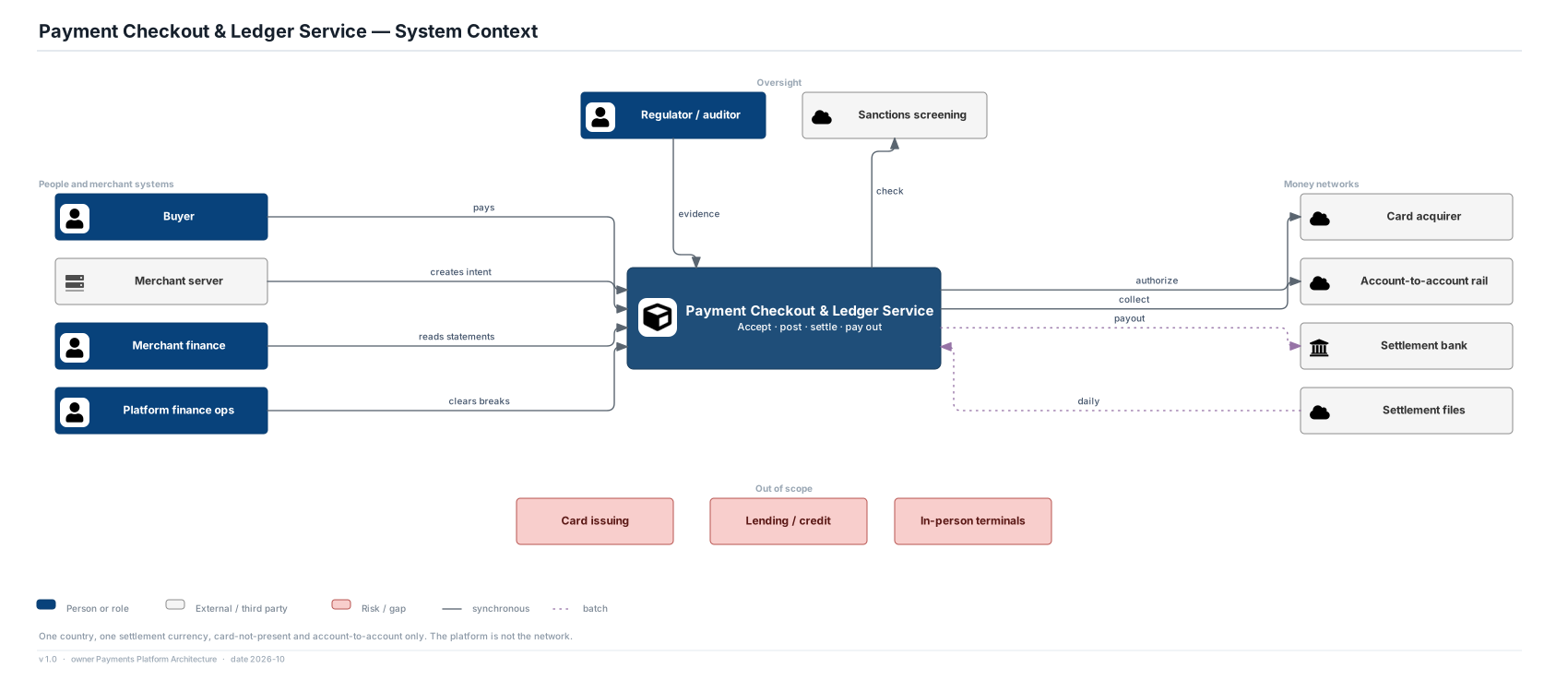
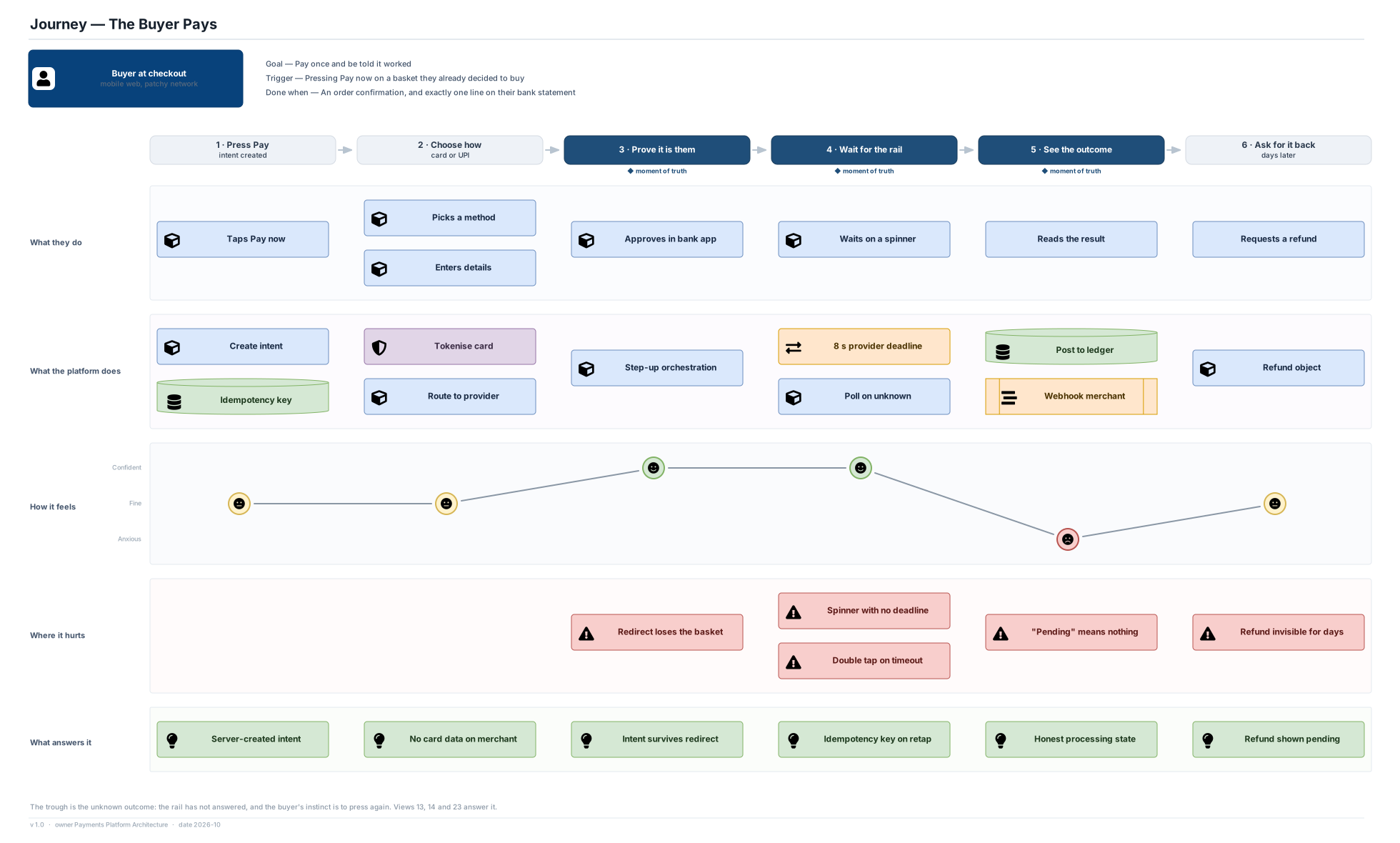
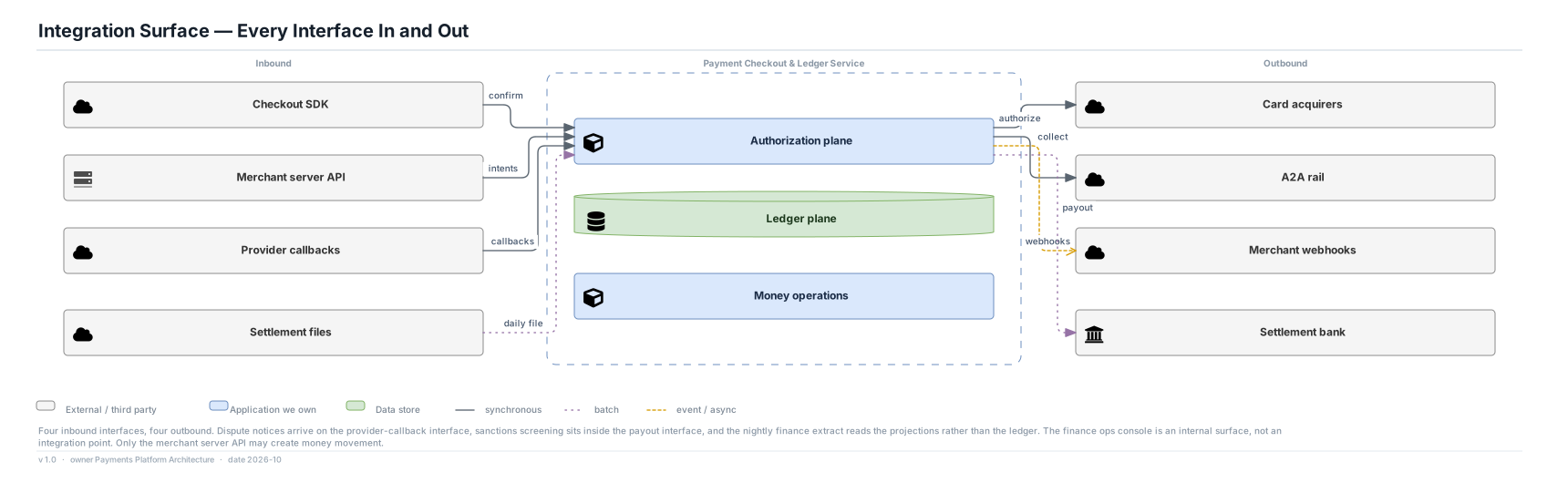
The service behind the "Pay now" button: it takes money from a buyer on a merchant's behalf, keeps a double-entry book of record that always balances, and pays the merchant out on schedule. Read it in seven acts. Act 1 sets the boundary. Act 2 is who it is for and what they get to do — read it before anything structural, because the trough in the buyer's journey is the whole design problem. Acts 3 and 4 are the parts and the data. Act 5 is what happens when the rails misbehave. Acts 6 and 7 are how it is run and why it is safe. One boundary decides the set: the authorization plane is allowed to fail, and the book of record is not allowed to be wrong.

Context and scope

What sits inside the boundary, which money networks it depends on, and what it deliberately is not.

People and journeys

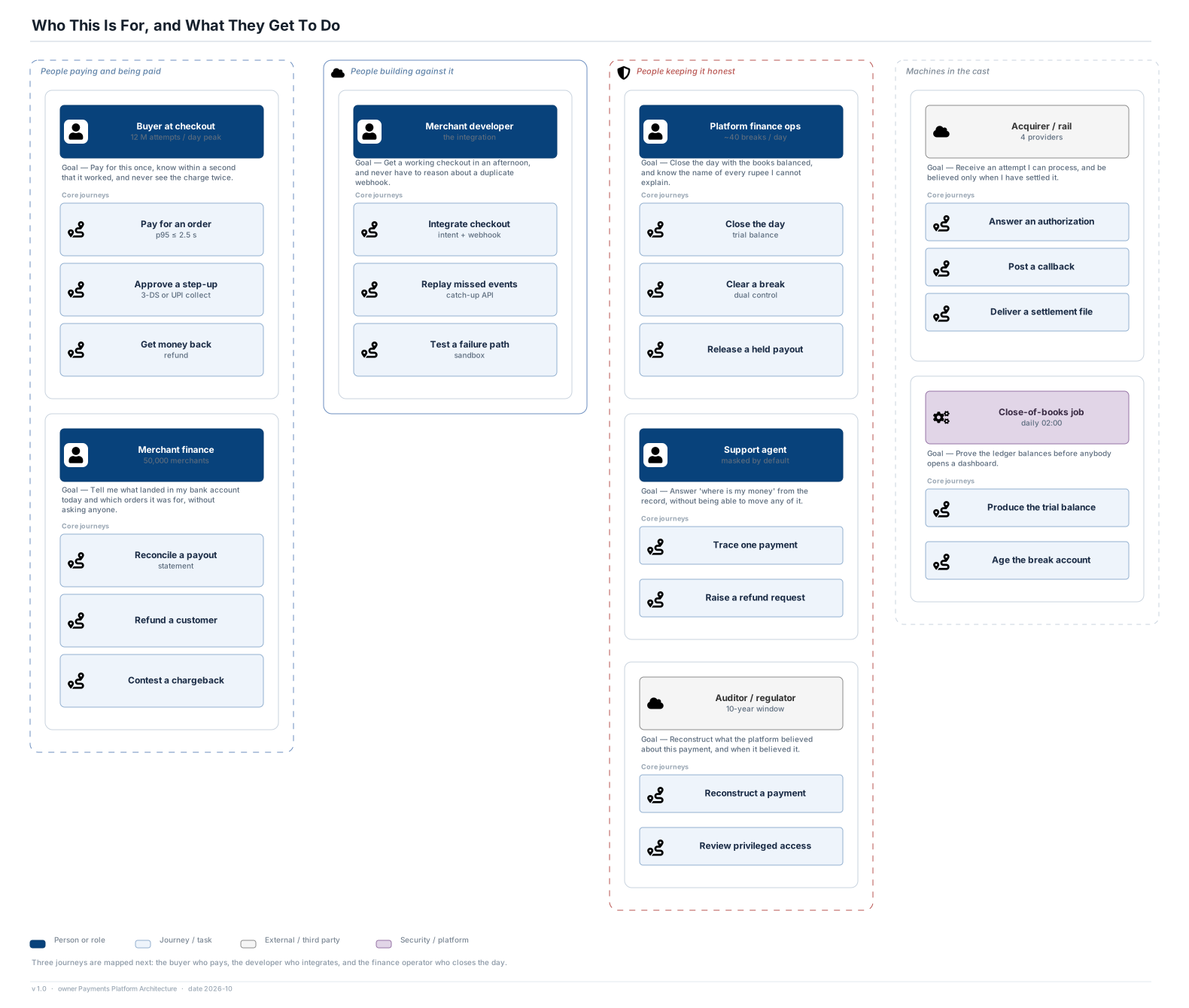
Who the platform is for, what each of them gets to do, and where each journey actually fails.
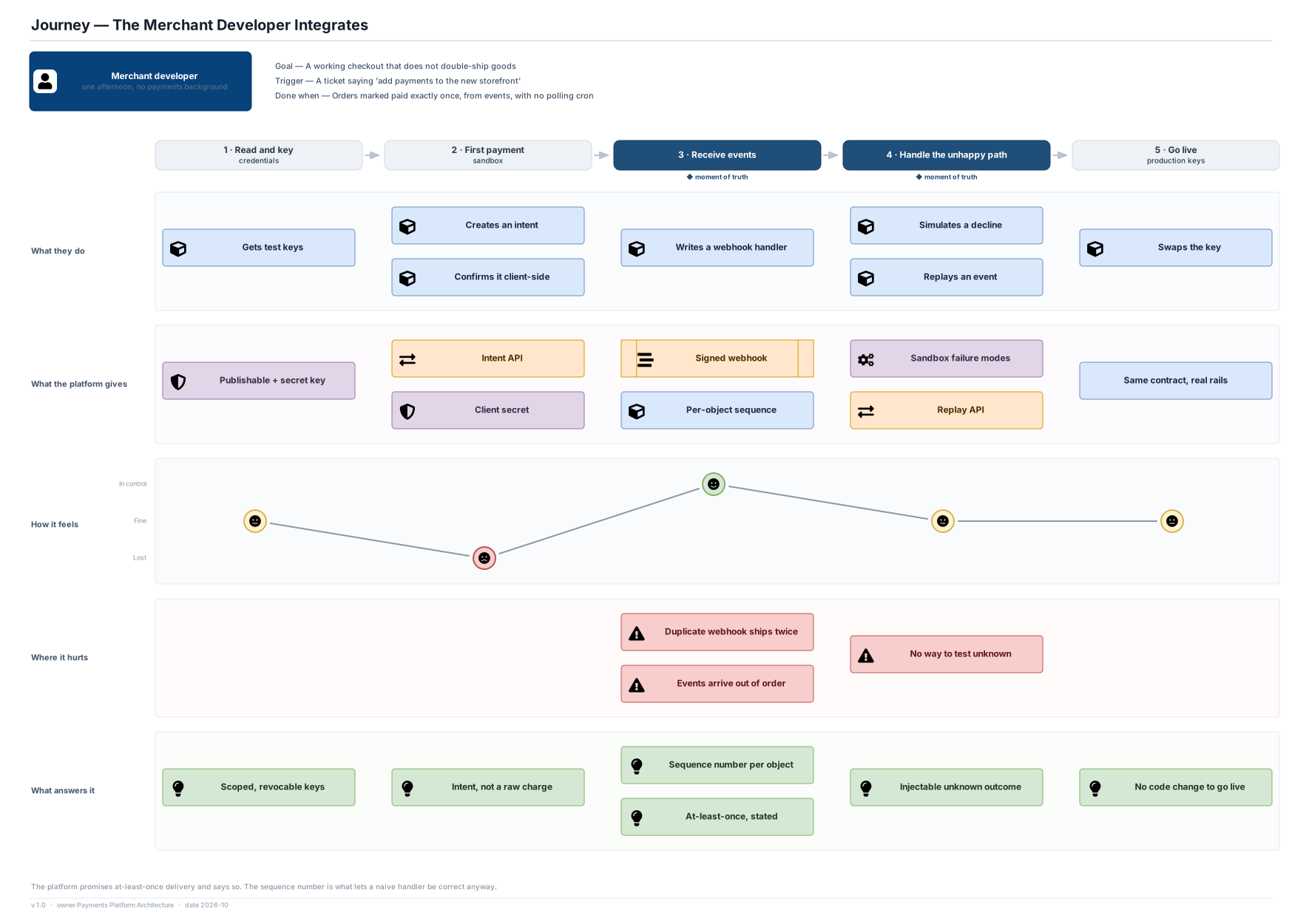
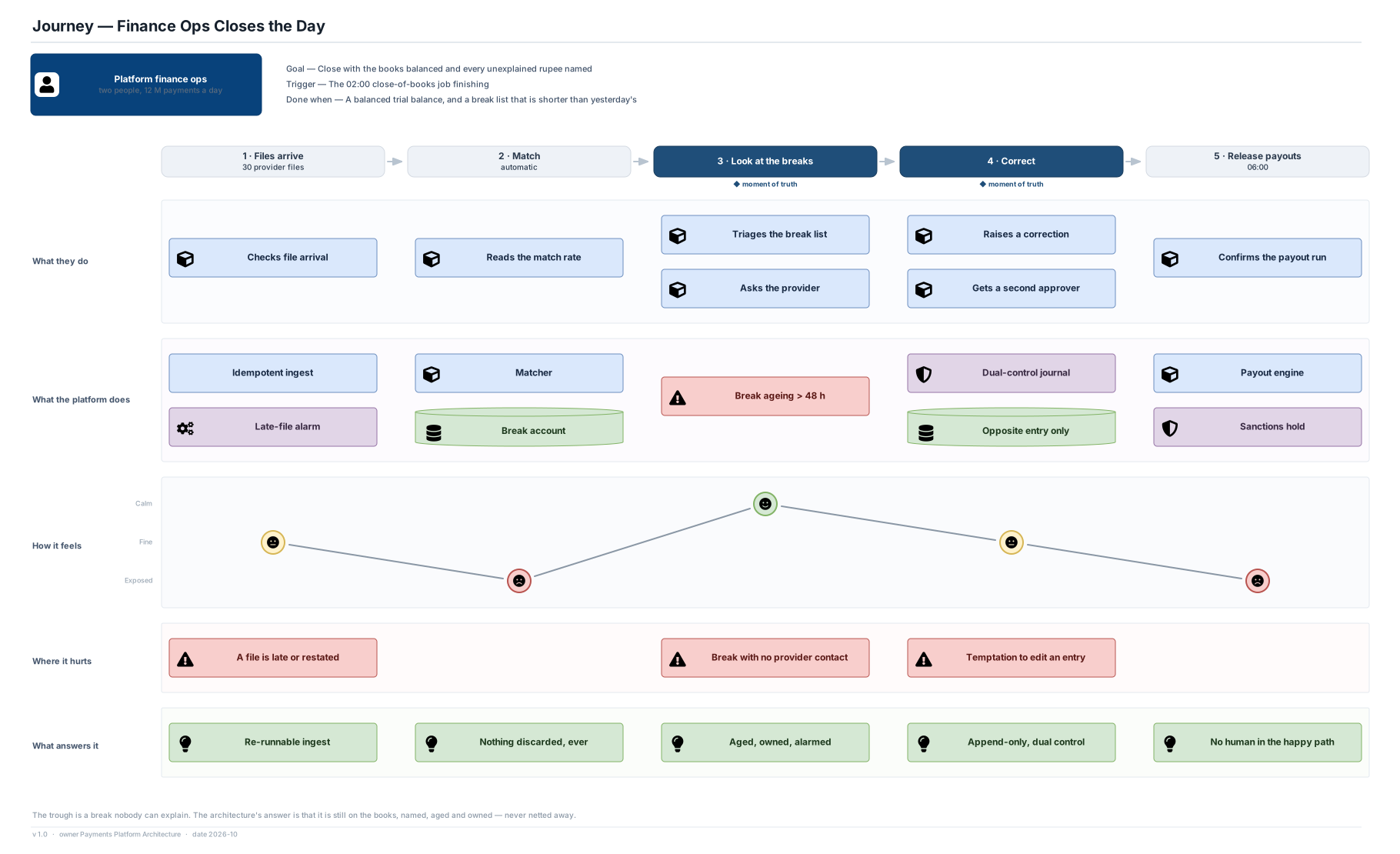
03 People paying and being paid Buyer at checkout 12 M attempts / day peak Goal — Pay for this once, know within a second that it worked, and never see the charge twice. Core journeys Pay for an order p95 ≤ 2.5 s Approve a step-up 3-DS or UPI collect Get money back refund Merchant finance 50,000 merchants Goal — Tell me what landed in my bank account today and which orders it was for, without asking anyone. Core journeys Reconcile a payout statement Refund a customer Contest a chargeback People building against it Merchant developer the integration Goal — Get a working checkout in an afternoon, and never have to reason about a duplicate webhook. Core journeys Integrate checkout intent + webhook Replay missed events catch-up API Test a failure path sandbox People keeping it honest Platform finance ops ~40 breaks / day Goal — Close the day with the books balanced, and know the name of every rupee I cannot explain. Core journeys Close the day trial balance Clear a break dual control Release a held payout Support agent masked by default Goal — Answer 'where is my money' from the record, without being able to move any of it. Core journeys Trace one payment Raise a refund request Auditor / regulator 10-year window Goal — Reconstruct what the platform believed about this payment, and when it believed it. Core journeys Reconstruct a payment Review privileged access Machines in the cast Acquirer / rail 4 providers Goal — Receive an attempt I can process, and be believed only when I have settled it. Core journeys Answer an authorization Post a callback Deliver a settlement file Close-of-books job daily 02:00 Goal — Prove the ledger balances before anybody opens a dashboard. Core journeys Produce the trial balance Age the break account Who This Is For, and What They Get To Do Person or role Journey / task External / third party Security / platform Three journeys are mapped next: the buyer who pays, the developer who integrates, and the finance operator who closes the day. v 1.0 · owner Payments Platform Architecture · date 2026-10 Actors and Their Core Journeys Six kinds of people and two machines, each with a goal in their own words. HTML page SVG draw.io

Structure

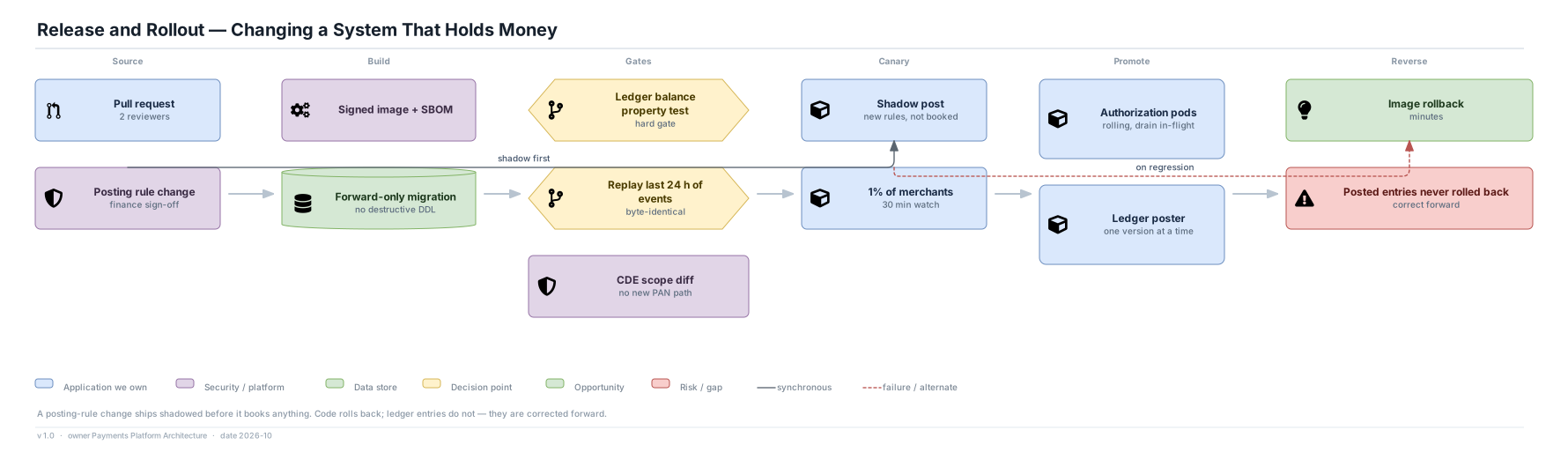
The parts, the planes they belong to, and the single path between them.
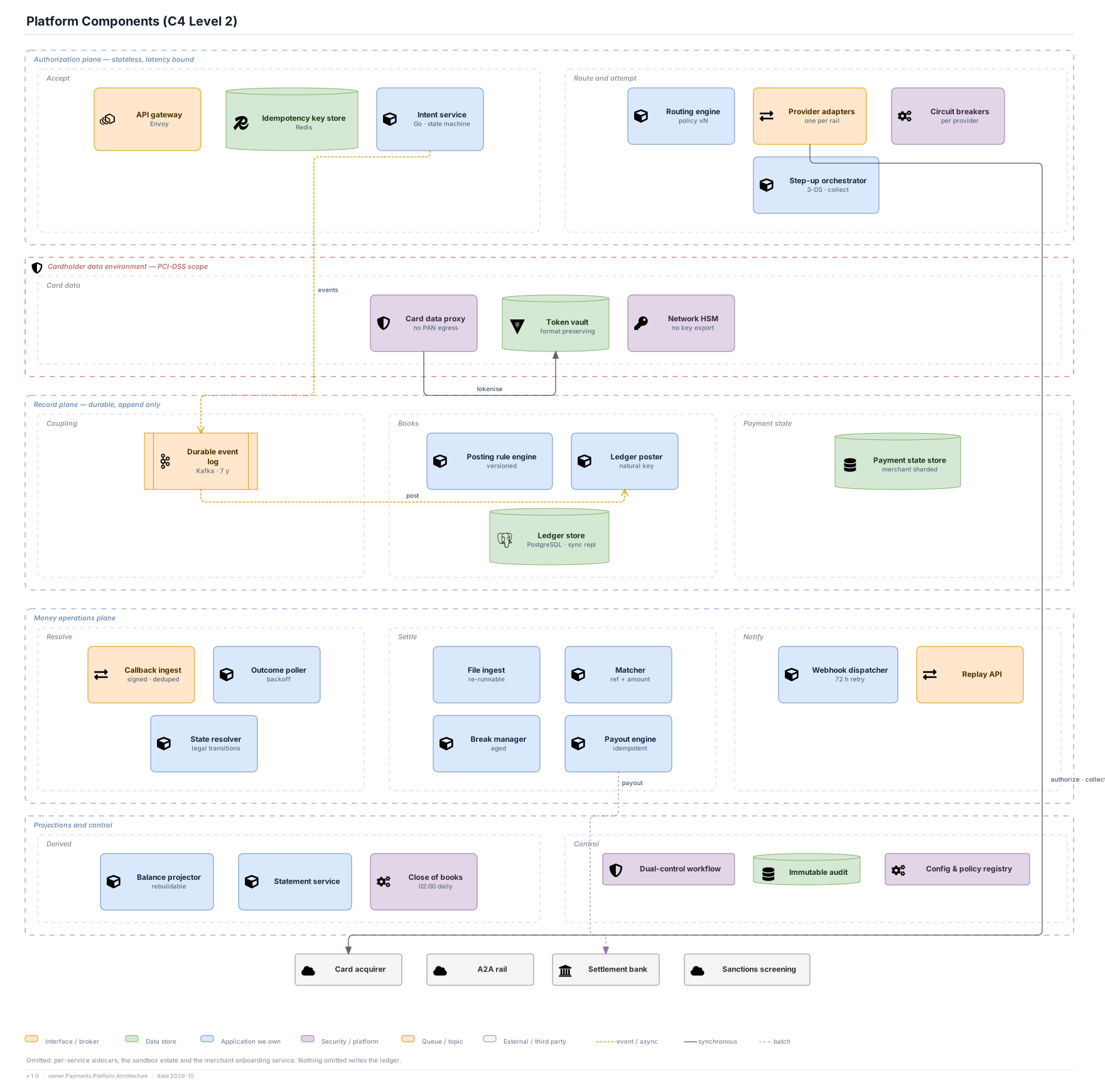
08 Authorization plane — stateless, latency bound Accept API gateway Envoy Idempotency key store Redis Intent service Go · state machine Route and attempt Routing engine policy vN Provider adapters one per rail Circuit breakers per provider Step-up orchestrator 3-DS · collect Cardholder data environment — PCI-DSS scope Card data Card data proxy no PAN egress Token vault format preserving Network HSM no key export Record plane — durable, append only Coupling Durable event log Kafka · 7 y Books Posting rule engine versioned Ledger poster natural key Ledger store PostgreSQL · sync repl Payment state Payment state store merchant sharded Money operations plane Resolve Callback ingest signed · deduped Outcome poller backoff State resolver legal transitions Settle File ingest re-runnable Matcher ref + amount Break manager aged Payout engine idempotent Notify Webhook dispatcher 72 h retry Replay API Projections and control Derived Balance projector rebuildable Statement service Close of books 02:00 daily Control Dual-control workflow Immutable audit Config & policy registry Card acquirer A2A rail Settlement bank Sanctions screening events post authorize · collect payout tokenise Platform Components (C4 Level 2) Interface / broker Data store Application we own Security / platform Queue / topic External / third party event / async synchronous batch Omitted: per-service sidecars, the sandbox estate and the merchant onboarding service. Nothing omitted writes the ledger. v 1.0 · owner Payments Platform Architecture · date 2026-10 Platform Components (C4 Level 2) Five planes: authorization, cardholder data, record, money operations and projections. HTML page SVG draw.io

Data

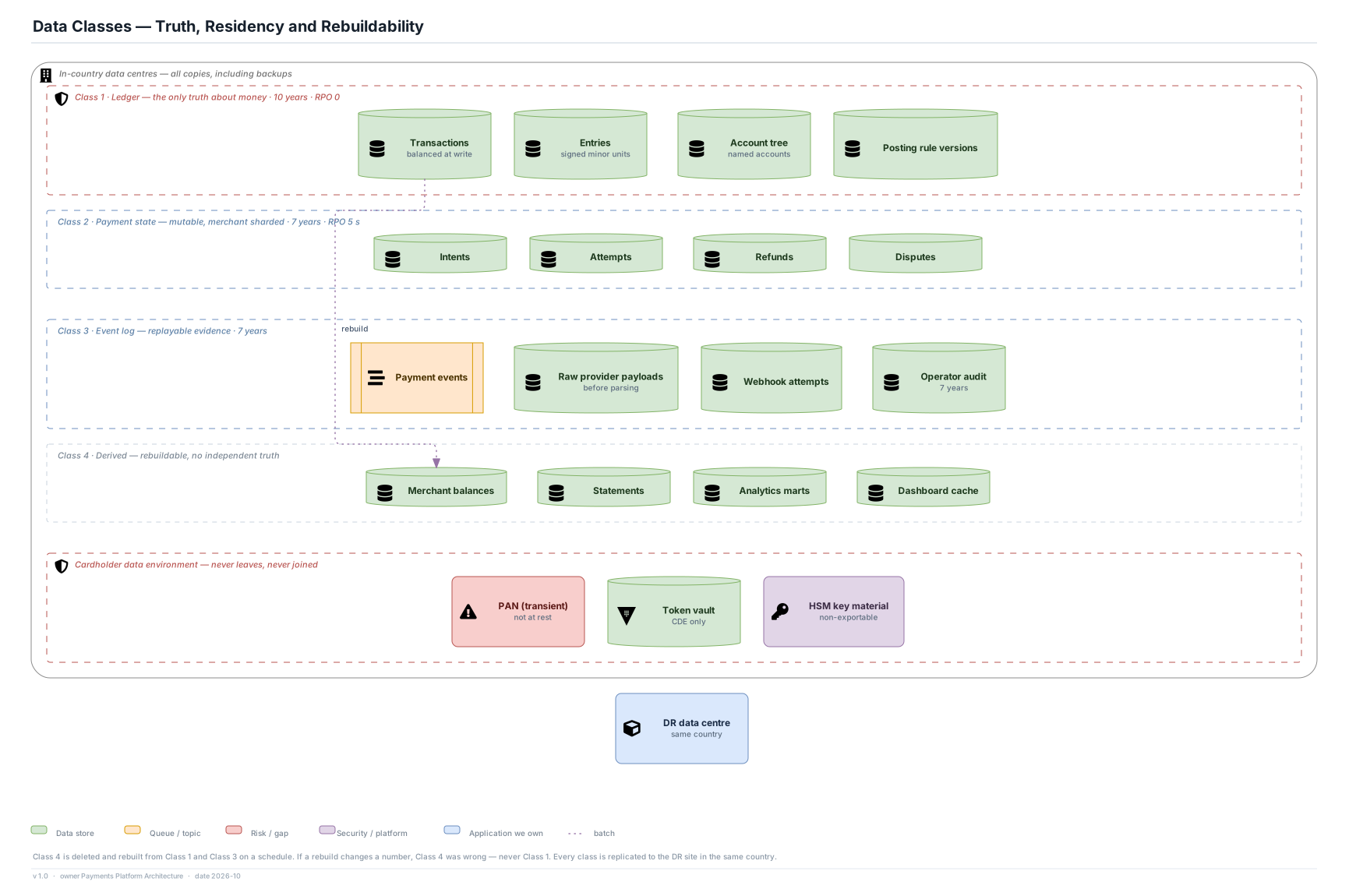
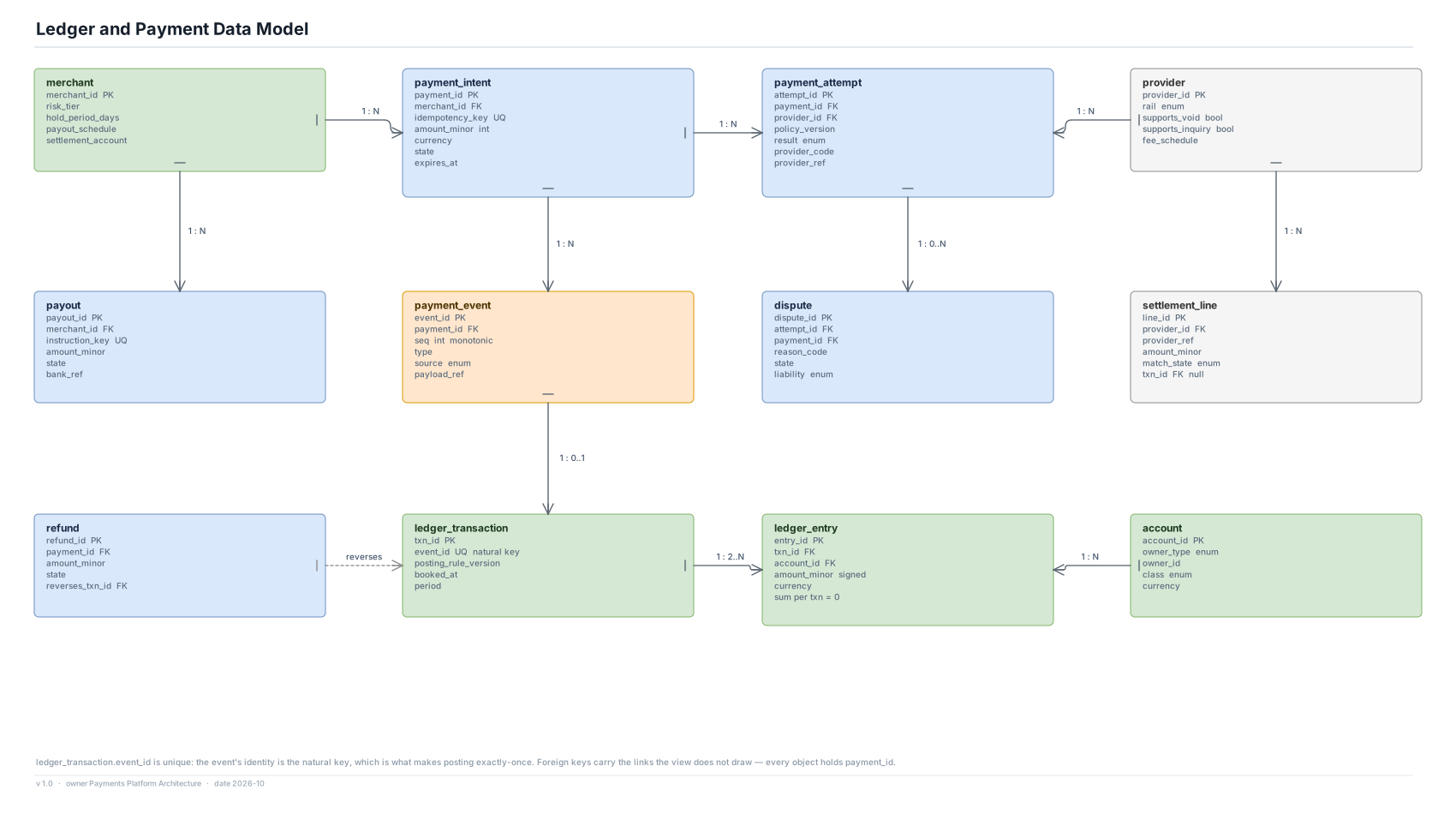
What is stored, which class is truth, which class is rebuildable, and what may never leave the cardholder environment.
12 merchant merchant_id PK risk_tier hold_period_days payout_schedule settlement_account payment_intent payment_id PK merchant_id FK idempotency_key UQ amount_minor int currency state expires_at payment_attempt attempt_id PK payment_id FK provider_id FK policy_version result enum provider_code provider_ref provider provider_id PK rail enum supports_void bool supports_inquiry bool fee_schedule payout payout_id PK merchant_id FK instruction_key UQ amount_minor state bank_ref payment_event event_id PK payment_id FK seq int monotonic type source enum payload_ref dispute dispute_id PK attempt_id FK payment_id FK reason_code state liability enum settlement_line line_id PK provider_id FK provider_ref amount_minor match_state enum txn_id FK null refund refund_id PK payment_id FK amount_minor state reverses_txn_id FK ledger_transaction txn_id PK event_id UQ natural key posting_rule_version booked_at period ledger_entry entry_id PK txn_id FK account_id FK amount_minor signed currency sum per txn = 0 account account_id PK owner_type enum owner_id class enum currency 1 : N 1 : N 1 : N 1 : N 1 : N 1 : 0..N 1 : N 1 : 0..1 1 : 2..N 1 : N reverses Ledger and Payment Data Model ledger_transaction.event_id is unique: the event's identity is the natural key, which is what makes posting exactly-once. Foreign keys carry the links the view does not draw — every object holds payment_id. v 1.0 · owner Payments Platform Architecture · date 2026-10 Ledger and Payment Data Model Twelve entities, and the one unique constraint that makes posting exactly-once without coordination. HTML page SVG draw.io

Runtime

What happens when a payment is actually made — including the case where the network will not say what happened.

Operations

Where it runs, what is watched, how the day closes, and how a system holding money is safely changed.

Assurance

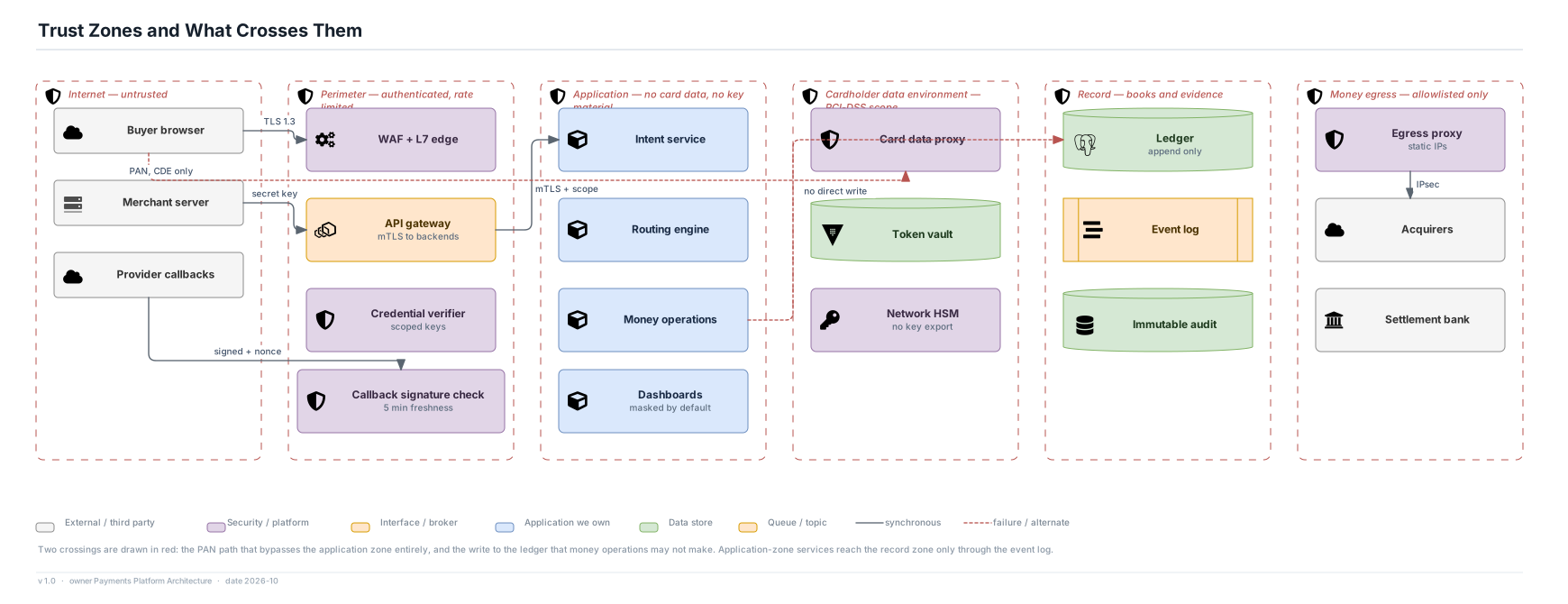
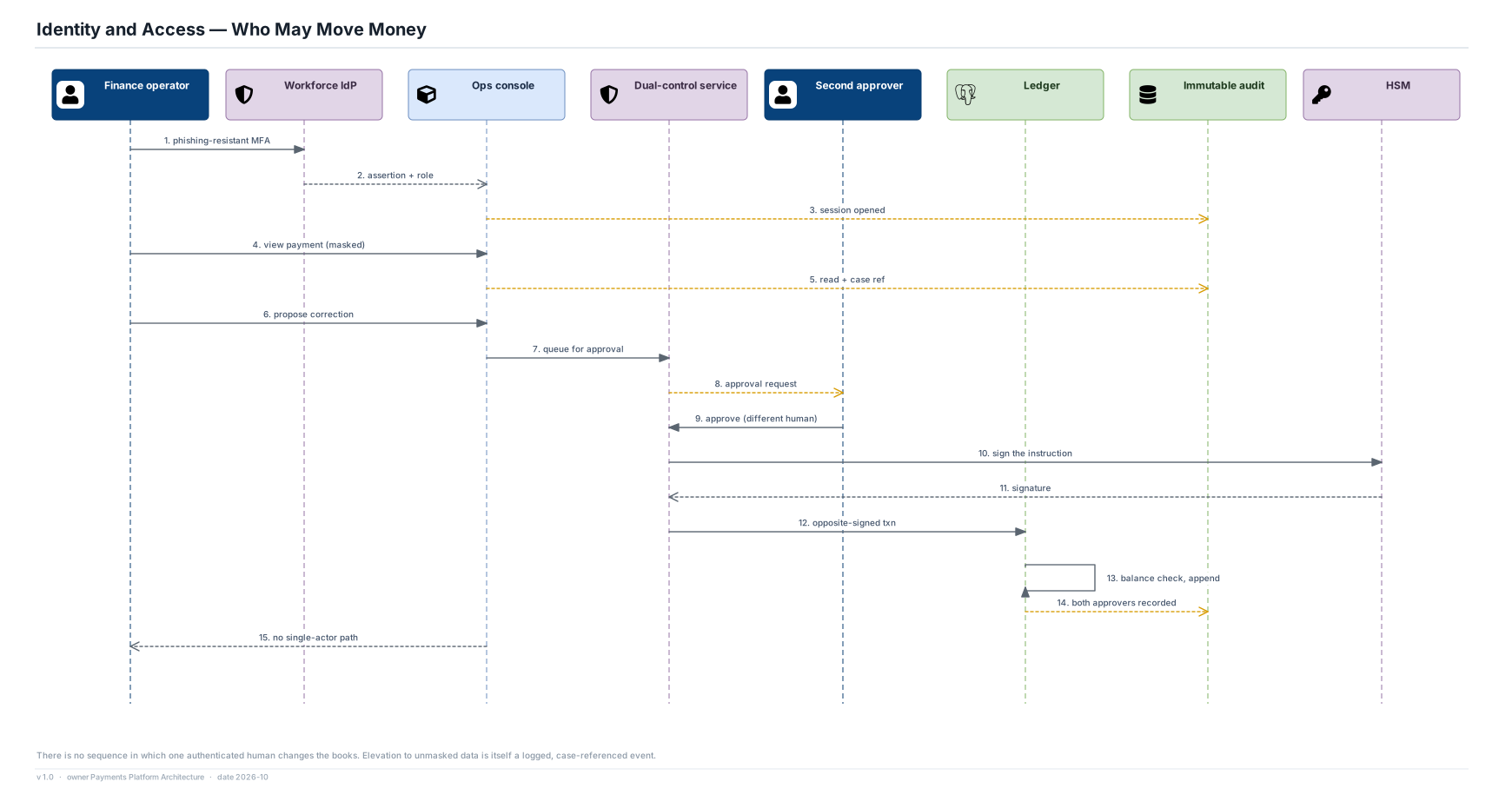
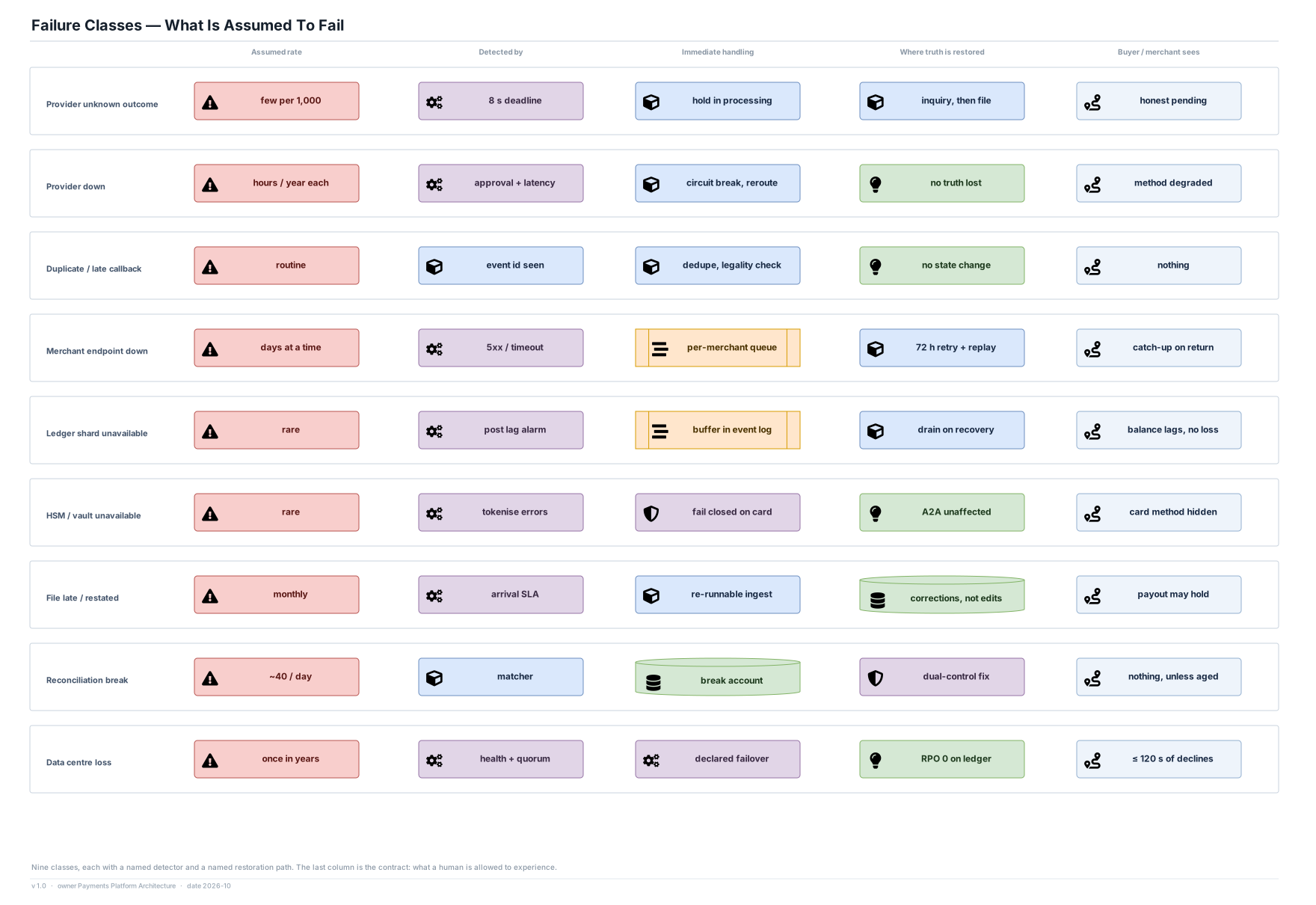
The trust boundaries, who may move money, and the failure classes the design assumes.

Architecture One-Pager

The problem, the shape of the answer, the decisions that carry it, and what a prototype should prove.

The authorization plane is allowed to fail; the book of record is not allowed to be wrong. A durable ordered event log is the only thing between them.

Everybody has pressed Pay now. What happens next is the part almost nobody sees, and it is harder than it looks for one reason: the money moves on networks the service does not own and cannot interrogate reliably. A card authorization can time out eight seconds after the issuer has already approved it, leaving the service genuinely unable to say whether the buyer has been charged. An account-to-account callback can arrive twice, out of order, or three hours late. A settlement file can turn up a day later and disagree with everything the service believed happened. Meanwhile the buyer is looking at a spinner and their instinct is to press the button again, the merchant is deciding whether to ship, and a regulator may ask in 2036 what the platform believed about this payment and when it believed it. A design that produces the right answer when the rails behave is not an architecture. It is a demo.

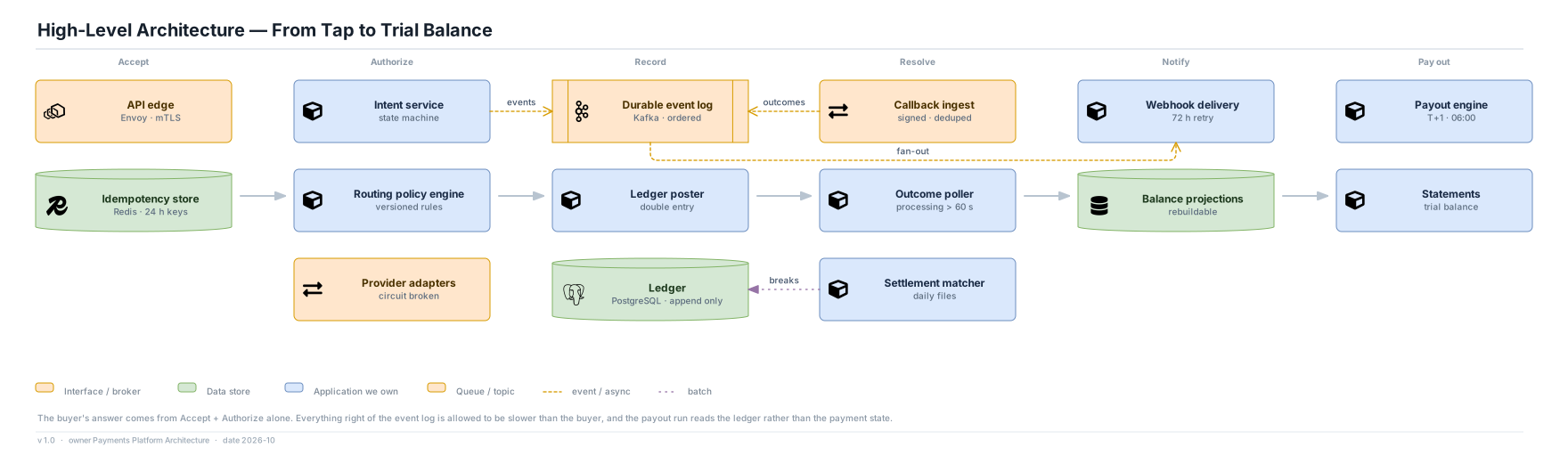
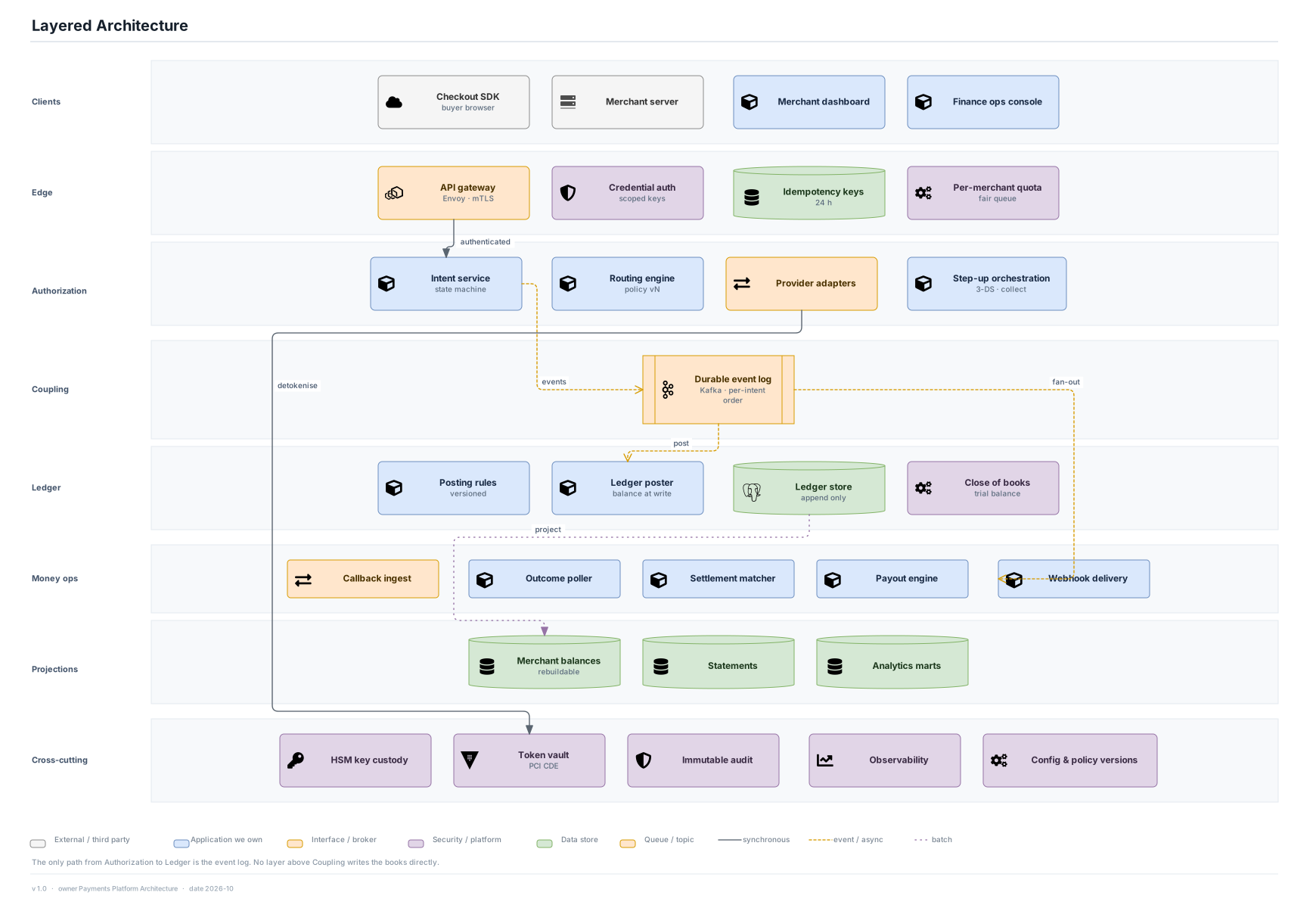
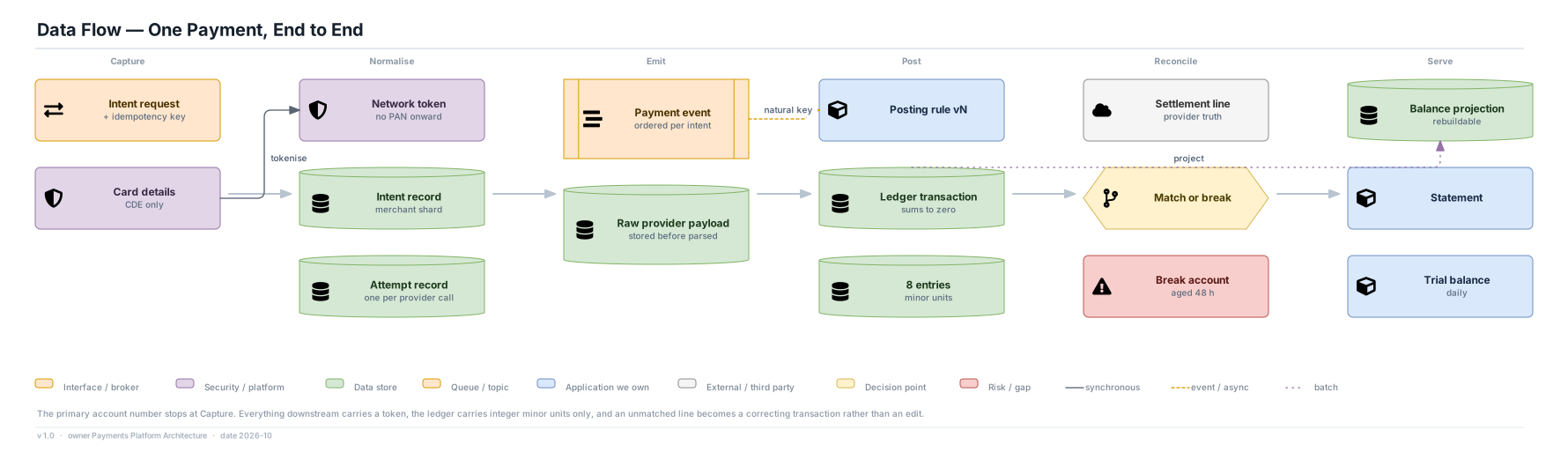
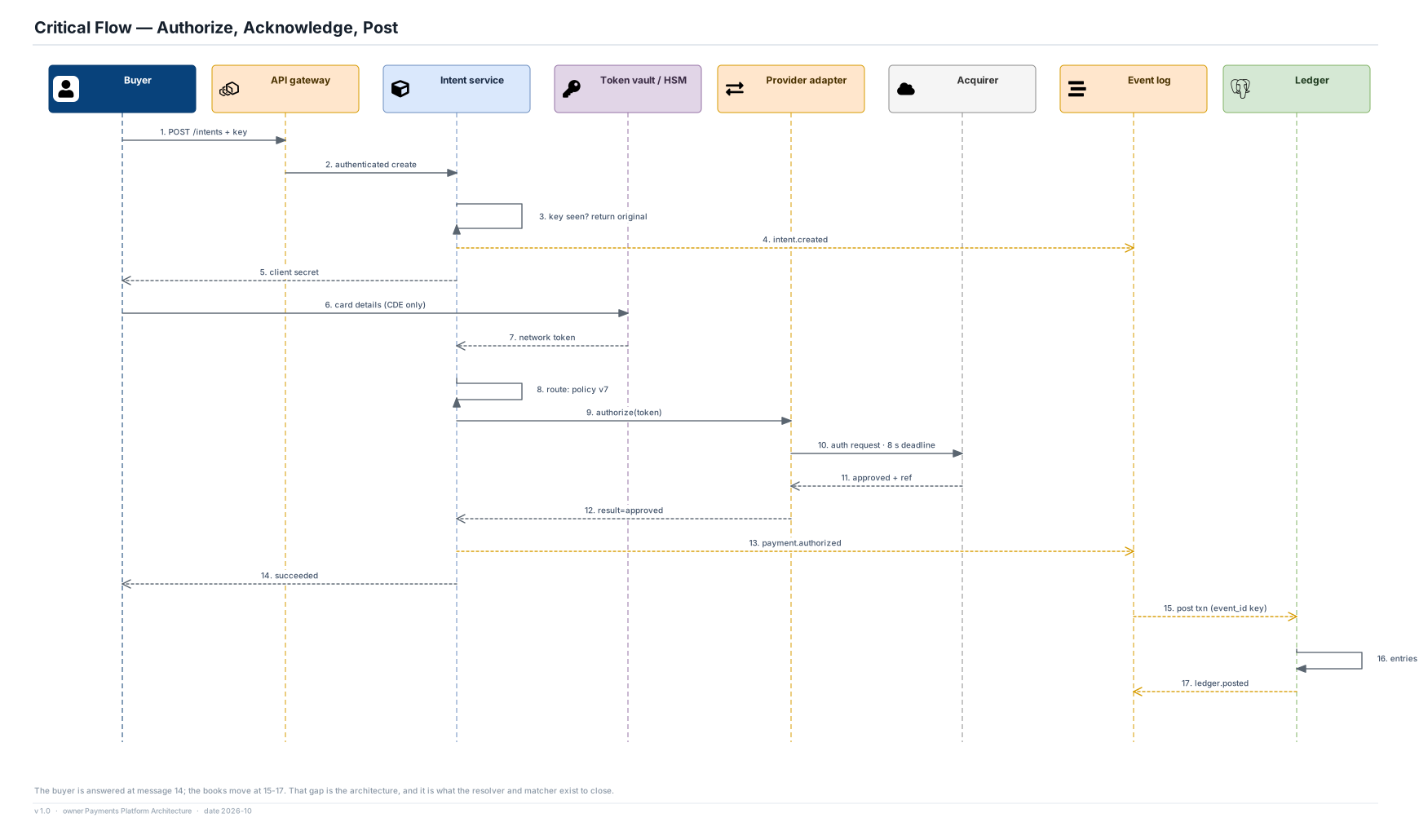
Split the system at the only boundary that matters. The authorization plane is stateless, latency-bound and allowed to fail: it authenticates the merchant, holds the payment intent's state machine, picks a provider from a versioned policy, calls it under a hard deadline, and answers the buyer. It holds no truth. The ledger plane is append-only double-entry, strongly consistent, synchronously replicated, slower by design, and allowed to be unavailable for writes for minutes without a buyer noticing — because nothing in it is on the buyer's path. Between them sits a durable ordered event log, which is the only coupling, and the reason a ledger partition does not become a checkout outage. Then accept the cost of that split honestly: there is a window in which a payment has succeeded in the world and is not yet in the books. Build the machinery that always closes it — an outcome poller for intents stuck in `processing`, a callback ingest that deduplicates and refuses illegal transitions, a daily settlement matcher whose file is the evidence, and a named break account for every amount that still cannot be explained. Treat `unknown` as an outcome rather than an error, never retry after one, declare idempotency separately at each boundary, and make every correction a new opposite-signed entry so the question "what did you believe, and when" always has an answer.

What it is, and what it is not

The double-entry ledger as the only truth about moneyA status column on a payments table, with balances cached beside it
Append-only, with corrections as new opposite entriesAn admin screen that can adjust a balance
`unknown` as a first-class provider outcomeA timeout treated as a failure and retried
The settlement file as the evidenceThe provider's synchronous HTTP response as the truth
Idempotency declared separately at each boundaryOne idempotency key assumed to cover every duplicate
At-least-once webhooks with a per-object sequenceExactly-once delivery promised to merchants
Unmatched value posted to a named, aged break accountUnmatched value netted away at month end
Fail closed on money movementAccept the payment and reconcile it later, optimistically

The decisions that are the architecture

01Authorization plane ≠ ledger plane, coupled only by a durable event log

The buyer-facing path is stateless, deadline-bound and permitted to decline, time out and fail closed; the book of record is append-only, strongly consistent and permitted to lag. A ledger outage becomes a balance that is behind, not a checkout that is down — and the price is a window the rest of the architecture exists to close.

ADR-01

02The ledger is append-only double entry, balanced at write time

Entries carry signed integer minor units, a transaction is rejected unless its entries sum to zero, and nothing is ever updated or deleted. Every balance, statement and report is a projection, so a number that cannot be derived from the ledger is a number the platform does not publish.

ADR-02

03Idempotency is declared separately at every boundary

The merchant's `Idempotency-Key` at the edge, the provider's own event identifier at the callback, the event identifier as a unique natural key on the ledger transaction, and a unique instruction key on the payout. Duplicate provider calls and duplicate ledger entries are different failures and need different keys.

ADR-03

04`unknown` is an outcome, and there is never a retry after one

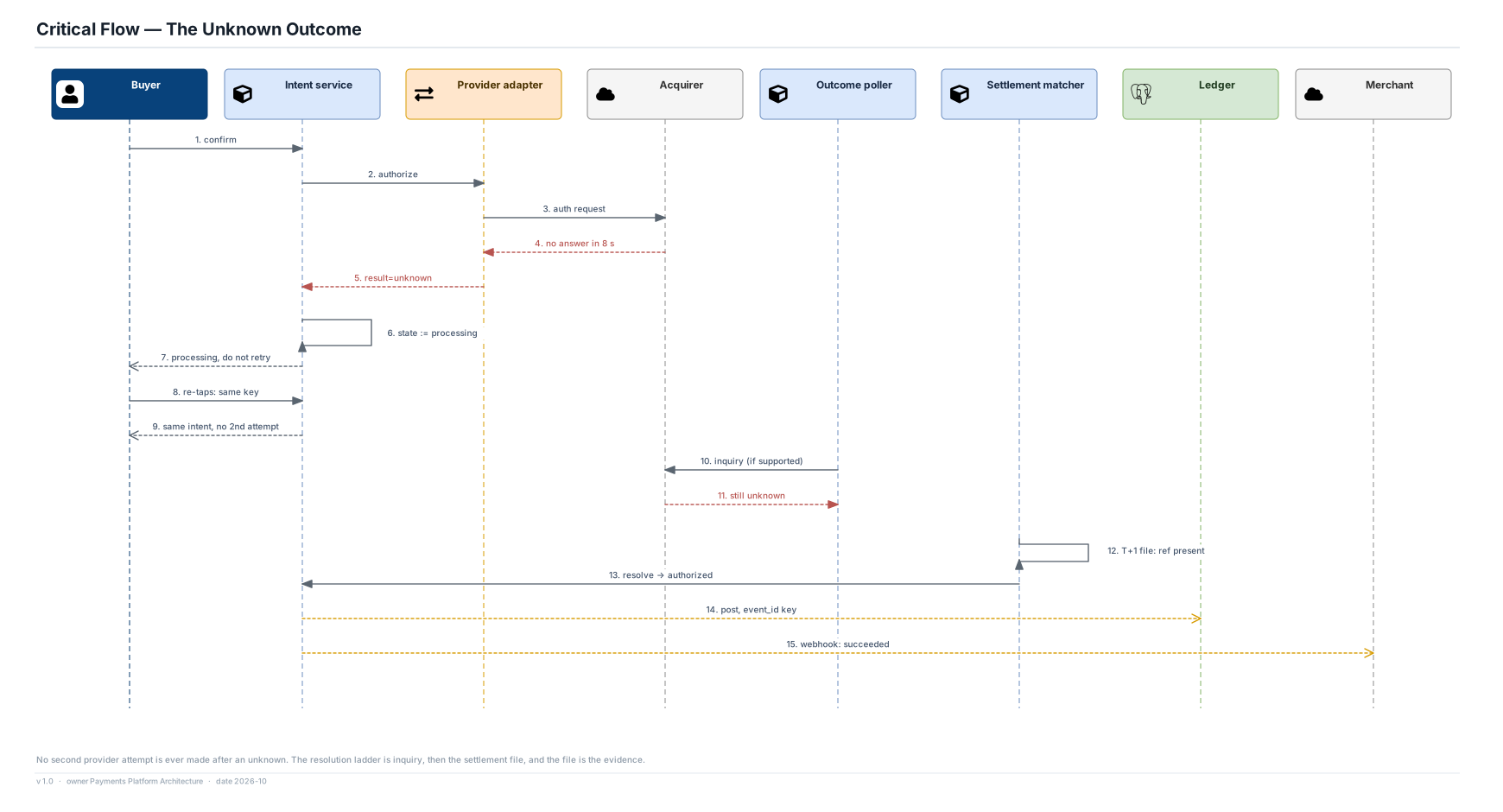
A provider that does not answer within eight seconds leaves the intent in `processing`, which only an inbound signal or a reconciliation job may leave. A retry is the one action that can produce a double charge, and the budget is one per million attempts.

ADR-04

05The provider's answer is a hint; the settlement file is the evidence

Raw callbacks are persisted before they are parsed, deduplicated on the provider's event identifier, and checked against the state machine's legal transitions. What the daily file says is what the platform ultimately books.

ADR-05

06Unmatched value is named, not netted

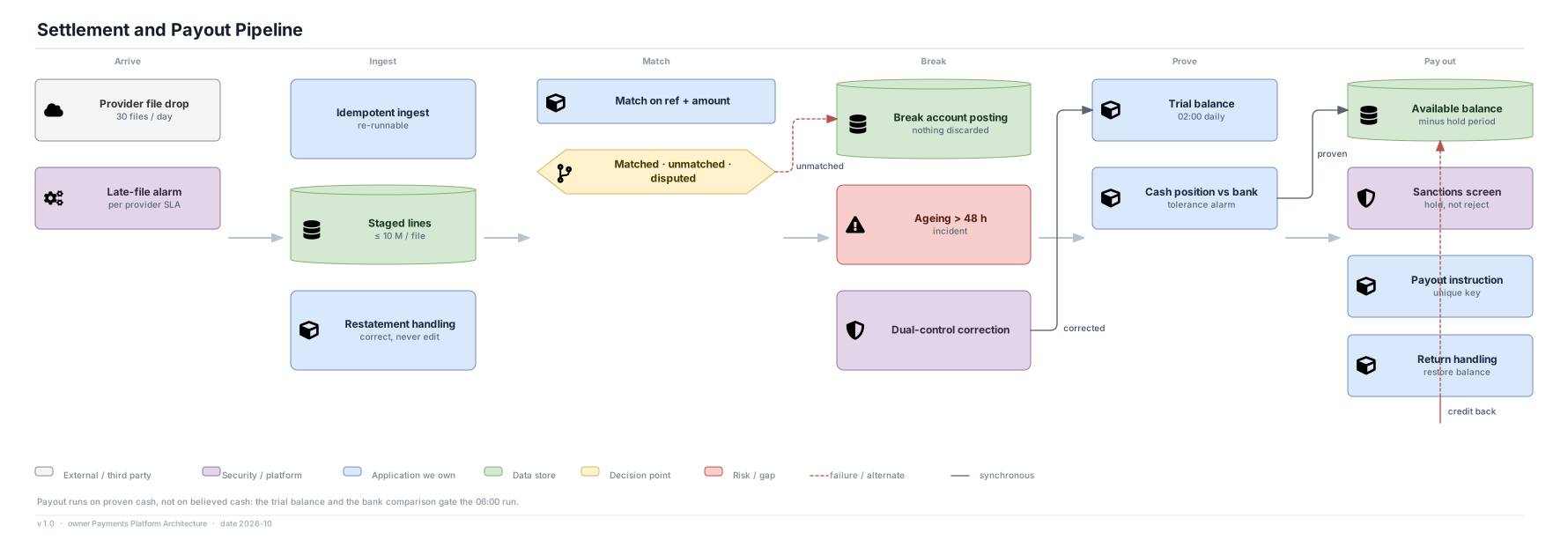
Every settlement line is matched, broken or disputed. A break is posted to a named account, aged, owned and alarmed past 48 hours. An unexplained rupee on the books is a finding; an unexplained rupee off the books is a loss nobody will ever find.

ADR-07

07Payment state is sharded by merchant; the ledger gives up a global sequence

No synchronous cross-shard transaction exists anywhere in the payment path, and one large merchant's sale cannot consume another's capacity. The ledger is partitioned by period and account class, providing per-account ordering and a deterministic close rather than one total order.

ADR-08

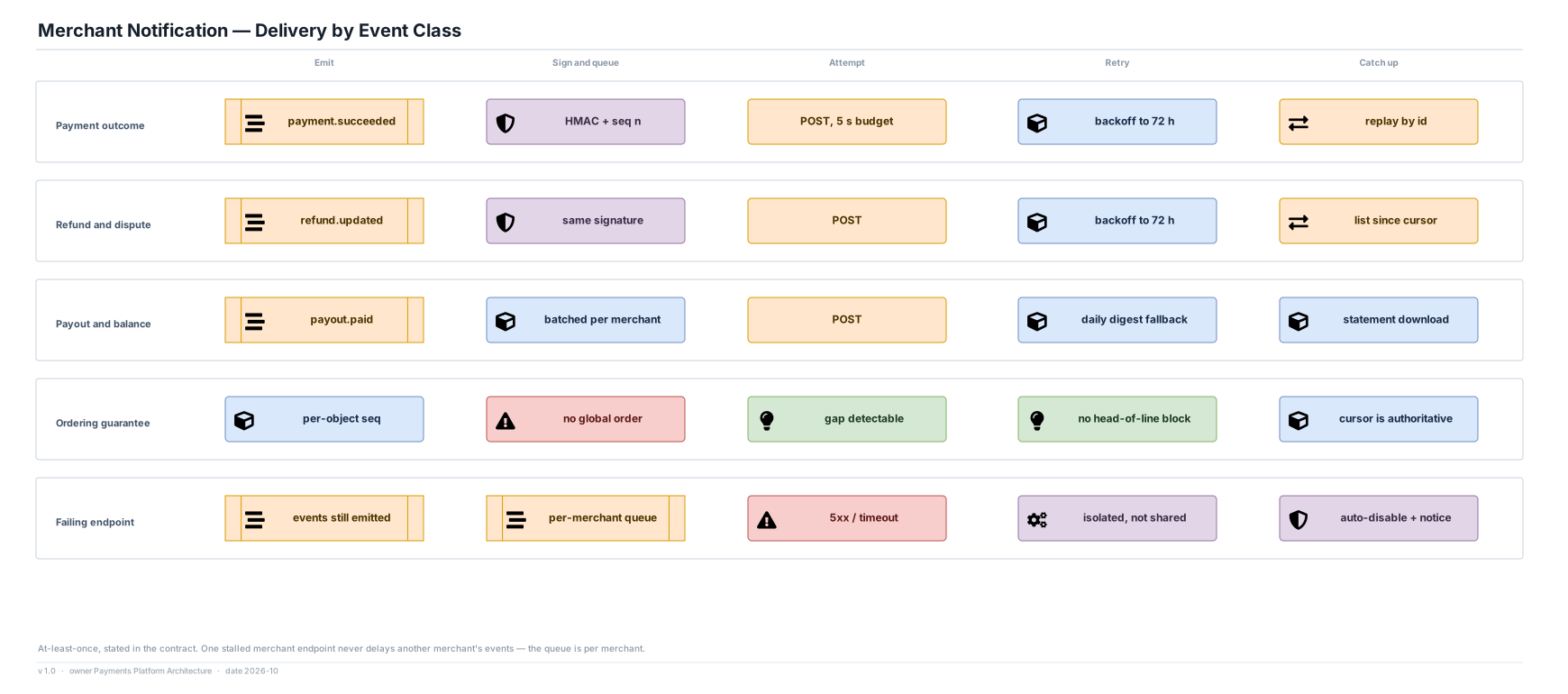
08At-least-once webhooks with a per-object sequence number

The platform promises what it can provide and says so, gives a monotonic per-object sequence so a gap is detectable, and queues per merchant so a stalled endpoint delays nobody else. Ordered delivery would be kinder to naive handlers and would turn one slow merchant into everyone's backlog.

ADR-09

09Keep the cardholder data environment small

Card details travel from the buyer's browser into a separately clustered CDE and never enter the application zone. Everything downstream carries a token, keys never leave the HSM, and a full compromise of the application zone yields tokens rather than the ability to take money anywhere.

ADR-11

10The platform holds merchant balances

Refunds, disputes, fees and hold periods become natural, and the platform becomes custodian of other people's money — segregated accounts, float accounting, a licence and a much larger account model. The alternative is a thin pass-through that pushes refund funding onto merchants.

ADR-13

11Dual control is a service in the path, not a policy in a document

No sequence exists in which one authenticated human changes the books. The proposal and the approval are separate authenticated acts by different people, and the resulting instruction is signed in the HSM so the approval is evidence rather than a row somebody could write.

ADR-14

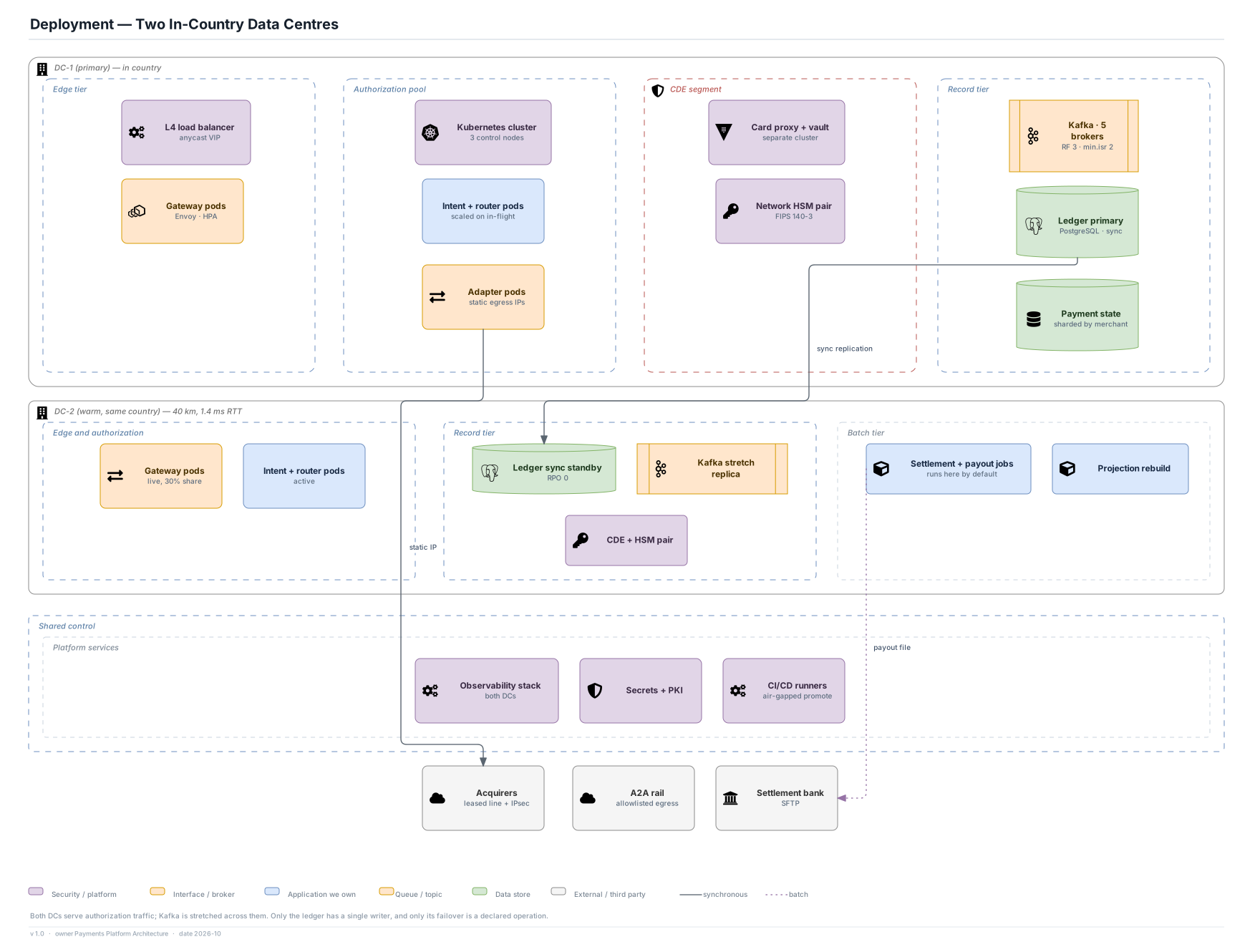
12Self-managed open source in two in-country data centres

Data localisation, PCI-DSS scope containment and a money path with no dependency a regulator has not approved outweigh the operational cost of running Kubernetes, Kafka, PostgreSQL and HSMs. Forty kilometres between sites is what makes synchronous replication and RPO 0 affordable.

ADR-18

Why this should still be right in ten years

The container platform, the broker, the relational store, the HSM vendor and every provider integration in this set will be replaced inside the platform's life. These are the properties that should outlast them.

The boundary is not a technology

"The buyer-facing path may fail; the book of record may not be wrong" is a statement about where truth lives, not about Kafka or PostgreSQL. Every component named in this set can be replaced without touching that sentence.

Double-entry is older than computing and will outlive this stack

The ledger's shape — balanced transactions, signed entries, named accounts, corrections as new entries — predates every technology here by centuries and is the one part of the design that will not need revisiting. Choosing it is choosing not to invent a money model.

`unknown` will still be an outcome

New rails arrive constantly and every one of them will occasionally fail to say what happened. A design that treats ambiguity as a first-class state absorbs a new rail as an adapter; a design that treats it as an error rewrites itself for each one.

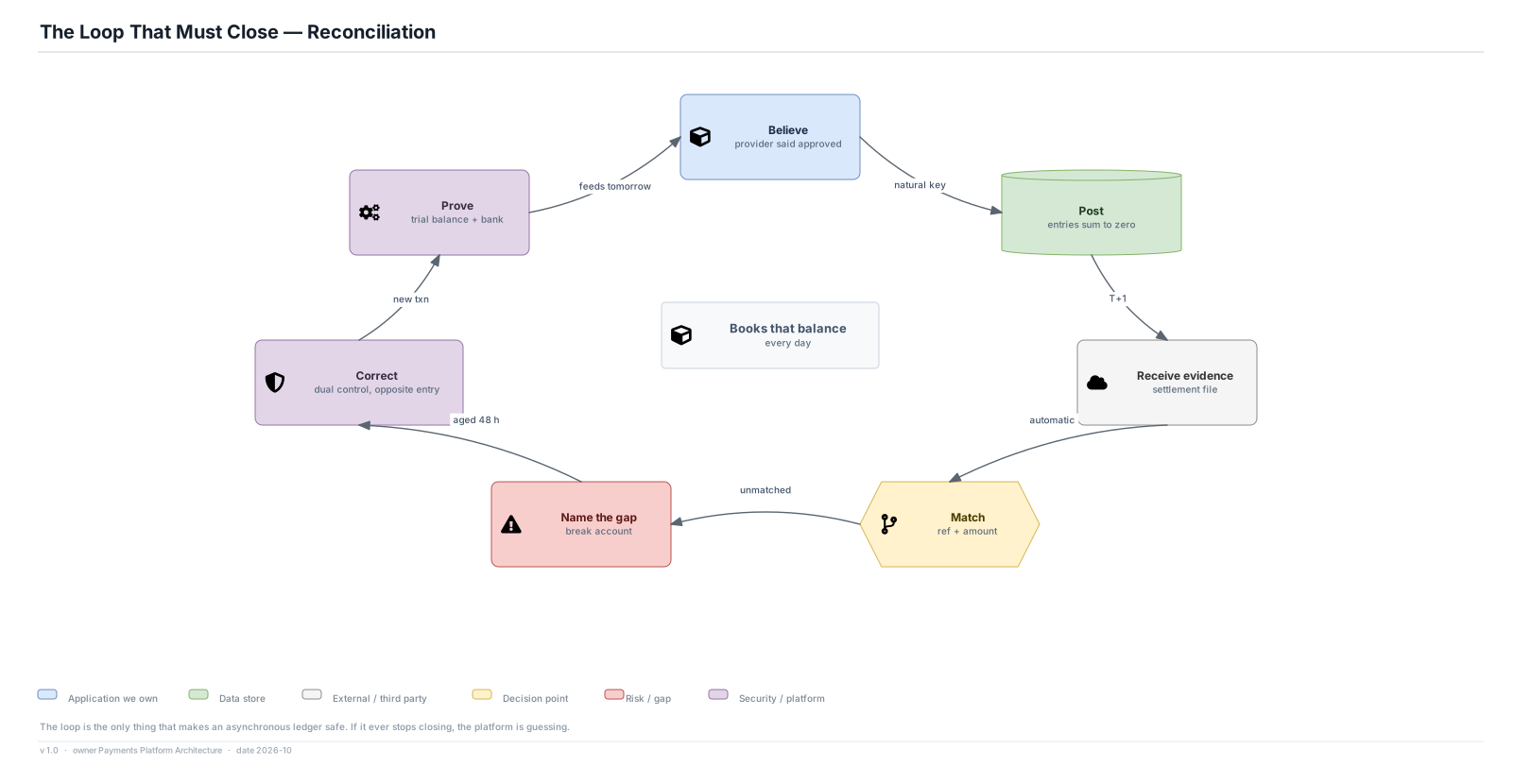
Reconciliation outlives trust in any provider

The loop of believe, post, receive evidence, match, name the gap, correct and prove is independent of who the providers are, how many there are, and what protocol they speak. It is the control that makes every other optimism in the system safe.

Evidence beats state

Storing the raw payload before parsing it, the policy version that made each routing decision and the posting rule version that booked each transaction means a question asked in 2036 is answerable from data rather than from code archaeology. Code changes; stored evidence does not.

The blast radius is drawn, not asserted

A leaked merchant credential can take money only into that merchant's own settlement account, and an application-zone compromise yields tokens. Those are structural properties of where data and keys live, so they survive every refactor that respects the zones.

Non-functional targets

Every figure below is a stated assumption for this design, chosen to be defensible and arguable rather than measured. A reviewer who changes one can follow it to the decision that depends on it.

QualityTargetHow it is metView
Authorization availability ≥ 99.99% monthly, maintenance included Stateless pods across two in-country DCs both serving traffic; circuit-broken providers; fail closed rather than lossy acceptance 18
Ledger write availability ≥ 99.99% monthly Synchronous replication at 1.4 ms RTT; posting buffers in the event log when the store is unwritable and drains on recovery 18
Intent create latency p99 ≤ 120 ms Single-shard write, idempotency key in an in-memory store, no provider call on this path 13
Confirm latency, platform time p99 ≤ 250 ms excluding provider Routing evaluated from cached policy; tokenisation on a separate hop inside the CDE 13
Buyer-visible confirm p95 ≤ 2.5 s, hard ceiling 8 s Hard per-provider deadline; `unknown` on expiry rather than an extended wait 14
Ledger posting lag p99 ≤ 2 s after a terminal event Dedicated poster consuming the event log, natural-key idempotent, one version at a time 13
Throughput 420 attempts/s steady, 4,000/s for 10 min Scale on concurrent in-flight provider calls; per-merchant concurrency limits and fair queuing 08
Double-charge rate ≤ 1 per 1,000,000 attempts Edge idempotency key, no retry after `unknown`, legality-checked callbacks, natural-key posting 14
Lost ledger entries zero tolerance Append-only store, balance check at write, synchronous replication, replay from the event log 12
Settlement match 100% matched or broken within 24 h; unmatched ≤ 0.01% of daily value Idempotent re-runnable ingest, match on provider reference and amount, named break account with 48 h ageing 16
Webhook delivery 99.9% dispatched within 5 s; 72 h retry Per-merchant queue, signed payload, per-object sequence number, pull-based catch-up API 17
Payout timeliness T+1 initiated by 06:00 local for 99.5% of eligible balances Nightly close gates the run; proven cash only; unique instruction key; returns restore the balance 16
Durability Ledger RPO 0; payment state RPO ≤ 5 s Synchronous ledger replication across two in-country DCs; asynchronous state replication 18
Recovery Authorization RTO ≤ 120 s; ledger write RTO ≤ 15 min; reporting RTO ≤ 4 h DC-2 already carrying ~30% of traffic; declared ledger failover; projections rebuilt rather than recovered 18
Retention Ledger 10 y; state and raw payloads 7 y; audit 7 y; logs 400 d Partition-level archival of closed periods with query support preserved; no PAN at rest outside the CDE 11

Scope

In scope

  • Server-created payment intents with an explicit state machine, edge idempotency, separate authorize and capture, partial and multiple captures, and expiry with a provider void
  • Card (network tokenised), account-to-account real-time transfer, wallet redirect and mandate debit behind one provider interface, with normalised outcomes including `unknown`
  • Versioned declarative provider routing with health and cost inputs, circuit breaking per provider and per method, and a capped second attempt on retriable declines only
  • Signed, deduplicated, legality-checked provider callbacks; an outcome poller for intents in `processing`; and a settlement matcher with authority to resolve payment state under constraint
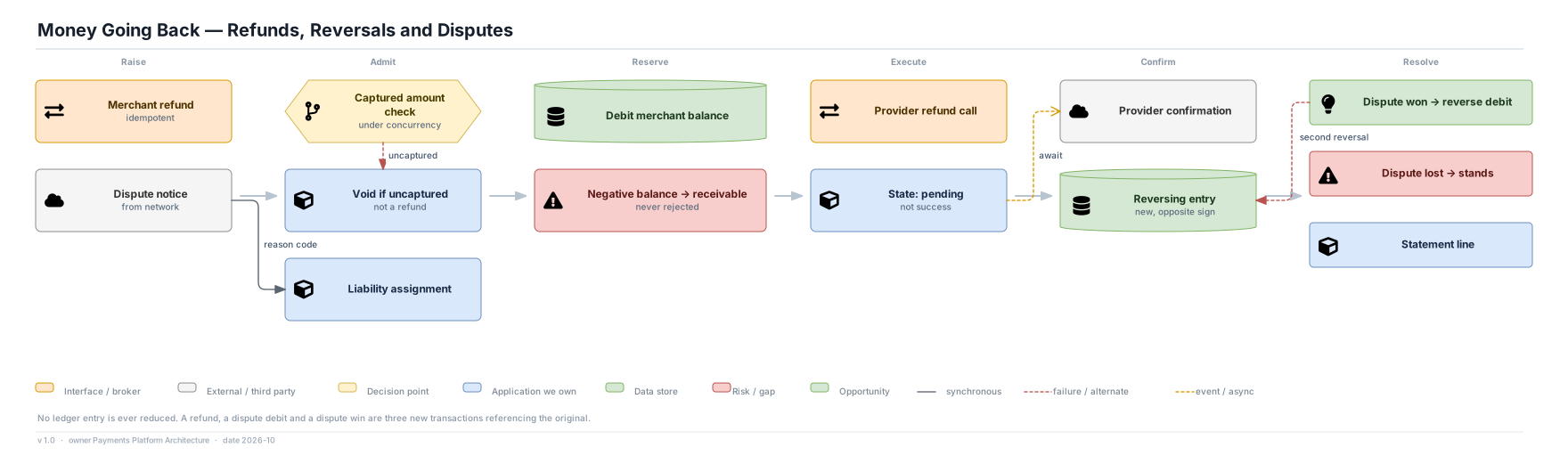
  • Full and partial refunds, voids of uncaptured authorizations, dispute and chargeback lifecycle with merchant debit and reversal, and receivables where a merchant balance goes negative
  • A double-entry ledger as sole system of record: balanced at write, append-only, versioned posting rules, natural-key idempotency, daily trial balance and cash-position proof
  • Daily settlement-file ingest with restatement handling, matching, a named and aged break account, and dual-control correction
  • Merchant balances with per-risk-tier hold periods, T+1 payouts with unique instruction keys, sanctions holds, return handling and per-period merchant statements
  • Signed at-least-once merchant webhooks with per-object sequence numbers, 72-hour retry, replay and a pull-based catch-up API
  • A PCI-DSS-scoped cardholder data environment with a token vault and HSM key custody, and a browser-to-CDE path that bypasses the application zone
  • Dual control on every privileged money operation, immutable operator audit with case references, masked-by-default operator views and logged elevation

Explicitly out of scope

  • Card issuing, lending and credit, and in-person terminals with their EMV kernels, key injection and offline capture
  • Acting as a payment network: the platform never clears or settles on its own rails
  • Merchant onboarding, KYC, risk scoring and pricing configuration — a separate platform whose merchant records this service reads
  • Fraud detection and decisioning as a product: the platform carries the hooks and the routing inputs, not the models
  • Multi-currency settlement, FX rate custody and revaluation, marketplace splits and inter-merchant transfer — all deferred, and all of them reshape the ledger's account model
  • The merchant's own storefront, order management and shipping decisions, including whether to ship on `processing`
  • Tax calculation and invoice generation; the ledger records tax withheld, it does not compute liability

What a four-week prototype should prove

The prototype's job is to falsify the two central claims — that an asynchronously posted ledger can be made provably correct, and that the unknown outcome can be resolved without ever double-charging — on one rail and one merchant, not to build a platform.

  1. One provider adapter against a simulator that can be told to approve, decline, time out silently, callback twice, callback out of order and omit a line from the settlement file.
  2. The full intent state machine with edge idempotency, and a real append-only double-entry store that rejects an unbalanced transaction at write time.
  3. The ledger poster consuming an event log with the event identifier as a unique natural key. Replay the whole log three times and prove the ledger is byte-identical.
  4. A settlement matcher, a break account, and a daily trial balance. Inject a missing line, a duplicate line and a restated file, and show the books still balance with the gap named.
  5. A property test that generates random sequences of approve / decline / timeout / duplicate-callback / late-callback and asserts, over ten thousand runs, that no intent ever produces two captures and no ledger transaction is ever posted twice.
  6. Measure intent create and confirm latency at p50 and p99 under 500 attempts a second against the simulator, and measure the posting lag separately.
  7. Deliberately excluded: disputes, payouts, multi-provider routing, the CDE, dashboards and anything with a user interface. If the above does not hold, none of them matter.
  • Tell the provider simulator to accept the authorization and then never answer: does the intent end in `processing`, does the buyer's second tap create a second attempt, and is the payment resolved from the settlement file within the window?
  • Deliver the same provider callback five times, two of them out of order and one for a state that is already terminal: does the ledger hold exactly one transaction, and is the ignored transition recorded rather than dropped?
  • Omit one line from the settlement file, then deliver a restated file containing it the next day: does the break appear, age, and clear by a correcting transaction rather than an edit?
  • Kill the ledger store mid-run for ten minutes: do authorizations keep succeeding, does posting lag alarm, and does the ledger drain to exactly the right state on recovery with nothing double-posted?
  • Replay the entire event log three times into an empty ledger: is the result byte-identical each time, and does the trial balance come out at zero?
  • Issue two concurrent refunds that together exceed the captured amount: is exactly one accepted, and does the rejection name the reason?
  • Submit the same merchant `Idempotency-Key` with a different amount: is it a conflict rather than a second payment?
  • Attempt a manual ledger correction with one operator account: does the ledger refuse it for want of a second signature?

Open risks, carried rather than hidden

RiskIf it landsResponse
The window between a successful payment and a posted ledger entry is permanent, by design A merchant can be told 'paid' seconds before the balance moves, and in the `unknown` case up to 24 hours before it moves The poller, the callback resolver, the matcher and the break account exist only to guarantee the window always closes and that its contents are visible while open; posting lag and processing age are first-class business metrics (ADR-01, ADR-07, ADR-12)
The reconciler has authority to change payment state, which makes a batch job a writer to the payment path A race between the resolver and a live callback could produce a double transition; the alternative is an unbounded manual backlog Resolution goes through the same state machine and legality check as any other transition, is idempotent on the event identifier, and is audited as a distinct source; the constraint is the whole content of ADR-12
Two data centres forty kilometres apart share a metro A regional event takes both sites; there is no third site in this design Accepted explicitly: the response is a declared, announced outage with RPO 0 rather than a third site, because synchronous replication is what buys RPO 0 and distance is what breaks it (ADR-18)
Self-managing Kubernetes, Kafka, PostgreSQL and HSMs is a standing operational commitment The localisation and PCI-scope benefits are paid for in headcount, and an understaffed platform team is the most likely cause of an outage in this design Named as the cost of ADR-18 rather than hidden; the batch tier is deliberately placed in DC-2 so reporting load never competes with payments, and the component count is kept deliberately small
Dual control is only as strong as the separation between the two approvers Two operators on the same shift under the same pressure are one control in practice The mechanism is cryptographic and auditable (ADR-14), and the organisational separation is named as outside the architecture's power to fix — which is itself the honest finding
Deferred Phase 3 items each reshape the ledger's account model Marketplace splits force cross-partition transactions; multi-currency forces FX custody and revaluation; both are expensive after 35 billion entries exist Both are named in MVP scope as deliberately deferred rather than quietly omitted, and the partitioning record (ADR-08) states the conditions under which it must be re-opened

Architecture Decision Record

Why every component and every technology on these 24 views is what it is, and what each choice costs.

Eighteen decisions make up this architecture. Everything else across the twenty-four views is either a consequence of one of them or a detail that could be decided differently next quarter without anyone redrawing the set. Each record carries more than the classic context / decision / consequences triple: the forcing question, how the decision is realised on a self-managed open-source stack, the alternatives including the ones that are right for a different organisation, the conditions that would flip the choice, why it should still hold as scale, staff and technology change, and the transferable lesson.

Status of this document. This is a design, not a report on a running system. Every rate, latency, interval, limit and retention figure is a stated assumption chosen to be defensible and arguable rather than measured. The operating context assumed throughout is a single-country payment service for 50,000 merchants, 12 million payment attempts a day at peak season, 420 attempts a second at steady state with a 4,000-a-second sale peak sustained for ten minutes, roughly eight ledger entries per payment and therefore about 35 billion entries a year, 30 provider settlement files a day of up to 10 million lines each, and a double-charge budget of one per million attempts.

How to read a record

QuestionThe forcing question: why a decision was needed at all.
ContextThe requirement, the scale and the constraint that make it hard.
DecisionWhat this architecture does, stated so it can be checked.
How it is realised on this stackThe concrete mechanism: which component, configured how, in which plane.
Options weighedChosen, rejected, deferred, or right elsewhere, with the reason for each.
ConsequencesWhat the choice buys and what it costs, both kept visible.
Choose differently whenThe conditions that would flip the decision for your system.
Why it holds up over timeWhat keeps the decision right as scale, staff and technology change.
LessonThe principle that transfers beyond this platform.

Decision map

The ledger and the record 3

Where truth about money lives, what shape it takes, and what makes a posting happen exactly once.

ADR-01Authorization plane and ledger plane are separate, coupled only by a durable event log ADR-02The ledger is append-only double entry, balanced at write time, and is the sole system of record ADR-03Idempotency is declared separately at every boundary, with a different key at each

Resolving the network 4

What to do when the rail will not say what happened, and whose word the platform ultimately takes.

ADR-04`unknown` is a first-class outcome, and no retry ever follows one ADR-05The provider's synchronous response is a hint; the settlement file is the evidence ADR-06Routing is a versioned declarative policy whose decisions are reproducible from stored inputs ADR-07Unmatched settlement value is posted to a named, aged break account and never netted away

Shape, scale and contracts 3

How state is divided, what is promised to merchants, and how a system holding money is changed.

ADR-08Payment state is sharded by merchant; the ledger gives up a global sequence ADR-09Merchant webhooks are at-least-once with a per-object sequence number and a queue per merchant ADR-10Posting rules are versioned artefacts, shipped shadowed, and gated on a replay that must be byte-identical

Trust and key custody 2

What is inside PCI scope, who may move money, and how large a leaked credential's blast radius is.

ADR-11Keep the cardholder data environment small: browser to CDE directly, tokens everywhere else ADR-15Publishable and secret credentials are separate, and a leaked secret reaches only its own merchant's account

Money, licensing and correction 4

Whether the platform holds funds, who may correct the books, and when money is held rather than refused.

ADR-12The settlement matcher may resolve payment state, under declared constraint ADR-13The platform holds merchant balances rather than passing funds through ADR-14Dual control is a service in the request path, not a policy in a document ADR-17A sanctions match holds a payout rather than rejecting it, and payouts move only proven cash

Platform and operations 2

Where it runs, what is derived rather than stored, and the cost of the localisation choice.

ADR-16Every derived store is rebuildable, and the rebuild is run on a schedule to prove it ADR-18Self-managed open source in two in-country data centres, not a hyperscaler

Technology by capability

The requirement document is vendor-neutral by design — "durable ordered log", not a product name — so the stack below is this design's answer rather than the requirement's. Every row names what else would be reasonable, because the decision that matters is the capability and not the component.

Open source This design
CapabilityChoiceOriginCredible alternativeWhy this oneRecord
API edge and service mesh Envoy behind an anycast VIP, mTLS to all backends, per-merchant concurrency and fair queuing open source, self-hosted NGINX or HAProxy at the edge; a managed API gateway where one is permitted Per-merchant concurrency limiting, not just rate limiting, is the mechanism that contains a single merchant's sale peak ADR-08
Idempotency key store Redis with 24-hour TTL, storing a request-body hash beside the resulting payment identifier open source, self-hosted A relational table with a TTL sweep, at lower volume A hot in-memory lookup on the critical path, where a conflicting key reuse must be detected rather than silently served ADR-03
Durable event log Kafka, 5 brokers stretched across both data centres, RF 3, min.insync.replicas 2, partitioned by payment identifier, 7-year retention open source, self-hosted Redpanda; Pulsar; NATS JetStream at lower volume Per-payment ordering plus long retention makes the log evidence as well as transport, which is what lets any projection be rebuilt by replay ADR-01
Ledger store PostgreSQL, append-only tables with UPDATE and DELETE revoked, a deferred zero-sum constraint per transaction, synchronous replication to DC-2, partitioned by period and account class open source, self-hosted A managed ledger service where permitted; CockroachDB or YugabyteDB for multi-region; TigerBeetle for pure ledger throughput A balance check enforced by the store catches a class of bug no amount of application test coverage reliably catches ADR-02
Payment state store PostgreSQL shards keyed by a hash of merchant identifier, shard map in the config registry open source, self-hosted Vitess or Citus for managed sharding; a single large instance below a few hundred attempts a second The merchant is the isolation boundary, and every payment-path operation must stay inside one shard so no synchronous cross-shard transaction exists ADR-08
Token vault and card data proxy Self-hosted tokenisation service on a dedicated Kubernetes cluster in its own network segment, format-preserving tokens, no PAN at rest outside it open source, self-hosted A PCI-compliant vault as a service; network tokens from the card schemes where coverage allows Scope reduction beats scope hardening: the application estate only ever sees tokens ADR-11
Key custody Network HSM pair per data centre, FIPS 140-3, no key exportable in plaintext, used for tokenisation, provider authentication and dual-control signing vendor hardware A cloud HSM service where permitted; SoftHSM for non-production only An operator with full database access still cannot decrypt anything, and a dual-control approval is cryptographic evidence rather than a row ADR-14
Routing policy registry Content-addressed YAML artefacts promoted through the release pipeline with commercial sign-off; active version stamped on every attempt open source, self-hosted A commercial decision-engine; a feature-flag platform for simpler weighting A routing decision must be reproducible from stored inputs years later, which is two columns and a registry rather than a model ADR-06
Workforce identity Self-hosted OIDC provider with phishing-resistant MFA, feeding the ops console and the dual-control service open source, self-hosted A managed workforce IdP where permitted A payments back office is a credential-phishing target by definition, and the second approver's identity must be independently trustworthy ADR-14
Settlement file transport SFTP ingest with file hashing and a run identifier, idempotent and re-runnable, restatements posting corrections open source, self-hosted Provider streaming APIs where offered, which most do not The file is the evidence, so ingest must be repeatable without changing the books ADR-05
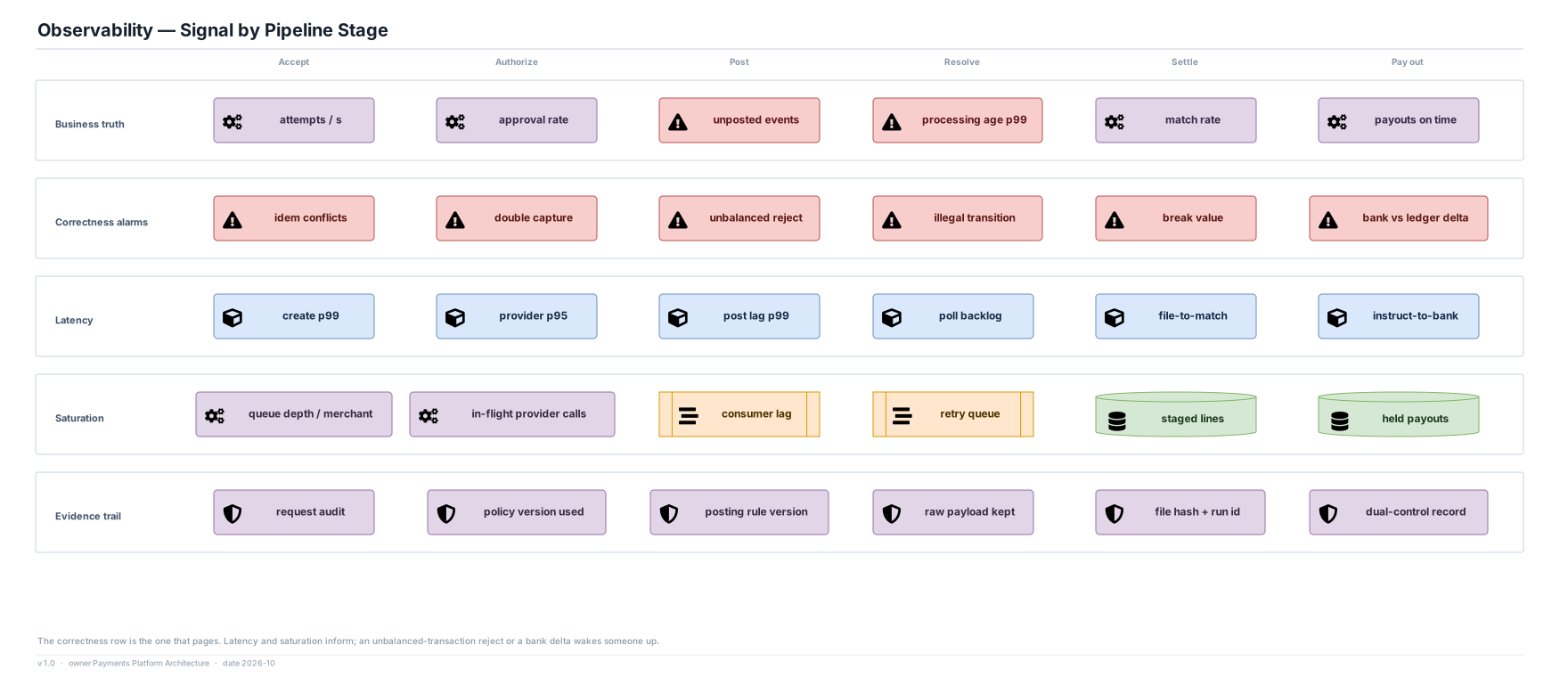
Observability Prometheus and Grafana for metrics, OpenTelemetry collection, Loki for logs with 400-day retention, correctness alarms separated from latency and saturation open source, self-hosted A managed observability platform where egress of operational metadata is permitted Only the correctness row pages: an unbalanced-transaction rejection or a bank-versus-ledger delta, not a latency percentile ADR-16
Compute platform Self-managed Kubernetes, three control-plane nodes per data centre, separate cluster for the CDE open source, self-hosted A managed Kubernetes service in an in-country region where the regulator accepts the provider Residency, PCI scope containment and dependency approval drove it, not a preference for owned hardware ADR-18

The decisions, and the alternatives that lost

The ledger and the recordWhere truth about money lives, what shape it takes, and what makes a posting happen exactly once.

ADR-01

Authorization plane and ledger plane are separate, coupled only by a durable event log

Accepted

When a payment succeeds, does the book of record move inside the buyer's request, or after it?

Context
A payment service has two jobs with incompatible failure profiles. Answering a buyer needs single-digit-hundreds of milliseconds of platform time, tolerates declining, and is worth failing rather than hanging. Keeping the books needs strong consistency, synchronous replication and an append-only store that may never lose or double an entry, and is worth waiting for. Putting both inside one request means the slowest, strictest store in the system sits on the buyer's critical path, so a ledger partition during a sale becomes a checkout outage at 4,000 attempts a second. Separating them means the platform will, for a window, have told a buyer and a merchant that a payment succeeded while the ledger says nothing about it — and that window never fully closes on its own.
Decision
Split the architecture at that boundary. The authorization plane is stateless, deadline-bound, holds no truth and is permitted to decline, time out and fail closed. The ledger plane is append-only, strongly consistent, synchronously replicated, and permitted to be unavailable for writes for minutes. The only coupling between them is a durable ordered event log; no service in the authorization plane writes the ledger, and no ledger operation sits on a buyer request. Accept the resulting window explicitly, make its width a first-class metric, and build the resolution machinery that guarantees it always closes.
How it is realised on this stack
Intent and routing services run as stateless pods on self-managed Kubernetes across both in-country data centres, scaled on concurrent in-flight provider calls rather than request rate. Every state transition is appended to Kafka, partitioned by payment identifier so a single intent's events are strictly ordered, with seven-year retention so the log is evidence rather than a buffer. A dedicated ledger poster is the only consumer that writes PostgreSQL's append-only ledger tables, which replicate synchronously to the second site at 1.4 ms RTT. Posting lag p99 and the age of the oldest unposted event are dashboard metrics with alarms, not debug counters.
Options weighed
  • ChosenSeparate planes coupled by a durable ordered log: Checkout survives a ledger partition; the books stay strict; the cost is a visible, bounded, always-closing window
  • Right elsewhereSynchronous ledger write inside the buyer's request: Right for a low-volume service where a ledger write is a few milliseconds and no sale peak exists — and it removes an entire class of reconciliation work; wrong at 4,000 attempts a second, where it converts every store hiccup into lost revenue
  • RejectedOne service owning both state machine and ledger, posting asynchronously inside itself: Keeps the window but loses the structural guarantee: with both in one process, the first urgent incident produces a direct ledger write and the boundary is gone
  • RejectedNo ledger; derive balances from the payment-state table on read: Cheapest to build and impossible to audit: there is no answer to what the platform believed last Tuesday, and corrections become edits
Consequences
What it buys
  • A ledger store partition degrades to a lagging balance rather than a failed checkout, which at a sale peak is the difference between a slow dashboard and lost revenue
  • The ledger can be as strict as it likes — synchronous replication, balance checks at write, no caching — because nothing in it is latency-critical
  • The event log is evidence as well as transport: any projection, including the ledger itself, can be rebuilt by replay
  • Reporting, analytics and settlement workloads read stores that are nowhere near the payment path
What it costs
  • A permanent window exists in which a payment has succeeded in the world and is not in the books, and in the `unknown` case it can be 24 hours wide
  • Four components — the poller, the callback resolver, the settlement matcher and the break manager — exist only to close that window and are pure overhead when the rails behave
  • A merchant can be told 'paid' before their balance moves, which generates support contacts that a synchronous design would not
  • Two durability stories to operate rather than one: a broker and a relational store, both self-managed
Choose differently when
If volume were an order of magnitude lower and there were no sale peak, a synchronous ledger write inside the request would be simpler, would remove the window entirely, and would delete four components. The decision rests on three facts: a 4,000-a-second peak confined to minutes, a ledger that must be synchronously replicated for RPO 0, and a double-charge budget that makes optimistic retries unavailable. Remove the peak and this record is the wrong one.
Why it holds up over time
The split is a statement about where truth lives, not about Kafka or PostgreSQL. Both can be replaced — and will be — without changing the sentence "the buyer-facing path may fail; the book of record may not be wrong." Every later view in this set either honours that sentence or contradicts it.
LessonWhen two halves of a system have incompatible failure profiles, the right move is usually to separate them and pay for the gap honestly, rather than to force the stricter half onto the faster half's latency budget. The cost of the separation is a window — and a window you have named, measured and built machinery to close is a far smaller liability than a shared path you have quietly made fragile.
Shown on views07 13 24
ADR-02

The ledger is append-only double entry, balanced at write time, and is the sole system of record

Accepted

What is the authoritative representation of money in this platform — a balance, or a history?

Context
The tempting design is a payments table with a status column and a merchant balance beside it, updated in the same transaction. It is simple, fast, and gives the wrong answer to the only questions that ultimately matter: what did the platform believe about this payment last March, why does this merchant's balance differ from the sum of their payments by 412 rupees, and who changed it. Double-entry bookkeeping answers all three by construction, at the price of roughly eight rows per payment instead of one, an account model that has to be designed before the first payment, and the loss of the ability to simply fix a number.
Decision
Record every money movement as a transaction of two or more entries whose signed amounts sum to zero, against named accounts. Reject an unbalanced transaction at write time rather than correcting it later. Make the ledger append-only — no update, no delete, and no privileged path that bypasses the balance check. Derive every entry from a declared, versioned posting rule keyed on event type. Store amounts as integer minor units with an explicit currency. Every balance, statement and report is a projection of this ledger, and a number that cannot be derived from it is a number the platform does not publish.
How it is realised on this stack
PostgreSQL with `ledger_transaction` and `ledger_entry` tables, a deferred constraint asserting that the signed `amount_minor` of a transaction's entries sums to zero, and `REVOKE UPDATE, DELETE` on both tables for every role including the application's. The named account tree — merchant payable, platform fee revenue, provider receivable, tax withheld, dispute reserve, settlement clearing, break — is reference data with its own history. Posting rules are versioned artefacts in a registry, and `posting_rule_version` is stored on every transaction. Closed fiscal periods are archived at partition level with query support preserved.
Options weighed
  • ChosenAppend-only double entry, balanced at write, as sole record: Auditable by construction; corrections are new entries; every report is derivable
  • Right elsewherePayment table with a status column and a cached balance: Right for a pre-revenue product or an internal tool where nobody will ever ask what you believed last quarter; wrong the moment a regulator, an auditor or a disputing merchant does
  • RejectedSingle-entry transaction log with balances derived by summing: Derivable but not self-checking: nothing catches a posting that credits without a corresponding debit, which is exactly the bug class double entry exists to catch
  • RejectedAn off-the-shelf ledger service or blockchain-backed ledger: A managed ledger would be reasonable in a cloud this design cannot use (ADR-18); a blockchain adds an immutability guarantee the platform already has and a consensus cost it does not need
Consequences
What it buys
  • An unbalanced transaction is impossible rather than unlikely: the store refuses it, so the bug surfaces as a rejection in the poster rather than as a wrong number in a report
  • Any question about history is answerable from the ledger plus the posting-rule version, including years later
  • Corrections are new opposite-signed entries, so there is no mechanism by which history changes and therefore no need to trust that nobody used one
  • A daily trial balance is a real check rather than a report, because an imbalance means a bug and not a rounding issue
What it costs
  • Roughly eight entries per payment — about 35 billion entries a year and 12 TB before compression — which makes partitioning and archival a day-one concern rather than a later one
  • The account model must be designed before the first payment, and getting it wrong is expensive once billions of entries reference it
  • Nobody can fix a number. Every correction is a workflow, which is correct and is also slower than an operator would like
  • Integer minor units mean every interface and every report must agree about currency exponents, and a single float anywhere in the chain is a defect
Choose differently when
If the platform were pure pass-through and never held a balance (see ADR-13), the account model would shrink dramatically and a simpler transaction log might carry it. And if there were no regulatory retention requirement and no disputes, the self-checking property would be worth less than the storage it costs. Neither condition holds here: the platform is custodian of merchant funds and must reconstruct any payment for ten years.
Why it holds up over time
Double-entry bookkeeping predates every technology in this set by centuries and will outlive all of them. Choosing it is choosing not to invent a money model — the one part of this architecture that is certain not to need revisiting, however many times the store beneath it is replaced.
LessonChoose a representation that makes the errors you fear structurally impossible rather than merely unlikely. A balance check enforced by the store catches a class of bug that no amount of test coverage over application code reliably catches, because it holds for code nobody has written yet.
Shown on views11 12 20
ADR-03

Idempotency is declared separately at every boundary, with a different key at each

Accepted

Which duplicate is being prevented — the buyer's second tap, the provider's repeated callback, or the poster's replayed event?

Context
"The system is idempotent" is the sentence that hides the bug. There are at least four distinct duplication events in a payment flow and they need four different keys. A buyer double-tapping produces two HTTP requests carrying the same merchant-supplied `Idempotency-Key`. A provider retrying a webhook produces two callbacks carrying the same provider event identifier. A consumer restart replays events, producing two attempts to post the same ledger transaction. A payout retry produces two instructions to a bank. An edge-only key protects against the first and none of the others; a ledger-only key protects the books and lets duplicate provider calls happen, which is a double charge.
Decision
Declare the natural key at each boundary explicitly and enforce it there. At the edge: the merchant's `Idempotency-Key`, scoped per merchant, where a repeat with an identical body returns the original intent and a repeat with a differing body is a conflict. At the callback: the provider's own event identifier. At the ledger: the payment event's identifier as a unique constraint on the ledger transaction, which is what makes posting exactly-once without coordination. At the payout: a unique instruction key derived from merchant, period and amount. Four keys, four guarantees, documented separately.
How it is realised on this stack
Redis holds edge idempotency keys with a 24-hour TTL, storing a hash of the request body alongside the resulting payment identifier so a conflicting repeat can be detected rather than silently served. Callback dedup is a unique index on `(provider_id, provider_event_id)` in the payment shard. The ledger carries `UNIQUE (event_id)` on `ledger_transaction`, so a replayed event's insert fails on the constraint and the poster treats that failure as success. The payout table carries `UNIQUE (instruction_key)`.
Options weighed
  • ChosenA declared natural key at each of the four boundaries: Each duplication event has an owner; replay safety at the ledger needs no distributed coordination
  • RejectedOne idempotency key threaded through the whole flow: The merchant's key does not exist at the callback boundary and is not unique per provider event; threading it requires inventing a mapping that is itself a store with its own races
  • RejectedExactly-once processing via a distributed transaction across broker and ledger: Buys what a unique constraint already buys, at the cost of a two-phase commit on the ledger's write path
  • Right elsewhereDeduplication windows with time-bounded caches at each hop: Right where no stable natural key exists — some legacy rails genuinely have none; wrong here, because a window that expires is a correctness bug waiting for a slow retry
Consequences
What it buys
  • The ledger poster can be replayed arbitrarily: a replay of the entire log produces a byte-identical ledger, which is the release gate in ADR-10
  • A buyer's double tap is answered with the original intent and produces no second provider call, which is where double charges actually come from
  • Each guarantee is independently testable, so a property test can target one boundary at a time
  • A conflicting idempotency-key reuse is reported as a conflict rather than quietly creating a second payment — a merchant integration bug surfaces as an error
What it costs
  • Four mechanisms to document, test and explain, and a reviewer must understand which one covers which failure
  • The edge key store is a hot in-memory dependency on the critical path; its loss degrades duplicate protection even though the ledger stays safe
  • The 24-hour edge TTL is a judgement call: a retry at 25 hours creates a second intent, and no window is obviously correct
  • Treating a unique-constraint violation as success is correct and reads like a bug to anyone encountering it for the first time
Choose differently when
If every provider offered a reliable idempotency key on authorization requests, the edge key and the no-retry-after-unknown rule in ADR-04 could both relax, because a retry would be provably safe. Most rails do not, and the ones that do disagree about semantics. If that changed industry-wide, this record and ADR-04 would both be rewritten.
Why it holds up over time
The keys are properties of the boundaries, not of the technology at them. A different broker, store or cache changes where the constraint is declared and not which key it is on — and a unique constraint on a natural key will remain the cheapest exactly-once mechanism available for as long as databases have unique constraints.
Lesson"Idempotent" is not a property of a system; it is a property of an operation with respect to a specific key. Naming the key at every boundary turns a vague reassurance into four testable guarantees, and usually reveals at least one boundary nobody had considered.
Shown on views12 13 14

Resolving the networkWhat to do when the rail will not say what happened, and whose word the platform ultimately takes.

ADR-04

`unknown` is a first-class outcome, and no retry ever follows one

Accepted

The provider did not answer within the deadline. Is the buyer charged?

Context
An authorization that times out is not a failure. The issuer may have approved it, the funds may be held, and the buyer's statement may already show it — the platform simply does not know. Treating it as a failure and retrying is the single most reliable way to charge someone twice. Treating it as a success is worse. The honest third state is uncomfortable for everyone: the buyer sees a spinner resolve into 'processing', the merchant cannot decide whether to ship, and the platform has an open obligation it must track to closure. There are three ways out — void-and-retry, poll-until-known, and defer to the settlement file — and they differ by hours and by risk.
Decision
Normalise every provider response into one of four results — `approved`, `soft_decline`, `hard_decline`, `unknown` — and treat `unknown` as a distinct outcome with its own resolution path, never as an error. An intent whose attempt returned `unknown` moves to `processing`, a terminal-pending state that only an inbound provider signal or a reconciliation job may leave. No second provider attempt is ever made after an `unknown`, by any path, including a buyer retry or an operator action. The resolution ladder is provider inquiry where supported, then the daily settlement file. Where a choice exists between declining a legitimate payment and risking a double charge, decline.
How it is realised on this stack
The adapter enforces an 8-second hard deadline and maps timeout, connection reset and any ambiguous provider code to `unknown`, keeping the raw code alongside. The intent state machine declares no legal transition from `processing` whose source is a client request, so a retry is structurally impossible rather than merely discouraged. The outcome poller picks up intents in `processing` beyond 60 seconds and issues provider inquiries with backoff where `provider.supports_inquiry` is true. Unresolved intents are picked up by the settlement matcher (ADR-12). The buyer-facing response for `processing` says explicitly not to retry, and the merchant webhook carries `processing` rather than silence.
Options weighed
  • ChosenHold in `processing`; inquire, then defer to the settlement file; never retry: Cannot double-charge; resolves in seconds when inquiry is supported and up to 24 hours when it is not
  • Right elsewhereVoid the ambiguous transaction, then retry: Right where every provider reliably honours a void for a transaction it has not acknowledged, which some single-acquirer setups genuinely have; wrong across four providers with differing void semantics, because a void that silently no-ops turns the retry into a double charge
  • RejectedRetry against a different provider: The worst option available: the second provider cannot see the first's hold, so a success on both is undetectable until settlement
  • RejectedTreat the timeout as a decline and let the buyer try again: Simplest and the classic cause of duplicate charges; it moves the retry decision to the buyer, who has no information
Consequences
What it buys
  • The double-charge budget of one per million attempts is achievable, because the action that causes double charges is structurally unavailable
  • `processing` is an honest product state the merchant can reason about, rather than a lie in either direction
  • Buyer retries are free: the edge idempotency key returns the same intent and no new attempt is made
  • The resolution path is the same machinery as ordinary reconciliation, so it is exercised daily rather than only during incidents
What it costs
  • Resolution can take up to 24 hours where the provider supports no inquiry, which is a genuinely poor buyer experience
  • Some merchants will ship on `processing` despite being told not to, and some of those payments will resolve as declined
  • A provider outage produces a growing population of `processing` intents, which is operationally alarming even when it is working as designed
  • Conversion is lost: a buyer told 'processing' sometimes abandons and pays by another method elsewhere
Choose differently when
If every provider in the routing set supported a reliable inquiry API answering within seconds, the 24-hour tail would disappear and `processing` would become a sub-second state — at which point void-and-retry becomes unnecessary rather than merely risky. Conversely, if the business decided that a double charge refunded within the hour was cheaper than lost conversion, the retry ban would be the wrong rule, and this record would be the first to go.
Why it holds up over time
New rails arrive constantly and every one of them will occasionally fail to say what happened. A design that treats ambiguity as a first-class state absorbs a new rail as an adapter; one that treats it as an error rewrites itself for each. The rule survives every change of provider, protocol and decade.
LessonWhen an external system can leave you genuinely uncertain, make the uncertainty a named state in your model rather than collapsing it into success or failure. The collapse is always where the expensive bug lives, and it is always the thing a first design does.
Shown on views04 14 24
ADR-05

The provider's synchronous response is a hint; the settlement file is the evidence

Accepted

When the provider's API and the provider's settlement file disagree, which one does the platform believe?

Context
A provider speaks to the platform through at least three channels that routinely disagree: a synchronous API response, asynchronous callbacks, and a daily settlement file. The API response is fastest and least reliable — it can time out after approval, report success for a transaction later reversed, or carry a code whose meaning differs between providers. Callbacks arrive duplicated, out of order, hours late, or occasionally for transactions the platform has no record of. The settlement file is slow, sometimes restated, and is the thing the provider will actually pay against. A platform that treats the API response as truth books revenue it may not receive; one that waits for the file cannot answer a buyer.
Decision
Rank the channels explicitly. The synchronous response advances the payment state machine and may be reported to the buyer and merchant. The callback resolves ambiguity and may advance state, subject to deduplication and a legal-transition check. The settlement file is the evidence: it is what reconciliation matches against, what payouts are computed from, and what wins any disagreement. Persist every raw callback payload before interpreting it, so a parser bug destroys no evidence, and ignore — while recording — any callback whose implied transition is illegal from the current state.
How it is realised on this stack
The callback endpoint verifies signature and freshness (5-minute window, nonce replay rejected) at the perimeter, writes the raw body to a 7-year payload store keyed by a content hash, and only then parses. Deduplication is a unique index on `(provider_id, provider_event_id)`. The state resolver consults the intent's declared legal transitions and records an `ignored_transition` event rather than dropping a callback silently. Settlement files land on SFTP, are hashed and recorded with a run identifier, and matched on `provider_ref` plus amount against `payment_attempt`.
Options weighed
  • ChosenRanked channels: response advances, callback resolves, file decides: Fast enough for a buyer, authoritative where money is concerned, and the ranking is explicit rather than emergent
  • Right elsewhereTreat the synchronous response as truth and reconcile as a back-office exercise: Right for a single-acquirer, low-volume integration with a reliable partner and small amounts; wrong where settlement disagreement is routine and the platform pays merchants before it is paid
  • RejectedWait for the settlement file before reporting any outcome: Correct and unusable: no buyer waits 24 hours, and no merchant can run a storefront on T+1 outcomes
  • RejectedTrust whichever channel arrived most recently: Not a ranking at all; with out-of-order callbacks it makes the final state depend on network timing
Consequences
What it buys
  • Revenue is only ever recognised against evidence the provider will pay, so the books do not drift optimistically
  • A parser bug or a schema change is recoverable: the raw payloads are kept and can be reprocessed
  • Out-of-order and duplicate callbacks are one mechanism — dedup plus legality — rather than four separate races
  • An ignored callback is recorded, so 'we never got told' is an answerable question
What it costs
  • Three channels to integrate, monitor and version per provider, each with its own failure modes
  • Raw payload storage for seven years is a meaningful volume and a data-residency obligation in its own right
  • Buyer-visible state can be contradicted later by the file, which is honest and generates support work
  • A restated file means yesterday's reconciliation output can change, so no reconciliation result is ever final until the period closes
Choose differently when
If the platform settled directly on a rail it operated, there would be no external file to reconcile against and the API response would be the truth by definition. That is the position of a network rather than a payment service, and it is explicitly out of scope. Within scope, the ranking would only change if a provider offered a synchronous response with a contractual settlement guarantee attached — which none does.
Why it holds up over time
The ranking is about trust, not technology. Protocols will change from SFTP files to streaming APIs and the question — which channel will the counterparty actually pay against — will have the same answer and the same ranking.
LessonWhere a counterparty speaks through several channels, rank them by what they commit to rather than by how fast they are, and store the raw form of each before interpreting it. The slowest channel is usually the one with money behind it, and the one you will wish you had kept verbatim.
Shown on views09 16 20
ADR-06

Routing is a versioned declarative policy whose decisions are reproducible from stored inputs

Accepted

Why did this payment go to this acquirer, and can that be answered in three years?

Context
With four providers across two rails, every attempt needs a routing decision, and that decision has commercial, reliability and regulatory consequences. The options run from static per-method configuration (auditable and dumb) through a rules engine evaluated per attempt (expressive, and a second production system with its own correctness problem) to an outcome-learning optimiser (highest value, and nearly impossible to explain to an auditor asking why this payment went where it did). Underneath sits a harder requirement: a disputing merchant or a regulator may ask about a specific payment years later, and "the model decided" is not an answer.
Decision
Express routing as a declarative policy evaluating payment method, issuer or bank identifier, amount band, merchant preference, provider health and provider cost. Version the policy as an immutable artefact and store `policy_version` on every attempt, so any decision is reproducible from stored inputs. Make cost an input that is strictly subordinate to approval rate and to any merchant-declared constraint. Derive provider health from observed approval rate and latency, never from a provider's status page. Allow providers to be added, weighted, drained and removed by configuration change, without deploying the authorization path. Defer outcome-learning routing to Phase 3, and only with reproducible decision records.
How it is realised on this stack
Policies are YAML artefacts in a registry, content-addressed and promoted through the same pipeline as code with a required commercial sign-off. Pods hold the active policy in memory and reload on registry change; the active version identifier is stamped on every `payment_attempt` row alongside the raw provider code. Health is computed from a rolling window of observed outcomes per provider and per method, feeding both the circuit breaker and the policy's health input. Draining a provider is a weight change, not a deployment.
Options weighed
  • ChosenVersioned declarative policy, decisions reproducible from stored inputs: Expressive enough for real routing, auditable years later, changeable without a deployment
  • Right elsewhereStatic per-method configuration: Right with one or two providers and no commercial routing requirement, where the simplicity is worth more than the expressiveness; wrong with four providers and per-issuer approval differences worth real money
  • DeferredOutcome-learning cost-and-approval optimiser: The highest-value option and the hardest to explain; revisit in Phase 3 once decision records are reproducible, which is what this record puts in place
  • RejectedLet each merchant specify the provider: Hands routing risk to people with no visibility of provider health, and makes draining a failing provider a customer-communication exercise
Consequences
What it buys
  • Any routing decision is reconstructable from the stored policy version and the attempt row, which is what makes a regulator's question answerable
  • Draining a degraded provider is a configuration change evaluated on the next attempt, not a release
  • Health derived from observed behaviour reacts faster than a provider's own status reporting and is not subject to its incentives
  • Cost being structurally subordinate to approval rate prevents the common failure where routing quietly optimises margin into lost conversion
What it costs
  • A policy language is a second production system with its own validation, testing and review needs
  • Immutable policy versions accumulate, and reproducing a 2027 decision in 2030 means keeping the evaluator able to run a 2027 policy
  • Declarative routing leaves value on the table compared with a learned router, and that gap grows with provider count
  • A policy change with a sign-off gate is slower than a commercial team would like, which creates pressure to add overrides
Choose differently when
If the platform ever ran with a single acquirer, the whole policy mechanism would be dead weight and static configuration would be correct. In the other direction, once the provider set grows past roughly ten and per-issuer approval differences dominate, declarative routing stops paying and the learned router in Phase 3 becomes the right answer — carrying this record's reproducibility requirement with it.
Why it holds up over time
The durable part is not the policy language but the requirement that a decision is reproducible from stored inputs. That requirement survives the move to a learned router, which is exactly why it is written down before the router exists rather than after.
LessonWhen a decision has commercial consequences and a long audit tail, store the inputs and the decision-maker's version alongside the outcome. It costs two columns and it is the difference between answering a question about 2027 and reconstructing it from code archaeology.
Shown on views02 08 13
ADR-07

Unmatched settlement value is posted to a named, aged break account and never netted away

Accepted

The provider's file reports an amount the platform cannot tie to anything it believes. Where does that amount go?

Context
Reconciliation never reaches 100%. Files contain lines for transactions the platform has no record of, amounts that differ by a fee the platform calculated differently, and references that match nothing. The convenient treatment is to net the difference into a suspense figure and move on, which is how organisations discover years later that they cannot explain their own cash position. The honest treatment puts the unexplained amount on the books as an explicit liability or asset in a named account, which means the trial balance still balances, the gap is visible, and somebody owns it.
Decision
Classify every settlement line as matched, unmatched or disputed. Post unmatched amounts to a named break account rather than discarding or netting them, so the ledger continues to balance and the gap is a row rather than an absence. Age every break, and raise one that passes a threshold — 48 hours by default — as an operational incident rather than a backlog item. Resolve a break only by a new opposite-signed correcting transaction under dual control. Produce a daily trial balance and a cash-position statement, and alarm when the ledger's view of held funds differs from the bank's by more than a configured tolerance.
How it is realised on this stack
`settlement_line.txn_id` is nullable and `match_state` is an enum, so an unmatched line is a row carrying its own classification. The matcher posts the unmatched amount against a break account in the same ledger transaction that records the line, preserving the balance invariant. A nightly job ages open breaks and raises a paging alert past 48 hours; break count and break value are both dashboard metrics, with value alarming and count not. Correction flows through the dual-control service in ADR-14.
Options weighed
  • ChosenNamed break account, aged, owned, alarmed; corrections under dual control: The trial balance stays meaningful and every unexplained amount has an owner and a clock
  • RejectedNet unmatched differences into a suspense figure at period close: The default in many organisations and the reason their cash position is not explainable; it converts a findable problem into an unfindable one
  • RejectedReject the file until it matches fully: Blocks every payout on the first unexplained line, which at 10 million lines a file means blocking every day
  • Right elsewhereTrack breaks in a separate operational system outside the ledger: Workable where the ledger is a downstream accounting system rather than the system of record; here it would mean the trial balance no longer balances, which removes the one daily check that catches posting bugs
Consequences
What it buys
  • The trial balance balances every day, which turns it into a real check on posting correctness rather than a report
  • Every unexplained amount has a name, an age and an owner, so a growing problem is visible within hours instead of at quarter end
  • The break account is a leading indicator for provider integration problems that no other metric surfaces
  • Resolution is append-only, so the history of what was believed and when is preserved through the correction
What it costs
  • A standing operational workload — assumed around 40 breaks a day — that must be staffed, and if it is not, the ageing alarm simply becomes noise
  • The 48-hour threshold is arbitrary and will be wrong for some providers whose files are routinely restated
  • The break account is a real balance-sheet item requiring finance sign-off on its treatment, which is organisational work the architecture creates
  • Dual-control correction makes clearing a break slower than editing a row, by design, and that friction will be complained about
Choose differently when
If the platform were pure pass-through with no held funds (ADR-13), unmatched lines would be the provider's and the merchant's problem rather than a balance-sheet item, and a simpler exception report might suffice. As custodian of merchant money, the platform owns the gap, and that ownership is what makes the break account necessary rather than merely tidy.
Why it holds up over time
"Name the gap rather than netting it" is an accounting discipline, not a technical one. It will apply identically to rails, file formats and reconciliation tooling that do not yet exist, and it is the control that makes every other optimism in this design safe.
LessonWhen two systems disagree about money, the disagreement itself is data worth storing on the books. Netting it away destroys the only record that could ever explain it, and the cost of that destruction is paid years later by someone who cannot reconstruct what happened.
Shown on views06 16 20

Shape, scale and contractsHow state is divided, what is promised to merchants, and how a system holding money is changed.

ADR-08

Payment state is sharded by merchant; the ledger gives up a global sequence

Accepted

What is the partition key, and what ordering guarantee is surrendered to get it?

Context
Two stores need partitioning for different reasons. Payment state is write-heavy and latency-sensitive, and its natural isolation boundary is the merchant: sharding there means one merchant's sale peak cannot consume another's capacity, and every payment-path operation — intent, attempts, refund-sum enforcement — stays inside one shard. The ledger is different. A single global append-only log gives a total order and a trivially correct close of books, and caps throughput at one writer. Partitioning it scales linearly and makes any transaction touching two merchants' accounts a distributed transaction, which is exactly what marketplace splits and inter-merchant transfers require.
Decision
Shard payment state by merchant, and keep every payment-path operation inside a single merchant's shard so that no synchronous cross-shard transaction exists. Enforce per-merchant concurrency limits and fair queuing at the edge, so a 10× spike confined to one large merchant does not degrade others. Partition the ledger by fiscal period and account class rather than by merchant, surrendering a single global sequence and providing instead a per-account ordering guarantee and a deterministic close-of-books procedure that aggregates across partitions. Accept that marketplace splits and inter-merchant transfer are therefore out of MVP scope, and state the condition for re-opening this record.
How it is realised on this stack
Payment state lives in PostgreSQL shards keyed by a hash of `merchant_id`, with the shard map in the config registry. The edge enforces per-merchant concurrency and a fair queue, so capacity is allocated rather than contested. The ledger is partitioned by period and account class, which keeps a day's postings and a day's close inside a bounded set of partitions and lets closed periods be archived whole. Close of books aggregates per-partition sums and asserts the total is zero; because each transaction's entries are written atomically within one period, the aggregate check is exact rather than approximate.
Options weighed
  • ChosenMerchant shards for state; period and account-class partitions for the ledger: No synchronous cross-shard transaction in the payment path; linear scaling; a deterministic daily close
  • Right elsewhereSingle global append-only ledger log: Right below roughly a thousand transactions a second, where one writer is ample and a total order makes marketplace splits and transfers trivial; wrong at 35 billion entries a year
  • RejectedLedger partitioned by merchant, matching the state store: Tempting for symmetry and it makes platform fee revenue — which touches a platform account on every payment — a cross-partition write on every single transaction
  • DeferredLedger partitioned by currency: The natural choice once multi-currency settlement lands in Phase 3, and premature in a single-settlement-currency design
Consequences
What it buys
  • One merchant's sale peak is structurally contained: fairness is a property of the partitioning and the queue, not of a throttle somebody has to tune during an incident
  • Refund-sum enforcement under concurrency is a single-shard constraint rather than a distributed lock
  • Closed fiscal periods archive as whole partitions, which is what keeps a 12 TB-a-year ledger queryable
  • Ledger write throughput scales with partitions rather than being capped by one writer
What it costs
  • There is no global sequence number, so "the Nth transaction ever" is not a concept the platform has
  • Close of books is an aggregation across partitions rather than a tail read, and its correctness depends on each transaction being wholly inside one period
  • Marketplace splits and inter-merchant transfer become distributed transactions, which is why they are deferred rather than simply unbuilt
  • A shard map is operational state: resharding a large merchant is a planned migration, and the design does not make it cheap
Choose differently when
This record must be re-opened the moment marketplace splits or inter-merchant transfer are accepted into scope, because both require a transaction spanning two merchants' accounts. If they land, the choice narrows to a two-phase commit across ledger partitions or a repartitioning — and doing it after 35 billion entries exist is far more expensive than doing it now, which is the argument for deciding scope deliberately rather than drifting into it.
Why it holds up over time
The merchant as the isolation boundary for payment state is a statement about who shares fate, and that does not change with technology. The ledger's partitioning is more contingent: it is the part of this architecture most likely to be revisited, which is why the conditions for revisiting it are written down.
LessonChoose the partition key from the isolation you need rather than from the symmetry you want. Two stores in the same system can and often should be partitioned differently, and matching them for tidiness is how a cross-partition write ends up on every transaction.
Shown on views08 11 18
ADR-09

Merchant webhooks are at-least-once with a per-object sequence number and a queue per merchant

Accepted

What delivery semantics are promised to merchants, and may one slow endpoint delay another merchant's events?

Context
The median merchant integration is written once, by someone with no payments background, and never revisited. It will receive a duplicate webhook and, if it is not idempotent, it will ship the goods twice. Three postures are available. At-least-once with documented merchant-side idempotency is cheap and honest. Ordered-per-object delivery — hold event n+1 until n is acknowledged — is far kinder to naive code and introduces head-of-line blocking that one stalled endpoint turns into a backlog. A pull-only event API moves the problem to the merchant entirely and guarantees that the ones who most need pushing will never poll.
Decision
Promise at-least-once delivery explicitly in the contract, and do not claim exactly-once the platform cannot provide. Attach a monotonic per-object sequence number to every event so a merchant can detect a gap and order events for an object without a global order existing. Give every merchant their own delivery queue, so a stalled endpoint delays nobody else. Retry with exponential backoff for up to 72 hours, then expose both an idempotent replay and a pull-based event list with a cursor, so a merchant who was down for a week catches up without contacting support. Auto-disable a persistently failing endpoint with a notice.
How it is realised on this stack
The dispatcher consumes the event log and writes into a per-merchant queue, so backpressure is per tenant. Payloads are HMAC-signed with a per-merchant secret that can be rotated with an overlap window, and carry `object_id` and a monotonic `seq` for that object. Retry schedule is exponential to 72 hours. The replay API re-sends by event identifier; the list API pages from a cursor that is the authoritative catch-up mechanism. Delivery attempts are retained for seven years, so "we never got told" is answerable.
Options weighed
  • ChosenAt-least-once, per-object sequence, per-merchant queue: Honest contract, gap detection without a global order, and one tenant's failure is contained
  • Right elsewhereOrdered-per-object delivery with blocking: Right where merchants are few, large and integration quality is contractually managed — it genuinely removes a class of merchant bug; wrong across 50,000 merchants, where it converts one dead endpoint into a shared backlog
  • RejectedPull-only event API, no webhooks: Perfectly reliable and guarantees the least sophisticated merchants — the ones who most need the push — never poll
  • RejectedClaim exactly-once delivery: Not deliverable over HTTP to endpoints that time out after processing, and claiming it means merchants build no defences
Consequences
What it buys
  • A naive but correct merchant handler is possible: deduplicate on event identifier, order on sequence, done — and that is documentable in a paragraph
  • One dead endpoint is contained to its own queue, so the common operational incident has a blast radius of one merchant
  • A merchant down for a week catches up by cursor without a support ticket or a manual replay
  • Stored delivery attempts make the recurring dispute about whether a notification was sent a matter of record
What it costs
  • Every merchant must be idempotent, and some will not be; duplicate-shipping incidents will happen and will be partly the platform's reputational problem
  • Per-merchant queues at 50,000 merchants is a lot of queues to monitor, and queue sprawl is its own operational burden
  • No global ordering means a merchant correlating events across objects must do it themselves
  • Auto-disable will occasionally silence a merchant who was about to recover, making the notice path as important as the disable
Choose differently when
If the merchant base were tens of large, contractually managed integrations rather than 50,000 self-serve ones, ordered delivery would be the better trade: the head-of-line risk shrinks with tenant count and the value of protecting naive handlers rises. The decision rests entirely on the shape of the merchant base.
Why it holds up over time
At-least-once plus a per-object sequence is the honest contract for any push over an unreliable transport to an endpoint you do not control. The transport will change; the contract will not, because the underlying impossibility does not.
LessonPromise the weakest guarantee you can actually keep, state it prominently, and then give consumers the primitive they need to build the stronger guarantee themselves. A sequence number costs four bytes and removes most of the reason anyone wanted exactly-once.
Shown on views05 17 09
ADR-10

Posting rules are versioned artefacts, shipped shadowed, and gated on a replay that must be byte-identical

Accepted

How is the code that books money changed, given that a posted entry can never be rolled back?

Context
Code rolls back in minutes. Ledger entries do not: a wrong posting is corrected by a new opposite entry, which means a bad release does not merely need reverting, it needs a correction campaign across every transaction it touched, under dual control, with finance sign-off. That asymmetry makes the gate before the release far more valuable than the rollback after it. It also makes the posting rules — the mapping from event type to ledger entries — the highest-risk artefact in the system, and the one most likely to be changed by someone reasoning about accounting rather than about software.
Decision
Treat posting rules as versioned, immutable artefacts separate from service code, requiring a finance sign-off to promote. Ship every posting-rule change shadowed first: the new rules are evaluated against live events and their output diffed against the live rules, with nothing booked. Gate promotion on a replay of the last 24 hours of events through the candidate poster producing byte-identical transactions. Run exactly one ledger-poster version at a time, so two rule versions can never book the same event. Use forward-only migrations with no destructive DDL on the append-only tables, and block any change that widens PCI scope at a CDE scope diff.
How it is realised on this stack
Rules are content-addressed artefacts in the config registry; `posting_rule_version` is written on every transaction. The shadow poster consumes the same event log with a separate consumer group, writes to a scratch schema, and a differ reports every divergence. The replay gate is a pipeline stage that fails the build on any difference. Canary is 1% of merchants with a 30-minute watch on the correctness metrics from view 19. Image rollback is a normal rolling operation; correction of already-posted entries is a dual-control workflow, deliberately not automated.
Options weighed
  • ChosenVersioned rules, shadow evaluation, byte-identical replay gate, single poster version: The asymmetry between cheap rollback and expensive correction is paid for before the release, not after
  • Right elsewherePosting logic inline in service code, released like any other change: Right for a product whose ledger is small enough to correct by hand; wrong where a bad release touches a day's postings across 50,000 merchants
  • RejectedBlue/green with two poster versions running: Standard practice that is actively wrong here: two versions can book the same event under different rules, which is the exact failure the design exists to prevent
  • RejectedSampled replay instead of a full 24-hour replay: The cheap version of the gate, and it misses precisely the rare event types where posting bugs concentrate
Consequences
What it buys
  • A posting-rule bug is caught by the shadow diff before any money is booked, which is the only point at which it is cheap
  • The replay gate also proves the natural-key idempotency from ADR-03 continuously, so two guarantees are tested by one mechanism
  • `posting_rule_version` on every transaction means a historical entry can be explained by the rules that produced it
  • Finance sign-off puts the people accountable for the accounting treatment in the approval path, where they belong
What it costs
  • The replay gate takes as long as the replay does, and grows with volume — it will become the slowest stage in the pipeline
  • The pressure to sample the replay as it slows is the most likely way this control decays, and nothing in the architecture prevents that
  • Shadow evaluation doubles posting compute during a rule change, and requires a scratch schema sized for a day of postings
  • One poster version at a time means poster deployment is a brief stop-and-start rather than a rolling update, so posting lag spikes on every release
Choose differently when
If ledger corrections were cheap — a small merchant base, small amounts, no regulator — the gate would be over-engineered and inline posting logic with a fast rollback would be the right trade. The gate is justified entirely by the cost of correcting a day of postings across 50,000 merchants under dual control.
Why it holds up over time
The principle is that the gate's strength should match the cost of the mistake, not the convenience of the release process. That holds for any system where an action cannot be undone, which is a growing rather than shrinking class as more systems take irreversible external actions.
LessonWhere rollback does not actually undo the damage, spend the effort before the release rather than after. A replay that must be byte-identical is a crude gate and it catches the class of bug that code review and unit tests reliably miss.
Shown on views21 12 19

Trust and key custodyWhat is inside PCI scope, who may move money, and how large a leaked credential's blast radius is.

ADR-11

Keep the cardholder data environment small: browser to CDE directly, tokens everywhere else

Accepted

Which components are inside PCI-DSS scope, and how few can that be?

Context
Every component that touches a primary account number falls inside PCI-DSS scope, and scope is the dominant long-run cost of accepting cards: it drives segmentation, change control, logging, scanning, penetration testing and an annual assessment for everything inside it. The naive design has card details arriving at the ordinary API gateway, passing through the intent service and out to the acquirer, which puts the entire application estate in scope. The alternative moves the card data path out of the application entirely: the buyer's browser posts card details to a separately clustered proxy inside the CDE, which tokenises and returns a reference, and the application only ever sees the token.
Decision
Store no primary account number, CVV or magnetic-stripe equivalent outside the PCI-scoped cardholder data environment, and reference card instruments by network or vault token everywhere else. Route the card data path from the buyer's browser directly into the CDE, bypassing the application zone. Run the CDE as its own cluster with its own HSM pair, and hold all cryptographic key material for tokenisation and provider authentication in HSMs with no key exportable in plaintext. Keep every copy of payment data — including backups and DR — inside the country of operation. Block any change that widens CDE scope at the release gate.
How it is realised on this stack
A card data proxy and token vault run on a separate Kubernetes cluster in a dedicated network segment in each data centre, each with a network HSM pair. The checkout SDK posts card details straight to the proxy using a publishable credential plus the intent's client secret; the proxy tokenises and the application receives only a vault or network token. Provider adapters request detokenisation at the moment of the call, inside the segment. The release pipeline computes a CDE scope diff and fails on any new path that could carry a PAN.
Options weighed
  • ChosenBrowser-to-CDE path, separate cluster, HSM key custody, tokens elsewhere: Smallest defensible scope; an application-zone compromise yields tokens, not card numbers
  • RejectedCard data through the ordinary application path: Puts the whole estate in PCI scope, which is the single most expensive avoidable decision available in a card platform
  • Right elsewhereOutsource card capture entirely to a provider-hosted page: Right for a merchant, and for a payment service that is content to lose control of routing and of the checkout experience; wrong for a platform whose routing across four acquirers is a core capability
  • RejectedEncrypt PANs at rest in the application database instead of tokenising: Keeps the data in scope while adding key management; tokenisation removes the data, which is the only real reduction
Consequences
What it buys
  • PCI scope is a handful of components rather than the whole estate, which compounds every year in assessment and change-control cost
  • A full compromise of the application zone yields tokens and the ability to attempt payments, not the ability to exfiltrate card numbers
  • Key material cannot leave the HSM, so an operator with full database access still cannot decrypt anything
  • Data residency is satisfied structurally: there is no cloud region to accidentally replicate into
What it costs
  • A second cluster, a second network segment and HSM pairs in both data centres — real capital and operational cost
  • The browser-to-CDE hop is an extra network round trip on the buyer's path, and a CDE outage fails card payments closed
  • Detokenisation at call time makes the HSM and vault a hard dependency of every card authorization
  • The scope diff in the pipeline will occasionally block a legitimate change and will be experienced as friction
Choose differently when
If the platform dropped cards and settled only on account-to-account rails, the CDE, the vault and the HSM pairs would all disappear and this record would be moot. Account-to-account volume is growing fast enough that this is a plausible future, and it would simplify the architecture more than any other single change.
Why it holds up over time
"Keep the regulated zone small and let everything else work on a token" is a structural property of where data lives. It will survive PCI-DSS version changes, HSM vendor changes and the arrival of rails nobody has built yet — and it is the reason the blast radius claims in this set are drawn rather than asserted.
LessonThe cheapest way to secure sensitive data is to arrange for most of your system never to receive it. Scope reduction beats scope hardening, and the architectural move that achieves it — a direct client-to-vault path that bypasses your own application — usually looks like a detour until you cost the alternative.
Shown on views11 22 13
ADR-15

Publishable and secret credentials are separate, and a leaked secret reaches only its own merchant's account

Accepted

A merchant's API credential has leaked. What can the holder do with it?

Context
Merchant credentials leak. They end up in public repositories, in mobile app bundles, in support tickets and in compromised developer laptops, and at 50,000 merchants it is a certainty rather than a risk. Two design properties decide what that costs. First, whether the credential that necessarily reaches the buyer's browser can do anything dangerous — it must exist, because the browser has to confirm a payment, and if it is the same credential the merchant server holds then every merchant with a client-side integration has published their secret. Second, where money can be directed: if a credential can specify a destination account, a leak is a theft; if the destination is a merchant attribute the credential cannot change, a leak is at worst a nuisance.
Decision
Issue separate publishable and secret credentials. A publishable credential can do nothing but confirm an existing intent, and cannot create a payment, read a payment, or issue a refund. Scope every credential to a declared set of operations, make each individually revocable, and separate environments. Make the merchant's settlement account a merchant attribute set by the onboarding platform, never a parameter on any API call, so no credential can redirect funds. Assume every secret credential will eventually leak and ensure the holder can only move money into that merchant's own settlement account.
How it is realised on this stack
Credentials are per-merchant, per-environment and per-scope, verified at the gateway before any routing. The publishable credential plus the intent's client secret is the only combination the checkout SDK carries, and the intent's amount and merchant are fixed server-side at creation so the browser cannot alter either. Settlement account details live in the merchant record and are changeable only through the onboarding platform under its own dual control. Credential rotation supports an overlap window so rotation never requires downtime.
Options weighed
  • ChosenSeparate publishable and secret credentials, scoped and revocable; destination not a parameter: A leaked secret can take money into the victim's own account, which is a nuisance rather than a theft
  • RejectedOne API key per merchant: Forces the secret into the browser for any client-side integration, which publishes it for a large fraction of merchants
  • Right elsewheremTLS client certificates for every merchant: Stronger, and right for a small number of large enterprise integrations; wrong for 50,000 self-serve merchants, most of whom cannot manage a certificate
  • RejectedAllow the destination account as a request parameter for flexibility: Converts every credential leak into a theft, and the flexibility it buys is a use case the onboarding platform should own
Consequences
What it buys
  • A leaked secret credential cannot redirect funds anywhere, which caps the loss at nuisance payments and refunds within one merchant
  • The browser never holds anything that can create a payment or read one, so a client-side integration is not a disclosure
  • Revocation is per credential, so a leak is remediated without disrupting the merchant's other integrations
  • Scoping makes least privilege the default rather than an option merchants have to discover
What it costs
  • Two credential types to explain, and merchants will occasionally use the wrong one and receive a confusing authorization error
  • A leaked secret can still issue refunds within the merchant, which is real damage even if it is not theft
  • Settlement account changes require the onboarding platform, which is correct and slower than merchants want
  • Credential rotation with overlap windows is more mechanism than a single static key, and some merchants will never rotate
Choose differently when
If the merchant base were a handful of large enterprises, mTLS with certificate rotation would be stronger and entirely practical. The split-credential model is chosen for a self-serve base of 50,000, where the binding constraint is what a merchant developer can be relied on to do correctly.
Why it holds up over time
The property that matters is that the destination of money is not a parameter the caller controls. That survives every change of credential technology, and it is the difference between a leak that is embarrassing and a leak that is a loss.
LessonDesign for the credential leak you know is coming by limiting what the credential can mean, not just how well it is protected. Making the dangerous field an attribute of the account rather than a parameter of the request is usually a one-line schema decision with an enormous blast-radius consequence.
Shown on views05 22 09

Money, licensing and correctionWhether the platform holds funds, who may correct the books, and when money is held rather than refused.

ADR-12

The settlement matcher may resolve payment state, under declared constraint

Accepted

If the settlement file says a payment the platform believes failed actually succeeded, may a batch job change the payment's state?

Context
Disagreement between the platform's belief and the provider's file is routine, and the unknown-outcome path in ADR-04 depends on something eventually resolving it. Two options exist. The reconciler corrects payment state itself, which makes a nightly batch job a writer to the payment path and introduces a race with live callbacks. Or it only raises a break for a human, which keeps the payment path single-writer and guarantees a manual backlog that grows linearly with volume — at 12 million attempts a day and a few unknowns per thousand, that is thousands of manual resolutions a day, which is not staffable.
Decision
Give the matcher authority to resolve payment state, under four constraints. It transitions state through the same state machine and legal-transition check as any other source, so it cannot produce a state the machine forbids. It is idempotent on the settlement line's identity, so a re-run of a file changes nothing. Its transitions are recorded with `source = reconciliation`, so a resolved payment is distinguishable from one the provider confirmed. And it may only resolve states that are explicitly pending — `processing` and pending refunds — never re-open a terminal `succeeded` or `failed`, which stays a dual-control correction.
How it is realised on this stack
The matcher calls the same intent-service transition API that callbacks use, with a source discriminator, rather than writing the payment store directly. Legality is enforced in the state machine, so the matcher's authority is bounded by data rather than by convention. Resolution emits a normal payment event, so the ledger posts through the usual path with the event identifier as natural key, and the merchant webhook fires as it would for any other outcome. A line that implies re-opening a terminal state becomes a break instead (ADR-07).
Options weighed
  • ChosenBounded resolution authority through the same state machine: Closes the unknown-outcome window automatically while keeping the dangerous transitions human
  • Right elsewhereBreak-only: the reconciler raises, a human resolves: Right at volumes where manual resolution is staffable, and genuinely safer; wrong at thousands a day, where the backlog becomes the failure mode
  • RejectedUnbounded resolution authority: A batch job able to flip a terminal state is a batch job able to un-refund a buyer, and the blast radius of a matcher bug becomes unbounded
  • RejectedDirect writes to the payment store from the matcher: Faster to build and bypasses the legality check, which is the only thing making this decision safe
Consequences
What it buys
  • The unknown-outcome window closes without a human, which is what makes ADR-04's 'never retry' rule operationally viable
  • Resolution reuses the ordinary transition, event and posting path, so it is exercised by the same tests and metrics as everything else
  • `source = reconciliation` makes resolved payments queryable, so the rate of platform-provider disagreement per provider is a measurable number
  • The dangerous transitions remain dual-control, so the authority granted is bounded by the state machine rather than by trust
What it costs
  • There is a real race between the matcher and a late callback arriving for the same payment; it resolves correctly because both go through the legality check, but reasoning about it is genuinely harder
  • A matcher bug can now affect payment state, not just reporting — the blast radius is bounded but not zero
  • The boundary between 'pending, resolvable' and 'terminal, dual-control' is a judgement call that will need revisiting per provider
  • Merchants receive a webhook up to 24 hours after a payment they were told was processing, which some integrations will handle badly
Choose differently when
If providers offered reliable inquiry APIs (see ADR-04), the matcher's resolution authority would be needed for a small residue rather than for the main path, and the safer break-only posture would become affordable. The authority exists because the automatic alternative does not.
Why it holds up over time
The durable part is the shape of the grant: authority bounded by a state machine rather than by convention, with the source recorded. That pattern — let the batch job act, but only through the same door as everything else — transfers to any system where an asynchronous process must correct a synchronous one.
LessonWhen a background process must write to a path that another process owns, give it the same door rather than a side door. The legality check that already protects the path is what makes the grant safe, and routing the batch job through it costs an API call.
Shown on views14 16 20
ADR-13

The platform holds merchant balances rather than passing funds through

Accepted

Does money rest in the platform's accounts between collection and payout, or does it never stop?

Context
This is the decision that determines perhaps a third of the ledger's account model and most of the platform's regulatory posture, and it is often made implicitly. Pass-through keeps the platform thin: funds settle to the merchant's own account and refund funding and dispute liability sit with the merchant and the acquirer. Holding a balance makes refunds, partial refunds, dispute debits, fee netting, hold periods and marketplace splits all natural operations on an internal account — and makes the platform custodian of other people's money, with segregated client accounts, float accounting, a licence, and a far larger ledger.
Decision
Hold merchant balances. Compute each merchant's available balance as settled receipts minus fees, taxes, refunds, disputes and prior payouts, with a configurable hold period per risk tier, and initiate payouts on a per-merchant schedule. Accept the consequences in full: segregated client funds, a named account model including dispute reserve and receivable accounts, float accounting, and the licensing obligations of a custodian. Permit a refund that takes a balance negative and record the result as a receivable rather than rejecting the refund.
How it is realised on this stack
The account tree carries merchant payable, platform fee revenue, tax withheld, dispute reserve, settlement clearing, receivable and break accounts, all in the ledger from day one. Available balance is a projection over the ledger with the hold period applied, never a stored number. Hold periods are merchant attributes set by the risk platform, which this service reads. Client funds sit in a segregated settlement account at the bank, and the daily cash-position comparison asserts that the ledger's view of held funds matches it within tolerance.
Options weighed
  • ChosenHold merchant balances as custodian: Refunds, disputes, fees and hold periods become ledger operations; the cost is licensing and a much larger account model
  • Right elsewherePure pass-through to the merchant's own account: Right for a thin gateway, and much simpler: no client funds, no float, a small ledger; wrong where refunds must succeed regardless of merchant liquidity and disputes must be debitable
  • RejectedHybrid: pass-through with a small retained reserve per merchant: Carries most of the custodial obligations for a fraction of the capability, which is the worst of both
  • RejectedDefer the decision and build pass-through first: The account model is the hardest thing to change after billions of entries exist; deferring it is choosing pass-through without saying so
Consequences
What it buys
  • A refund succeeds even when the merchant has no liquidity, so a buyer who has been charged is never caught by their merchant's cash position
  • Dispute debits, fee netting and hold periods are ordinary ledger transactions rather than external arrangements
  • Payout timing becomes a platform control, which is what makes risk-tiered hold periods possible at all
  • The account model needed for marketplace splits in Phase 3 already exists in outline rather than needing to be retrofitted
What it costs
  • The platform is a custodian of client money: segregated accounts, float accounting, licensing and a materially heavier compliance obligation
  • Negative balances are real credit exposure, and the receivable account will have genuinely uncollectable amounts in it
  • Dispute reserve sizing is a risk policy this architecture requires and does not set, which is a dependency on a function outside it
  • The ledger is substantially larger than a pass-through design's, which drives the partitioning and archival work in ADR-08
Choose differently when
If the licence were unobtainable in the country of operation, or if the business decided the compliance burden outweighed the product value, pass-through would be the only option and roughly a third of the ledger's accounts would disappear along with the payout engine. This is the one record whose reversal would change the shape of every other view in the set.
Why it holds up over time
Custody is a business and regulatory posture, not a technical one, and it is the most stable kind of decision there is: it changes when a licence or a business model changes, not when technology does. Which is also why getting it wrong is so expensive.
LessonSome architectural decisions are really regulatory ones wearing technical clothing. Decide them explicitly and early, because the data model that follows is the single hardest thing in the system to change later — and deferring the decision is itself a decision.
Shown on views15 16 12
ADR-14

Dual control is a service in the request path, not a policy in a document

Accepted

Can one authenticated human change the books?

Context
Every ledger needs a manual correction path: breaks must be cleared, misapplied fees reversed, genuine disagreements settled. That path is also the most dangerous capability in the platform, and the usual control is a written policy saying two people must agree — enforced by culture, reviewed at audit, and routinely bypassed under time pressure by exactly the people the policy is aimed at. The alternative is to make the second approval a technical precondition, which cannot be skipped because the operation does not complete without it.
Decision
Enforce dual control in the path. Any privileged operation that moves money outside the normal flow — manual ledger adjustment, payout release override, merchant balance correction — is a proposal by one authenticated human and an approval by a different authenticated human, with both recorded. Sign the resulting instruction in the HSM so the approval is cryptographic evidence rather than a row somebody with database access could write. Write an immutable audit record for every read and write of payment data by a human operator, including the justifying case reference. Mask amounts and identifiers from operator views by default and require explicit, logged elevation.
How it is realised on this stack
A dual-control service holds proposals, enforces that the approver's identity differs from the proposer's, and signs the approved instruction with an HSM key before the ledger accepts it. The ledger's correction path requires a valid signature, so the control is enforced by the store rather than by the console. Workforce authentication requires phishing-resistant MFA. The operator console is masked by default; elevation emits an audit event carrying the support case reference. Audit records are append-only with seven-year retention.
Options weighed
  • ChosenIn-path dual control with HSM-signed instructions: No sequence exists in which one human changes the books, and the approval is evidence rather than a claim
  • Right elsewherePolicy-based dual control reviewed at audit: Right in a small team where the technical control costs more than the risk; wrong anywhere the control is load-bearing, because the bypass is always available exactly when it is most tempting
  • RejectedFour-eyes in the ticketing system, single actor in the platform: The common compromise: the audit trail looks right and the technical capability is unchanged, so the control is theatre
  • RejectedNo manual correction path at all: Admirably strict and unworkable: breaks and genuine errors need resolution, and removing the path means someone eventually does it with raw SQL
Consequences
What it buys
  • A single compromised operator account cannot move money, which changes the value of phishing a finance team member
  • The approval is cryptographic, so it survives a compromise of the application database that could forge an approval row
  • Every privileged read is attributable to a case, which makes the insider-curiosity question answerable rather than merely discouraged
  • The control is enforced by the ledger, so a new console or a direct API call is subject to it too
What it costs
  • Clearing a break needs two people available, which is slow at 03:00 and will be complained about in exactly the incidents where speed matters
  • A dual-control service on the correction path is another component to keep available, and its unavailability blocks all corrections
  • Masking by default makes routine support slower and generates elevation volume that someone must review
  • The control is only as strong as the separation between the approvers, which the architecture cannot enforce
Choose differently when
If the platform held no funds (ADR-13) and corrections only affected reporting rather than money owed, the HSM signing would be disproportionate and a policy control would be adequate. The cryptographic enforcement is justified by custody: the balances being corrected are other people's money.
Why it holds up over time
"Make the control a precondition rather than a rule" outlives every identity provider, HSM and console in the design. The specific mechanism will be replaced; the property that the operation does not complete without a second human will not.
LessonA control that can be bypassed under pressure will be bypassed under pressure, and pressure is precisely when it matters. Moving a policy into the request path converts good intentions into a guarantee, and it is usually a smaller build than the policy document was.
Shown on views23 06 20
ADR-17

A sanctions match holds a payout rather than rejecting it, and payouts move only proven cash

Accepted

When screening flags a payout, and when the books have not been proved, what happens to the money?

Context
Two gates sit in front of money leaving the platform and they fail in opposite directions. Sanctions screening produces false positives at a meaningful rate against common names; rejecting on a match would permanently strand a legitimate merchant's funds and create a dispute with no obvious resolution path, while ignoring a match is a regulatory breach. Separately, a payout computed from a ledger that has not been reconciled and proved is a payout of money the platform believes it holds, and the gap between believed and actual cash is exactly what reconciliation exists to find.
Decision
Screen payees against sanctions lists before payout and hold rather than reject on a potential match, routing the hold to a review queue with an owner and an ageing clock. Gate the payout run on the daily trial balance and the bank cash-position comparison, so payouts move proven cash rather than believed cash. Treat a payout as pending until the bank confirms, and handle a returned or failed payout by restoring the balance and recording the failure reason. Make payout instructions idempotent on a unique instruction key so a retry cannot send money twice.
How it is realised on this stack
Screening runs as a pre-payout step; a match sets the payout to `held` with a reason and raises a review item rather than failing it. The 02:00 close produces the trial balance and the cash-position comparison; a tolerance breach blocks the 06:00 payout run entirely rather than paying out partially, because a partial run on unproven books is harder to unwind than a delay. Payouts carry `UNIQUE (instruction_key)`. A bank return credits the balance back through a normal ledger transaction.
Options weighed
  • ChosenHold on match; gate the run on a proved trial balance and bank comparison: False positives are recoverable, and no payout moves money the books have not proved
  • RejectedReject on a sanctions match: Strands legitimate funds permanently and gives the merchant no path back, which is both a worse outcome and a worse compliance posture than a reviewed hold
  • Right elsewherePay out on believed balances and reconcile afterwards: Right where payout amounts are small relative to capital and speed is the product; wrong as a custodian, where paying out money you do not hold is the failure the licence exists to prevent
  • RejectedBlock only the matched merchant's payout and run the rest on unproved books: Conflates the two gates: the screening gate is per merchant, the proof gate is about the whole ledger
Consequences
What it buys
  • A false positive costs a merchant a delay and a review, not their funds, which is the difference between a support conversation and a legal one
  • No payout can exceed what the books have been proved to hold, so the licence obligation is enforced by the pipeline rather than by care
  • An idempotent instruction key makes payout retries safe, which is what allows retrying at all
  • A returned payout flows back through the ledger, so the merchant's balance history explains the round trip
What it costs
  • A tolerance breach in the cash comparison blocks every payout that morning, so one unexplained discrepancy delays 50,000 merchants
  • Held payouts need a staffed review queue, and an unstaffed queue turns a hold into an indefinite freeze — the outcome the decision was meant to avoid
  • Merchants see a balance go up and then back down when a payout is returned, which is honest and confusing
  • The tolerance threshold is a judgement call that trades false blocks against undetected drift
Choose differently when
If the close-of-books proof could be produced continuously rather than nightly, the all-or-nothing payout gate could become per-merchant and a single discrepancy would stop paying one merchant rather than all of them. That is a worthwhile future change and it depends on the ledger partitioning in ADR-08 supporting a continuous close.
Why it holds up over time
Both rules are about the direction a gate fails in: hold rather than reject where a false positive harms an innocent party, and refuse rather than proceed where the books are unproved. Those directions do not change with screening technology or accounting tooling.
LessonFor every gate in front of an irreversible action, decide which way it fails and why, and check that the failure direction protects the party who cannot protect themselves. A gate whose failure mode nobody chose will fail in whichever direction was easier to code.
Shown on views16 06 24

Platform and operationsWhere it runs, what is derived rather than stored, and the cost of the localisation choice.

ADR-16

Every derived store is rebuildable, and the rebuild is run on a schedule to prove it

Accepted

How does the platform know that a balance on a dashboard is derived from the ledger rather than quietly authoritative?

Context
Projections drift into becoming truth. A balance table is created as a cache, an incremental updater is written for speed, a bug or a missed event leaves it slightly wrong, and because nobody ever rebuilds it the drift is permanent and invisible. Eventually a correction is applied to the projection rather than to the ledger, and from that moment the projection holds information the ledger does not. Claiming a store is derived is cheap; proving it requires actually deleting and rebuilding it, and comparing.
Decision
Treat every derived store — merchant balances, statements, analytics marts, dashboard caches — as rebuildable from the ledger and the event log, and prove it by rebuilding at least one projection on a schedule and comparing the result. No correction is ever applied to a projection; corrections go to the ledger and flow through. Keep settlement, reporting and analytics workloads off the stores in the payment path, and report their infrastructure cost separately so a reporting workload cannot quietly consume the payment path's budget.
How it is realised on this stack
Projection builders are batch jobs running in DC-2 reading the ledger and the event log, writing to versioned target schemas so a rebuild is a build-and-swap rather than a mutation. A scheduled rebuild of the balance projection runs weekly and diffs against the incrementally maintained copy; a non-zero diff is a paging alert, because it means either the incremental path or the rebuild is wrong. Projection stores have no write path from the operator console. Cost attribution tags separate payment-path from reporting infrastructure.
Options weighed
  • ChosenRebuildable projections with a scheduled rebuild-and-compare: The claim that a store is derived is continuously tested rather than asserted
  • Right elsewhereIncrementally maintained projections, trusted: Right where projections are cosmetic and a stale number costs nothing; wrong where the number is a merchant's balance and someone will eventually correct it in place
  • RejectedRebuild only on demand, when a discrepancy is reported: The rebuild path then has no test coverage and will be broken exactly when it is first needed
  • RejectedCompute balances on read from the ledger, no projection: Correct by construction and too slow at 35 billion entries; it also puts dashboard load directly on the payment path's store
Consequences
What it buys
  • A drift between the incremental path and the ledger is caught within a week rather than at an audit
  • The rebuild path is exercised routinely, so a disaster-recovery rebuild of projections is a known operation rather than an experiment
  • No operator write path to projections means the tempting shortcut — fix the number the merchant can see — does not exist
  • Reporting load is physically separated from the payment path, so an expensive query cannot slow a payment
What it costs
  • A weekly full rebuild of a large projection is real compute, and its cost grows with ledger volume
  • The rebuild-and-compare job will become slow and will be the first thing someone proposes to disable, which is how this control decays
  • Build-and-swap schemas mean projection storage is roughly doubled during a rebuild
  • A diff alert is ambiguous — either side could be wrong — so it requires investigation rather than a mechanical fix
Choose differently when
If projections were small enough to compute on read, none of this machinery would be needed and the ledger would serve the dashboard directly. At 35 billion entries that is not available, and the rebuild-and-compare is the cheapest substitute for the guarantee that on-read computation would have given for free.
Why it holds up over time
"Prove the derivation by performing it" is a general discipline that applies to caches, search indexes, materialised views and anything else claimed to be downstream of a source of truth. The claim decays silently; the scheduled proof does not.
LessonA system that claims a store is derived should delete and rebuild it regularly, because the claim is otherwise untested and will eventually be false. The scheduled rebuild is also the only honest way to know the recovery path works.
Shown on views11 19 18
ADR-18

Self-managed open source in two in-country data centres, not a hyperscaler

Accepted

Where does a regulated money path run, and what is the operational price of that answer?

Context
The default answer for a platform of this shape is a managed cloud: fewer components to operate, managed brokers and databases, and an HSM service. Three constraints push against it here. Payment data for domestic transactions must stay in the country, including backups and disaster-recovery copies, which narrows the region choice and makes every managed service's replication topology a compliance question. PCI-DSS scope containment is easier to demonstrate with a physically segmented cardholder data environment than with a shared-tenancy service. And the money path should not depend on a provider the regulator has not assessed. Against that: self-managing Kubernetes, Kafka, PostgreSQL and HSMs is a standing headcount commitment, and an understaffed platform team is the most likely cause of an outage in any design.
Decision
Run the platform on self-managed open source across two in-country data centres, 40 km apart at 1.4 ms round-trip. Both sites serve authorization traffic, with DC-2 carrying roughly 30% in steady state so failover is a weight change rather than a cold start. Replicate the ledger synchronously between them for RPO 0. Place settlement, payout and projection batch workloads in DC-2 by default. Accept that there is no third site, and that a metro-wide event is a declared, announced outage with RPO 0 rather than a failover.
How it is realised on this stack
Kubernetes with three control-plane nodes per site; Kafka with five brokers, replication factor 3 and min.insync.replicas 2, stretched across both sites; PostgreSQL primary in DC-1 with a synchronous standby in DC-2; network HSM pairs in each site's CDE segment; Envoy at the edge behind an anycast VIP. Provider egress leaves through an allowlisted proxy on static IPs over IPsec and leased lines, which is itself easier to arrange from owned infrastructure than from a cloud egress.
Options weighed
  • ChosenSelf-managed open source, two in-country data centres: Residency and PCI scope are structural rather than configured; 40 km buys synchronous replication and RPO 0
  • Right elsewhereManaged cloud in an in-country region: Right where the regulator accepts the provider and in-country regions with compliant replication exist — and genuinely cheaper to operate; wrong where every managed service's replication topology becomes a compliance argument
  • RejectedHybrid: CDE on-premises, everything else in a managed cloud: A reasonable-sounding compromise that puts the ledger in the cloud and the keys outside it, which maximises the number of residency and latency boundaries on the money path
  • RejectedThree sites for metro-event survival: The honest fix for the accepted risk, and the third site breaks synchronous replication and therefore RPO 0 — the trade was taken in favour of durability
Consequences
What it buys
  • Data residency is satisfied by there being no other region to replicate into, rather than by configuration anyone could change
  • PCI scope is a set of physically segmented racks, which is the easiest form of scope to demonstrate to an assessor
  • Synchronous ledger replication at 1.4 ms makes RPO 0 affordable, which is the single strongest durability property in the design
  • Static-IP, leased-line egress to money networks is straightforward from owned infrastructure
What it costs
  • Self-managing Kubernetes, Kafka, PostgreSQL and HSMs is a standing headcount commitment, and the most likely cause of an outage in this design is an understaffed platform team
  • Two sites in one metro means a metro-wide event takes both, with no failover available
  • Capacity is bought ahead of demand: the 4,000-a-second sale peak must be physically present year round
  • Every managed-service convenience — autoscaling groups, managed backups, a console — has to be built or done without
Choose differently when
If the regulator accepted a hyperscaler and a compliant in-country region existed with replication confined to the country, the managed option would win on operational cost alone and most of this record would be deleted. It is a regulatory decision presented as an infrastructure one, and it should be re-opened whenever that regulatory position changes.
Why it holds up over time
What should outlast the choice is the reasoning: residency, scope containment and dependency approval drove it, not a preference for owned hardware. If those three change, the conclusion should change with them — and the rest of the architecture, which names no vendor in its requirements, is deliberately portable if it does.
LessonRecord infrastructure decisions with the constraints that forced them, not the preference that resulted. A future team reading "we run our own because of residency, PCI scope and dependency approval" can re-evaluate it when those change; a team reading "we run our own" will either cargo-cult it or rip it out for the wrong reason.
Shown on views18 11 22

Every package used, in one table

Twelve terms this set uses precisely, and what each one is deliberately not. Where a more common word exists, the reason it was not used is given — the distinction is usually the one a decision rests on.

PackageWhat it isWhat it does hereConsidered instead
Payment intent A server-created object representing one attempt to collect a specific amount for a specific merchant, with an explicit state machine and a client secret usable only for it. The unit of idempotency at the edge, of state, and of everything a buyer can see. 'Charge' or 'transaction', which imply the money has already moved and leave no name for the period before it has.
Attempt One call to one provider on behalf of one intent, carrying the routing policy version, the normalised result and the raw provider code. The unit of provider interaction, of settlement matching, and of routing analysis. Treating the intent as the provider interaction, which makes a second provider attempt indistinguishable from a second payment.
`unknown` A normalised provider result meaning the platform does not know whether the buyer was charged, distinct from approved, soft decline and hard decline. The outcome that triggers the resolution ladder and forbids any retry. 'Timeout' or 'error', which both imply nothing happened — the assumption that causes double charges (ADR-04).
`processing` A terminal-pending intent state that only an inbound provider signal or a reconciliation job may leave. The honest product state for an unresolved payment, reported to buyer and merchant alike. 'Pending', which is used loosely for everything from 'not started' to 'awaiting capture' and therefore says nothing.
Ledger transaction Two or more entries whose signed minor-unit amounts sum to zero, keyed uniquely on the payment event that caused it. The unit of money movement, of posting idempotency and of correction. 'Journal' or 'posting', which in most systems can be edited; this one cannot.
Posting rule A declared, versioned mapping from a payment event type to the ledger entries it produces. The reason an entry exists, reconstructable years later from the version stamped on the transaction. Accounting logic embedded in service code, which makes a 2027 entry explainable only by reading 2027's code.
Break A settlement line that cannot be matched to a ledger transaction, posted to a named account so the trial balance still balances. The named, aged, owned representation of an amount nobody can yet explain. 'Suspense' or 'unreconciled difference', which are usually netted rather than owned (ADR-07).
Trial balance The daily assertion that the sum of all ledger entries across all partitions is zero, produced by the close-of-books job. A gate on the payout run, not a report. A balance report, which tells you numbers rather than telling you whether the numbers can be trusted.
Cardholder data environment The physically and logically segmented zone that is the only place a primary account number may exist, with its own cluster and HSM pair. The boundary that keeps the rest of the estate out of PCI-DSS scope. 'Secure zone', which suggests a degree of protection rather than a defined regulatory scope.
Available balance A projection over the ledger of settled receipts minus fees, taxes, refunds, disputes and prior payouts, with the merchant's hold period applied. What a payout may move, computed rather than stored. A balance column, which is a number somebody can correct in place — the drift this design exists to prevent (ADR-16).
Dual control A proposal by one authenticated human and an approval by a different one, with the resulting instruction signed in the HSM before the ledger accepts it. The precondition for every manual money operation. 'Four eyes' as a policy, which is enforced by culture and bypassed under pressure (ADR-14).
Projection Any store derived from the ledger and the event log, rebuilt on a schedule and compared, with no write path from an operator. Everything a merchant or an analyst reads, and nothing that holds independent truth. 'Cache', which implies staleness is the only risk; the real risk is a projection quietly becoming authoritative.
Open svg/<view>.svg or drawio/<view>.drawio in draw.io Desktop or at app.diagrams.net to edit. The SVG carries the diagram inside it, so it is both the picture and the source. This folder is self-contained — copy it whole and every link still resolves.