Backup and Restore Service

Architecture Views

26 views, in reading order. Every view ships three ways: an HTML page, an SVG that re-opens in diagrams.net fully editable, and draw.io source.

A platform that copies 120 datastores into storage it cannot delete from, and then proves every day that the copies turn back into working systems within a stated time. It runs on hardware the organisation owns: Ceph object storage with Object Lock in two data centres, WORM tape at a third site, each engine's own backup tool behind one adapter contract, and an isolated cluster where restores are rehearsed through the same path an emergency would use. Read the set in order. Acts 1 and 2 fix the boundary and the people who depend on it. Act 3 shows the parts, act 4 which store may be lost and which may not, act 5 the restore paths including the one where nobody knows when the corruption started, and acts 6 and 7 how it is run and why it survives its own operators. One decision governs every page: protection status is written by the verifier, never by a backup job.

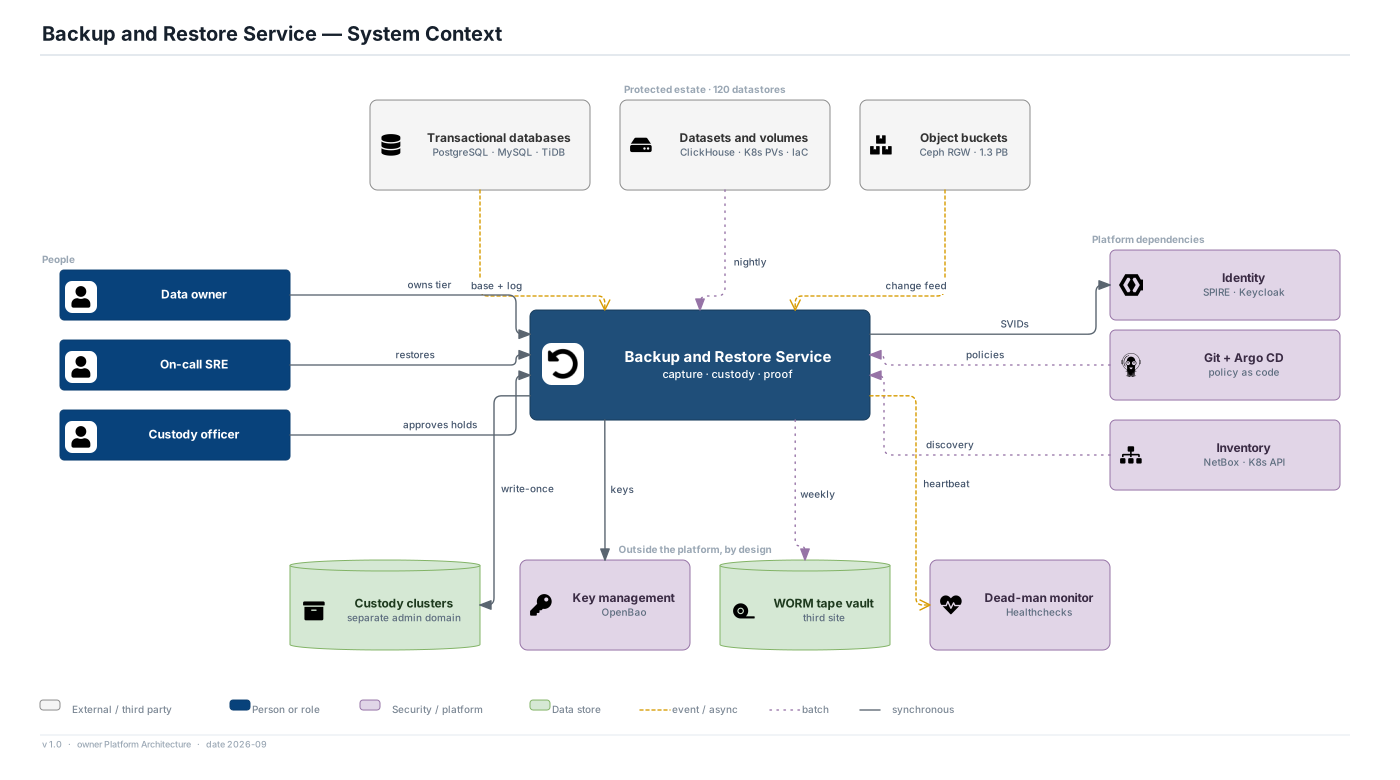
1 · Context and scope

What the platform protects, what it depends on, and what sits deliberately outside its reach.

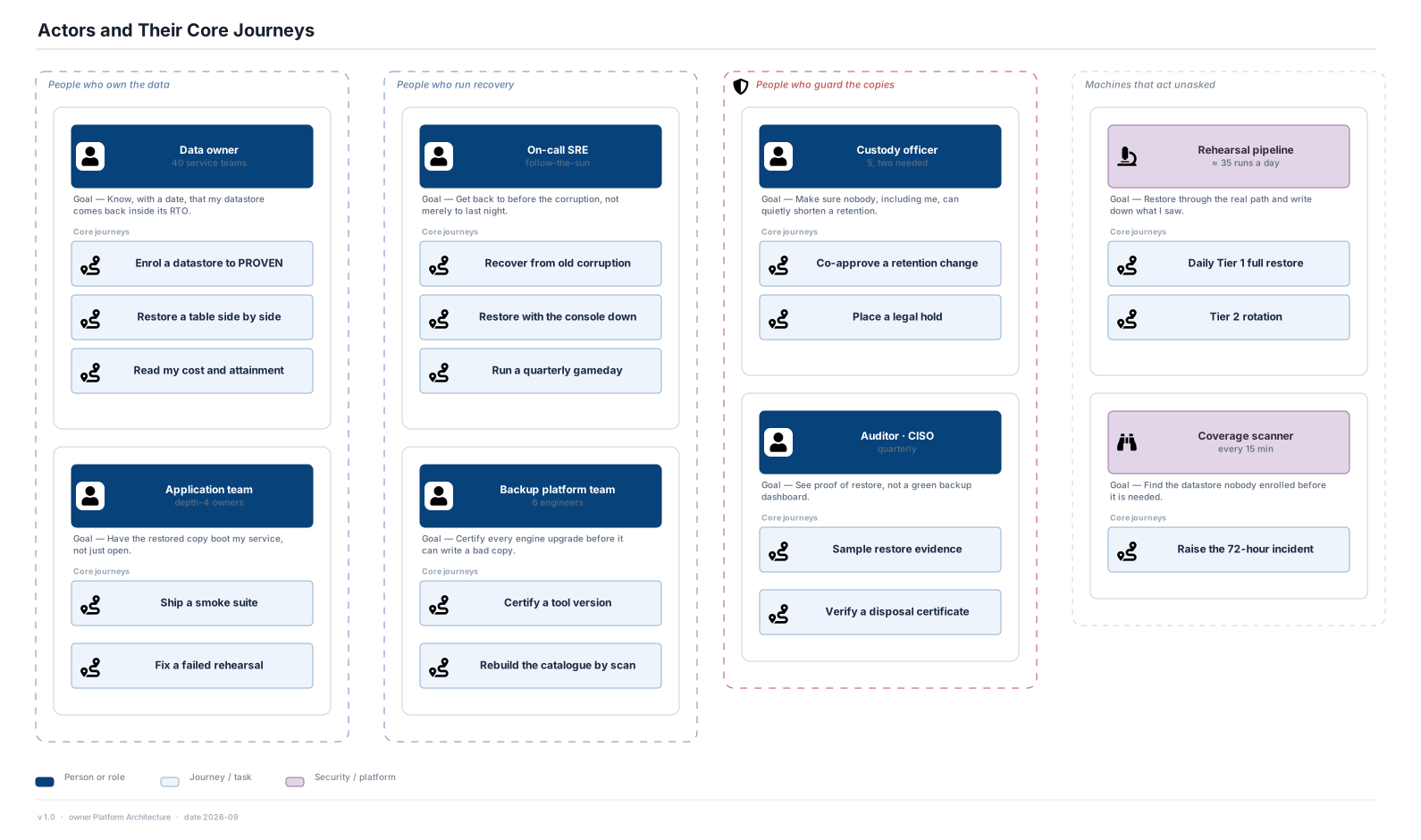
2 · People and journeys

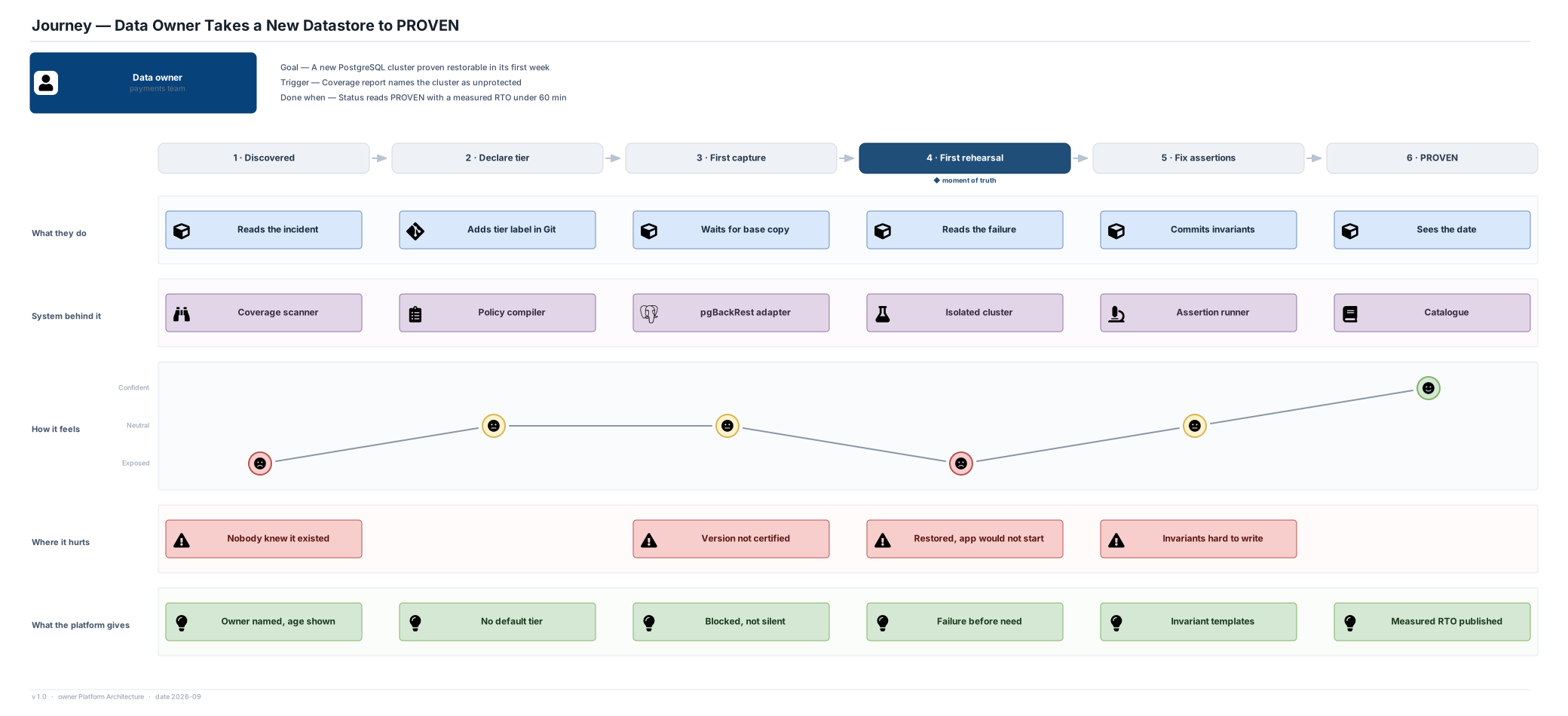
Who depends on a restore, what each of them needs from it, and the two moments where a backup platform earns or loses trust.
03 People who own the data Data owner 40 service teams Goal — Know, with a date, that my datastore comes back inside its RTO. Core journeys Enrol a datastore to PROVEN Restore a table side by side Read my cost and attainment Application team depth-4 owners Goal — Have the restored copy boot my service, not just open. Core journeys Ship a smoke suite Fix a failed rehearsal People who run recovery On-call SRE follow-the-sun Goal — Get back to before the corruption, not merely to last night. Core journeys Recover from old corruption Restore with the console down Run a quarterly gameday Backup platform team 6 engineers Goal — Certify every engine upgrade before it can write a bad copy. Core journeys Certify a tool version Rebuild the catalogue by scan People who guard the copies Custody officer 5, two needed Goal — Make sure nobody, including me, can quietly shorten a retention. Core journeys Co-approve a retention change Place a legal hold Auditor · CISO quarterly Goal — See proof of restore, not a green backup dashboard. Core journeys Sample restore evidence Verify a disposal certificate Machines that act unasked Rehearsal pipeline ≈ 35 runs a day Goal — Restore through the real path and write down what I saw. Core journeys Daily Tier 1 full restore Tier 2 rotation Coverage scanner every 15 min Goal — Find the datastore nobody enrolled before it is needed. Core journeys Raise the 72-hour incident Actors and Their Core Journeys Person or role Journey / task Security / platform v 1.0 · owner Platform Architecture · date 2026-09 Actors and Their Core Journeys Who depends on a restore working, what each of them is actually trying to get done, and the two machines that act without being asked. HTML page SVG draw.io

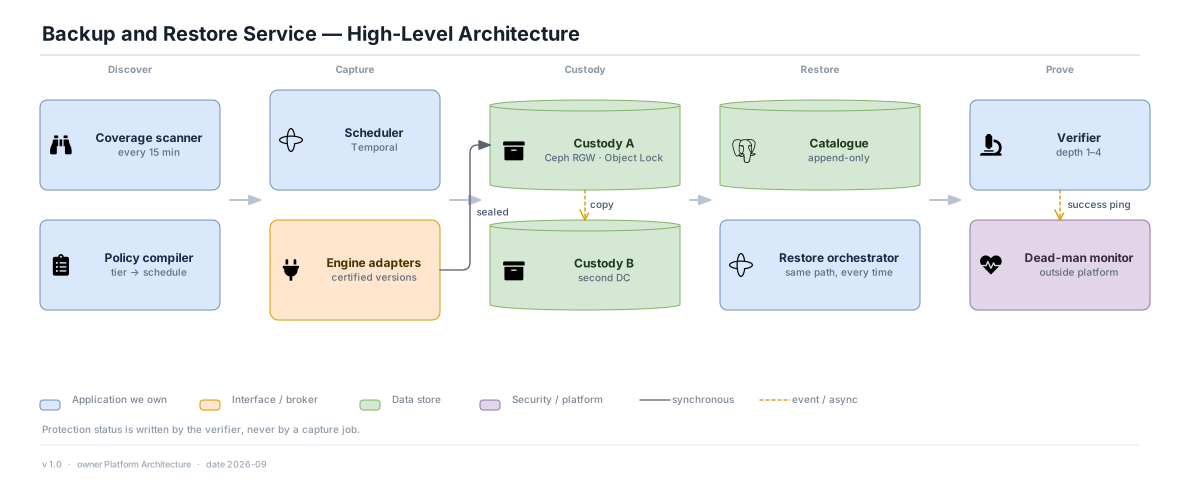
3 · Structure

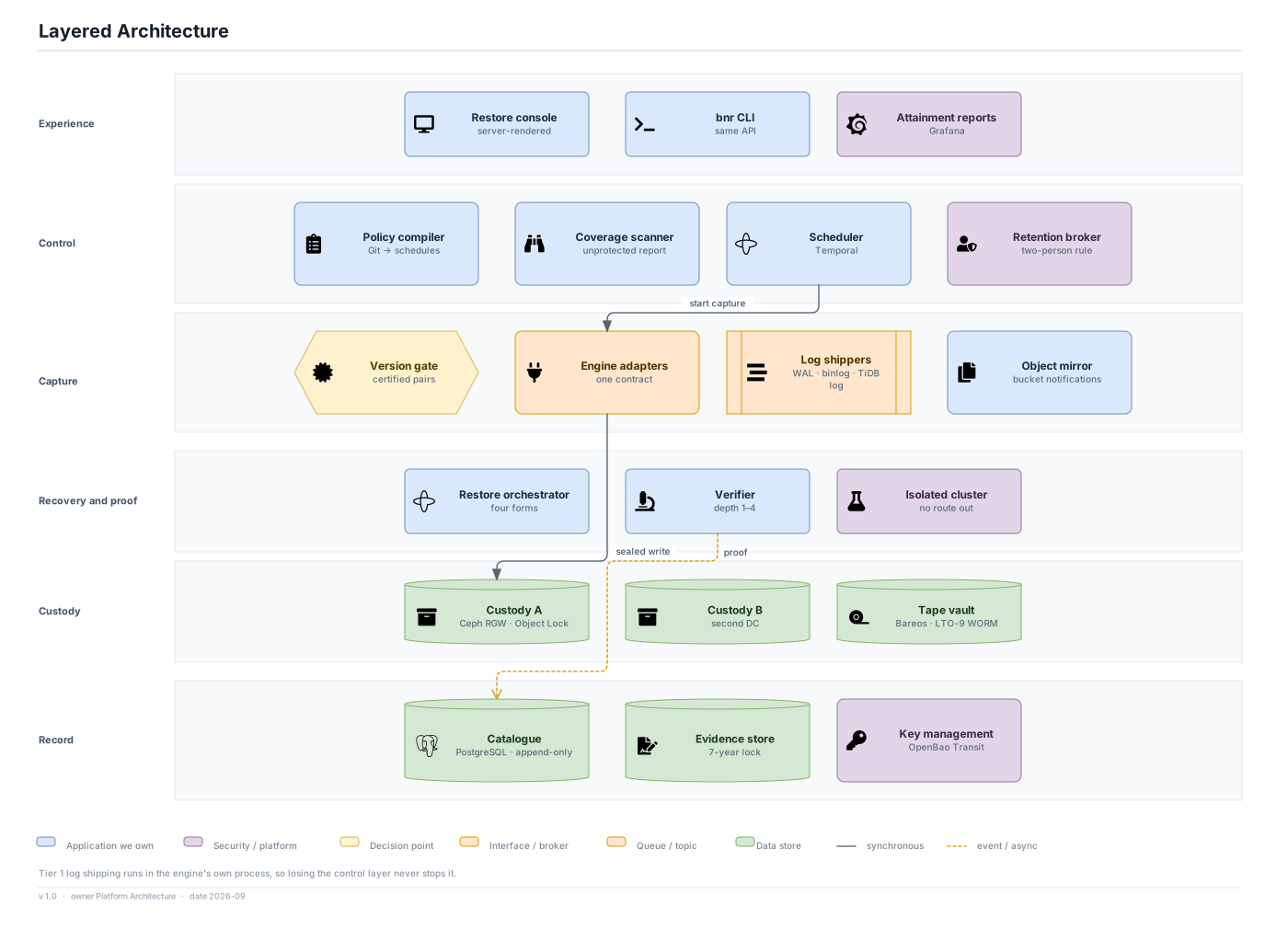
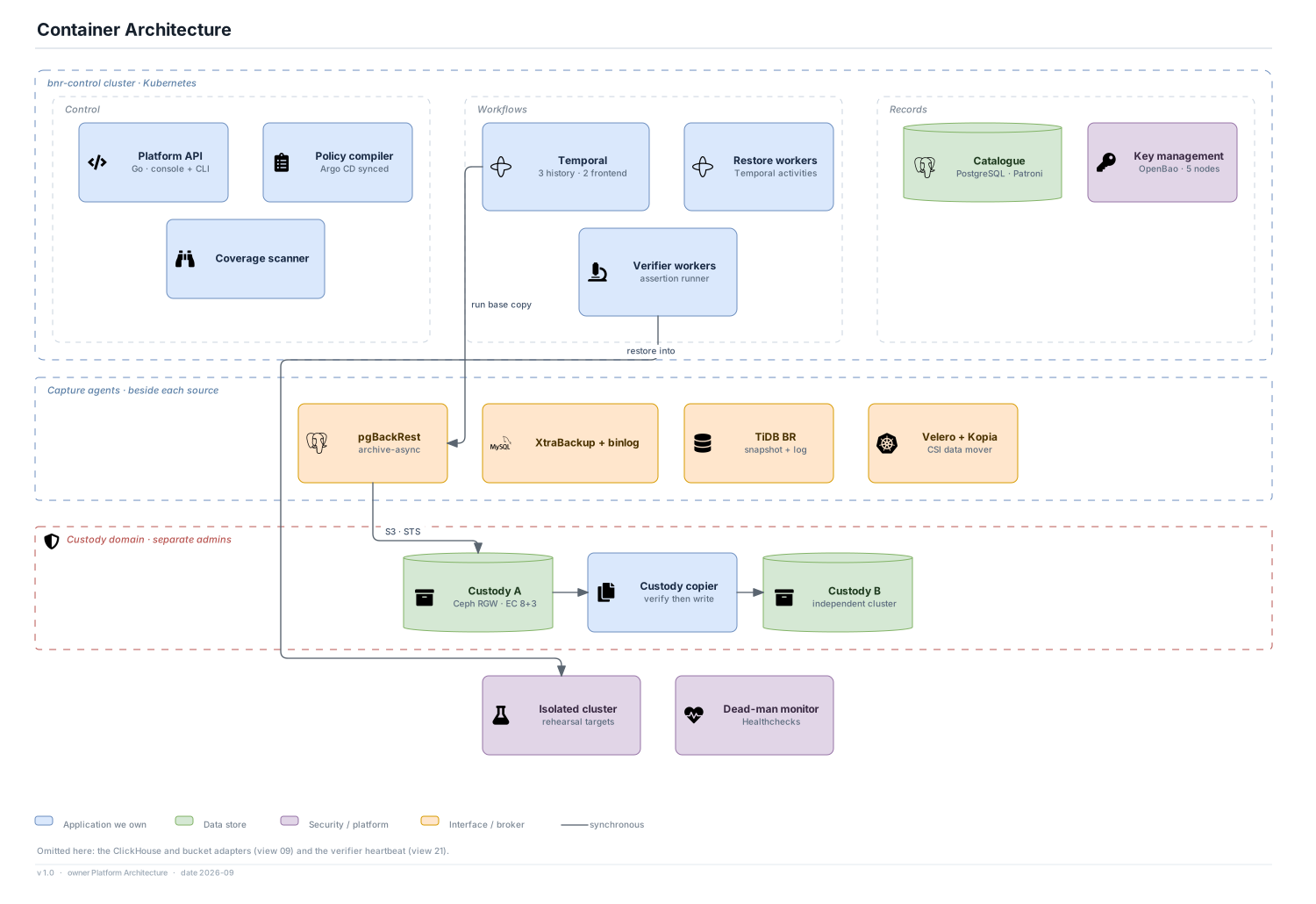
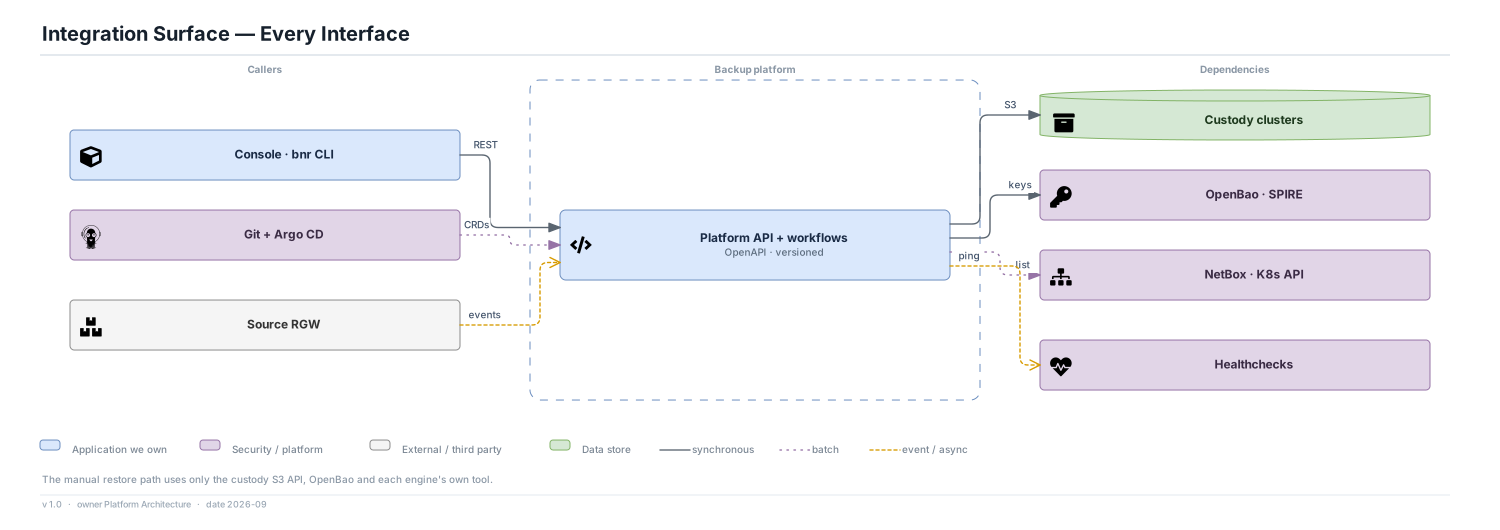
The layers, the deployable units, every interface, and how six different engines sit behind one contract.

4 · Data

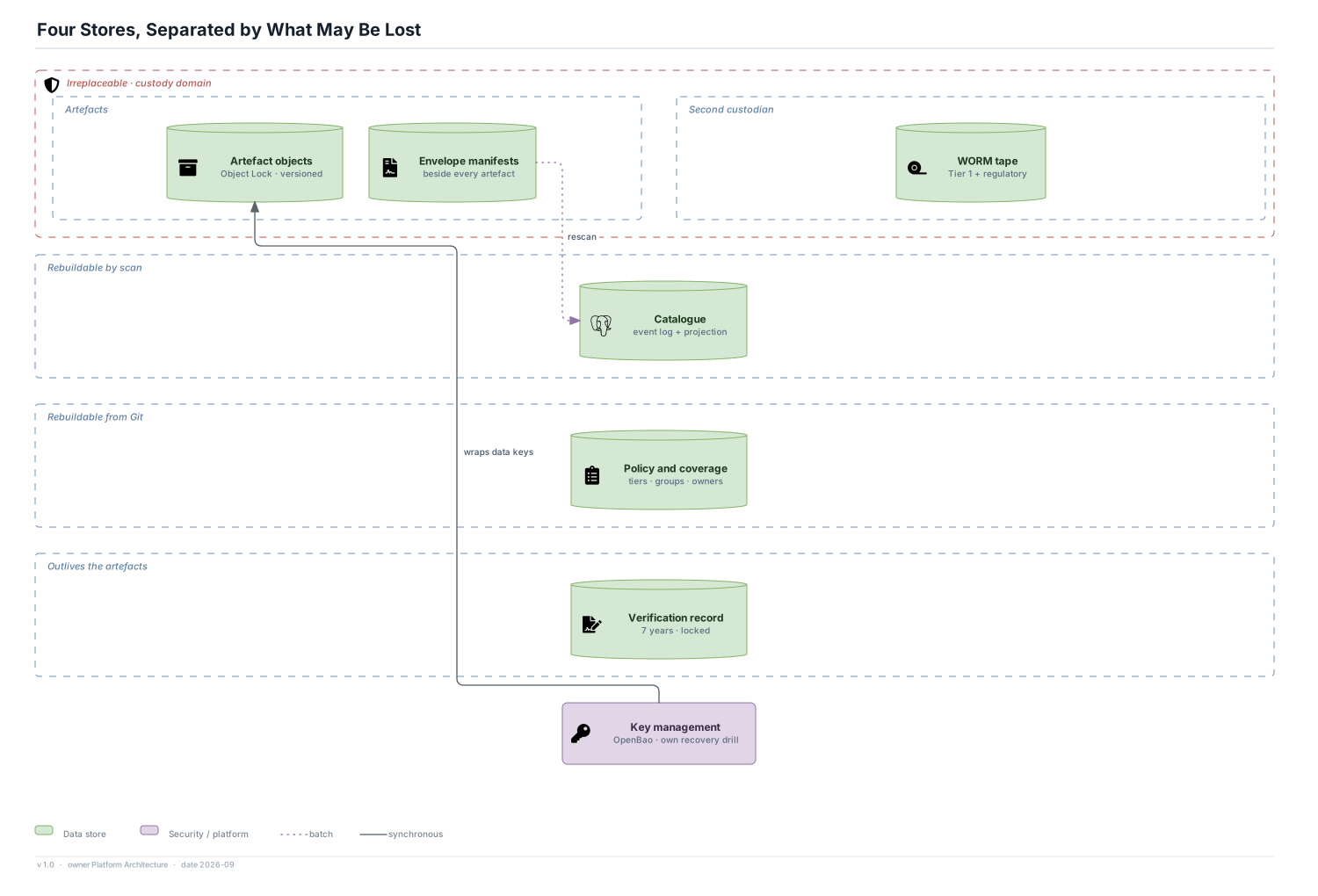
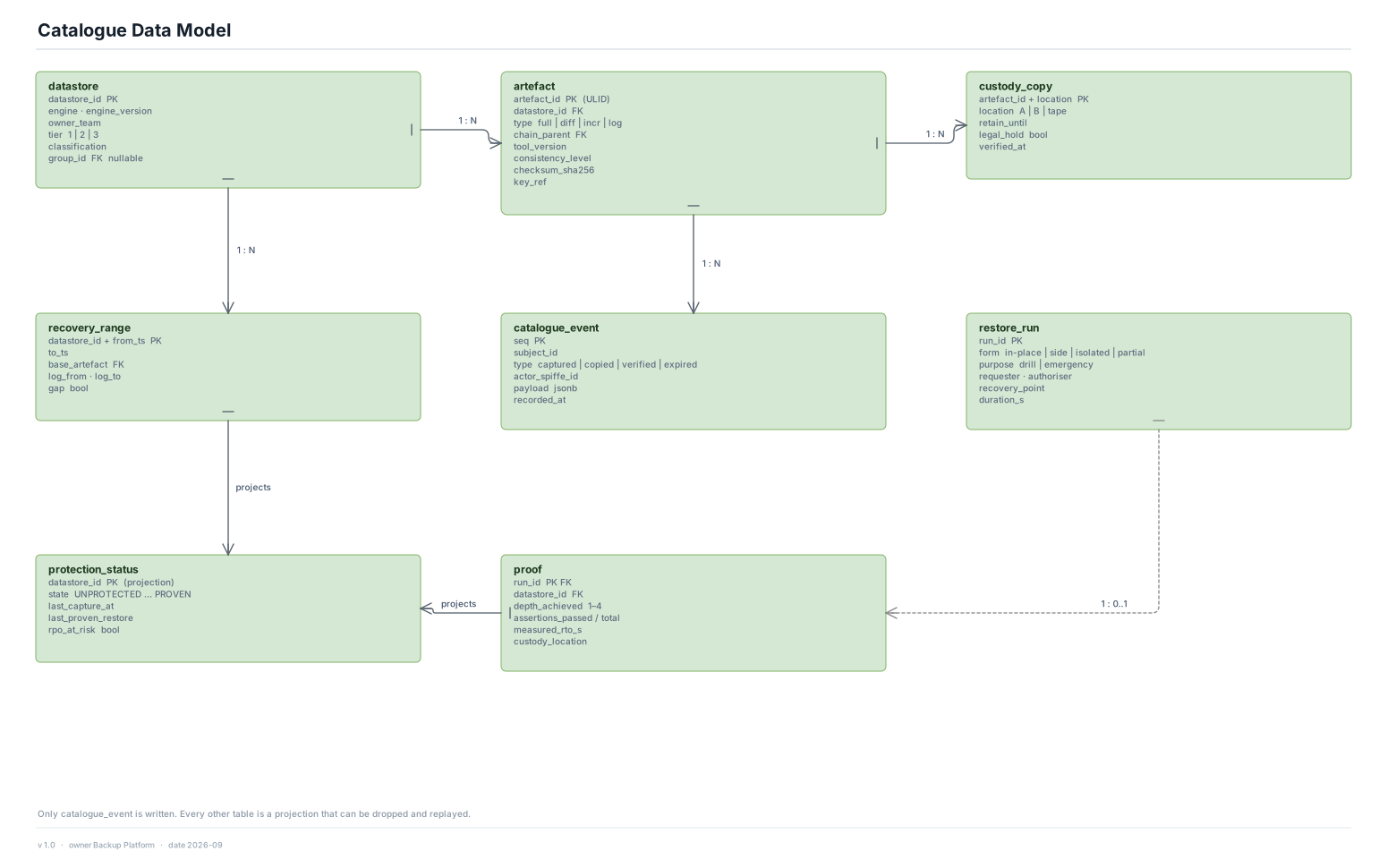
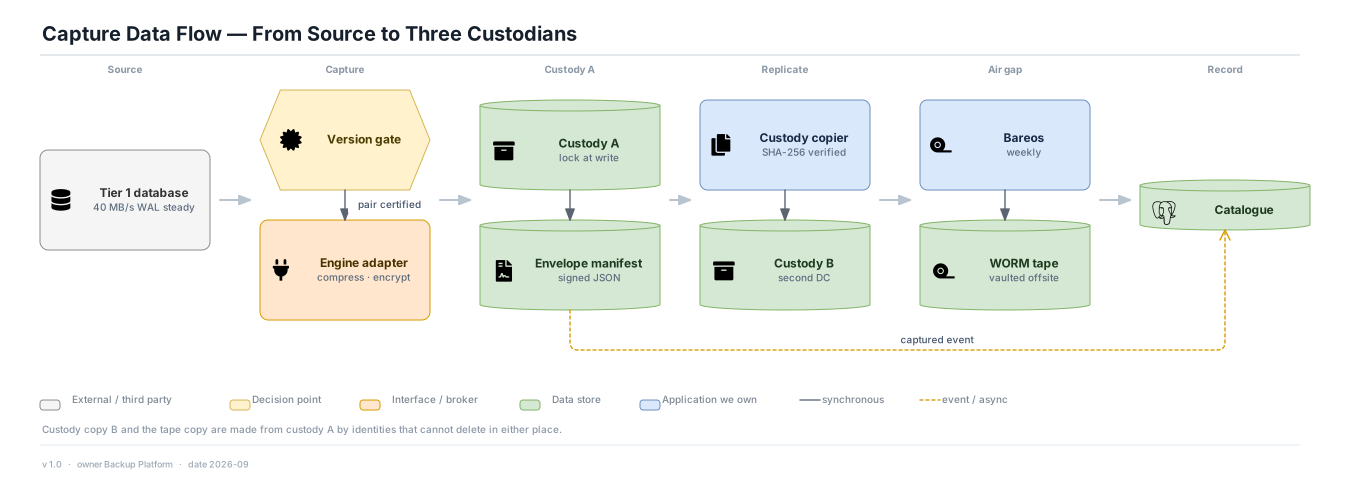
Which store is irreplaceable, which can be rebuilt, the catalogue model, how a copy reaches three custodians, and how long each copy lives.

5 · Runtime

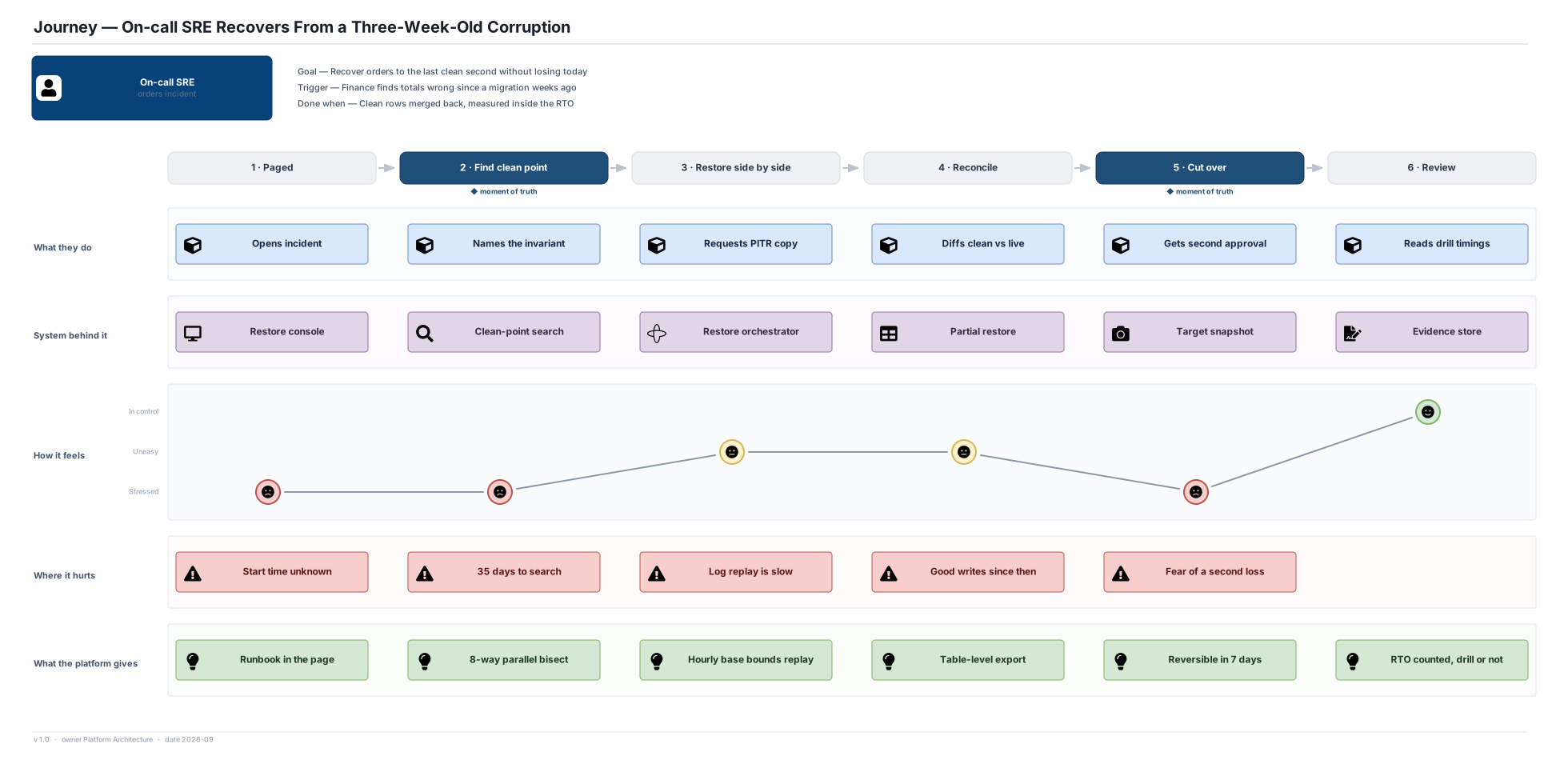
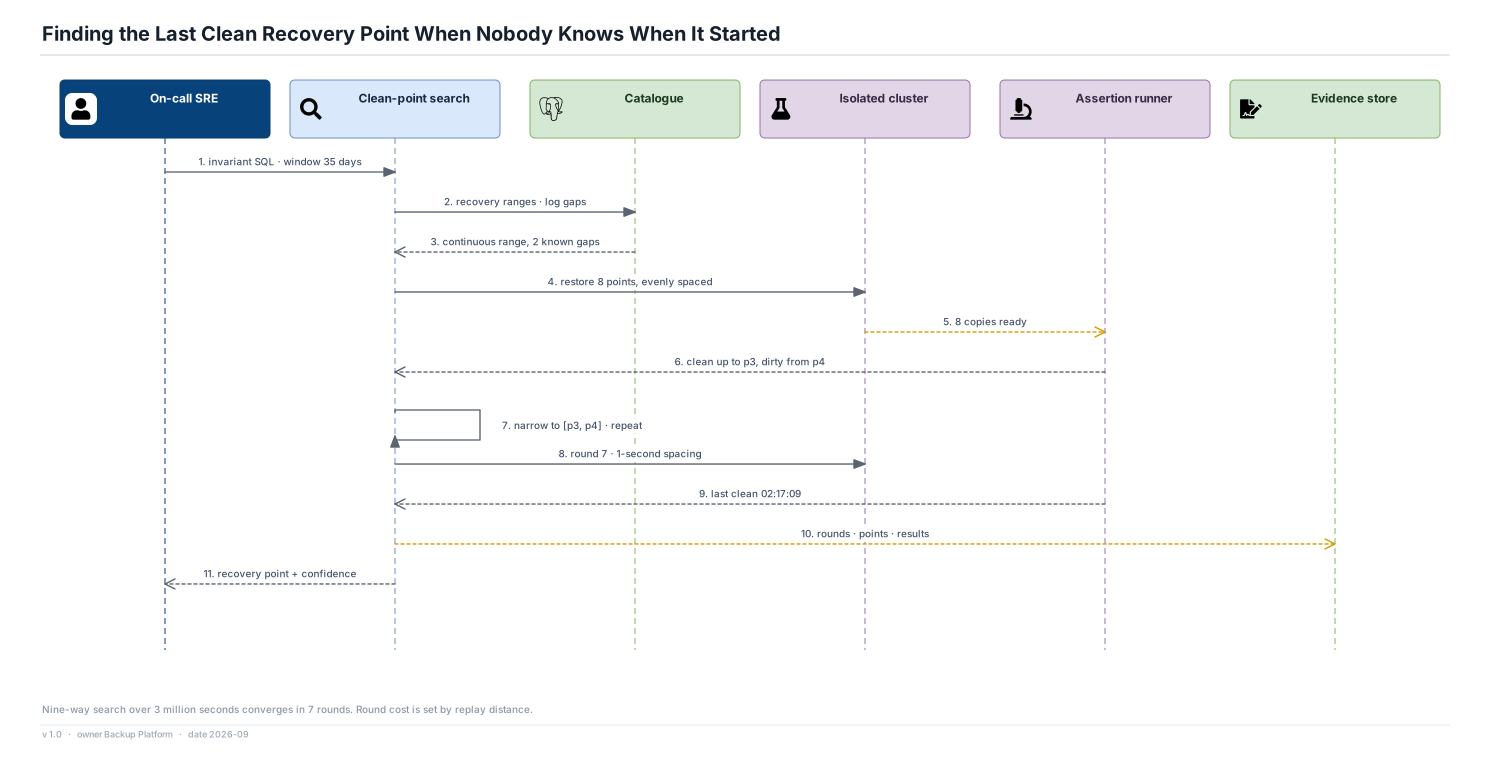
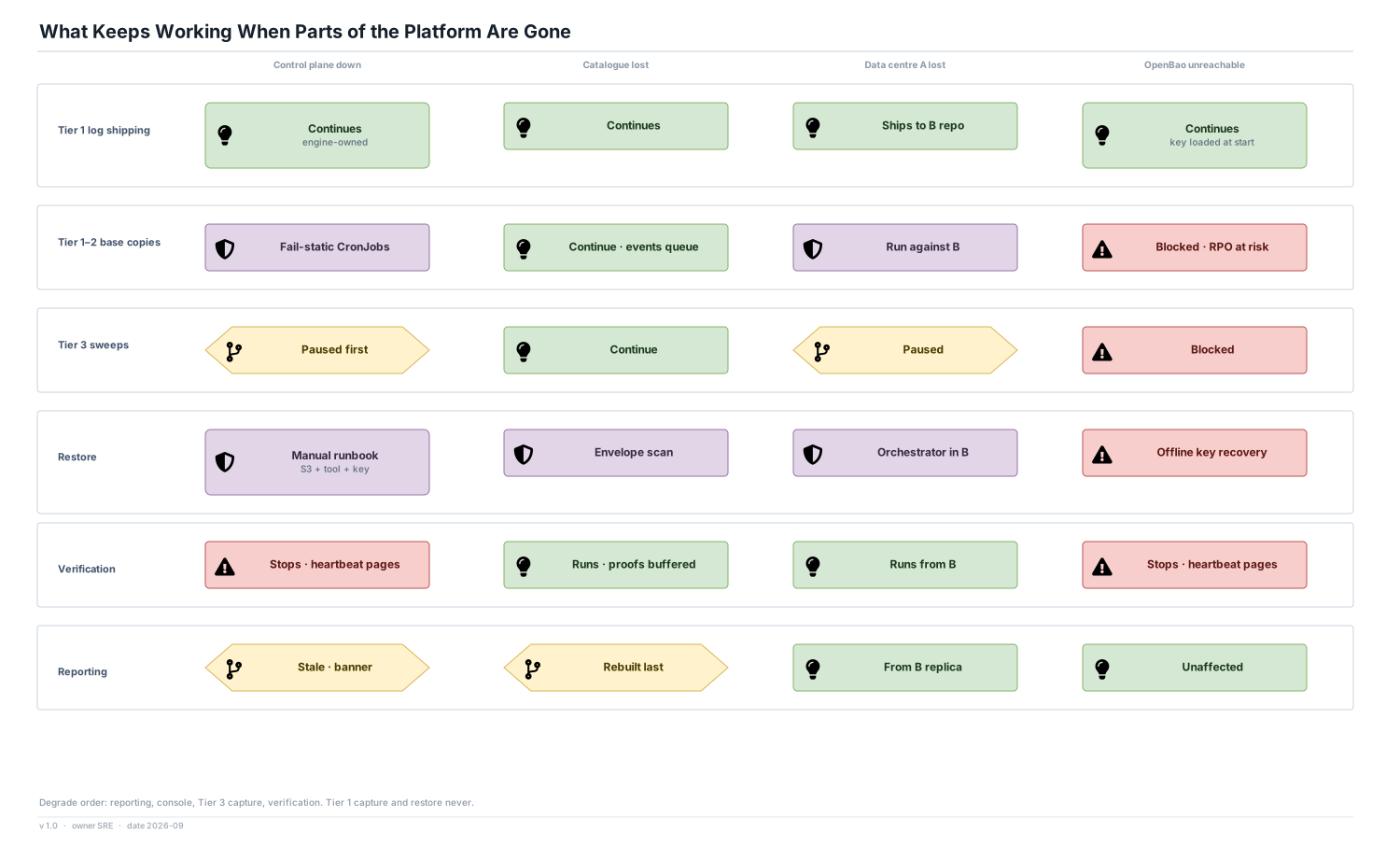
A point-in-time restore, the daily rehearsal that proves it, the search for a clean point, the dangerous in-place restore, and what still works when parts are gone.

6 · Operations

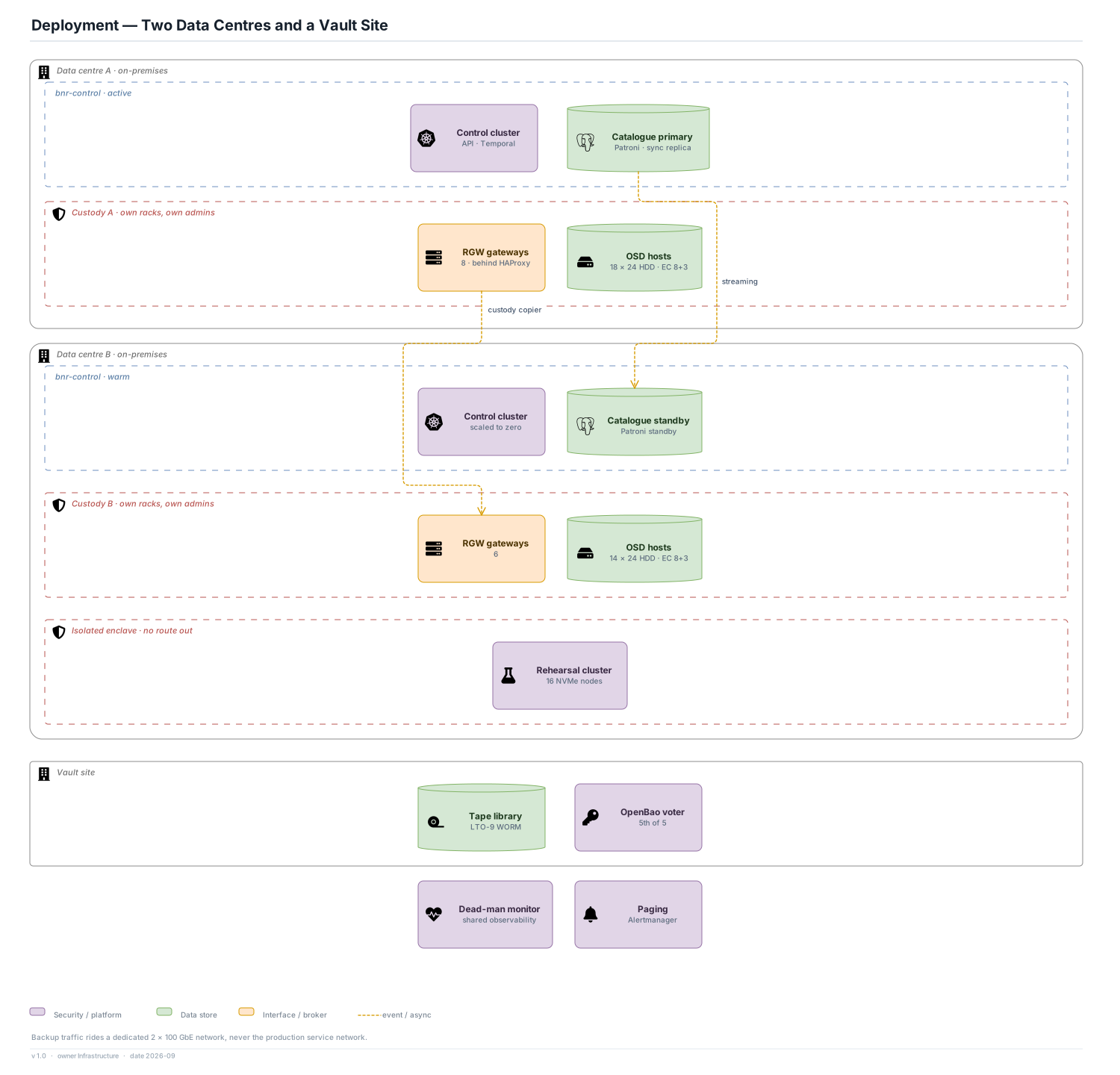
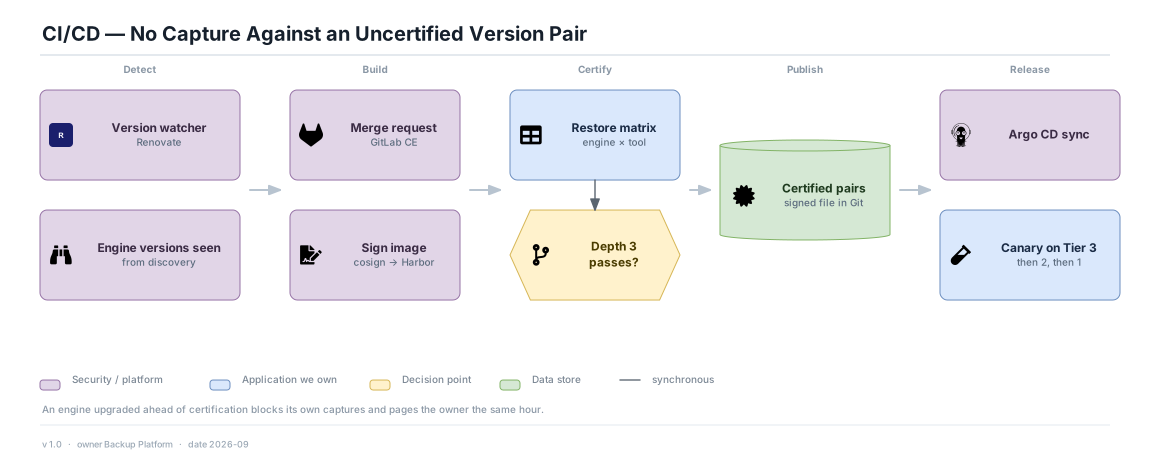
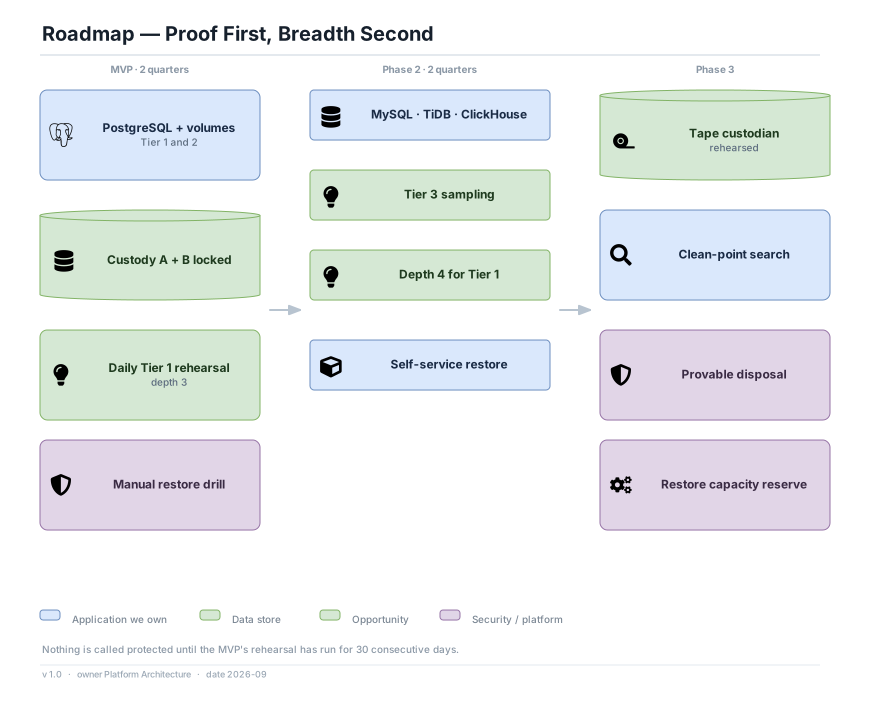
Where it runs, how a tool upgrade is proven before it can write a bad copy, what is watched, the status loop, and the order it gets built.

7 · Assurance

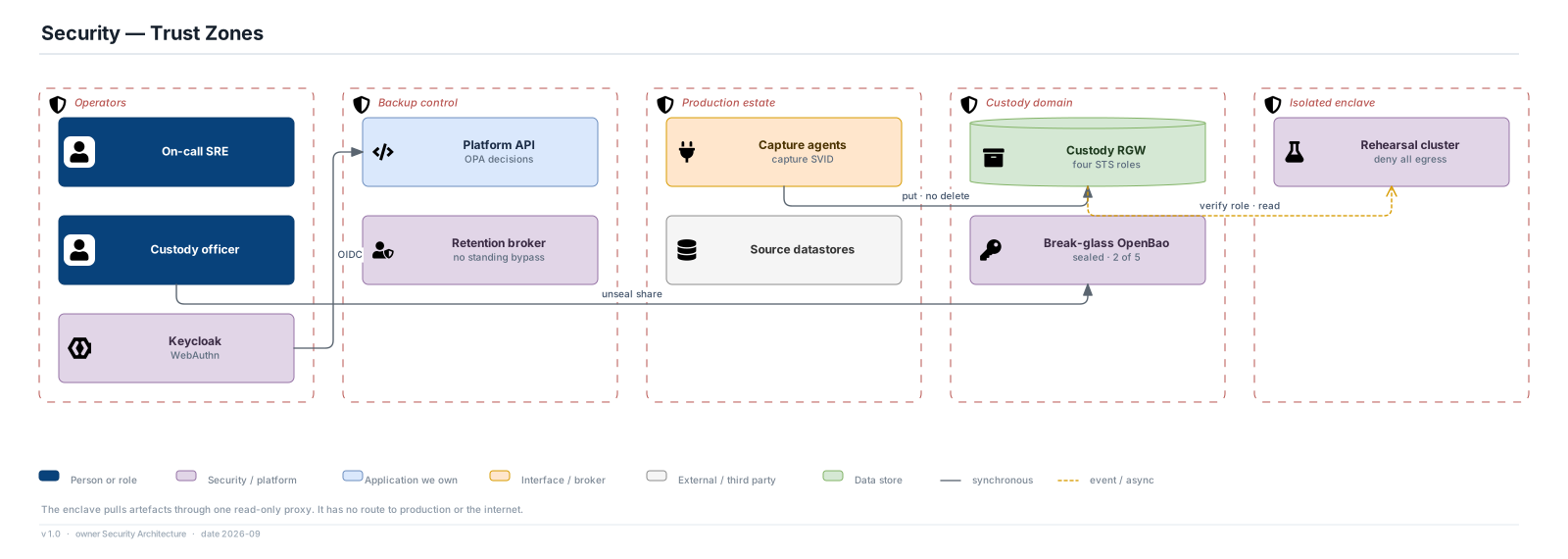
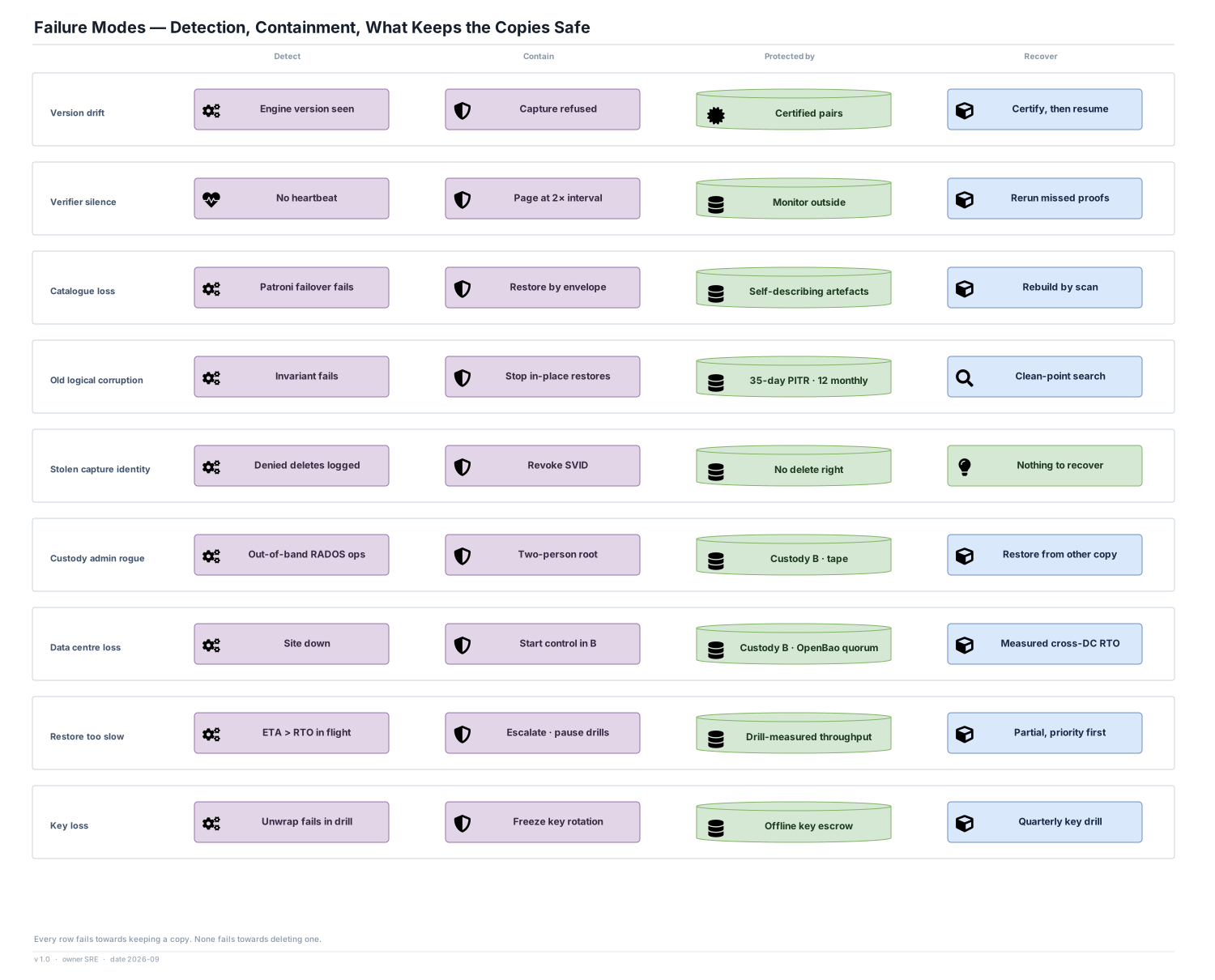
Trust zones, the two-person path for shortening a lock, and every named failure with the mechanism that keeps the copies safe.

Architecture One-Pager

The problem, the shape of the answer, the decisions that carry it, and why it should still be the right shape in ten years.

A successful backup job proves that something was written. Only a restore proves that something can be recovered. This architecture is built around that difference.

Almost every serious data loss story has the same shape. There were several backup mechanisms, each reporting success, and none of them had ever been restored from until the day it was needed. The tool had drifted from the engine version, or the key had been rotated away, or the restore took nine hours against a one-hour promise, or the only copies sat in an account the attacker also controlled. The estate here is 120 datastores across six kinds of engine, about 1.4 PB, run in two of the organisation's own data centres. The job is not to take more copies. It is to be able to say, for each datastore, when a restore last actually worked and how long it took.

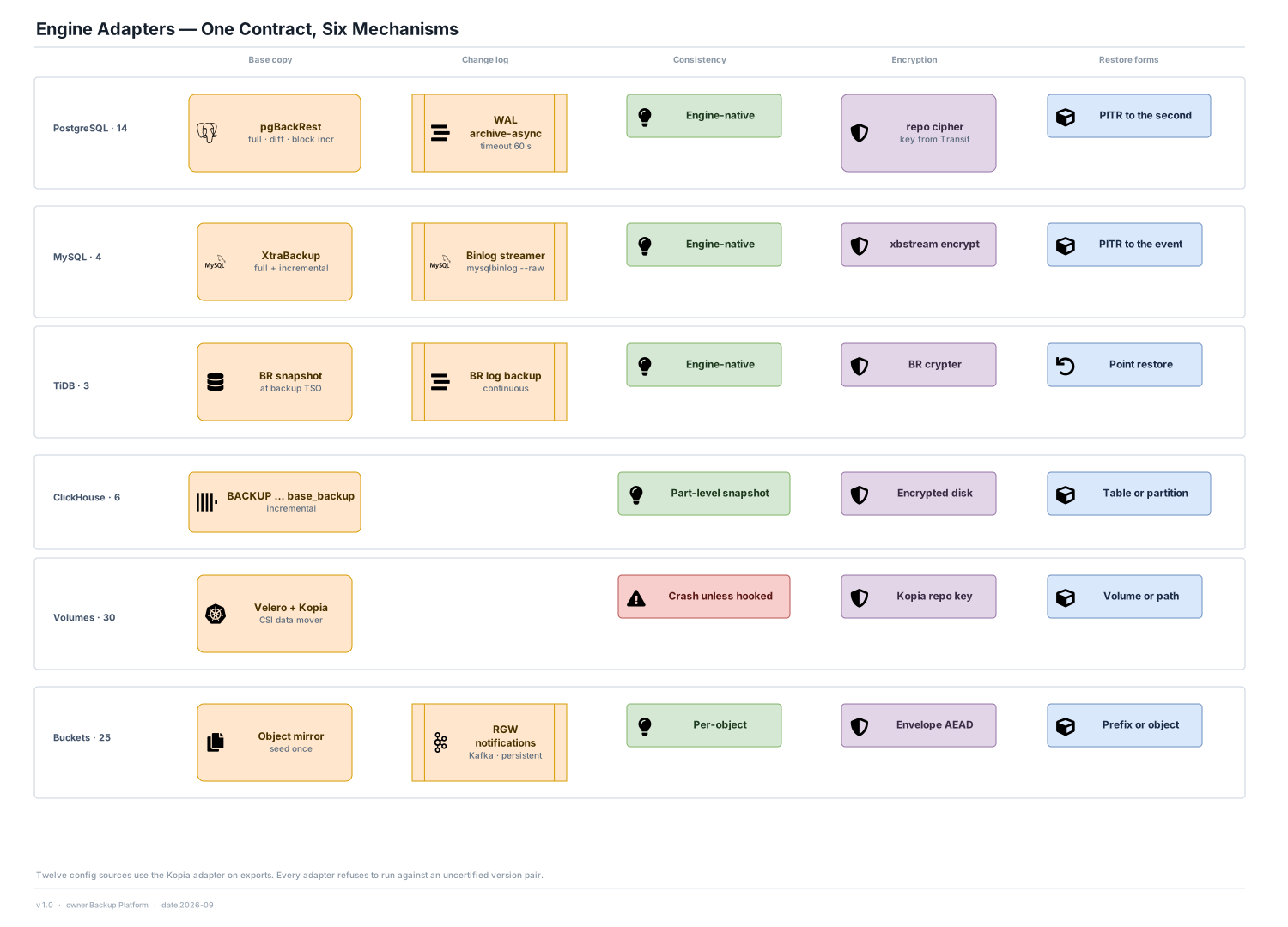
Each engine's own tool takes the copy (pgBackRest, XtraBackup, TiDB BR, ClickHouse BACKUP, Velero with Kopia) behind one adapter contract. A version gate refuses any tool and engine pair that has not been certified by a real restore. Copies are encrypted at the source and written to Ceph object storage with Object Lock, in a custody domain the backup platform cannot delete from. A verifying copier fills a second, independently administered cluster in the other data centre, and Tier 1 and the regulatory set also go to WORM tape at a third site. A PostgreSQL catalogue indexes it all, but every copy describes itself, so the catalogue can be rebuilt by scanning. Every day, an isolated cluster with no route out restores each Tier 1 datastore through the same Temporal workflow an emergency would use. It checks structure, content and whether the application boots, and records a proof with a measured duration. Protection status is computed from those proofs and nothing else, and a monitor run by another team pages when the proofs stop arriving.

What it is, and what it is not

A platform that proves every datastore can be restored, with a datea backup scheduler with a green dashboard of job results.
Custody the backup platform can write to but cannot delete fromimmutability implemented in the platform's own code, which a stolen credential would bypass.
Each engine's own backup and point-in-time tooling, orchestrateda home-grown universal backup format that reimplements database recovery.
A catalogue that makes restores fasta single point of failure. The copies describe themselves and the catalogue is rebuilt from them every week.
An RTO measured in drills and published next to the targetan RTO calculated from a storage vendor's throughput sheet.
Protection against the data being corrupted, deleted or encryptedhigh availability. Replicas and failover belong to the protected systems, and a replica is never counted as a backup.

The decisions that are the architecture

01Status is a verification outcome

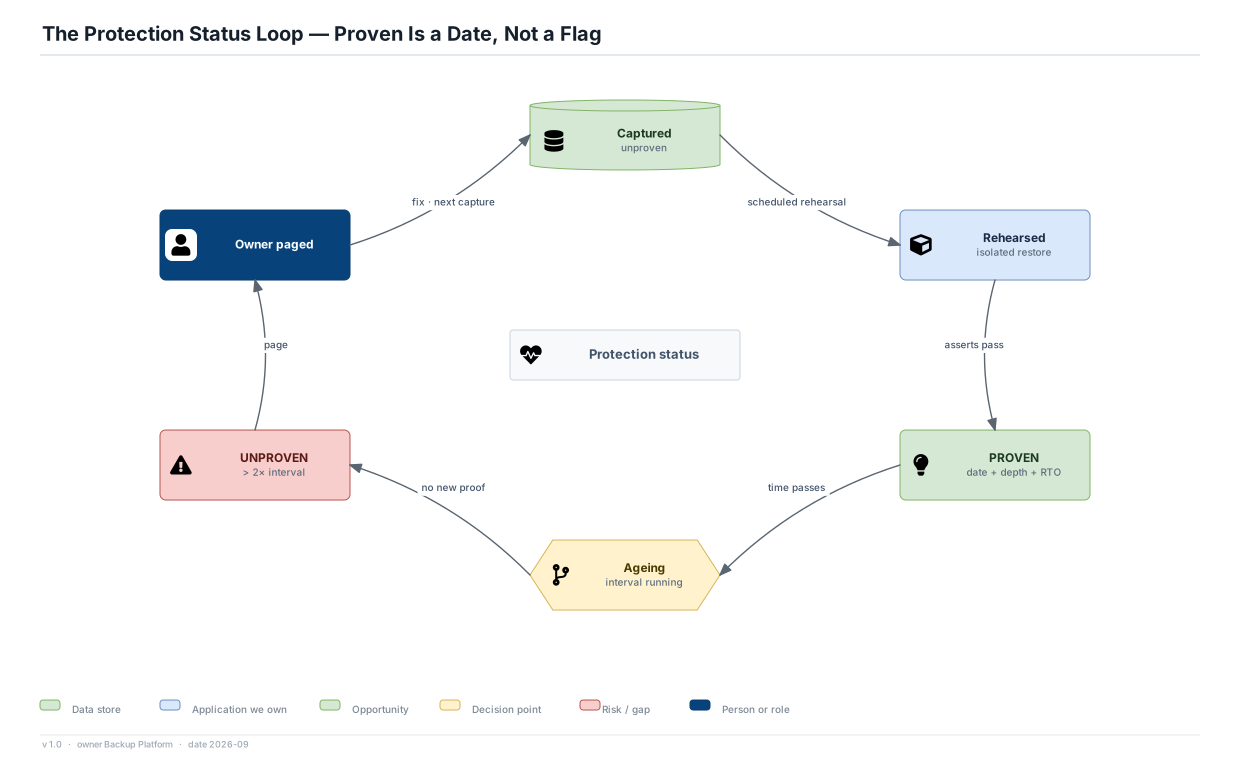
Only a successful rehearsal writes PROVEN, and proof expires at twice the verification interval. The field that is reported, paged on and audited is last_proven_restore.

ADR-01

02Rehearse through the real path

Rehearsals use the same workflow, adapters, keys and custody reads as an emergency, to a random second, alternating custody copies. A special verification path would only prove itself.

ADR-03

03Watch for silence from outside

Healthchecks, run by the observability team, expects a success ping per tier and per Tier 1 datastore, and pages at twice the interval. A pipeline that stops looks exactly like a healthy one to a monitor that only watches for failures.

ADR-04

04A custody domain the platform cannot delete from

Ceph RGW with Object Lock set at write time, on separate racks with separate administrators and credentials. The capture role can put and get, and nothing else.

ADR-06

05Two people, enforced by cryptography

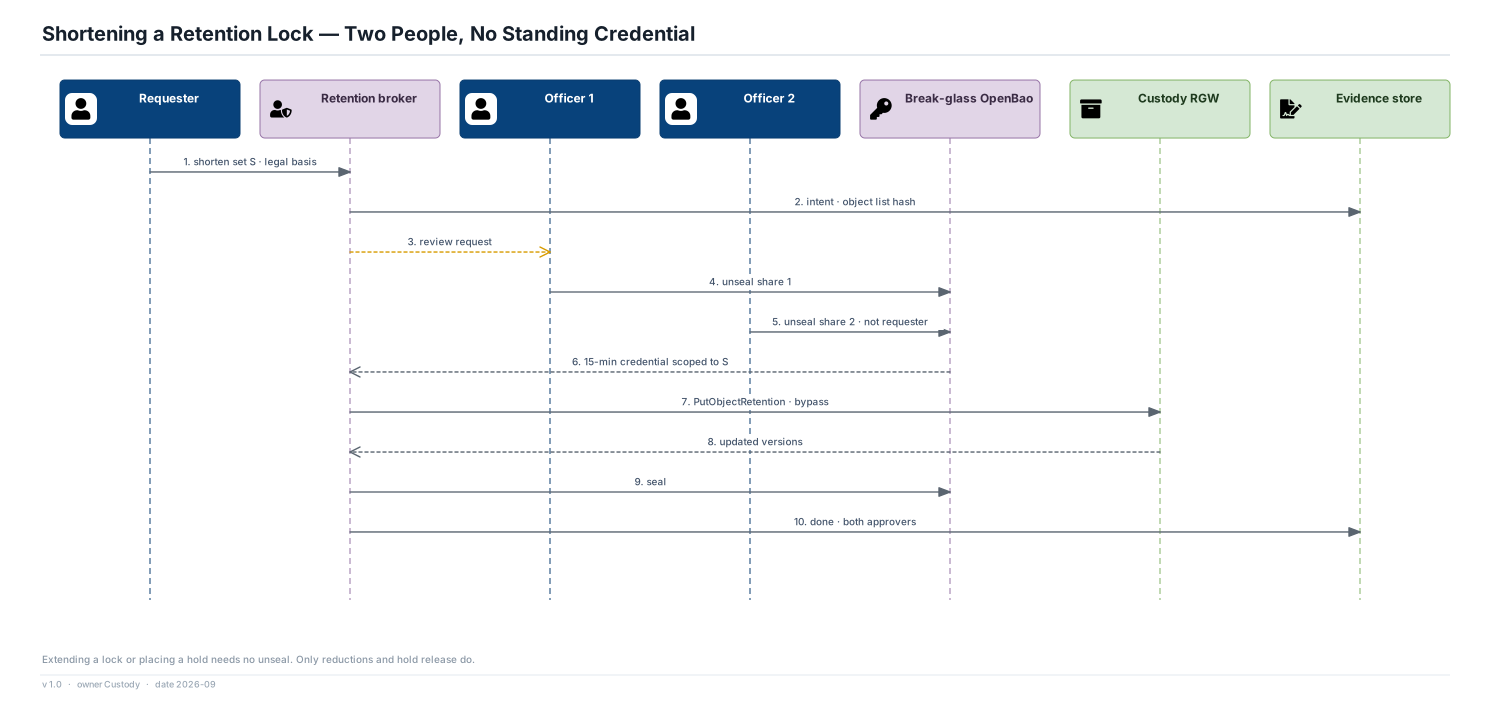
The permission to shorten a lock lives only in a sealed OpenBao instance that needs 2 of 5 officer key shares to open. It issues one scoped 15-minute credential per unseal, and no standing identity holds that permission.

ADR-07

06A second custodian that fails differently

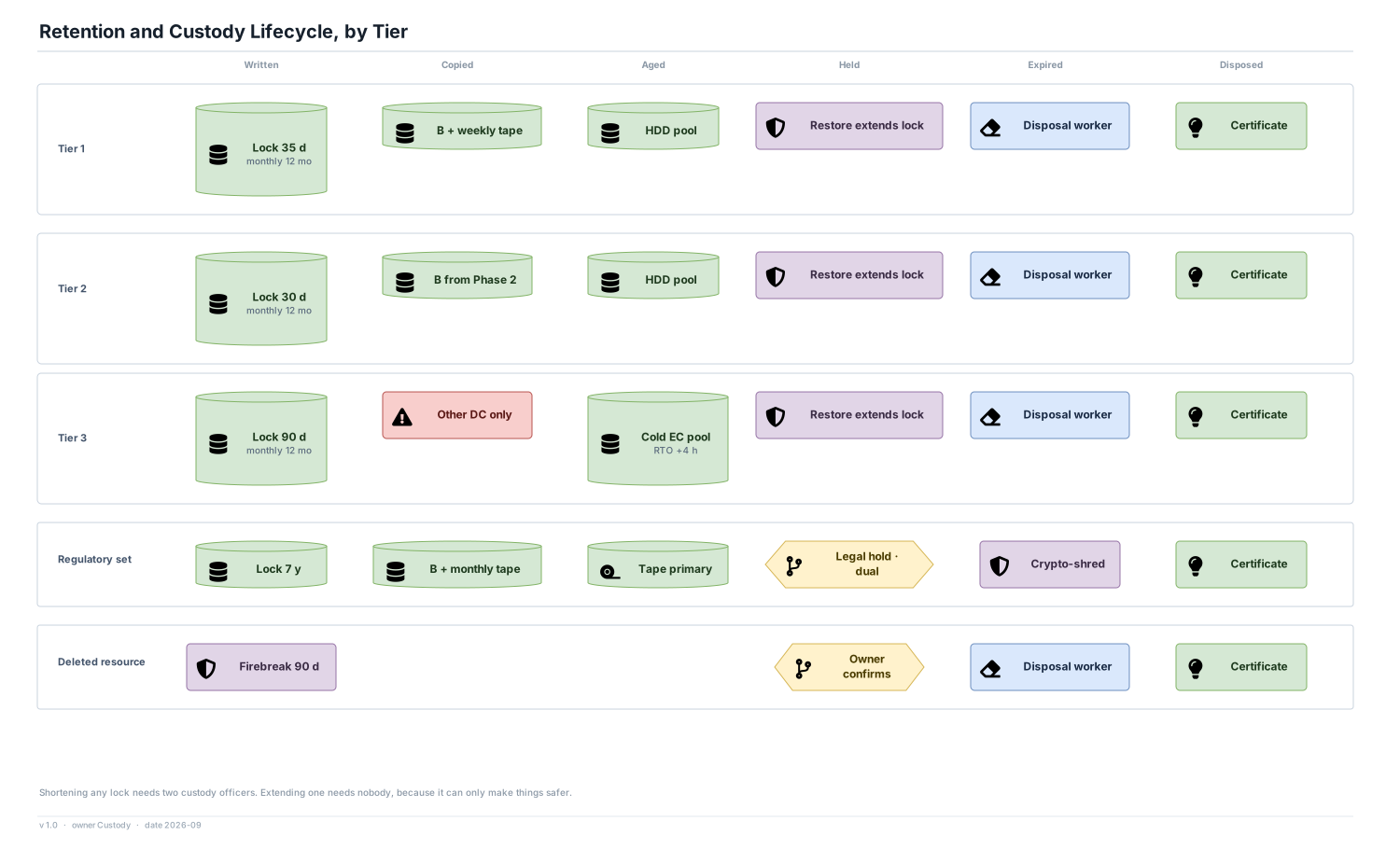
WORM tape written by Bareos and vaulted at a third site, for Tier 1 and the regulatory set, with its own quarterly restore rehearsal.

ADR-09

07Engine-native tools behind one contract

Six mature engine tools do the byte-level work and each engine's own point-in-time recovery. The platform standardises the artefact envelope, the recovery-point map and the promise.

ADR-10

08Uncertified version pairs cannot capture

A nightly restore matrix certifies each engine version against each tool version at depth 3. Adapters refuse any pair not in the signed list, so drift shows up as a blocked capture that day, not a failed restore months later.

ADR-12

09Artefacts are the truth; the catalogue is an index

A signed envelope beside every artefact carries everything a restore needs. The catalogue is rebuilt from a scan every week and diffed against the live one.

ADR-15

10RTO is a budget, and replay is the line item people forget

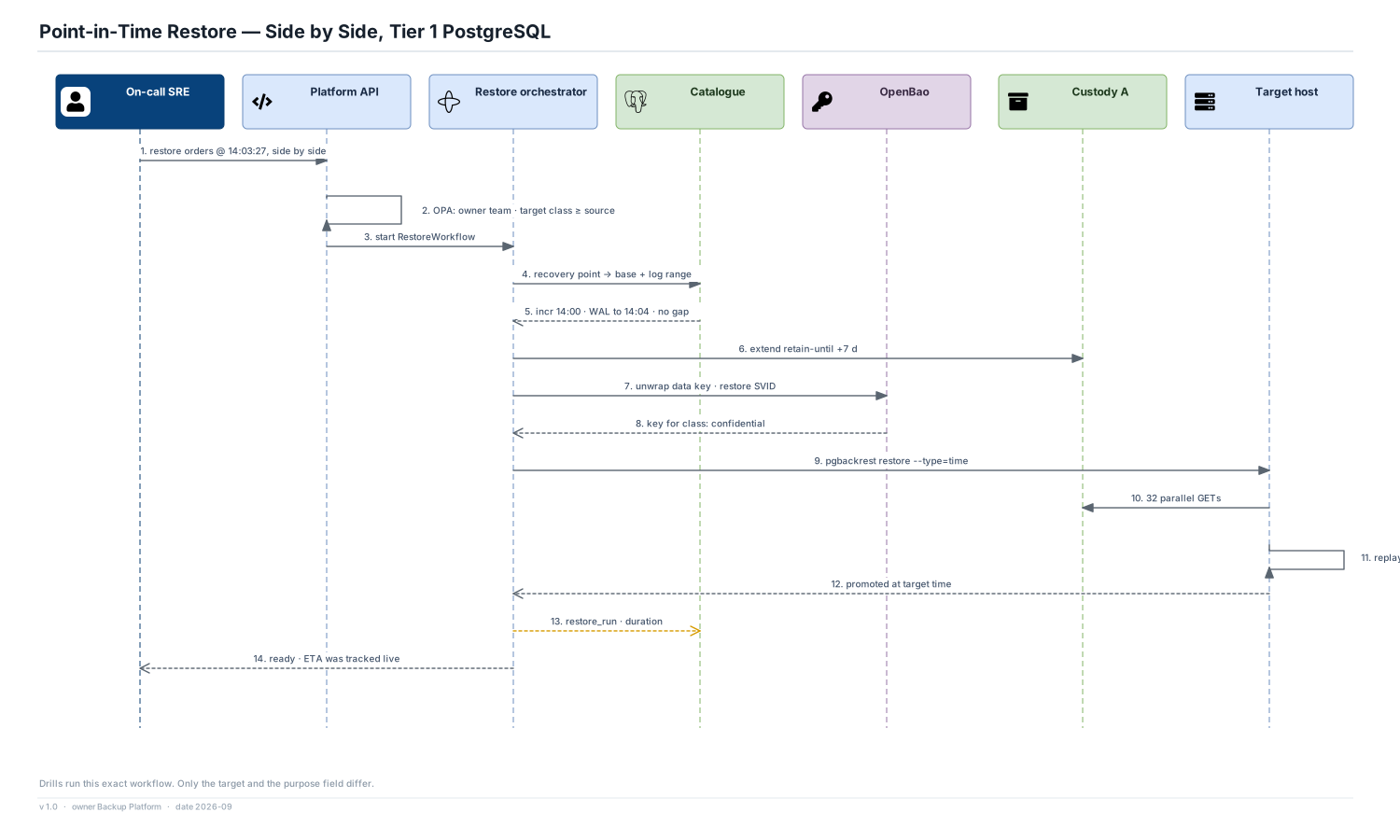
Hourly block-incremental bases keep WAL replay under an hour for Tier 1. The 60-minute RTO is allocated to authorisation, transfer, replay and assertions, and each part is measured every day.

ADR-19

Why this holds up over time

Backup platforms usually age badly in one of three ways. The tooling is replaced and nobody can read the old copies. A vendor or licence changes and the custody layer has to be migrated under pressure. Or the drills quietly stop, and the platform is back to reporting job success. The design defends against each of these on purpose.

The central property belongs to no technology

A copy counts once a restore from it has worked. That was true of tape in 1990 and will be true of whatever replaces object storage. The verifier, the proof record and the silence alarm are the lasting parts, and none of them assumes a particular engine, tool or storage product.

Every tool sits behind a contract that outlives it

Adapters are replaceable one engine at a time. The envelope is a versioned, documented JSON schema stored next to tool-native data, so a copy written by pgBackRest in 2026 can still be found, described and restored with the pgBackRest version recorded in it, even after the platform has moved to another tool.

Custody speaks the most widely implemented storage API

The platform uses nothing from Ceph except the S3 API, Object Lock and STS. Any S3-compatible store with Object Lock can replace it, and moving is a copy under a new lock, not a redesign. Nothing depends on the Ceph admin API, deliberately.

Open source chosen for its governance, not just its licence

Recent relicensing forced forks and migrations elsewhere in the industry: HashiCorp Vault moved to the Business Source License in 2023, and MinIO's community edition narrowed sharply in 2025. Custody and keys therefore sit on foundation-governed or long-stable projects: Ceph, PostgreSQL, and OpenBao under the Linux Foundation. Every choice has a named alternative in the decision record.

Keys can change without rewriting a petabyte

Artefacts are encrypted with data keys wrapped by per-classification key-encryption keys in OpenBao, and the envelope records the key id and algorithm. Rotating a key, or moving to a new algorithm, rewraps small data keys and leaves the stored bytes alone. Old key versions are kept for longer than the longest retention.

Numbers are re-measured, not inherited

RTO, restore throughput and replay speed are measured again every day, so when hardware, data volume or engine versions change, the published numbers change too. A design sized once, on paper, goes out of date without anyone noticing. This one shows its drift in the daily report.

Controls that survive people leaving

Two-person rules are enforced with key shares that are re-issued whenever a holder leaves, not by remembering who is trusted. Runbooks are proven by gamedays run by people who did not write them, so knowledge does not leave with the original team.

Non-functional targets

Targets from the requirement, and the mechanism that meets each one. Every duration and throughput figure is replaced by a measured value at the first drill and republished monthly.

QualityTargetHow it is metView
Tier 1 RPO ≤ 5 min; log shipping lag p99 ≤ 60 s Engine-owned continuous log shipping (WAL archive-async with a 60 s timeout, binlog streamer, TiDB log backup) that keeps running without the control plane 09
Tier 1 RTO ≤ 60 min, measured Budget of 10 min start, about 17 min transfer at 4 GB/s, ≤ 10 min replay (bounded by hourly bases) and 10 min asserts; escalated in flight when the estimate passes target 14
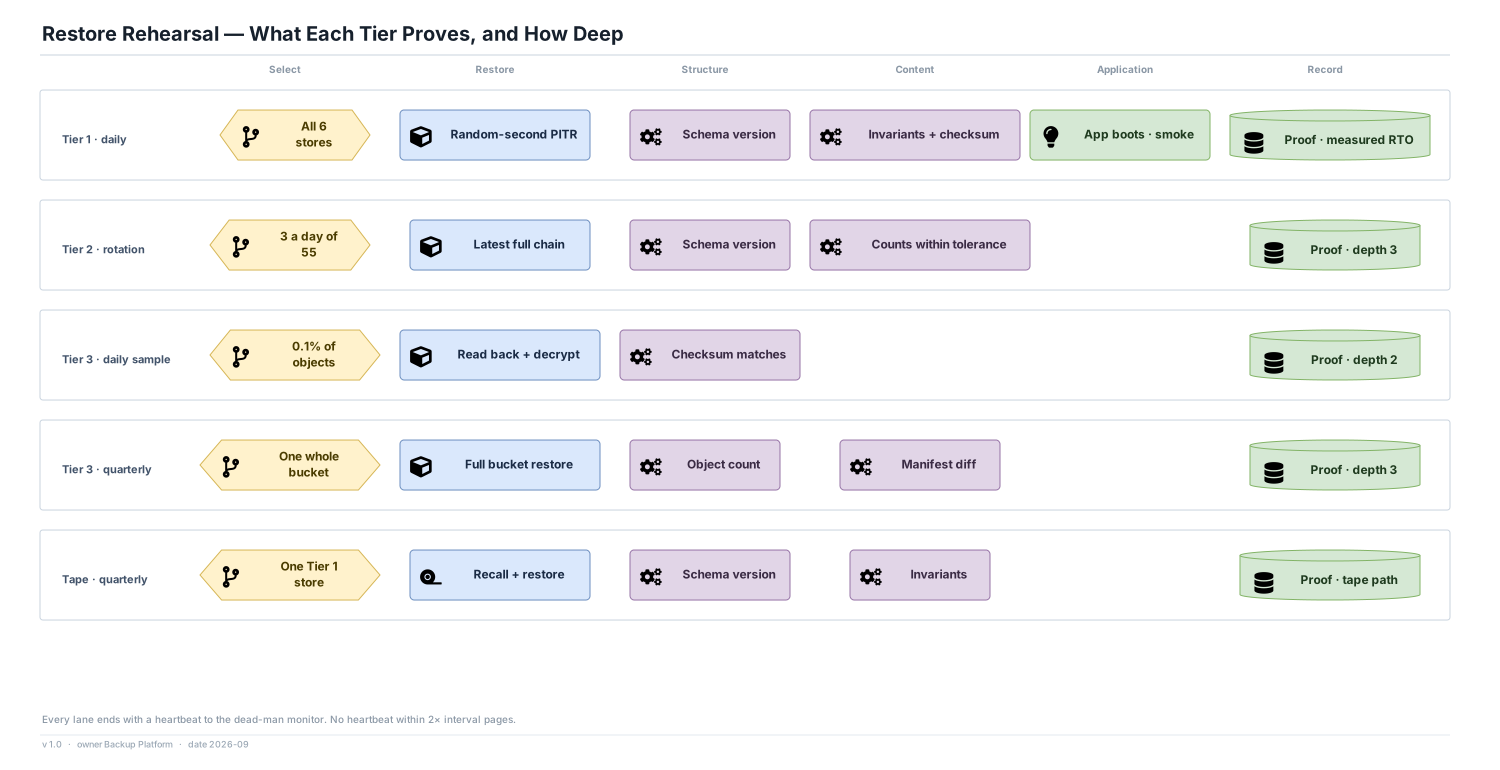
Recoverability evidence 100% of Tier 1 proven in interval; 98% of Tier 2; 95% of Tier 3 Daily Tier 1 rehearsal at depth 4, Tier 2 rotation of 3 a day, Tier 3 sampling plus a quarterly full bucket restore 15
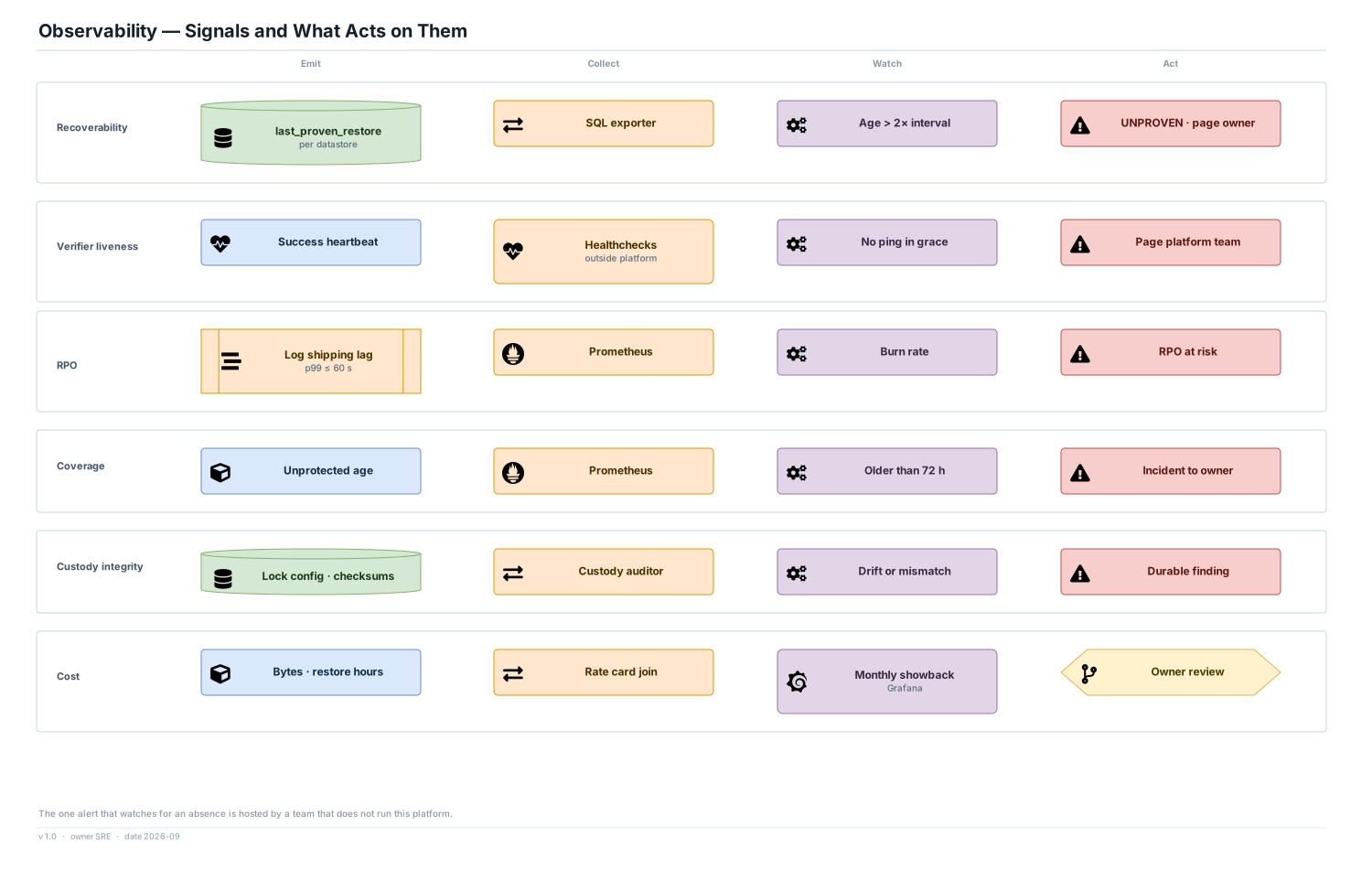
Verifier silence Paged within 2× interval Success heartbeat per tier and per Tier 1 datastore to Healthchecks, run outside the platform 21
Deletion resistance No single person or component can delete or shorten Object Lock at write, capture role without delete, sealed break-glass OpenBao needing 2 of 5 shares, separately administered custody B and tape 25
Restore path availability ≥ 99.95% monthly; works with control plane down Orchestrator deployable in either data centre; manual runbook needing only custody, envelope, key and engine tool, rehearsed quarterly 18
Capture throughput ≥ 2 GB/s sustained, provisioned 3 GB/s Agents beside sources on a dedicated 2 × 100 GbE backup network; 8 RGW gateways; Tier 3 sweeps rate-limited below Tier 1 log shipping 19
Catalogue query p95 ≤ 500 ms at 30 M artefacts PostgreSQL B-tree range scans on (datastore_id, from_ts) over monthly partitions 11
Catalogue loss Restore possible with catalogue absent Self-describing envelopes; weekly rebuild by scan into a shadow catalogue, diffed 10
Unprotected resources 0 older than 72 h Discovery from NetBox, the Kubernetes API and RGW every 15 minutes; admission refuses a PVC without a tier label; incident to the owner at 72 h 04
Evidence retention Audit and drill records 7 years, immutable Evidence bucket in compliance-mode Object Lock; intent written before every destructive action 17

Scope

In scope

  • Capture, custody, catalogue, restore and verification for about 120 datastores in two data centres
  • Point-in-time recovery for Tier 1 PostgreSQL, MySQL and TiDB
  • Isolated rehearsal at a declared depth per tier, with measured RTO
  • Two-person control of retention reduction, legal hold and disposal
  • WORM tape as the second custodian for Tier 1 and the regulatory set
  • Coverage discovery and the unprotected-resource report
  • Cost showback per team, with verification on its own line

Explicitly out of scope

  • High availability, replication and site failover of the protected systems
  • Archival of data for analytical reuse, and data export for portability
  • Endpoint, laptop and SaaS application backup
  • Business reconciliation of rows written after a corruption, which belongs to the owning team
  • Protection against a regional disaster taking both data centres beyond tape, which is accepted and registered as a risk

The six-week proof

Not a slice of every feature. The proof shows the properties everything else depends on: a copy the platform cannot delete, a restore that works with the platform switched off, and a proof record that shows the silence alarm working.

  1. Two small Ceph clusters with Object Lock and STS; capture role denied delete and bypass, confirmed by attempting both
  2. pgBackRest against one PostgreSQL cluster with hourly block-incremental bases and WAL archive-async to custody A
  3. Temporal restore workflow into an isolated namespace to a random second, with a depth-3 invariant and a measured duration
  4. Healthchecks dead-man check with the rehearsal pipeline deliberately stopped, and time-to-page recorded
  5. Sealed OpenBao with 2-of-5 shares issuing one scoped bypass credential, then resealed
  • Delete the catalogue database, rebuild it by scanning envelopes, and restore from the rebuilt copy
  • Run the manual restore runbook with the control cluster switched off, performed by someone who did not write it
  • Upgrade PostgreSQL by one minor version without certification and confirm the capture is refused and paged
  • Steal the capture credential in a test and confirm every delete, overwrite of a locked version and retention change is refused

Open risks, carried rather than hidden

RiskIf it landsResponse
Storage administrators can bypass Object Lock A rogue or compromised Ceph administrator in custody A can destroy locked objects below the S3 layer Two-person root access to custody hosts; custody B and tape administered by different people; out-of-band RADOS operations alerted on (ADR-06, ADR-09)
The 3% daily change rate is a guess Custody and capture capacity sized wrong by as much as half Measured in the first 30 days; custody bought in two stages; Tier 3 retention is the first lever, with the owner's written agreement (ADR-06)
Teams do not write invariants Datastores stay at depth 2, and silent data loss passes rehearsal Invariant templates per engine; depth reported per datastore; the owner accepts a lower depth in writing, recorded against the tier (ADR-02)
Both data centres lost to one regional event Only tape survives, with an RTO of days Accepted and placed on the enterprise risk register; a third-site custody cluster is priced and deferred (ADR-26)
Temporal becomes a hidden dependency Captures or restores stall during a control plane outage Tier 1 log shipping outside Temporal, fail-static CronJobs for base copies, and a manual restore rehearsed quarterly with Temporal switched off (ADR-22)

Architecture Decision Record

Why every component and every technology on these 26 views is what it is, and what each choice costs.

Twenty-six decisions make up this architecture. Everything else on the twenty-six views is convention, and convention needs no defence. Each record starts with the question that forced a decision, says what was chosen and how it is built on hardware the organisation owns, lists the options that lost and why, and states what the choice costs. It then gives the conditions under which a different organisation should choose differently, and explains why the choice should still be right after the tools, the hardware and the team have all changed. Read the one-pager first. Read a record when you want to argue with it.

Status of this document. This is a design, not a report on a running system. Throughput, capacity and duration figures are sized targets and stated assumptions taken from the requirement, and each one is replaced by a measured value at the first drill. Four product behaviours are relied on and must be confirmed in the proof of concept before any production copy depends on them: Ceph RGW honouring governance bypass only for a caller with the explicit permission, RGW STS web-identity roles accepting SPIRE-issued JWT-SVIDs, ClickHouse BACKUP to an encrypted disk over S3, and TiDB BR log backup writing to a bucket with Object Lock enabled.

How to read a record

QuestionThe forcing question: why a decision was needed at all.
ContextThe requirement, the scale and the constraint that make it hard.
DecisionWhat this architecture does, stated so it can be checked.
How it works on-premiseThe concrete mechanism: which package, configured how, on whose hardware.
Options weighedChosen, rejected, deferred, or right elsewhere, with the reason for each.
ConsequencesWhat the choice buys and what it costs, both kept visible.
Choose differently whenThe conditions that would flip the decision for your system.
Why it holds up over timeWhat keeps the decision right as scale, staff and technology change.
LessonThe principle that transfers beyond this platform.

Decision map

The proof 5

What makes a datastore count as recoverable, how deep that proof goes, and who notices when the proving stops.

ADR-01Protection status is written by the verifier, never by a capture job ADR-02Verification depth is chosen per tier by the failure class it catches ADR-03Rehearsals use the emergency restore path, to a random second, alternating custody copies ADR-04Page on the verifier's silence, from a monitor outside the platform ADR-05Rehearse in a dedicated enclave with no route to production or the internet

Custody 4

Where the copies live, who can and cannot destroy them, and the second custodian that fails differently.

ADR-06Custody on Ceph RGW with Object Lock, in a separately administered domain ADR-07Governance-mode locks, reduced only through a sealed OpenBao needing two of five officers ADR-08Two independent custody clusters joined by a verifying copier, not RGW multisite ADR-09WORM tape at a third site as the second custodian, with its own rehearsed restore

Capture 5

How six kinds of engine are copied consistently, at the right version, without the platform reimplementing any of them.

ADR-10Engine-native tools behind one adapter contract and one envelope ADR-11Point-in-time recovery is each engine's capability, orchestrated rather than reimplemented ADR-12Refuse to capture with a tool and engine version pair that has not been certified by a restore ADR-14Capture buckets from change notifications, reconciled by a weekly listing ADR-25Consistency groups by marker transactions, only for applications that cannot tolerate skew

Records 3

What the catalogue is, what it is not, and the evidence that must outlive the copies.

ADR-15Artefacts are authoritative and self-describing; the catalogue is a rebuildable index ADR-16The catalogue is an append-only event log in PostgreSQL with projections ADR-17Evidence is written before action, kept 7 years under a compliance lock, apart from the catalogue

Restore 4

How a copy becomes a running system inside its RTO, including the dangerous and the unknown cases.

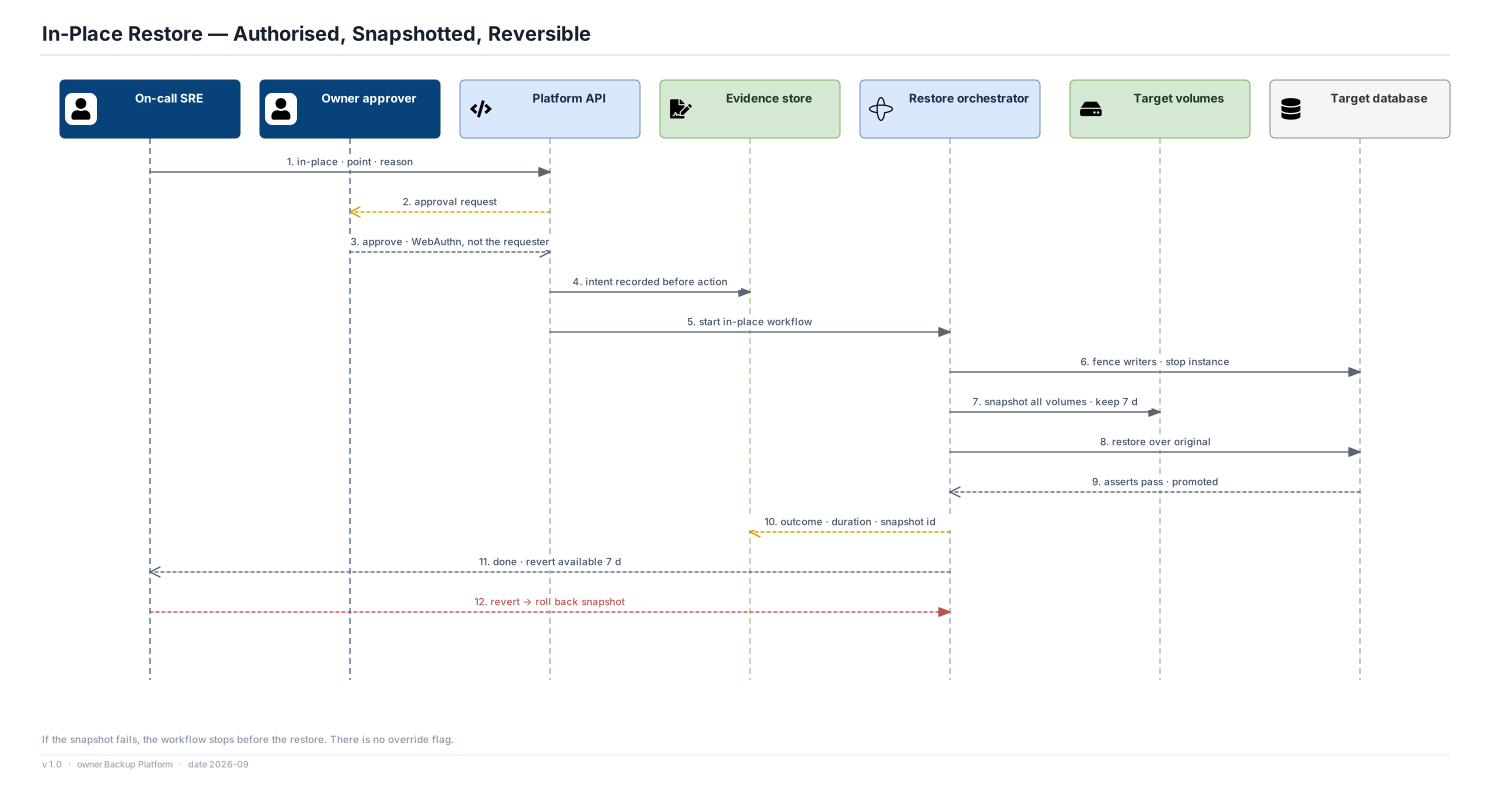
ADR-18Side by side by default; in-place needs a second approver and a mandatory snapshot ADR-19RTO is a budget, and hourly block-incremental bases keep log replay inside it ADR-20Find the last clean recovery point by parallel nine-way search against an owner invariant ADR-21A manual restore path that needs only custody, the envelope, the key and the engine tool

Control and operations 3

What orchestrates the work, how protection is declared, and where everything runs.

ADR-22Temporal for durable workflows, with fail-static CronJobs for base copies ADR-23Protection as policy on a declared tier, with no default and continuous discovery ADR-26Two data centres and a vault site, a warm control plane, and a dedicated backup network

Identity and keys 2

Who may do what to which copy, and how cryptography enforces the separations that policy alone would not.

ADR-13Encrypt at the source with data keys wrapped by per-classification keys in OpenBao ADR-24Four disjoint custody roles assumed with SPIRE workload identity; no long-lived credentials

Technology by capability

Every capability on the views, the package that provides it, a credible alternative, and the record that justifies the choice. Everything runs on hardware the organisation owns, with no managed service and no external network dependency.

Open source This design
CapabilityChoiceOriginCredible alternativeWhy this oneRecord
Custody object storage Ceph RGW (Squid line), S3 Object Lock, EC 8+3 Open source MinIO; Garage; SeaweedFS Mature Object Lock and STS behind the S3 API, a very large production base, and governance that has not changed hands ADR-06
Two-person lock reduction Dedicated sealed OpenBao, Shamir 2 of 5 Open source Custom approval service holding a bypass key; HSM quorum cards Uses an audited, existing threshold-cryptography primitive instead of inventing one ADR-07
Custody replication Custody copier (Go), verifying SHA-256 This design RGW multisite zone sync; rclone Keeps the two clusters in separate administrative realms and checks every byte before it counts as a second copy ADR-08
Second custodian Bareos with LTO-9 WORM media Open source Third-site Ceph cluster; Bacula Different media, different software, offline once vaulted ADR-09
PostgreSQL capture and PITR pgBackRest 2.5x, block incremental, archive-async Open source WAL-G; Barman Parallel restore, block incremental, repository encryption and a built-in verify command ADR-10
MySQL capture and PITR Percona XtraBackup 8.4 plus binlog streaming Open source MySQL Shell dump; mydumper Physical hot backup with fast restore and binlog position recorded for replay ADR-11
Distributed SQL capture and PITR TiDB BR snapshot plus log backup Open source Logical Dumpling export Consistent at a cluster-wide timestamp, with native point-in-time restore ADR-11
Analytics capture ClickHouse BACKUP with base_backup to an encrypted S3 disk Open source clickhouse-backup (Altinity) Engine-native, part-level incremental, no extra daemon ADR-10
Volume and config capture Velero with Kopia data mover, CSI snapshots Open source Kasten K10 (commercial); Stash Kubernetes-native, deduplicating, encrypted repository, freeze hooks ADR-10
Bucket capture Object mirror (Go) consuming RGW notifications via Kafka This design Nightly rclone listing sync Work in proportion to what changed, not to how many objects exist ADR-14
Version certification Restore matrix in GitLab CI; signed pair list in Git This design Pin versions by convention Turns silent drift into a blocked capture on the same day ADR-12
Workflow orchestration Temporal on PostgreSQL Open source Argo Workflows; Kubernetes CronJobs alone Durable timers, signals for approvals and retries that survive worker restarts ADR-22
Catalogue PostgreSQL 17 with Patroni, append-only events Open source Kafka with ksqlDB; ClickHouse 30 M rows is an ordinary index workload; transactional projections are simple ADR-16
Evidence store Compliance-mode locked bucket, hash-chained daily segments This design Audit table in the catalogue only Evidence must not share the catalogue's failure or its administrators ADR-17
Key management OpenBao Transit, 5 voters over three sites Open source HashiCorp Vault (BSL); HSM with PKCS#11 Envelope encryption, key versioning and rewrapping, community governed ADR-13
Workload identity SPIRE JWT-SVIDs to RGW STS roles Open source Static RGW keys in Kubernetes secrets No long-lived custody credential exists to steal ADR-24
Human identity and approvals Keycloak with WebAuthn Open source LDAP with OTP Phishing-resistant second person for in-place restore approvals ADR-18
Restore authorisation Open Policy Agent Open source Rules coded in the API Owner and classification rules as reviewable, testable policy ADR-18
Dead-man monitor Healthchecks (self-hosted) on the shared observability estate Open source Prometheus absent() rules Push-based absence detection, hosted by another team ADR-04
Isolated rehearsal Dedicated Kubernetes cluster, Cilium deny-all egress, own VRF Open source Namespace in a shared cluster A full copy of production needs a network boundary, not a label ADR-05
Policy and inventory Git plus Argo CD, NetBox, Kyverno admission Open source Per-datastore job configuration in a UI Protection bound to a class and tier, reviewed like code, inherited by new resources ADR-23
Observability Prometheus, Grafana, Loki, Alertmanager (shared) Open source A dedicated stack for the platform Existing on-call routes; only the dead-man check needs independence ADR-04

The decisions, and the alternatives that lost

The proofWhat makes a datastore count as recoverable, how deep that proof goes, and who notices when the proving stops.

ADR-01

Protection status is written by the verifier, never by a capture job

Accepted

What event makes the platform say a datastore is protected?

Context
Capture jobs report success when bytes are written. A copy can be written cleanly and still be unrestorable: the wrong engine version, a truncated chain, a lost key, or a restore far slower than the RTO. Most of the loss this platform exists to prevent looked fully protected on a job-status dashboard.
Decision
A datastore is PROVEN only when a rehearsal restored it at its declared depth inside the verification interval. Proof expires at twice that interval. Capture success moves a datastore to Captured, which is displayed as unproven. last_backup_succeeded does not appear in the status projection at all.
How it works on-premise
The verifier appends a verified event carrying depth, assertion counts, measured duration and custody location to catalogue_event in PostgreSQL. protection_status is a projection maintained in the same transaction. A Prometheus SQL exporter publishes the age of last_proven_restore, and Alertmanager pages the owner when it passes twice the interval.
Options weighed
  • ChosenVerifier-written status with expiring proof: The only option where the thing reported is the thing that matters on the day of need.
  • RejectedJob success as status, rehearsal as a separate report: Two reports, and in practice everyone reads the green one.
  • RejectedJob success plus periodic checksum verification: Proves bytes are intact, not that a system comes back. It misses version drift, key loss and slow restores.
  • Right elsewhereStatus from job success for low tiers only: Reasonable for scratch data with no RTO. Here, Tier 3 still gets sampled proof, because it is 1.3 PB of someone's data.
Consequences
What it buys
  • The dashboard and the day of need agree
  • Rehearsal failures surface as normal, owned work
  • Auditors get a date and a measured duration
What it costs
  • A rehearsal pipeline must exist before anything is called protected
  • Status looks worse than job-success dashboards at launch, which needs managing
  • Verification becomes the largest recurring cost
Choose differently when
Choose job-based status only for data whose loss the business has explicitly accepted, such as caches and reproducible build outputs, and label that status 'captured' rather than 'protected'.
Why it holds up over time
It does not matter which engine, tool or storage medium is in use: a copy is only as good as the last restore from it. Tools will change several times over the life of this platform, and this rule will not need to.
LessonReport the outcome you are promising, not the step that usually comes before it.
Shown on views02 11 22
ADR-02

Verification depth is chosen per tier by the failure class it catches

Accepted

What does 'verified' actually mean, and should it mean the same thing for every datastore?

Context
Each extra depth of assertion catches a different failure and costs roughly an order of magnitude more. A restore that completes catches unreadable copies. Structure checks catch partial restores. Content checks catch silent loss. Booting the application catches copies that are intact but unusable. Running depth 4 for 120 datastores daily would need a second production estate.
Decision
Tier 1 is rehearsed daily at depth 4, Tier 2 on a rotation at depth 3 with every datastore proven within 30 days, and Tier 3 by 0.1% daily sampled read-back at depth 2 plus one full bucket restore per quarter at depth 3. The depth actually reached is recorded on every proof. Lowering depth or frequency requires the tier's RPO and RTO owner to accept it in writing.
How it works on-premise
The assertion runner is a container that runs engine-specific checks. Depth 2 checks the schema migration version, object counts and partition coverage. Depth 3 runs owner-supplied invariant SQL, counts within tolerance, and a checksum over sampled cold key ranges compared to a probe taken on the source at a recorded log position. Depth 4 deploys the owner's Helm chart into the enclave against the restored copy and runs their smoke-suite container.
Options weighed
  • ChosenDepth per tier, depth recorded per proof: Spends verification money where the RTO is short and the data is critical.
  • RejectedDepth 1 everywhere, daily: Cheap, and blind to most of the failures that matter.
  • RejectedDepth 4 everywhere, weekly: Unaffordable at this estate size, and the gap is too long for Tier 1.
  • Right elsewhereStatistical sampling across all tiers: Right for very large fleets of identical datastores. This estate has few, dissimilar ones.
Consequences
What it buys
  • Cost is proportional to criticality and argued in one place
  • Each depth maps to named failures, so a gap is visible
  • Owners can see what a cheaper tier gives up
What it costs
  • Depth 3 and 4 need owners to write invariants and smoke suites
  • Tier 3 proof is probabilistic and has to be explained with its confidence figure
  • Depth 4 needs a deployable application in an isolated network
Choose differently when
Raise Tier 2 to depth 4 if a real incident shows an intact-but-unusable copy there. Drop Tier 1 to depth 3 for a datastore whose application genuinely cannot boot in isolation, with the gap written against the tier.
Why it holds up over time
The failure classes (unreadable, incomplete, silently wrong, unusable) are properties of data and applications, not of any tool. As hardware gets cheaper, the per-tier depths can be raised without changing the structure.
LessonDecide what each check proves before deciding how often to run it.
Shown on views15 22
ADR-03

Rehearsals use the emergency restore path, to a random second, alternating custody copies

Accepted

Should verification run through its own optimised path, or through exactly the path a real restore would use?

Context
It is tempting to verify by reading a snapshot directly or mounting a volume, which is fast and cheap. But a verification path that differs from the emergency path proves only the verification path. Restores to 'now' never exercise long replay, and restores from the nearest custody cluster never measure the cross-site one.
Decision
Rehearsals start the same Temporal RestoreWorkflow as an emergency, with the same adapters, identities, key unwrap and custody reads. Only the target (the enclave) and a purpose field differ. Tier 1 targets a random second in the last 24 hours. Rehearsals alternate between custody A and custody B. Durations count toward published RTO attainment.
How it works on-premise
The verifier schedules Temporal workflows with purpose=drill and target=enclave. The restore activities are the same code as for emergencies, and a CI rule fails any change that adds a purpose branch outside target selection. Custody location is recorded on the proof, and the enclave in DC-B reads A over the inter-site link.
Options weighed
  • ChosenSame path, random point, alternating copy: Every drill is a real restore, so its duration is a real RTO sample.
  • RejectedDedicated fast verification path: Proves the fast path works, which nobody will use in an incident.
  • RejectedRestore to latest point only: Never exercises the replay that old recovery points need.
  • RejectedVerify in production against a live replica: Puts a copy of production and restore traffic inside the production network, and proves nothing about custody.
Consequences
What it buys
  • Measured RTO is a byproduct of verification
  • Regressions in the restore path show up the next morning
  • Cross-site restore throughput is known, not assumed
What it costs
  • Rehearsals are as slow as real restores
  • Custody reads across sites cost link capacity every other day
  • Restore path changes need drill capacity to test
Choose differently when
A separate path is reasonable where the restore procedure is purely manual and cannot be automated, but then the drill is a timed human exercise, and it should be run more often.
Why it holds up over time
However the restore path changes, the drill follows it automatically because it is the same code. Nothing needs to be kept in step by hand, and code that has to be kept in step by hand eventually drifts.
LessonTest the path you will actually use, or you have only tested your test.
Shown on views14 15 19
ADR-04

Page on the verifier's silence, from a monitor outside the platform

Accepted

How do we find out that verification has quietly stopped?

Context
The most dangerous failure of a verification pipeline is not a failed rehearsal, which pages. It is the pipeline not running: a suspended schedule, an expired credential, or a notification route dropped upstream. To a monitor that watches only for failures, all of these look like health. A monitor inside the platform fails along with it.
Decision
Every successful rehearsal pings a Healthchecks check, one per tier and one per Tier 1 datastore, with a grace period of twice the interval. Healthchecks is operated by the observability team on the shared estate and pages through their routes. Silence is a page, not a ticket.
How it works on-premise
A self-hosted Healthchecks instance (BSD licence) runs on the observability team's cluster in DC-B, backed by their PostgreSQL. The verifier calls it with a plain HTTPS GET to the check's URL after writing the proof, with no platform identity involved. A Prometheus blackbox probe from the same team monitors Healthchecks itself.
Options weighed
  • ChosenPush-based dead-man check operated by another team: Independent failure domain, and alerts on absence by design.
  • RejectedPrometheus absent() or timestamp-age rules in our own stack: Fails with the platform's own scrape path and is easy to silence with the platform's own access.
  • RejectedDaily email report of rehearsals run: Nobody notices the email that did not arrive.
  • Right elsewhereA commercial SaaS dead-man service: A fine choice where outbound internet from the monitoring estate is acceptable. It is excluded by the on-premises constraint here.
Consequences
What it buys
  • A stopped pipeline pages within two intervals
  • The alarm does not share credentials or infrastructure with the thing it watches
  • One more organisation has visibility of recoverability
What it costs
  • A cross-team dependency with its own change process
  • Check lists must be kept in sync as datastores are enrolled
  • A monitor to be monitored
Choose differently when
If there is no independent observability team, host the check at the vault site on separate hardware, run by custody officers. What matters is that it is independent, not which team owns it.
Why it holds up over time
Alerting on absence is a pattern that does not depend on any tool. Healthchecks can be replaced by any push-based check without the verifier changing more than a URL.
LessonThe alarm for 'nothing happened' has to live somewhere that keeps running when you do not.
Shown on views15 21 01
ADR-05

Rehearse in a dedicated enclave with no route to production or the internet

Accepted

Where do daily restores of full production data go?

Context
Rehearsals restore full copies of production every day into the environment that is created most often and watched least. A namespace in a shared cluster is one bad network policy away from connecting a restored payments database to something that can reach it, or reach out from it.
Decision
A dedicated Kubernetes cluster in its own VRF in DC-B, with deny-all egress at both the network and the Cilium layer, no production credentials, and a single read-only proxy to custody. Restored data is destroyed at the end of each rehearsal, and access to a restored copy is an audited event. Depth-4 applications run with enclave-only configuration.
How it works on-premise
16 NVMe nodes. The data-centre firewall permits the VRF to reach only the custody read proxy and the internal registry mirror. CiliumNetworkPolicy defaults to deny with a cluster-wide rule. Kyverno rejects Secrets that reference production credential paths. Volumes are provisioned from local NVMe and wiped with blkdiscard when released.
Options weighed
  • ChosenDedicated cluster in its own VRF: A network boundary enforced below Kubernetes, so a misconfiguration inside the cluster cannot open a route out.
  • RejectedNamespace in a shared non-production cluster: A label is not a boundary for data this sensitive.
  • RejectedRestore into the production cluster: Puts restored data one DNS name away from real clients.
  • Right elsewhereEphemeral virtual machines per rehearsal: Good isolation, but slower to start for depth-4 application boots at this cadence.
Consequences
What it buys
  • Rehearsal cannot leak data or send to real downstream systems
  • Security review happens once, for a fixed environment
  • Wiping is automatic
What it costs
  • A second cluster to run and patch
  • Depth-4 smoke suites cannot call real dependencies and need stubs
  • An image registry mirror inside the enclave
Choose differently when
If masking obligations require it, run content assertions on masked copies. In that case the enclave's isolation matters less than the masking pipeline, and that pipeline must be rehearsed too.
Why it holds up over time
The risk (full copies of production in an environment used every day) grows with every new datastore, not with any particular technology. A network boundary below the orchestrator remains valid whether rehearsal later moves to virtual machines or to something else.
LessonThe environment holding copies of everything deserves the same security review as production.
Shown on views19 24

CustodyWhere the copies live, who can and cannot destroy them, and the second custodian that fails differently.

ADR-06

Custody on Ceph RGW with Object Lock, in a separately administered domain

Accepted

Where do copies live so that nothing able to destroy the original can reach them?

Context
The copies must survive a compromised backup platform, a stolen credential and a well-meaning operator having a bad day. Immutability implemented in application code protects only against callers who use that code. The requirement puts the failure domain at the account boundary, which on-premises means a separate administrative domain: hardware, credentials and staff.
Decision
Artefacts are written to Ceph RGW buckets with versioning and Object Lock default retention applied at write time, on racks, switches, bastions and a Keycloak realm that the backup platform and production administrators cannot access. The platform reaches custody only through the S3 API with STS roles. Custody root access is two-person.
How it works on-premise
Custody A has 18 hosts of 24 × 22 TB HDD with erasure coding 8+3 and 8 RGW gateways behind HAProxy on the backup network. Bucket defaults set the retention mode and period per tier. Versioning means a tool rewriting a manifest creates a new version and the locked version remains. Host root access requires SSH certificates issued only against two approvals, and RADOS-level object operations outside RGW raise an alert.
Options weighed
  • ChosenCeph RGW with Object Lock in a separate domain: Storage-enforced immutability through the most common storage API, on a project with stable governance.
  • RejectedMinIO with Object Lock: Technically capable, but the community edition's scope and distribution changed during 2025, which is the wrong profile for a store meant to last a decade.
  • RejectedBackup appliance with a proprietary immutable store: Conflicts with the open-source constraint, and its restore path depends on one vendor's software.
  • Right elsewhereDeduplicating backup server on a filesystem (Bareos disk, restic REST): Simpler for small estates. The immutability is weaker and it does not scale to 5 PB.
Consequences
What it buys
  • A stolen capture credential cannot delete or overwrite a locked version
  • Custody can be replaced by any S3 Object Lock implementation
  • Erasure coding keeps the raw-to-usable ratio at 1.375
What it costs
  • Ceph needs skilled operators, and the custody team must include them
  • Object Lock protects against S3 callers, not against storage root
  • Versioned buckets grow with every manifest rewrite until expiry
Choose differently when
For estates under about 100 TB, a pair of well-separated backup servers with append-only repositories and tape may be simpler and adequate. Above a few petabytes with a strong compliance mandate, adding a third-site cluster is the next step.
Why it holds up over time
The S3 API with Object Lock is the most widely implemented form of object storage, available from several independent open-source and commercial implementations. Because the platform uses only that API, custody can move to another implementation without redesign. Separating administrative domains is an organisational control and does not depend on the storage technology.
LessonPut immutability where the attacker's credential does not reach, and be honest about who can still reach below it.
Shown on views06 07 19 24
ADR-07

Governance-mode locks, reduced only through a sealed OpenBao needing two of five officers

Accepted

Who can shorten a retention lock, release a legal hold, or delete before expiry, and how do we make sure that is never one person?

Context
Compliance-mode locks cannot be shortened by anyone, which makes lawful erasure and correcting a wrong tier impossible for up to seven years. Governance mode can be bypassed by any caller with the bypass permission, so whoever holds that permission is a single point of destruction. A workflow that asks for two approvals but then uses one service credential only moves that single point somewhere else.
Decision
Tier retention uses governance mode. The bypass permission is held by no standing identity. It is issued by a dedicated OpenBao instance in the custody domain that stays sealed. Unsealing needs 2 of 5 Shamir shares held by custody officers, neither of whom may be the requester. Once unsealed, it issues one 15-minute credential scoped to the listed object versions, and it is sealed again straight away. The evidence store uses compliance mode.
How it works on-premise
The break-glass OpenBao runs on two small hosts in the custody racks with integrated storage and auto-unseal disabled. The retention broker (Go) records intent with the object-list hash, collects approvals through Keycloak WebAuthn, waits for the unseal, requests the credential from a role whose policy is templated to the object list, performs PutObjectRetention with the bypass header, then calls seal. Placing a hold or extending retention needs none of this.
Options weighed
  • ChosenGovernance mode plus threshold-sealed issuer: Two people are needed by construction, and disposal is still possible when the law requires it.
  • RejectedCompliance mode for everything: A mistaken seven-year lock cannot be released, and erasure obligations cannot be met.
  • RejectedApproval workflow holding a standing bypass key: Whoever compromises the workflow's host gets the bypass, with or without approvals.
  • Right elsewhereHSM with an m-of-n card quorum: Equivalent strength, better physical tamper resistance, and a higher cost and procurement burden.
Consequences
What it buys
  • No person or component alone can reduce retention
  • The mechanism is an audited open-source primitive, not new cryptography
  • Legal disposal remains possible
What it costs
  • Every reduction takes about an hour of two officers' time
  • Share custody must be kept up through staff turnover
  • If three of five holders are unavailable, reductions stop until shares are re-issued
Choose differently when
If the regulator requires records that cannot be altered at all and there is no erasure obligation, use compliance mode for that set and accept that a mistake lasts until expiry.
Why it holds up over time
Threshold secret sharing is decades old and does not depend on a product. The design depends only on 'sealed until k of n agree', which any successor key manager or HSM provides. Share re-issue on role change keeps the control valid as people come and go.
LessonA two-person rule enforced by software one person administers is still a one-person rule.
Shown on views13 25
ADR-08

Two independent custody clusters joined by a verifying copier, not RGW multisite

Accepted

How does a Tier 1 copy reach the second data centre?

Context
The requirement asks for Tier 1 in two locations. Ceph's multisite replication does this natively, but it joins both clusters into one realm with shared metadata and an administrator who can act on both. It also copies whatever arrives, including a corrupted object, without checking it.
Decision
Custody A and custody B are separate Ceph clusters with separate realms, keys and administrators. A custody copier with a read role on A and a write-only role on B copies each artefact, recomputes SHA-256 against the envelope, and only then records a copied event. Tier 3 goes to the custody cluster in the data centre opposite its source.
How it works on-premise
The copier is a Go service driven by captured events from the catalogue, with a lag target under 15 minutes for Tier 1. It holds two STS sessions, one per cluster, from different trust configurations. A checksum mismatch is a durable finding and the copy is retried from A. B's bucket defaults set their own Object Lock retention independently of A.
Options weighed
  • ChosenIndependent clusters with a verifying copier: Two administrative domains, and the second copy is checked before it counts.
  • RejectedRGW multisite zone replication: One realm and one blast radius, and nothing is verified end to end.
  • RejectedCapture agents write to both clusters: Doubles source-side load and puts write access to both custodians on every source host.
  • Right elsewhererclone sync on a schedule: Fine for small estates, but it lists everything and has no event record per artefact.
Consequences
What it buys
  • Compromising custody A's administration does not reach B
  • Every second copy has been checked against its checksum
  • Copy lag is a monitored number per tier
What it costs
  • Own code to write and run
  • The copier's two roles need careful review
  • Twice the Ceph operational surface
Choose differently when
Use native multisite where both sites really are administered by one team under one risk model and speed of replication matters more than independence.
Why it holds up over time
Copy, verify, then count is independent of storage technology. If either cluster is replaced, the copier changes one endpoint.
LessonA second copy is independent only if a different set of people and credentials can destroy it.
Shown on views02 12 19
ADR-09

WORM tape at a third site as the second custodian, with its own rehearsed restore

Accepted

What takes the role of the off-provider copy for an estate that is already on-premises?

Context
In the cloud version of this requirement, the second custodian protects against losing the provider or the account. On-premises, the equivalent common failure is the storage software and its administrators: a Ceph bug, a compromised Ceph administrator, or one team's mistake across both clusters. The second custodian must not share any of those.
Decision
Tier 1 weekly fulls and the regulatory set's monthly copies are written by Bareos to LTO-9 WORM cartridges, vaulted at a third site under custody officers' control. Once tape is live, one Tier 1 datastore is restored from tape every quarter in the enclave and timed. Writing to tape starts in Phase 3, as the requirement stages it, but the library is ordered during the MVP because tape hardware takes the longest to procure.
How it works on-premise
A tape library with 4 LTO-9 drives at the vault site, a Bareos director and storage daemon on separate hosts, and a staging pool that reads already-encrypted artefacts from custody B with a read role. Cartridges are write-once media and leave the library on a weekly rotation. Media is migrated every two LTO generations, and a working drive of the old generation is kept until migration is proven by a restore.
Options weighed
  • ChosenWORM tape via Bareos, vaulted: Different media, software and administrators, and offline once vaulted.
  • RejectedThird Ceph cluster at the vault site: Shares the software, bugs and skills of the first two.
  • Right elsewhereCommercial cloud object storage with Object Lock: A strong independent custodian where data may leave the premises. The on-premises constraint excludes it here.
  • RejectedRemovable disk cartridges: Short shelf life and no write-once guarantee.
Consequences
What it buys
  • No online credential reaches a vaulted cartridge
  • 30-year media life with a clear migration path
  • Cheapest cost per terabyte of any custodian
What it costs
  • Restore from tape takes hours to days, and the stated RTO says so
  • Physical logistics and chain of custody
  • Media and drive generations must be managed
Choose differently when
Where regulation allows data to leave the premises and there is no appetite for tape operations, a different organisation's object storage with Object Lock and its own credentials does the same job with a faster restore.
Why it holds up over time
LTO has published a roadmap and kept read-back compatibility across generations since 2000. A copy that needs only a drive, Bareos and a key recorded in its envelope is about as long-lasting as digital storage currently gets.
LessonThe second custodian's value is in how differently it fails, not in how fast it restores.
Shown on views12 13 15 19

CaptureHow six kinds of engine are copied consistently, at the right version, without the platform reimplementing any of them.

ADR-10

Engine-native tools behind one adapter contract and one envelope

Accepted

Do we build one backup mechanism for everything, or use each engine's own?

Context
The estate has six kinds of datastore. A universal mechanism (volume snapshots of everything) is uniform, but for a running database it produces crash-consistent copies whose restore is a recovery. A universal logical export is slow and loses point-in-time recovery. Every engine already has a mature, well-tested backup tool.
Decision
Each engine class uses its own tool: pgBackRest, XtraBackup with binlog streaming, TiDB BR, ClickHouse BACKUP, Velero with Kopia for volumes and configuration exports, and the object mirror for buckets. Every adapter implements one contract (capture, write envelope, report size, duration, log position, checksum and consistency level) so that the catalogue, policy and verification layers see one kind of artefact. Tool-native expiry is disabled under capture identities.
How it works on-premise
Adapters are thin Go wrappers packaged as sidecars or node agents that call the tool, stream the tool's output to custody, and write the envelope last. pgBackRest runs with repository encryption and automatic expiry off. Velero repository maintenance runs as a separate job under the disposal identity. The consistency level is taken from the adapter's declaration and the presence of freeze hooks, never inferred.
Options weighed
  • ChosenNative tools behind one contract: Consistent, fast restores and point-in-time recovery from tools with years of production use, with differences contained in adapters.
  • RejectedStorage snapshots for everything: Crash-consistent copies of databases, and no PITR.
  • RejectedCommercial multi-engine backup suite: Conflicts with the open-source constraint, and its restore path is its own format.
  • Right elsewhereLogical exports for all databases: Good for small databases and version portability. Too slow for a 60-minute RTO on terabytes.
Consequences
What it buys
  • Restore speed and PITR as good as each engine allows
  • Upstream fixes arrive without platform work
  • Differences stay inside adapters
What it costs
  • Six tools to certify, upgrade and understand
  • Each tool's expiry and maintenance behaviour must be tamed under a no-delete identity
  • Operator skill across six tools
Choose differently when
Consolidate on storage snapshots when every datastore runs on storage with application-consistent group snapshots and RPO is measured in hours rather than minutes.
Why it holds up over time
Engine tools evolve with their engines, which is exactly the coupling needed. When an engine is retired or a better tool appears, only one adapter changes. Old artefacts keep the tool version in their envelope and remain restorable with that version.
LessonStandardise the contract, not the mechanism.
Shown on views07 09 12
ADR-11

Point-in-time recovery is each engine's capability, orchestrated rather than reimplemented

Accepted

Does the platform ship and replay its own change log, or rely on each engine's?

Context
One platform-owned log would give a uniform recovery promise, but it means capturing changes (logical decoding, binlog parsing, TiDB CDC) and writing replay for each engine, which amounts to reimplementing database recovery. Engine-native PITR is well tested but differs in granularity and limits between engines.
Decision
Use WAL archiving with pgBackRest, binlog streaming with mysqlbinlog for MySQL, and BR log backup for TiDB. The platform standardises the recovery-point map (recovery_range with explicit gaps) and the promise per tier, and translates a requested timestamp into each engine's restore command. ClickHouse and volumes are declared as having no PITR.
How it works on-premise
archive_timeout of 60 s with async push. A binlog streamer Deployment per MySQL primary uploading 1-minute chunks. A BR log task per TiDB cluster. Each adapter reports log ranges as it ships them. The catalogue marks a gap whenever a range does not join its predecessor, and the gap counts against RPO attainment.
Options weighed
  • ChosenOrchestrate native PITR with a uniform range map: A uniform promise and report without owning replay correctness.
  • RejectedPlatform-owned CDC log and replay: Reimplements recovery per engine and becomes the most dangerous code in the estate.
  • RejectedNo PITR; frequent snapshots only: Cannot meet a 5-minute RPO or recover to just before a named event.
Consequences
What it buys
  • Replay correctness is the engine's, tested by its community
  • Explicit gaps make RPO honest
  • Adding an engine means adding a range reporter
What it costs
  • Granularity differs: to the second for PostgreSQL, to the event for MySQL, to the timestamp for TiDB
  • Replay speed is whatever the engine gives, which is why ADR-19 exists
Choose differently when
Own the log only when many engines without native PITR need a minutes-scale RPO and restore into an environment the engines' tools cannot reach.
Why it holds up over time
Engines keep improving their own recovery, and this design benefits from that automatically. The range map is a plain data structure that any future engine can report into.
LessonCoordinate what the experts already do well before deciding to do it yourself.
Shown on views09 14
ADR-12

Refuse to capture with a tool and engine version pair that has not been certified by a restore

Accepted

How do we stop version drift from producing copies that write cleanly and do not restore?

Context
Version drift is the most common cause of a backup that succeeds and cannot be restored: XtraBackup behind a MySQL minor release, pgBackRest meeting a new WAL format, a BR version incompatible with its cluster. Nothing fails at capture time. It fails months later at restore.
Decision
A nightly restore matrix certifies every engine version seen in the estate against every tool version in use at depth 3. Passing pairs are written to a signed file in Git. Every adapter checks its pair against the file before capturing and refuses if it is absent, which raises RPO-at-risk and pages the owner. Engine versions come from discovery, not declarations.
How it works on-premise
GitLab CI triggers the matrix when Renovate proposes a tool upgrade or discovery reports a new engine version. The matrix runs in the enclave with synthetic datasets per engine and signs the result with cosign. Adapters verify the signature and read the pair list at start, and each capture reads the live engine version.
Options weighed
  • ChosenSigned certification gate, enforced at capture: Drift becomes a same-day blocked capture instead of a failure found at restore.
  • RejectedPin versions by policy and trust teams: The versions that break things are the unplanned ones.
  • RejectedRely on the daily rehearsal to catch drift: Tier 2 and 3 rehearse too rarely, and every copy in between may be bad.
  • Right elsewhereWarn but capture anyway: Acceptable for Tier 3, where a blocked capture might cost more than a doubtful copy. Here it is not used even there, to keep one rule.
Consequences
What it buys
  • No uncertified copy is written
  • Upgrades are proven by a restore before they matter
  • The certification list documents what works with what
What it costs
  • An early engine upgrade blocks captures until certification, up to a day
  • Matrix runs use enclave capacity overnight
  • Synthetic datasets must cover each engine's features in use
Choose differently when
Relax to warn-and-capture for a datastore whose owner accepts, in writing, that a doubtful copy is better than none during an upgrade window.
Why it holds up over time
Engines and tools will keep releasing, faster rather than slower. A gate driven by what is actually running scales with that pace and needs no one to remember which versions are compatible.
LessonTurn a failure found late into a refusal made early.
Shown on views04 20 26
ADR-14

Capture buckets from change notifications, reconciled by a weekly listing

Accepted

How do we protect 1.3 PB of object storage without listing billions of objects every night?

Context
Tier 3 buckets change about 3% a day. A nightly listing to find changes costs time and gateway load in proportion to the total object count, not the change. Notifications are efficient but can be lost, and a missed notification is a silently unprotected object.
Decision
Source buckets have versioning and persistent RGW bucket notifications to Kafka. The object mirror consumes them, copies each new version to custody with an envelope, and records the event. A weekly reconciliation lists each bucket and compares it with the catalogue, and any difference is copied and reported as a finding.
How it works on-premise
Persistent notifications (queued by RGW until delivered) go to a three-broker Kafka topic per custody destination. The mirror is a Go consumer group that streams GET to PUT without staging and encrypts per object with the bucket's data key. Reconciliation shards listings by prefix and runs at low priority in the maintenance window.
Options weighed
  • ChosenNotifications with weekly reconciliation: Work in proportion to change, plus a regular check that nothing was missed.
  • RejectedNightly rclone listing sync: Listing cost grows with total objects and competes with Tier 1 for gateways.
  • RejectedStorage-level replication to custody: Replicates deletes and corruption, and joins the domains.
Consequences
What it buys
  • Capture load follows change
  • Per-object envelopes allow per-object restore
  • Reconciliation limits the damage a lost notification can do to one week
What it costs
  • Kafka becomes a dependency for Tier 3 RPO
  • Versioning on source buckets adds source storage
  • Many small artefacts in the catalogue
Choose differently when
For buckets of large, rarely changing objects, a periodic listing is simpler and the notification pipeline is not worth running.
Why it holds up over time
Change feeds plus periodic reconciliation is a general pattern for keeping two stores in step, used well beyond backup. Either part can change (a different broker, a different listing tool) without changing the other.
LessonUse an event stream for speed and a full comparison for truth, and run both.
Shown on views08 09
ADR-25

Consistency groups by marker transactions, only for applications that cannot tolerate skew

Accepted

How are several datastores restored to a mutually consistent point when their engines share no common quiesce?

Context
Two applications write to more than one datastore in one business operation (orders to PostgreSQL and TiDB, for example). Restoring each to the same wall-clock second does not guarantee consistency, because clocks differ and log positions do not line up. Coordinated freezes across engines would stall production.
Decision
A consistency group writes a marker row with the same group id to each member datastore every 5 minutes through the application's own connection pool. Group restore recovers each member to the log position containing a chosen marker. Each group must declare whether operations in flight between markers are safe to replay, and supply a reconciliation check that the rehearsal runs.
How it works on-premise
A small marker job per group, with credentials from OpenBao. Adapters index marker positions from WAL, binlog and TiDB log ranges into recovery_range. The group restore workflow restores members in parallel, each to the marker position, then runs the group's reconciliation assertion at depth 3.
Options weighed
  • ChosenMarker transactions with a tested reconciliation: Consistency is approximate but aligned, and the remaining skew is checked, not assumed.
  • RejectedCoordinated freeze across engines: Stalls production writes and has no cross-engine primitive.
  • RejectedSame-timestamp restore with no alignment: Clock skew and commit ordering make it silently inconsistent.
  • RejectedGroups for every multi-store service: Most services tolerate skew. Groups only for the two that cannot.
Consequences
What it buys
  • Group restore to an aligned point without stopping writes
  • Reconciliation is exercised by rehearsal
  • Cost limited to two applications
What it costs
  • Marker rows in application schemas
  • Owners must write reconciliation checks
  • Five-minute alignment granularity
Choose differently when
If an application moves to a single distributed database for both stores, the group becomes unnecessary and should be dissolved.
Why it holds up over time
Markers written into each store's own log survive any change of backup tool, because they are data, not tool metadata. Multi-store consistency is an application property and stays with the application.
LessonWhen systems cannot agree on time, write the agreement into their data.
Shown on views09 11

RecordsWhat the catalogue is, what it is not, and the evidence that must outlive the copies.

ADR-15

Artefacts are authoritative and self-describing; the catalogue is a rebuildable index

Accepted

If the catalogue is lost, are the copies still usable?

Context
A catalogue that is the source of truth is fast and queryable, and it is a single point of failure for data it does not hold. At 30 million artefacts a scan is slow, but not prohibitively so. A rebuild that has never been run is exactly the kind of unproven claim this platform exists to eliminate.
Decision
Every artefact has a signed envelope beside it in custody: engine and version, tool and version, consistency level, key id, chain parent, log range and checksum. The catalogue is derived. A full rebuild by scan runs every week into a shadow database and is diffed against the live catalogue. Restore can proceed from envelopes alone.
How it works on-premise
Envelopes are JSON with a schema version, signed with the adapter's SPIFFE identity and written under the same Object Lock. Keys are prefixed by datastore, day and artefact ULID, so a scan can be split. The weekly job uses 32 listers and a projection builder writing to a standalone PostgreSQL instance, and a diff mismatch is a finding.
Options weighed
  • ChosenSelf-describing artefacts with a weekly rebuild: The index is an accelerator, and the rebuild is proven every week.
  • RejectedCatalogue as the only source of truth, backed up: The catalogue's backup becomes a special case with its own unproven restore.
  • RejectedNo catalogue; always scan: Finding a recovery point would take hours, which breaks the RTO.
Consequences
What it buys
  • Catalogue loss delays reports but does not prevent restores
  • Tools of the future can read today's copies
  • Weekly diff catches catalogue bugs
What it costs
  • Envelope writing is part of every adapter
  • A few hours of custody listing load every week
  • Orphan artefacts without envelopes must be handled
Choose differently when
If artefact counts reach billions, a full weekly scan stops being feasible. Move to incremental rebuild by day prefix and a monthly full scan.
Why it holds up over time
A copy that carries its own description stays usable when the catalogue software, the schema and even the organisation that built them have all changed. The envelope schema is the one format here designed to last a decade, and it is versioned for that reason.
LessonKeep everything needed to restore next to the copy, and treat indexes as rebuildable.
Shown on views10 12 26
ADR-16

The catalogue is an append-only event log in PostgreSQL with projections

Accepted

How is catalogue state stored so that its history survives corrections?

Context
Artefact state changes: captured, copied, verified, held, expired. A mutable row loses what was claimed before a correction, which matters when auditing why a datastore was shown as PROVEN. The query load is modest: recovery-point lookups at p95 of 500 ms over 30 million artefacts.
Decision
catalogue_event is the only table written to. Status, recovery ranges, custody copies and proofs are projections updated in the same transaction and can be dropped and replayed. PostgreSQL 17 with Patroni, a synchronous replica in DC-A and a standby cluster streaming to DC-B.
How it works on-premise
Events are partitioned by month and never updated or deleted during retention. Projection tables are indexed on (datastore_id, from_ts) and (datastore_id, state). The catalogue itself is backed up with pgBackRest to custody, and is also independently rebuildable from envelopes (ADR-15).
Options weighed
  • ChosenPostgreSQL event table with projections: Familiar, transactional and more than sufficient at this scale.
  • RejectedKafka as the event log with stream-processed views: More moving parts for a workload with modest write rates.
  • RejectedMutable relational rows: Loses the history of claims.
  • Right elsewhereClickHouse: Good for analytics over proofs later. Wrong for transactional projections.
Consequences
What it buys
  • Every past claim is reconstructable
  • Projections can be fixed by replay
  • Ordinary operational skills apply
What it costs
  • Event growth must be partitioned and managed
  • Projection logic must be idempotent
  • Two recovery paths for the catalogue to keep healthy
Choose differently when
Move to a distributed log only if many independent consumers need the event stream in real time, not just the catalogue.
Why it holds up over time
An append-only log plus derived views has worked for decades, from accounting ledgers to database write-ahead logs. PostgreSQL has long-term community governance and an unusually conservative approach to compatibility.
LessonWhen history is evidence, record history and derive state from it.
Shown on views07 11
ADR-17

Evidence is written before action, kept 7 years under a compliance lock, apart from the catalogue

Accepted

Where do audit events and drill records live, and what happens if they cannot be written?

Context
Every capture, restore, retention change, hold, disposal and access to a restored copy must be an attributed, immutable event written before the action completes. Drill records underpin every RTO claim and must outlive the artefacts they verified. If evidence shares the catalogue's database, it also shares its administrators and its failures.
Decision
Destructive actions write an intent event first, and if that write fails the action does not start. Events are also sealed into hash-chained daily segments in an evidence bucket in custody B with compliance-mode Object Lock for 7 years. Verification and drill records follow the same path.
How it works on-premise
The API writes intent to catalogue_event and to an outbox in the same transaction. A sealer service writes segments hourly and closes each day with a hash that includes the previous day's hash, and publishes the daily hash to the Git repository as an external anchor. Auditors verify the chain with a small open-source CLI.
Options weighed
  • ChosenIntent first, sealed segments under compliance lock: No record, no action, and evidence nobody can change.
  • RejectedAudit table in the catalogue only: Catalogue administrators could alter it and its loss takes the evidence too.
  • Right elsewhereLog shipping to a SIEM only: Useful for detection, and events are also sent there. It is not the evidence store.
Consequences
What it buys
  • Tamper-evident history with an external anchor
  • Evidence survives catalogue loss
  • Auditors verify independently
What it costs
  • An evidence outage blocks destructive actions
  • A seven-year compliance lock cannot be undone if something is written by mistake
  • One more service
Choose differently when
If a jurisdiction requires personal data in audit events to be erasable, store pseudonymous ids in sealed segments and keep the identity mapping in a separately erasable table.
Why it holds up over time
Hash chains with an external anchor are a long-established method, and their verification needs only the data and a hash function. Seven-year evidence remains checkable long after this platform's software has been replaced.
LessonIf an action matters enough to audit, it matters enough not to happen unaudited.
Shown on views10 17 25

RestoreHow a copy becomes a running system inside its RTO, including the dangerous and the unknown cases.

ADR-18

Side by side by default; in-place needs a second approver and a mandatory snapshot

Accepted

Who may restore, into what, and how is overwriting production made safe?

Context
Self-service restore brings RTO down and makes drills routine. Overwriting a production datastore with an older copy is the most destructive operation the platform can perform, and most recoveries do not need it: restoring side by side and copying back damaged rows keeps today's good writes.
Decision
Owners may self-serve side-by-side, partial and isolated restores into targets whose classification is at least as strict as the source. In-place restore requires an approver from the owner group who is not the requester, using WebAuthn, an intent record, and a pre-restore snapshot of every target volume kept 7 days. A failed snapshot stops the workflow.
How it works on-premise
OPA evaluates team ownership and target classification from NetBox and namespace labels. Keycloak provides WebAuthn step-up for approvals. The in-place workflow fences writers, takes Ceph RBD snapshots through the CSI snapshot API, restores, runs depth-2 checks and promotes. Reverting rolls back the snapshot. Bare-metal targets take a pgBackRest full copy instead.
Options weighed
  • ChosenSelf-service side by side, gated in-place: Fast for the common case, and deliberate and reversible for the dangerous one.
  • RejectedCentral team performs all restores by ticket: Slow restores, and drills become rare.
  • RejectedFull self-service including in-place: One mistaken click overwrites today's data with last month's.
Consequences
What it buys
  • Most restores need no second person
  • In-place restores are reversible for 7 days
  • Classification enforcement is automatic
What it costs
  • Approver availability adds minutes to in-place restores
  • Snapshots need capacity on production storage
  • Owner metadata must be accurate for authorisation to work
Choose differently when
Restrict self-service to a central team where target classification cannot be enforced automatically, such as unlabelled legacy environments.
Why it holds up over time
Default to non-destructive and make the destructive path reversible: this holds however restores are implemented. The rules live in OPA policy, so they can change as the organisation changes without touching workflow code.
LessonMake the common recovery fast and the destructive one reversible.
Shown on views05 14 17
ADR-19

RTO is a budget, and hourly block-incremental bases keep log replay inside it

Accepted

What actually determines whether a Tier 1 restore finishes in 60 minutes?

Context
Restore time is set by the slowest link. Transfer at 4 GB/s moves 4 TB in about 17 minutes, but PostgreSQL replays WAL on a single process. A day of WAL on a busy store can take over an hour to replay by itself. A base copy taken nightly makes the 60-minute RTO impossible for most of the day, whatever the storage throughput.
Decision
The Tier 1 RTO is broken into a budget: 10 min to authorise and start, about 17 min to transfer, at most 10 min of replay, and 10 min of assertions and promotion. Hourly block-incremental bases bound replay distance. The 60-minute RTO applies to recovery points in the last 7 days, while points from day 8 to day 35 have a stated RTO of 3 hours. Every drill records all four parts separately.
How it works on-premise
pgBackRest block incremental with bundling, run hourly and cheap because only changed blocks are copied. Weekly full, daily differential and hourly incremental, with chain depth up to 25 and at most 7 days from a full. Restores use process-max 32 across RGW gateways. Drill telemetry stores transfer, replay and assertion durations per run.
Options weighed
  • ChosenBudgeted RTO with hourly bases: Makes the replay term, the usual limit, small and measured.
  • RejectedNightly base with WAL: Replay alone can exceed the RTO late in the day.
  • Right elsewhereWarm standby restored continuously: The lowest RTO, at the cost of a second copy of every Tier 1 store. It is also close to being a replica, which cannot replace a backup.
Consequences
What it buys
  • The RTO holds throughout the day, not only after the nightly copy
  • The four-part breakdown tells you what to fix when a drill is slow
  • Owners see the RTO step change at day 7
What it costs
  • Hourly capture load on Tier 1 sources
  • Longer backup chains
  • Two stated RTOs to explain
Choose differently when
If replay speed improves enough (parallel recovery in future engine versions), hourly bases can become daily. The drill breakdown will show when that point is reached.
Why it holds up over time
Whatever the technology, RTO is transfer plus replay plus checking. Measuring each part every day means the budget changes when the numbers change, instead of being inherited from a document.
LessonThe part of recovery nobody benchmarks is usually the part that breaks the RTO.
Shown on views05 09 14
ADR-20

Find the last clean recovery point by parallel nine-way search against an owner invariant

Accepted

How do we recover to before a corruption whose start time nobody knows?

Context
Logical corruption is usually found weeks after it started. An SRE guessing recovery points one at a time spends a multi-hour restore per guess. The platform can restore any second, but only the owner can say what 'clean' means.
Decision
Clean-point search takes an owner-supplied invariant and a window, restores 8 evenly spaced points in parallel in the enclave, evaluates the invariant, and narrows to the interval where it changes from clean to dirty. Seven rounds get from 35 days to one second. Every round is recorded as evidence. Tier 2 rehearsals pause during a search, and Tier 1 rehearsals continue.
How it works on-premise
A Temporal workflow fans out 8 restores through the normal RestoreWorkflow, each to a point in the current interval, then runs the invariant through the assertion runner and chooses the next interval. Round duration is dominated by replay distance, which the hourly bases (ADR-19) keep short within 7 days.
Options weighed
  • ChosenParallel k-ary search with owner invariant: Turns days of guessing into hours of automated work with a record.
  • RejectedManual binary search by SRE: Sequential, slow and unrecorded.
  • RejectedReplay change log row by row looking for the bad write: Needs application semantics the platform does not have.
Consequences
What it buys
  • Recovery point found in about 3 hours inside the hourly window
  • Evidence of how the point was chosen
  • Reuses rehearsal capacity and code
What it costs
  • Only as good as the invariant
  • Assumes corruption, once present, persists
  • Consumes 8 enclave slots for the duration
Choose differently when
When corruption is intermittent or repaired and recurring, use the round results as input for a person rather than trusting the search's final answer.
Why it holds up over time
Searching a monotonic predicate over time is a general algorithm. Faster restores make each round cheaper, and more slots make it wider.
LessonWhen you cannot know when something broke, make each check cheap enough to run many of them at once.
Shown on views05 16
ADR-21

A manual restore path that needs only custody, the envelope, the key and the engine tool

Accepted

Can a restore be done when the platform itself is part of the outage?

Context
The day a restore is needed may be the day the control cluster, catalogue and console are down too, for example after a ransomware incident or a data-centre loss. A restore that needs the platform to be healthy has a hidden dependency on everything the platform depends on.
Decision
A written runbook restores any engine class using only a break-glass custody read role, the envelope next to the artefact, OpenBao to unwrap the key, and the engine's tool at the version recorded in the envelope. It is rehearsed every quarter with the control cluster switched off, by someone who did not write it, and timed.
How it works on-premise
Break-glass read credentials come from the sealed custody OpenBao after the usual two-officer unseal, from a read-only role kept separate from the bypass role. Tool container images at every certified version are mirrored to a registry at the vault site. A static binary of the bnr CLI lists envelopes by prefix and prints the exact restore command.
Options weighed
  • ChosenDocumented, rehearsed, minimal-dependency runbook: The restore does not depend on the platform being healthy.
  • RejectedHighly available control plane as the answer: Reduces the probability of the platform being down but not its correlation with the incident.
  • RejectedRunbook written but not rehearsed: An unrehearsed runbook is another unproven claim.
Consequences
What it buys
  • Restore survives platform loss
  • The runbook's accuracy is proven quarterly
  • Engineers learn the underlying tools
What it costs
  • Quarterly gameday time
  • The image mirror and CLI binary must be kept current
  • Break-glass read access is one more credential path to guard
Choose differently when
Nothing flips this for Tier 1. For Tier 3, a manual path that is documented but only rehearsed yearly may be acceptable.
Why it holds up over time
Because the dependencies are minimal and are the standard building blocks (an S3 API, a JSON file, a key manager, a tool), the runbook stays short when the platform gets complicated. It also becomes the migration path if the platform is ever replaced.
LessonYour last-resort restore must not depend on the system you are recovering from.
Shown on views08 18 26

Control and operationsWhat orchestrates the work, how protection is declared, and where everything runs.

ADR-22

Temporal for durable workflows, with fail-static CronJobs for base copies

Accepted

What orchestrates captures, restores and rehearsals, and what happens when it is down?

Context
Restores and rehearsals are long, multi-step, wait on humans, retry throttled reads and must survive worker restarts. Cron can start a job but cannot resume a half-finished restore. Any orchestrator is also a dependency that can fail at the worst moment.
Decision
Temporal orchestrates captures, restores, rehearsals and searches. Tier 1 log shipping runs outside it in the engines' own processes. Base copy schedules are also rendered as suspended Kubernetes CronJobs beside agents, and a watchdog unsuspends them when Temporal's heartbeat is missing for two intervals. Degradation order is reporting, console, Tier 3 capture, verification. Tier 1 capture and restore never degrade.
How it works on-premise
Temporal server on the control cluster with PostgreSQL persistence (3 history, 2 frontend, 2 matching). Workers are Go. The policy compiler writes both Temporal Schedules and the CronJob manifests from the same compiled policy. The watchdog is a small DaemonSet on agent nodes. Envelopes written during fail-static mode are ingested when Temporal returns.
Options weighed
  • ChosenTemporal with fail-static fallback: Durable, resumable workflows, without making capture depend on them.
  • Right elsewhereArgo Workflows: A good fit for batch pipelines. Weaker for long human-in-the-loop waits and signals.
  • RejectedKubernetes CronJobs only: No resumable restores, approvals or in-flight ETA escalation.
  • RejectedCustom state machine in the API: Reimplements durable execution, badly.
Consequences
What it buys
  • Restores survive worker crashes
  • Approvals are signals, not polling
  • Control-plane loss delays but does not lose Tier 1
What it costs
  • Temporal is a significant system to run
  • Two schedule representations to keep in step
  • Workflow code versioning discipline
Choose differently when
For an estate of a dozen datastores with no human approvals, CronJobs and a simple restore script are proportionate.
Why it holds up over time
Durable execution is a well-established category with several implementations. Workflows are ordinary Go code calling adapters, so a move to another engine rewrites orchestration, not adapters or custody.
LessonUse a workflow engine where it is needed, but do not put the most important path inside it.
Shown on views06 07 18
ADR-23

Protection as policy on a declared tier, with no default and continuous discovery

Accepted

How does a new datastore get protected without someone remembering to set it up?

Context
Per-resource job configuration drifts and is forgotten for new resources. A default tier silently assigns an RPO nobody agreed. The biggest loss class is the datastore nobody enrolled, which a platform watching only its own jobs cannot see.
Decision
Protection policy binds a resource class and a declared tier. Owners declare the tier by label in Git, the NetBox custom field or the namespace. A resource with no tier is refused where admission allows (Kyverno for PVCs and operator CRs) and reported everywhere else. Discovery runs every 15 minutes and raises an incident for anything unprotected for more than 72 hours.
How it works on-premise
Policies are CRDs in Git, synced by Argo CD and compiled into schedules, retention and rehearsal slots. The coverage scanner reads NetBox, the Kubernetes API (PVCs, CloudNativePG and TiDB operator CRs), the RGW admin listing and OpenTofu state, and publishes unprotected age as a metric. Kyverno rejects a PVC without backup.tier in namespaces marked for production.
Options weighed
  • ChosenTier-bound policy, no default, continuous discovery: New resources inherit protection, and unknown ones become visible.
  • RejectedPer-datastore jobs configured in a UI: Drifts, and misses whatever nobody configured.
  • RejectedDefault everything to Tier 2: An RPO and a cost that nobody agreed to.
Consequences
What it buys
  • Protection is reviewed like code
  • Unprotected resources have an age and an owner
  • New services get protection without asking
What it costs
  • Admission refusals annoy teams at first
  • Inventory quality limits discovery
  • Resources outside NetBox and Kubernetes need other sources
Choose differently when
Allow a temporary default with a short expiry during a large migration, when refusing every unlabelled resource would stop the migration.
Why it holds up over time
Policy on classes rather than instances scales with the estate and survives inventory tools changing. Discovery sources are pluggable, and the rule that unprotected is a reported state, not an unknown one, stays the same.
LessonMake protection the default that must be declared, and make the absence of a declaration loud.
Shown on views03 04 21
ADR-26

Two data centres and a vault site, a warm control plane, and a dedicated backup network

Accepted

Where does everything run so that one site's loss leaves both copies and the ability to restore them?

Context
The platform must restore after losing a data centre, with its control plane possibly in that site. Backup and restore traffic runs at 3 to 4 GB/s and must not compete with production. The key service must keep quorum through a site loss.
Decision
Custody A in DC-A, custody B and the enclave in DC-B, tape and one OpenBao voter at the vault site. The control plane is active in DC-A and warm in DC-B, with a Patroni standby catalogue and the Argo CD application defined but scaled to zero. Backup traffic runs on a dedicated 2 × 100 GbE network. A regional loss of both data centres is accepted as a tape-only recovery.
How it works on-premise
OpenBao voters: 2 in DC-A, 2 in DC-B, 1 at the vault site. The Patroni standby cluster streams to DC-B. Starting the DC-B control plane is a runbook step (promote the standby, scale up) timed at gamedays. Capture and gateway hosts have dual 100 GbE ports on a separate spine from the service network.
Options weighed
  • ChosenTwo data centres plus vault site, warm control: Survives a site loss with both a copy and a way to restore it, at modest standing cost.
  • RejectedActive-active control plane: Adds Temporal multi-cluster complexity for a plane whose loss delays but does not lose data.
  • DeferredThird data centre with a custody cluster: Priced. Revisit if the regional risk is not accepted by the board.
  • RejectedBackup traffic on the production network: 3 GB/s of backup traffic becomes a production incident.
Consequences
What it buys
  • Site loss survivable with measured RTO
  • Key service keeps quorum
  • No backup traffic on production links
What it costs
  • Warm standby must be exercised to be real
  • Dedicated network hardware
  • Regional risk accepted, not removed
Choose differently when
Add a third custody site when the regulatory set grows or the regional risk is no longer accepted. The copier pattern (ADR-08) extends to a third target without redesign.
Why it holds up over time
Physical failure domains, independent networks and quorum across three sites are infrastructure basics that have not changed in decades. Each piece can be refreshed on its own hardware cycle without changing the topology.
LessonPlace state so that each failure you accept still leaves a copy and a way to reach it.
Shown on views19 26

Identity and keysWho may do what to which copy, and how cryptography enforces the separations that policy alone would not.

ADR-13

Encrypt at the source with data keys wrapped by per-classification keys in OpenBao

Accepted

Who can read a copy, and how do we make a restore into the wrong environment fail?

Context
Custody administrators must never be able to read plaintext. Restores into a less protected environment must fail by construction. Lawful erasure must be possible across immutable copies. And a copy whose key is lost is not a backup.
Decision
Adapters encrypt before bytes leave the source with a data key, per datastore per month for the regulatory set and per datastore per week otherwise. Data keys are wrapped by a key-encryption key per data classification in OpenBao Transit. Restore and verify identities may unwrap only for classifications their target is cleared for. Key versions are kept for longer than the longest retention and backed up offline under two-of-five escrow.
How it works on-premise
OpenBao runs with 5 Raft voters across DC-A, DC-B and the vault site. Tools use their native encryption (pgBackRest repository cipher, xbstream encryption, BR crypter, ClickHouse encrypted disk, Kopia repository key), keyed by the unwrapped data key. The envelope records the key id, version and algorithm. Transit exports are wrapped to an offline key held in escrow, and restoring them is drilled every quarter.
Options weighed
  • ChosenEnvelope encryption, per-classification wrapping keys: Cryptographic separation of environments, cheap rotation, and erasure by destroying a key.
  • RejectedServer-side encryption in custody: Custody administrators could read plaintext, and a restore could go anywhere.
  • RejectedOne key per tool configured in files: No classification separation, and rotation means re-encrypting data.
  • Right elsewhereHSM-backed key hierarchy: Adds tamper resistance where the regulator requires it, and can sit under OpenBao as a seal.
Consequences
What it buys
  • A wrong-environment restore fails at unwrap
  • Rotation rewraps kilobytes, not petabytes
  • Erasure by destroying a key covers tape too
What it costs
  • OpenBao is on the critical path for capture and restore
  • Tool-native encryption differs per engine and has to be certified
  • Offline key escrow has to be managed and drilled
Choose differently when
If every engine and tool supported a common external key management protocol natively, move wrapping into that protocol and remove per-tool configuration.
Why it holds up over time
Envelope encryption lets algorithms and key managers change without touching stored data: rewrap under a new key or a post-quantum wrapping algorithm, and the petabytes stay as they are. The envelope's key id and algorithm fields exist for that move.
LessonPut the separations you most need in key access, where a policy mistake cannot undo them.
Shown on views08 14 18
ADR-24

Four disjoint custody roles assumed with SPIRE workload identity; no long-lived credentials

Accepted

How are the four identities in the requirement made real, and what is stolen if a host is compromised?

Context
The requirement separates capture, custody administration, restore and verification with disjoint rights. Static S3 keys and database passwords on capture hosts are the credentials most likely to be stolen, and they last until someone notices.
Decision
Custody has four RGW STS roles: capture (put and get, no delete, no retention change), custody admin (lock configuration, no object read), restore (get and extend retention) and verify (get only, from the enclave proxy). Workloads assume roles with SPIRE JWT-SVIDs. Source database credentials are issued per run by OpenBao's database engine. No long-lived credential exists in the platform.
How it works on-premise
SPIRE server per data centre with the Kubernetes and node attestors. RGW is configured with SPIRE's OIDC discovery endpoint as a web-identity provider, and each role's trust policy matches a SPIFFE id path. STS sessions last 1 hour. OpenBao issues PostgreSQL and MySQL users with a 2-hour lease and a grant limited to backup functions.
Options weighed
  • ChosenSTS roles via workload identity: Nothing long-lived to steal, and rights per purpose.
  • RejectedStatic RGW keys in Kubernetes Secrets: Long-lived and copyable, and often over-privileged.
  • RejectedOne service account for the platform: A single compromise has every right, including the ones that must be separated.
Consequences
What it buys
  • A stolen capture identity can write but never destroy
  • Credentials expire within hours
  • Rights are auditable per role
What it costs
  • SPIRE becomes a trust root for custody roles
  • RGW STS web identity must be proven in the PoC
  • Database engines need backup-scoped roles designed per engine
Choose differently when
Where SPIRE is not available, Kubernetes projected service-account tokens can be the web identity, at the cost of weaker node attestation.
Why it holds up over time
Short-lived credentials from attested identity is where the whole industry is heading, and SPIFFE is a CNCF graduated standard. Roles defined by purpose remain valid whatever issues the tokens.
LessonGrant each job exactly the destruction it needs, which for capture is none.
Shown on views08 24

Every package used, in one table

Every open-source package named on the views, what it is, and the job it does here.

PackageWhat it isWhat it does hereConsidered instead
Ceph (RGW) Distributed storage system; RGW is its S3-compatible object gateway Both custody clusters: Object Lock, versioning, STS roles, erasure-coded storage MinIO, Garage, SeaweedFS
OpenBao Community fork of HashiCorp Vault under the Linux Foundation Transit key wrapping, short-lived database credentials, and the sealed break-glass issuer HashiCorp Vault, HSM
Bareos Network backup system descended from Bacula, with tape support Writes Tier 1 and regulatory artefacts to LTO-9 WORM media at the vault site Bacula, Amanda
pgBackRest PostgreSQL backup and restore tool Full, differential and block-incremental base copies; asynchronous WAL archiving; parallel PITR restore WAL-G, Barman
Percona XtraBackup Hot physical backup tool for MySQL MySQL base copies, paired with mysqlbinlog streaming for PITR MySQL Shell dump utilities
TiDB BR TiDB's Backup and Restore tool Cluster-consistent snapshots and continuous log backup for point restore Dumpling
ClickHouse BACKUP ClickHouse's native backup statement Incremental table and partition backups to an encrypted S3 disk clickhouse-backup
Velero with Kopia Kubernetes backup tool with a deduplicating, encrypted repository Persistent volume snapshots moved to custody, and configuration exports Stash, Kasten K10 (commercial)
Apache Kafka Distributed event log Carries persistent RGW bucket notifications to the object mirror Redpanda, NATS JetStream
Temporal Durable workflow execution engine Orchestrates captures, restores, rehearsals, approvals and clean-point search Argo Workflows, Cadence
PostgreSQL with Patroni Relational database with an HA manager Catalogue event log and projections; Temporal persistence CockroachDB, MySQL with Orchestrator
SPIRE Reference implementation of SPIFFE workload identity Issues JWT-SVIDs that capture, restore and verify workloads exchange for RGW STS roles Kubernetes projected service-account tokens
Keycloak Identity and access management server Operator sign-in and WebAuthn step-up for approvals; a separate realm for custody Authentik, Dex with an upstream IdP
Open Policy Agent General-purpose policy engine Restore authorisation by ownership and target classification Cedar, rules in code
Kyverno Kubernetes policy engine Refuses PVCs and operator resources without a declared tier; guards enclave secrets OPA Gatekeeper
Cilium eBPF-based Kubernetes networking and policy Deny-all egress in the rehearsal enclave Calico
NetBox Infrastructure source-of-truth application Inventory and ownership of non-Kubernetes datastores for discovery A CMDB
Argo CD GitOps continuous delivery for Kubernetes Syncs policies, platform services and the warm DC-B control plane Flux
GitLab CE and Renovate Source control with CI, and a dependency update bot Runs the certification matrix when tools or engines change Forgejo with Woodpecker
cosign and Harbor Artefact signing, and an OCI registry Signed adapter images and signed certification lists; mirrored images at the vault site Notation, Zot
Healthchecks Self-hostable dead-man's-switch monitoring service Pages when rehearsal success pings stop arriving Prometheus absent() rules
Prometheus, Grafana, Loki, Alertmanager Metrics, dashboards, logs and alert routing RPO lag, proof age, coverage and showback, routed to on-call VictoriaMetrics, OpenSearch
Open svg/<view>.svg or drawio/<view>.drawio in draw.io Desktop or at app.diagrams.net to edit. The SVG carries the diagram inside it, so it is both the picture and the source. This folder is self-contained — copy it whole and every link still resolves.