Spot Capacity Orchestrator · View 30 of 32 · 7 · Assurance
Decisions
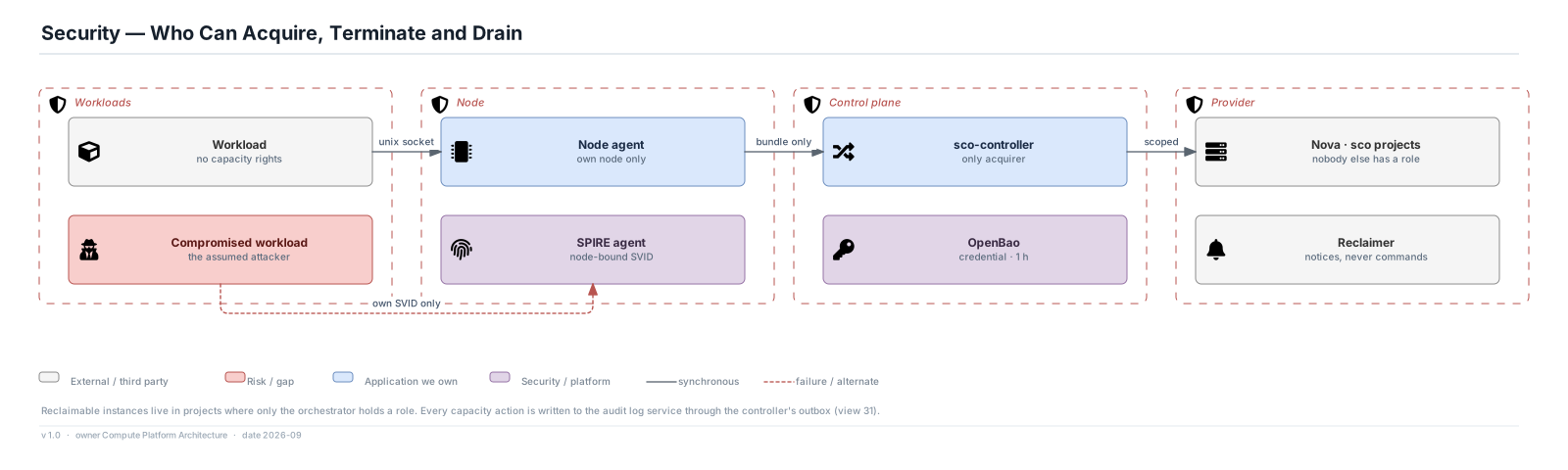
- Termination authority is scoped by OpenStack project, not by tag. Reclaimable and fallback instances live in projects where only the orchestrator's identity holds a role; tags are mutable and a policy that trusts them can be talked out of its scope.
- The orchestrator's provider credential is an application credential issued through OpenBao for an hour. The node agent holds no provider credential at all.
- When an instance is terminated, the controller bans its SPIRE agent and revokes OpenBao leases issued to that node, rather than relying on the instance disappearing.
The assumed attacker
- A compromised workload can reach the local agent socket, which answers notice and deadline queries only, and can obtain its own SVID. It cannot drain another node, launch or terminate capacity, change a contract or read another workload's checkpoints.
Omitted
- Checkpoint isolation per workload is on view 13; the authority to spend beyond a cap is on view 31.