Spot Capacity Orchestrator  ·  View 31 of 32  ·  7 · Assurance

Spend Authority

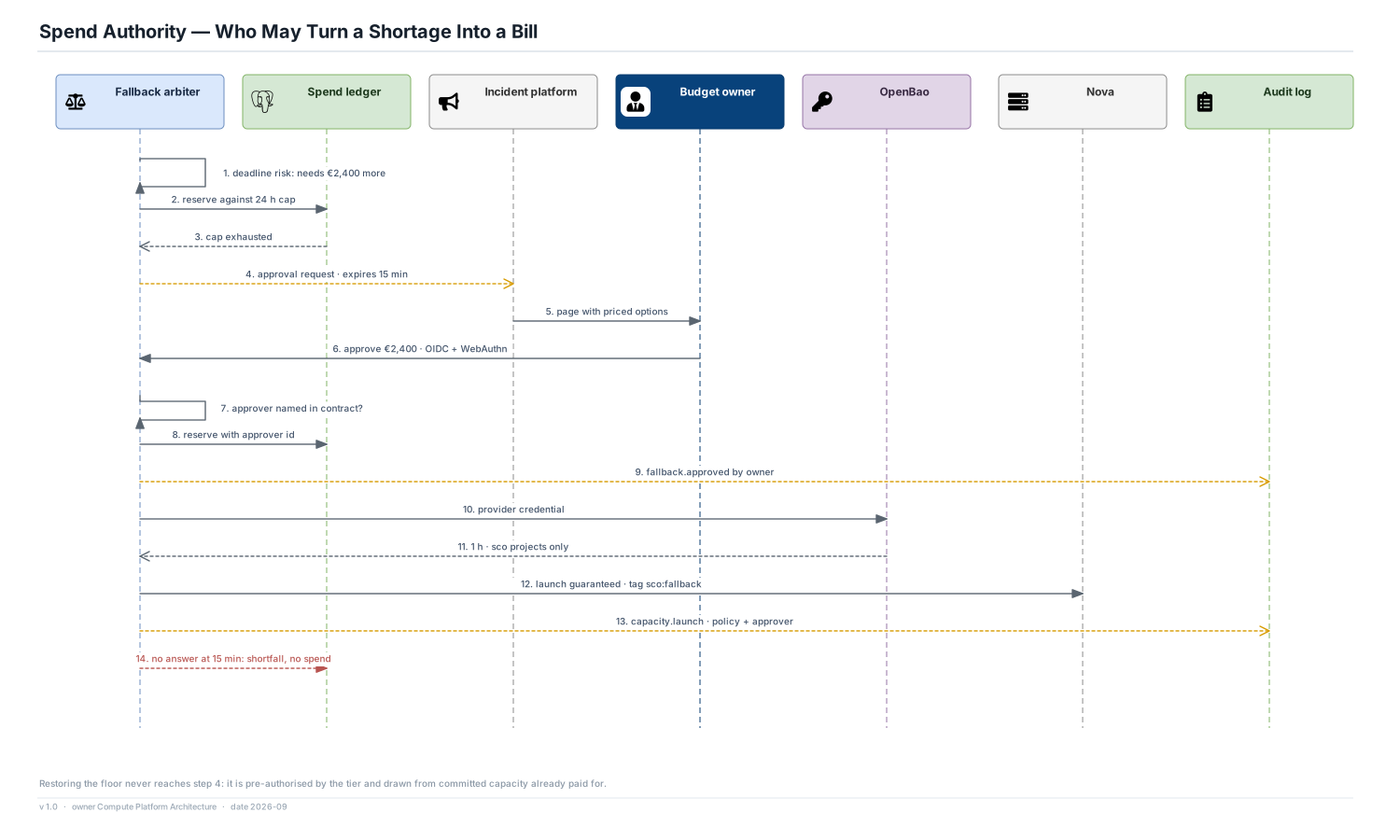
Who may turn a capacity shortage into a bill, how their approval is proved, and how every step is recorded outside the telemetry pipeline.

Editable source SVG draw.io All views
Fallback arbiter Spend ledger Incident platform Budget owner OpenBao Nova Audit log 1. deadline risk: needs €2,400 more 2. reserve against 24 h cap 3. cap exhausted 4. approval request · expires 15 min 5. page with priced options 6. approve €2,400 · OIDC + WebAuthn 7. approver named in contract? 8. reserve with approver id 9. fallback.approved by owner 10. provider credential 11. 1 h · sco projects only 12. launch guaranteed · tag sco:fallback 13. capacity.launch · policy + approver 14. no answer at 15 min: shortfall, no spend Spend Authority — Who May Turn a Shortage Into a Bill Restoring the floor never reaches step 4: it is pre-authorised by the tier and drawn from committed capacity already paid for. v 1.0 · owner Compute Platform Architecture · date 2026-09

Decisions

  • Moving work from reclaimable to guaranteed capacity is treated as spending money, because it is. The approver must be named in the contract, sign in with a phishing-resistant factor, and approve a priced option rather than a vague request.
  • Every capacity action records the identity that caused it: an operator, a policy, or a policy acting under a named approval. The record goes to the audit log service through an outbox, independent of Kafka and ClickHouse.

Separation of authority

  • Routine contract edits need the platform team's review. Floors, spend caps and fallback policy need a governance signature as well. Operators of the orchestrator cannot approve their own fallback spend.

Risk

  • A budget owner who never answers at night turns every broad shortage into a recorded shortfall. That is the chosen failure; the review after each one decides whether the cap was simply too low.