Spot Capacity Orchestrator · View 21 of 32 · 5 · Runtime
Why it stays an event, not an outage
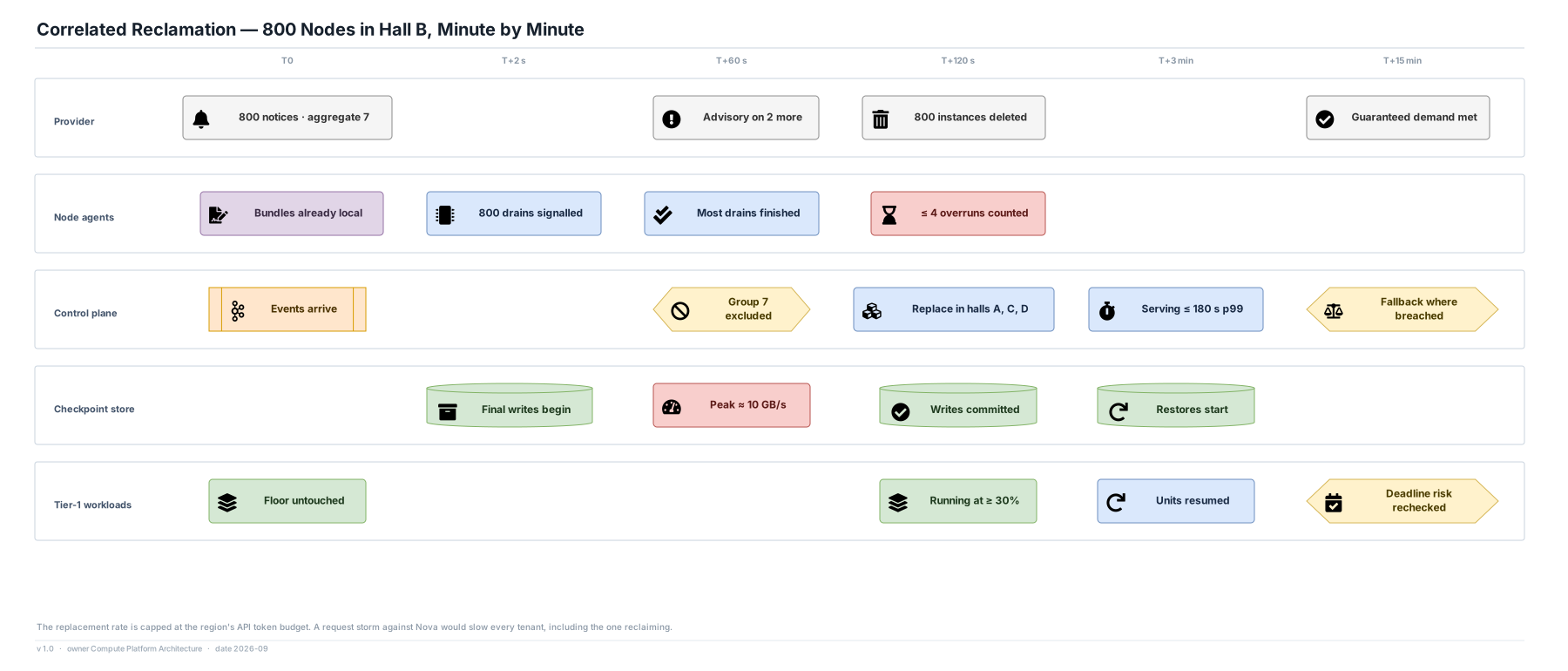
- Every drain was decided before T0, by a bundle already on each node. Nothing central queues 800 decisions.
- No workload had more than 30% of its units in the aggregate's correlation group, so the worst-hit tier-1 workload lost 30% of its reclaimable share and kept its whole guaranteed floor.
The load nobody sizes for
- Final checkpoints, not drains, are the peak. About 40% of the 800 nodes run checkpointing units; 320 writes of 1.4 GB inside 45 s is about 10 GB/s into Ceph RGW. The region's gateways are sized for 20 GB/s, and the proof phase measures it (view 29).
- Replacement is capped by the Nova token budget. A faster replacement would be a request storm against the same API guaranteed tenants are using to claim the capacity back.
Assumption
- The replacement halls have headroom. When they do not, the shortfall is reported as shortfall, separately from interruption, and the fallback path in view 22 takes over.