Spot Capacity Orchestrator · View 20 of 32 · 5 · Runtime
Decisions
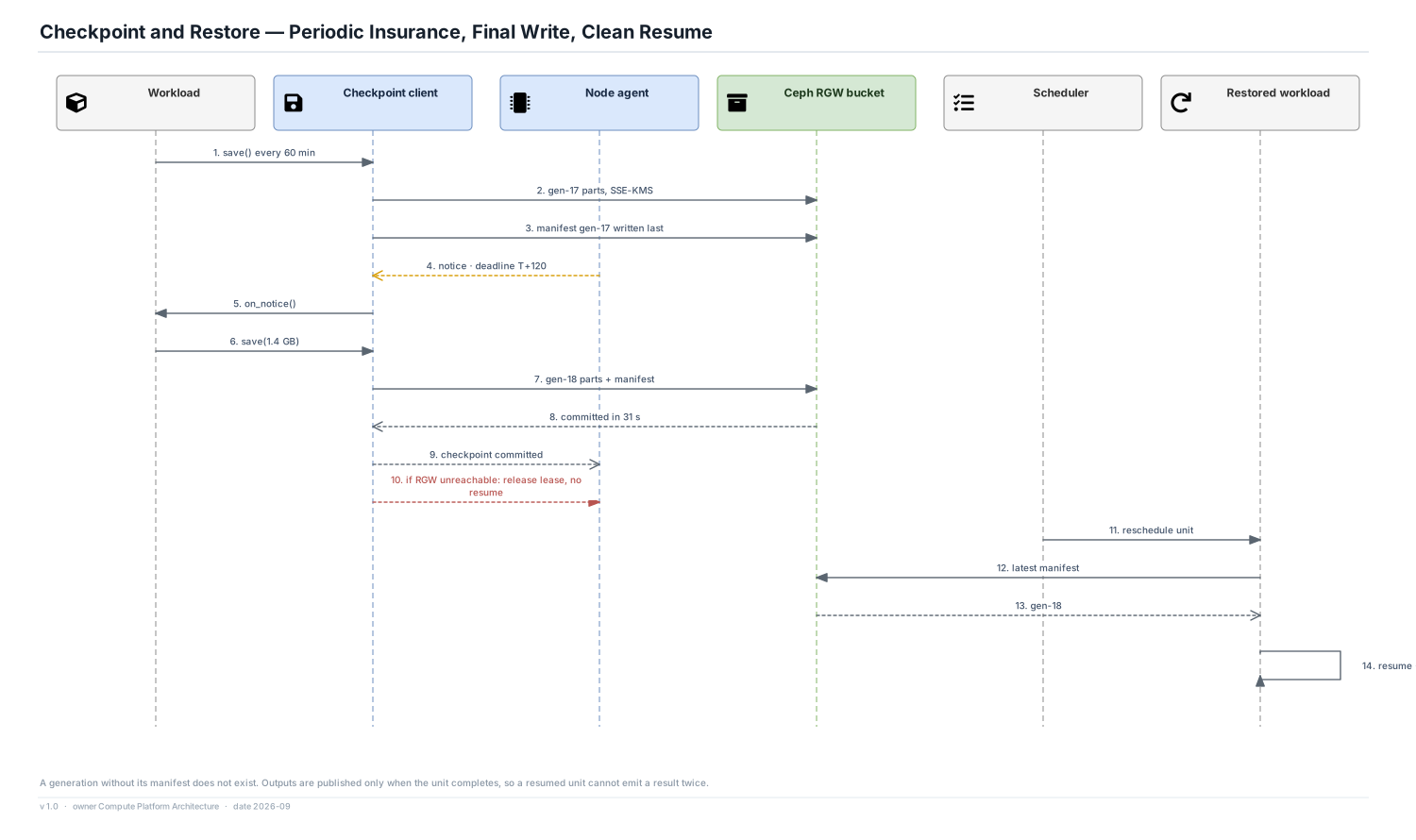
- Application checkpoints through a platform client, not process snapshots. The client handles encryption, multipart upload, the manifest commit and the notice callback; the workload decides what state is.
- A generation exists only when its manifest is written, last. A write interrupted halfway leaves parts without a manifest, which restore ignores and lifecycle rules delete.
- Restart semantics are declared: outputs go to a staging prefix and are published when the unit completes, so a resumed unit cannot produce a duplicate externally visible effect.
Why periodic checkpoints can be infrequent
- With notice, most reclaims end in a final write. Only no-notice terminations (2%), overruns (0.5%) and failed final writes (about 1%) lose work since the last periodic checkpoint: roughly 0.14% of instances an hour instead of 4%.
- The Young–Daly interval √(2 × cost × MTBF) with a 45 s checkpoint and a 714-hour effective MTBF is about 4 hours. The default is capped at 60 minutes, because the no-notice rate is an assumption and one lost hour is what an ML engineer said they could accept.
Store unavailable
- If RGW cannot be reached during drain, the client releases the work item's lease and the agent records the failure. The unit restarts from its last committed generation; nothing is lost silently.