Spot Capacity Orchestrator · View 12 of 32 · 3 · Structure
Decisions
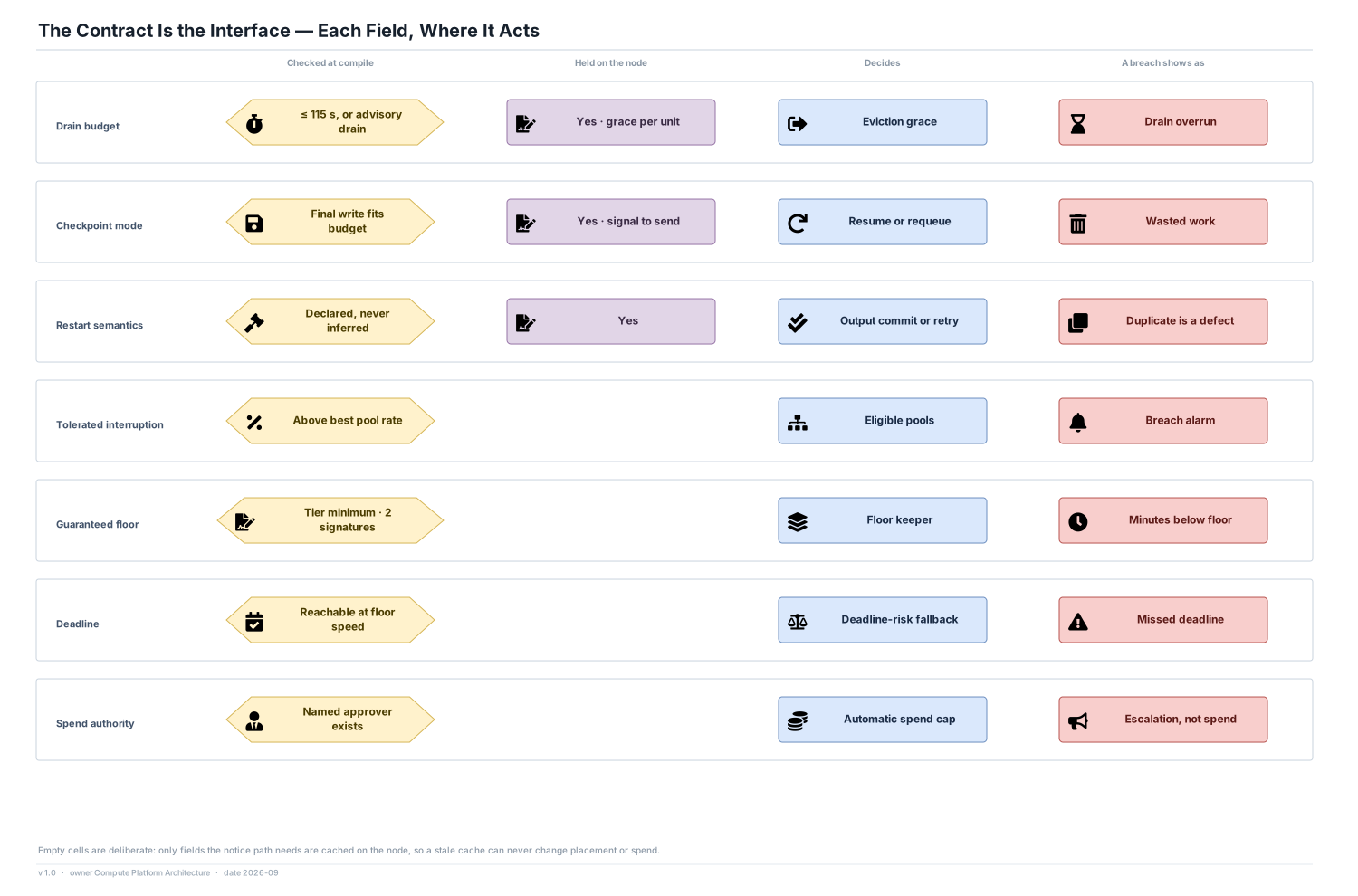
- Behaviour is a function of the contract and nothing else. To change how a workload drains, falls back or is placed, someone changes a reviewed file; the platform never infers tolerance from a workload that happened to survive.
- Five tiers cover most workloads: T1 deadline (30% floor, checkpoints, capped automatic fallback), T2 checkpointed long-running (10% floor), T3 requeue (short units, no floor), T4 stateless service (30% floor, connection drain) and T5 opportunistic (no floor, never falls back). A bespoke contract is allowed and reviewed by the platform team.
- Only the three fields the notice path needs are cached on the node. A stale node cache can therefore never change placement or spend.
Feasibility checks with numbers
- A drain budget above 115 s needs advisory drain, which is Phase 2, so the MVP rejects it.
- A requeue contract's longest unit must satisfy rate × unit ÷ 2 ≤ 3% wasted work. At the 4% hourly baseline that is 90 minutes; if the workload declares tolerance of a 12% pool, 30 minutes.
- A declared final checkpoint must fit inside the drain budget at the measured store throughput, not the hoped-for one.
Risk
- Owners will over-declare tolerance to get the discount. The breach alarm and, in Phase 3, contract-priced chargeback make over-declaration visible and then expensive (ADR-27).