Spot Capacity Orchestrator · View 11 of 32 · 3 · Structure
Inbound
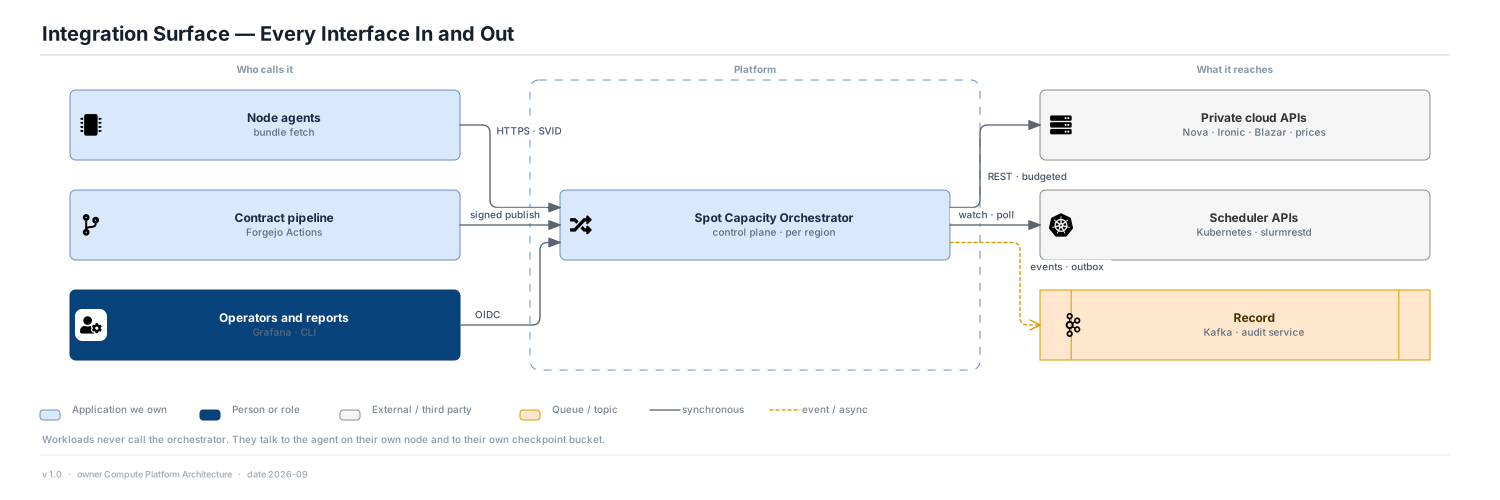
- Agents fetch bundles over HTTPS with their SVID; the contract pipeline publishes signed bundles; operators and reports use OIDC. Workloads have no route to the control plane at all.
Outbound
- Private cloud: Nova and Ironic to launch and delete, Placement and quotas for headroom, Blazar for committed reservations and the forward calendar, and the rate card feed. Every mutating call draws from a regional token budget.
- Schedulers: a watch on the Kubernetes API and a poll of slurmrestd for pending work. Record: lifecycle events to Kafka and capacity actions through a transactional outbox to the audit log service.
The provider contract
- Five things the private cloud team commits to: a hard notice ≥ 120 s before deletion, delivered to the node in ≤ 1 s; an advisory when it arrives; a rate card per pool every 5 minutes; reservation and forward-capacity data; and a reclaim API the exercise job can call. If any one is missing, this design degrades to what the requirement calls the no-notice case.