Certificate Lifecycle Service  ·  View 06 of 21  ·  Structure

Layered Architecture

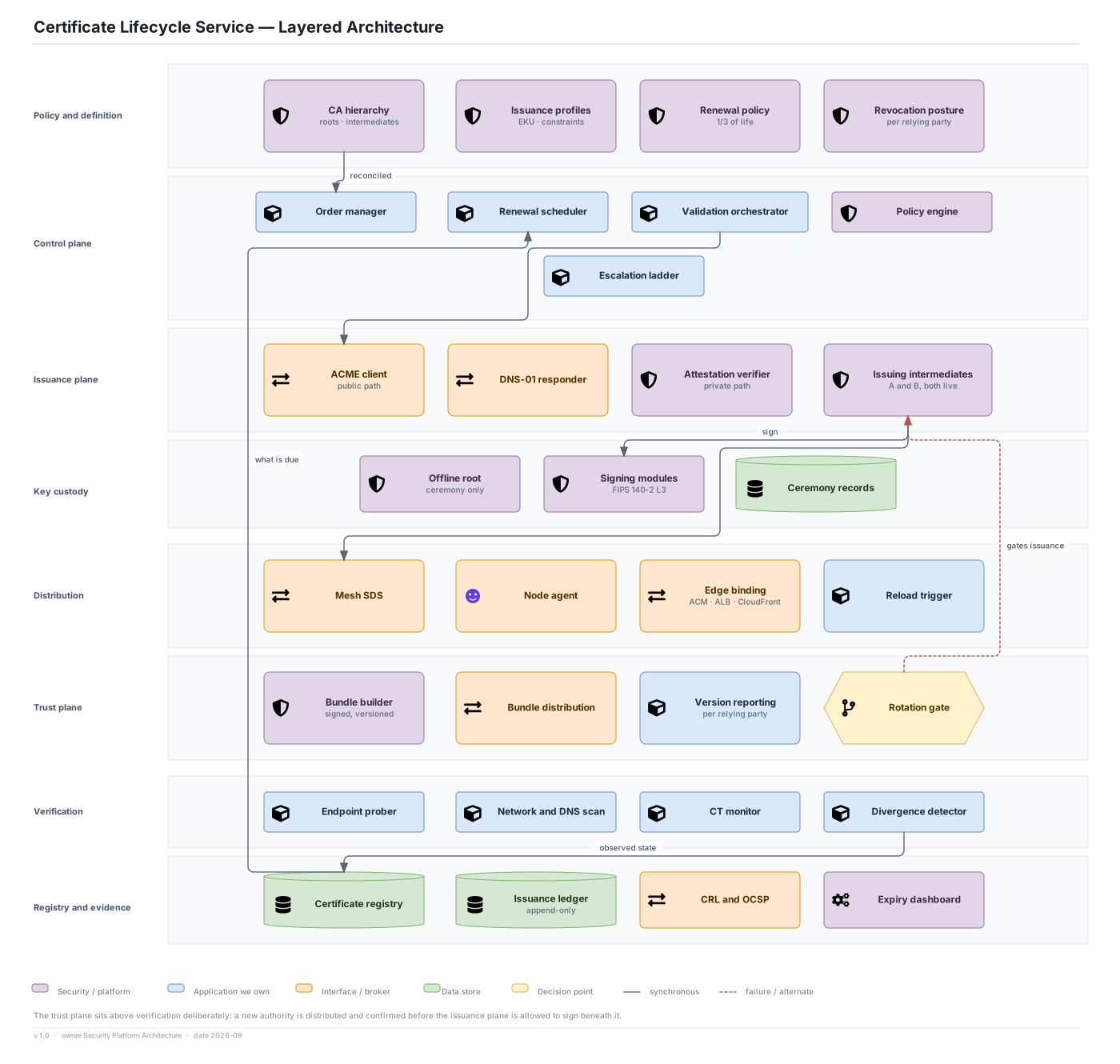
Eight layers, and the deliberate ordering that puts trust distribution above the thing it gates.

Editable source SVG draw.io All views
Policy and definition CA hierarchy roots · intermediates Issuance profiles EKU · constraints Renewal policy 1/3 of life Revocation posture per relying party Control plane Order manager Renewal scheduler Validation orchestrator Policy engine Escalation ladder Issuance plane ACME client public path DNS-01 responder Attestation verifier private path Issuing intermediates A and B, both live Key custody Offline root ceremony only Signing modules FIPS 140-2 L3 Ceremony records Distribution Mesh SDS Node agent Edge binding ACM · ALB · CloudFront Reload trigger Trust plane Bundle builder signed, versioned Bundle distribution Version reporting per relying party Rotation gate Verification Endpoint prober Network and DNS scan CT monitor Divergence detector Registry and evidence Certificate registry Issuance ledger append-only CRL and OCSP Expiry dashboard reconciled sign gates issuance observed state what is due Certificate Lifecycle Service — Layered Architecture Security / platform Application we own Interface / broker Data store Decision point synchronous failure / alternate The trust plane sits above verification deliberately: a new authority is distributed and confirmed before the issuance plane is allowed to sign beneath it. v 1.0 · owner Security Platform Architecture · date 2026-09

The ordering argument

  • Policy is declared and versioned; the control plane reconciles it and is never the authority for it.
  • The trust plane sits above the issuance plane because a new authority must be distributed and confirmed everywhere before a single leaf is signed beneath it — enforced by the rotation gate, not by a runbook.
  • Verification sits below distribution and writes to the registry, so observed state is what the renewal scheduler reads back.

Separation that matters

  • Key custody is its own layer with exactly one caller: the issuing intermediates. Nothing in the control plane can reach a signing module.
  • CRL and OCSP publication sits in the evidence layer, independent of issuance, so an issuance outage cannot prevent a revocation.

Assumption

  • Two issuing intermediates are live at all times, which is what makes replacing one a 4-hour operation rather than an estate-wide event.