Spot Capacity Orchestrator  ·  View 28 of 32  ·  6 · Operations

Net Savings Ledger

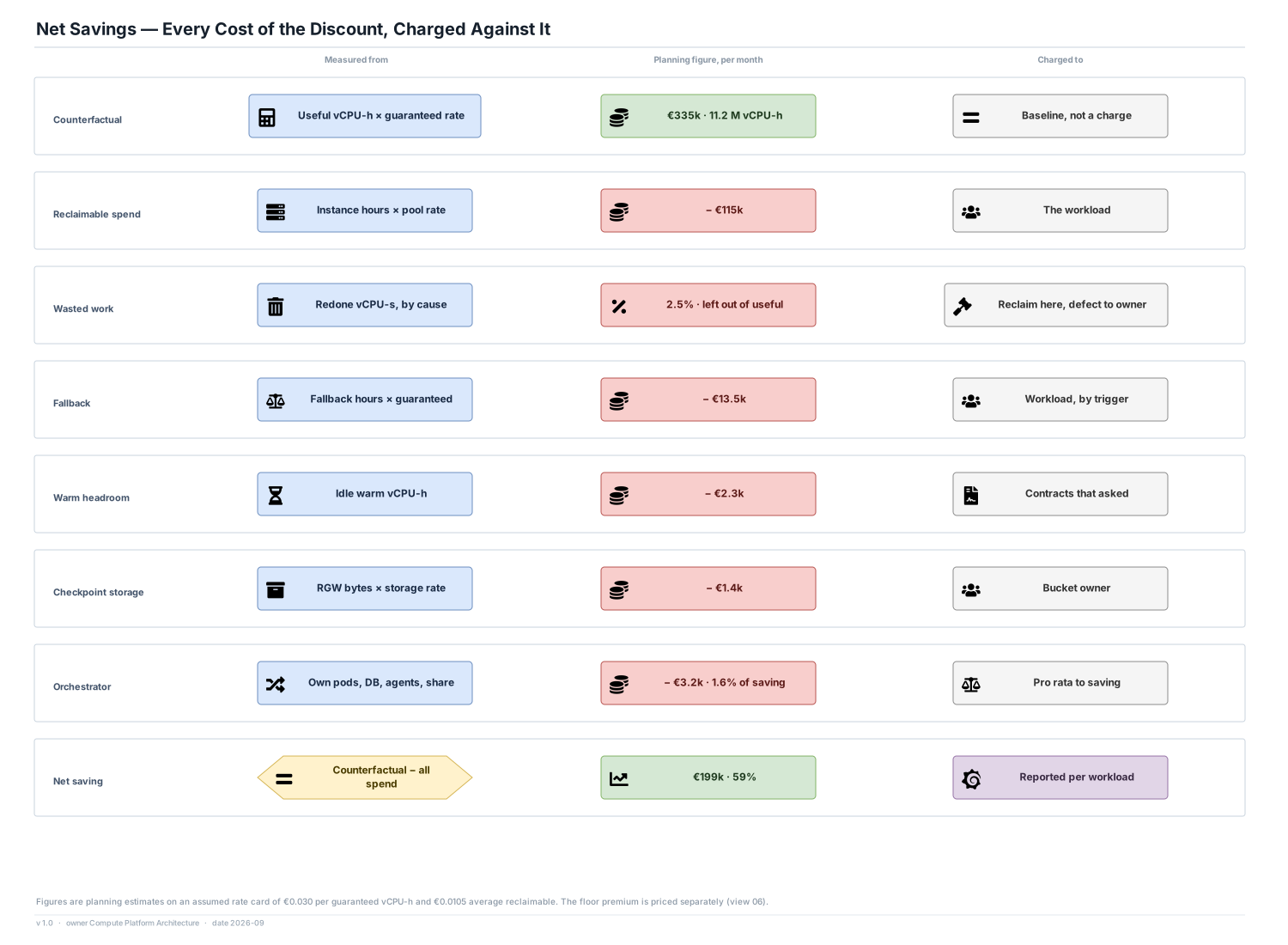
How the saving is computed: useful work at guaranteed prices, minus every cost of running on reclaimable capacity, each charged to the workload that caused it.

Editable source SVG draw.io All views
Measured from Planning figure, per month Charged to Counterfactual Useful vCPU-h × guaranteed rate €335k · 11.2 M vCPU-h Baseline, not a charge Reclaimable spend Instance hours × pool rate − €115k The workload Wasted work Redone vCPU-s, by cause 2.5% · left out of useful Reclaim here, defect to owner Fallback Fallback hours × guaranteed − €13.5k Workload, by trigger Warm headroom Idle warm vCPU-h − €2.3k Contracts that asked Checkpoint storage RGW bytes × storage rate − €1.4k Bucket owner Orchestrator Own pods, DB, agents, share − €3.2k · 1.6% of saving Pro rata to saving Net saving Counterfactual − all spend €199k · 59% Reported per workload Net Savings — Every Cost of the Discount, Charged Against It Figures are planning estimates on an assumed rate card of €0.030 per guaranteed vCPU-h and €0.0105 average reclaimable. The floor premium is priced separately (view 06). v 1.0 · owner Compute Platform Architecture · date 2026-09

The arithmetic

  • 11.45 M vCPU-h served a month: 11.0 M reclaimable, 0.45 M fallback. 2.5% of reclaimable hours redone, so 11.18 M useful × €0.030 = €335k counterfactual.
  • Spend: €115.5k reclaimable, €13.5k fallback, €2.3k warm headroom, €1.4k checkpoint storage, €3.2k orchestrator. Net saving €199k, 59%, against a 55% target. The orchestrator is 1.6% of the saving against a 2% ceiling.

The honest part

  • On hardware the organisation already owns, a rate-card saving turns into money only when the next purchase of guaranteed capacity is smaller than it would otherwise have been. The ledger reports the rate-card number; capacity planning has to use it for it to be real.

Decisions

  • Wasted work is excluded from useful work rather than added as a cost, so it is never counted twice. Losses caused by a workload's defects go to that workload's own report and not to the platform's.
  • Warm headroom is a purchase of reliability with a price, charged to the contracts that asked for it, never background overhead.