Spot Capacity Orchestrator · View 15 of 32 · 4 · Data
Decisions
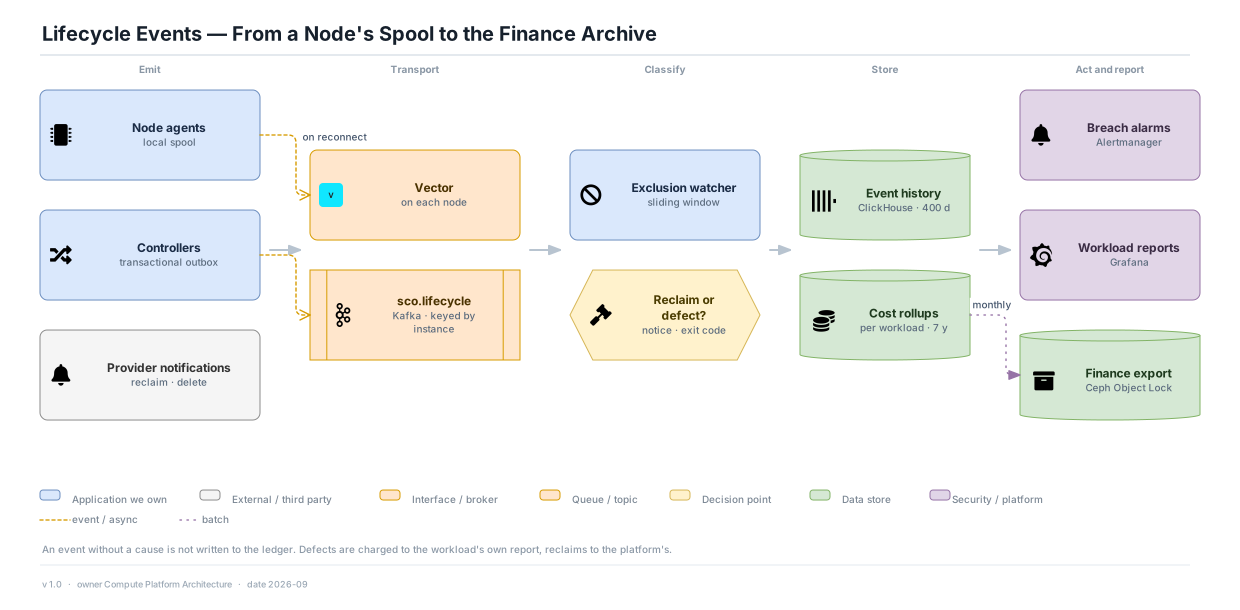
- Agents write to a bounded 64 MB local spool before anything else, and Vector ships it when the network allows. The spool dies with the node, which is why the outcome is flushed within the last three seconds of the window.
- Controllers write events through a transactional outbox in PostgreSQL, so a placement and its event commit together or not at all.
- Classification happens before storage. A unit that exited non-zero with no notice on its node is a defect; one that ended within a notice window is a reclaim; operator drains and drills are labelled at source.
Adopted
- Kafka and ClickHouse are the estate's shared clusters with dedicated topics and databases. At 30,000 events on the worst day, dedicated clusters would breach the orchestrator's 2% cost ceiling on their own.
Risk
- Events from nodes deleted during a long control-plane or network outage are lost with the node. The provider's deletion notifications fill the gap with the fact of loss, and the ledger marks the missing outcome as unknown rather than as zero.