Passkey Authentication Service  ·  View 08 of 21  ·  Structure

Platform Components

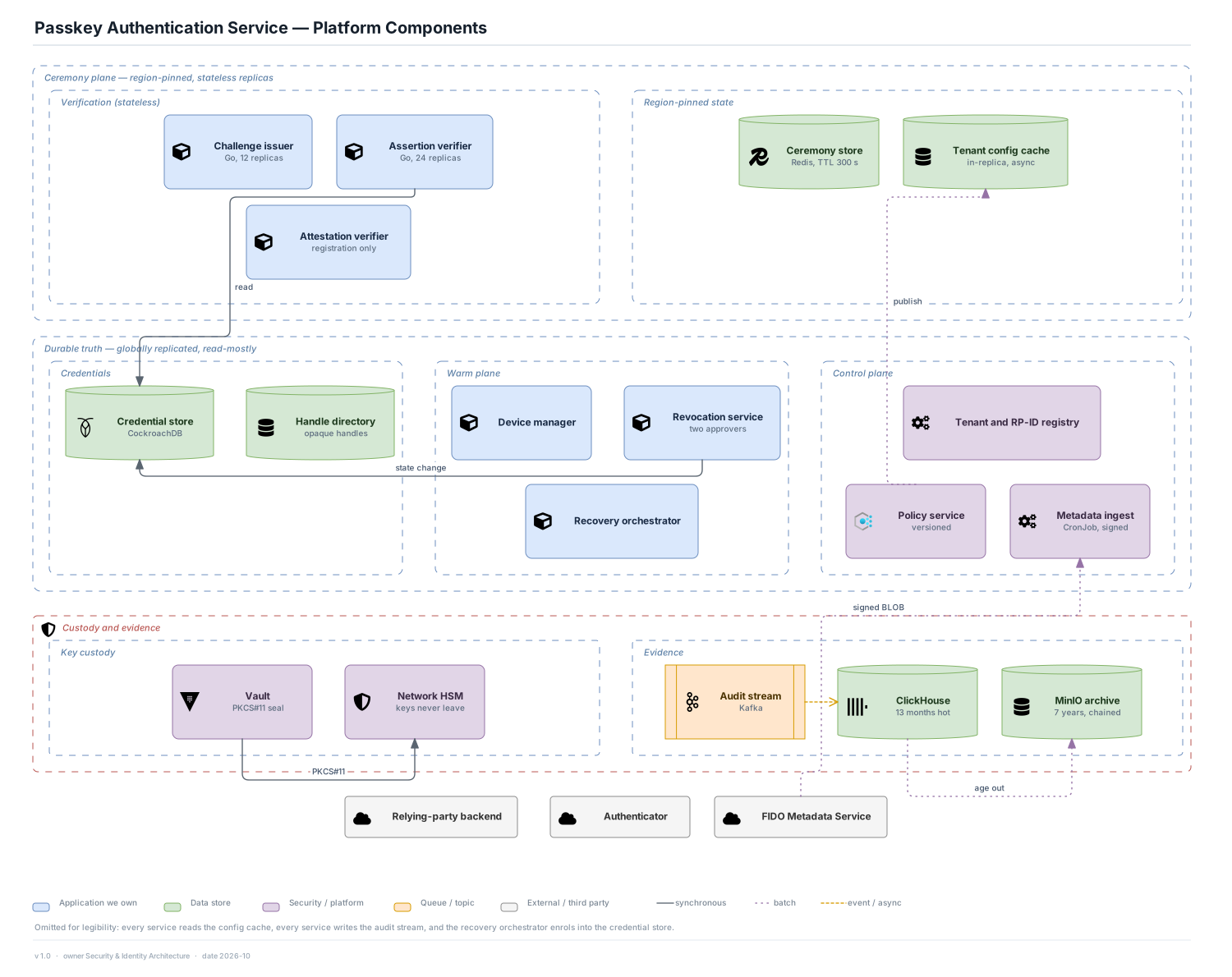
What is stateless, what is region-pinned, what is globally replicated, and what holds a key.

Editable source SVG draw.io All views
Ceremony plane — region-pinned, stateless replicas Verification (stateless) Challenge issuer Go, 12 replicas Assertion verifier Go, 24 replicas Attestation verifier registration only Region-pinned state Ceremony store Redis, TTL 300 s Tenant config cache in-replica, async Durable truth — globally replicated, read-mostly Credentials Credential store CockroachDB Handle directory opaque handles Warm plane Device manager Revocation service two approvers Recovery orchestrator Control plane Tenant and RP-ID registry Policy service versioned Metadata ingest CronJob, signed Custody and evidence Key custody Vault PKCS#11 seal Network HSM keys never leave Evidence Audit stream Kafka ClickHouse 13 months hot MinIO archive 7 years, chained Relying-party backend Authenticator FIDO Metadata Service read state change publish signed BLOB PKCS#11 age out Passkey Authentication Service — Platform Components Application we own Data store Security / platform Queue / topic External / third party synchronous batch event / async Omitted for legibility: every service reads the config cache, every service writes the audit stream, and the recovery orchestrator enrols into the credential store. v 1.0 · owner Security & Identity Architecture · date 2026-10

Decisions

  • Verification replicas are stateless and disposable; the only affinity in the system is the region pin, not a session.
  • The ceremony store and the tenant config cache sit inside the region-pinned boundary because both are reconstructible — one by the user retrying, the other by an asynchronous refresh.
  • Revocation is a service with a two-approver control, not a database update, because bulk revocation is the most destructive capability in the platform.
  • The HSM is reachable only from the custody boundary and signs only; no key material is ever exported, including to a backup.

Assumptions

  • 24 assertion-verifier replicas and 12 challenge-issuer replicas per region at steady state; the ratio follows the two-call ceremony with a cheaper first call.
  • Credential store 480 GB across 400 million records at roughly 1.2 KB each.
  • Metadata ingest runs daily as a signature-checked job, not continuously.

What this view omits

  • Every service's read of the config cache and write to the audit stream.
  • The recovery orchestrator's enrolment write into the credential store, which view 15 shows in its proper sequence.