Enterprise Generative Search — Azure and Open Source  ·  View 28 of 41  ·  Runtime

Multimodal Retrieval

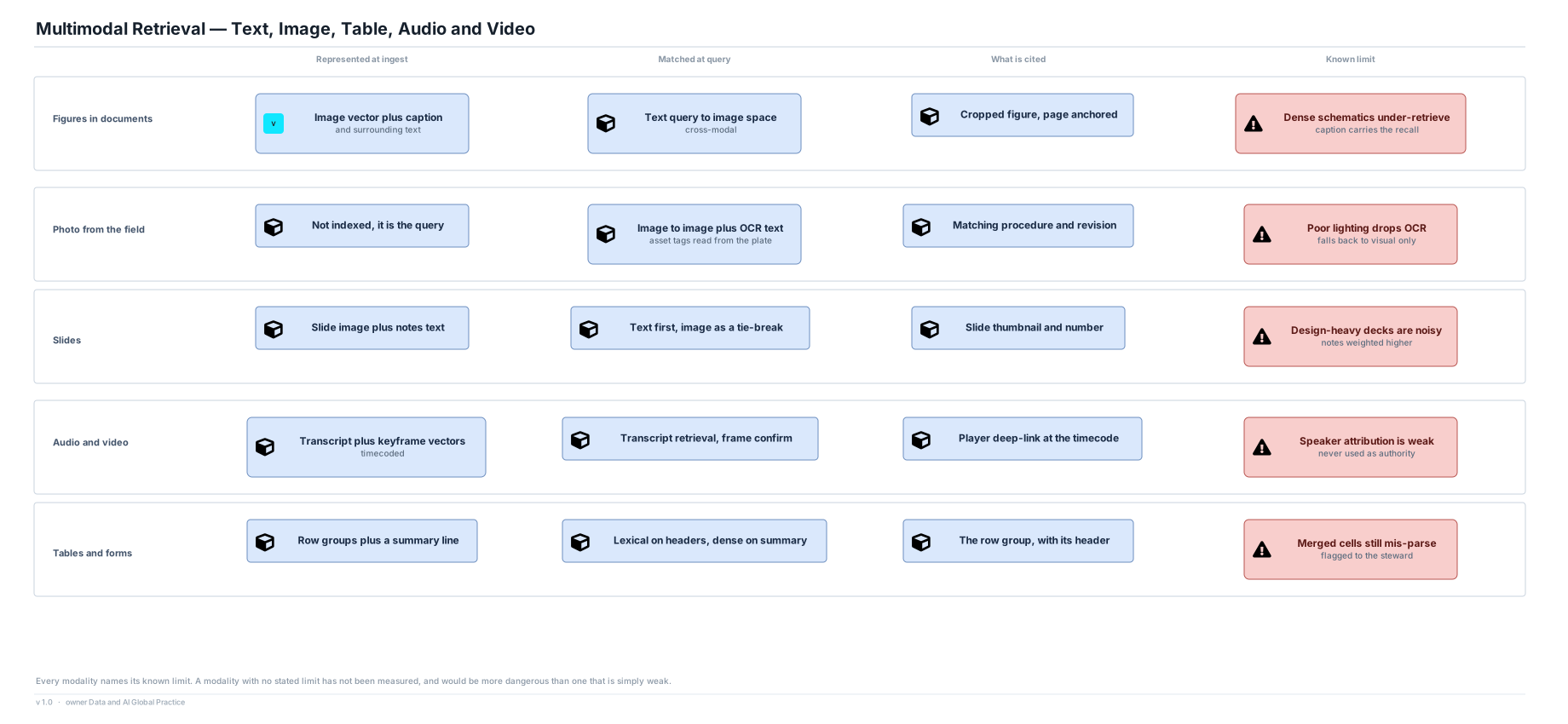
Five modalities, how each is represented and matched, and the limit each one has.

Editable source SVG draw.io All views
Represented at ingest Matched at query What is cited Known limit Figures in documents Image vector plus caption and surrounding text Text query to image space cross-modal Cropped figure, page anchored Dense schematics under-retrieve caption carries the recall Photo from the field Not indexed, it is the query Image to image plus OCR text asset tags read from the plate Matching procedure and revision Poor lighting drops OCR falls back to visual only Slides Slide image plus notes text Text first, image as a tie-break Slide thumbnail and number Design-heavy decks are noisy notes weighted higher Audio and video Transcript plus keyframe vectors timecoded Transcript retrieval, frame confirm Player deep-link at the timecode Speaker attribution is weak never used as authority Tables and forms Row groups plus a summary line Lexical on headers, dense on summary The row group, with its header Merged cells still mis-parse flagged to the steward Multimodal Retrieval — Text, Image, Table, Audio and Video Every modality names its known limit. A modality with no stated limit has not been measured, and would be more dangerous than one that is simply weak. v 1.0 · owner Data and AI Global Practice

Decisions

  • Text remains the primary retrieval channel for every modality. Images and frames confirm and locate; they rarely lead, and a design that leads with them retrieves confidently and wrongly.
  • Every modality names its known limit on the page. A modality with no stated limit has not been measured, which is more dangerous than one that is simply weak.
  • Citations for media anchor to a location a person can open — a page and bounding box, a slide number, a player timecode.

Numbers

  • 6% of queries carry media; field-engineer photo search is 78% of those.
  • Multimodal adds 400 ms and 0.003 USD to a query; the ingest-time cost is far larger and is paid once.
  • Transcript-led retrieval on video reached 0.81 Recall@20 against 0.44 for keyframe-led, which is why the order is what it is.

Risks

  • Dense engineering schematics under-retrieve. The caption and surrounding text carry the recall, so a diagram in a document with no caption is effectively invisible — reported to stewards as a coverage defect.
  • Speaker attribution from audio is weak and is never used as an authority signal.