Cloud Development Environment Platform  ·  View 18 of 21  ·  Operations

Observability Matrix

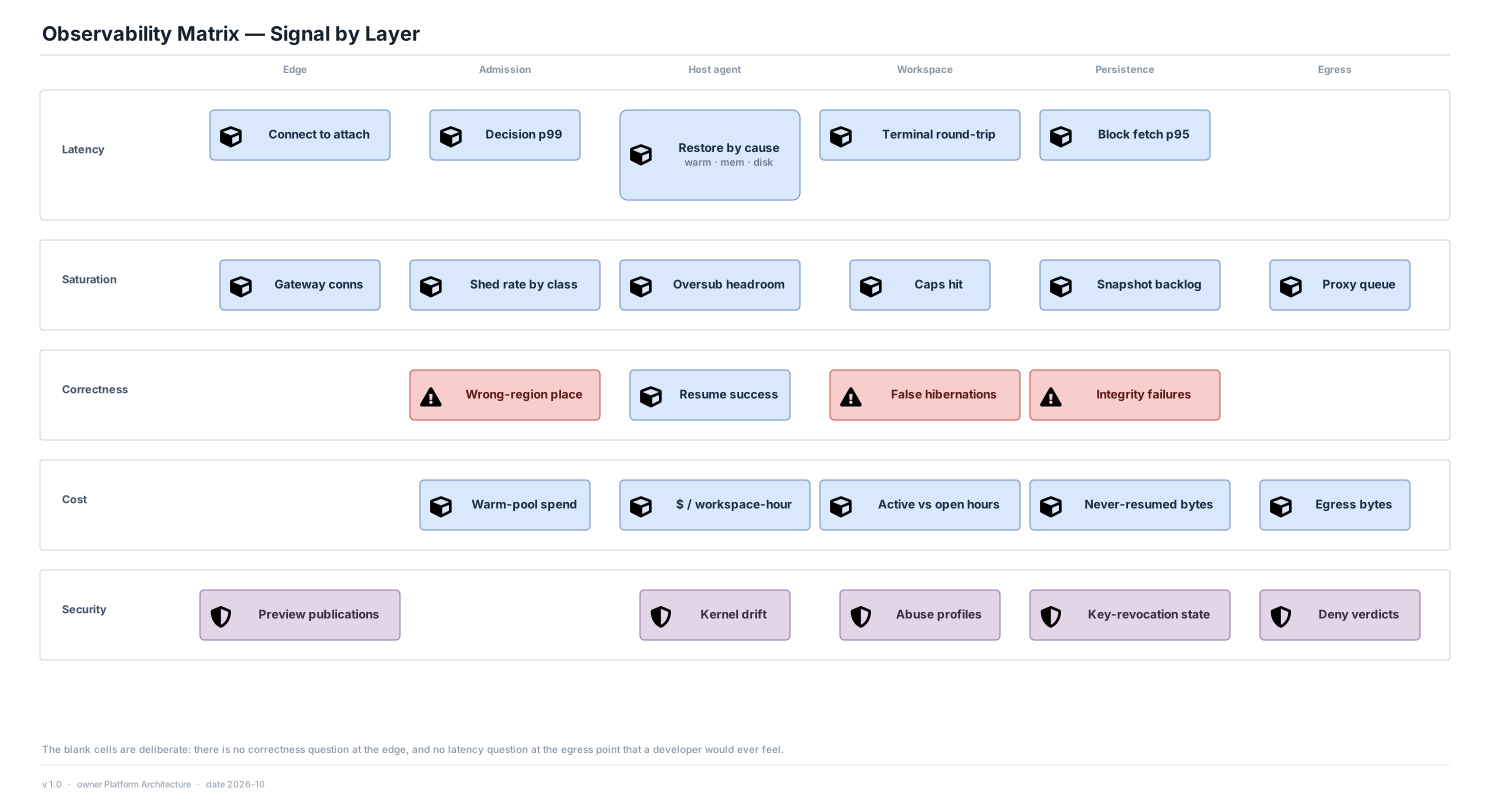
Five signal types across six layers, with the blank cells meant literally.

Editable source SVG draw.io All views
Edge Admission Host agent Workspace Persistence Egress Latency Connect to attach Decision p99 Restore by cause warm · mem · disk Terminal round-trip Block fetch p95 Saturation Gateway conns Shed rate by class Oversub headroom Caps hit Snapshot backlog Proxy queue Correctness Wrong-region place Resume success False hibernations Integrity failures Cost Warm-pool spend $ / workspace-hour Active vs open hours Never-resumed bytes Egress bytes Security Preview publications Kernel drift Abuse profiles Key-revocation state Deny verdicts Observability Matrix — Signal by Layer The blank cells are deliberate: there is no correctness question at the edge, and no latency question at the egress point that a developer would ever feel. v 1.0 · owner Platform Architecture · date 2026-10

Decisions

  • Start latency is sliced by cause — warm-pool claim, memory restore, disk-only restore, prebuild restore, inline build — because an undifferentiated p95 cannot be acted on.
  • Hibernation accuracy (false hibernations, missed idleness) is a first-class signal: it is simultaneously the cost metric and the trust metric.
  • Cost per active workspace-hour is measured on the host agent, where the host-seconds actually are, and attributed to workspace, principal and tenant.

Assumptions

  • OpenTelemetry collection with Prometheus for metrics and a log store for verdicts; raw telemetry 14 days, aggregated 400.
  • Fleet utilisation ≥ 60% of allocated host-seconds over a working day; warm pools ≤ 7% of compute spend.

Deliberately omitted

  • There is no correctness row at the edge and no latency row at the egress point, because neither question has an answer a developer would ever feel.
  • Nothing in this matrix reads the contents of a workspace; every signal is observed at the boundary.