Certificate Lifecycle Service  ·  View 14 of 21  ·  Runtime

Issuance Paths by Trust Domain

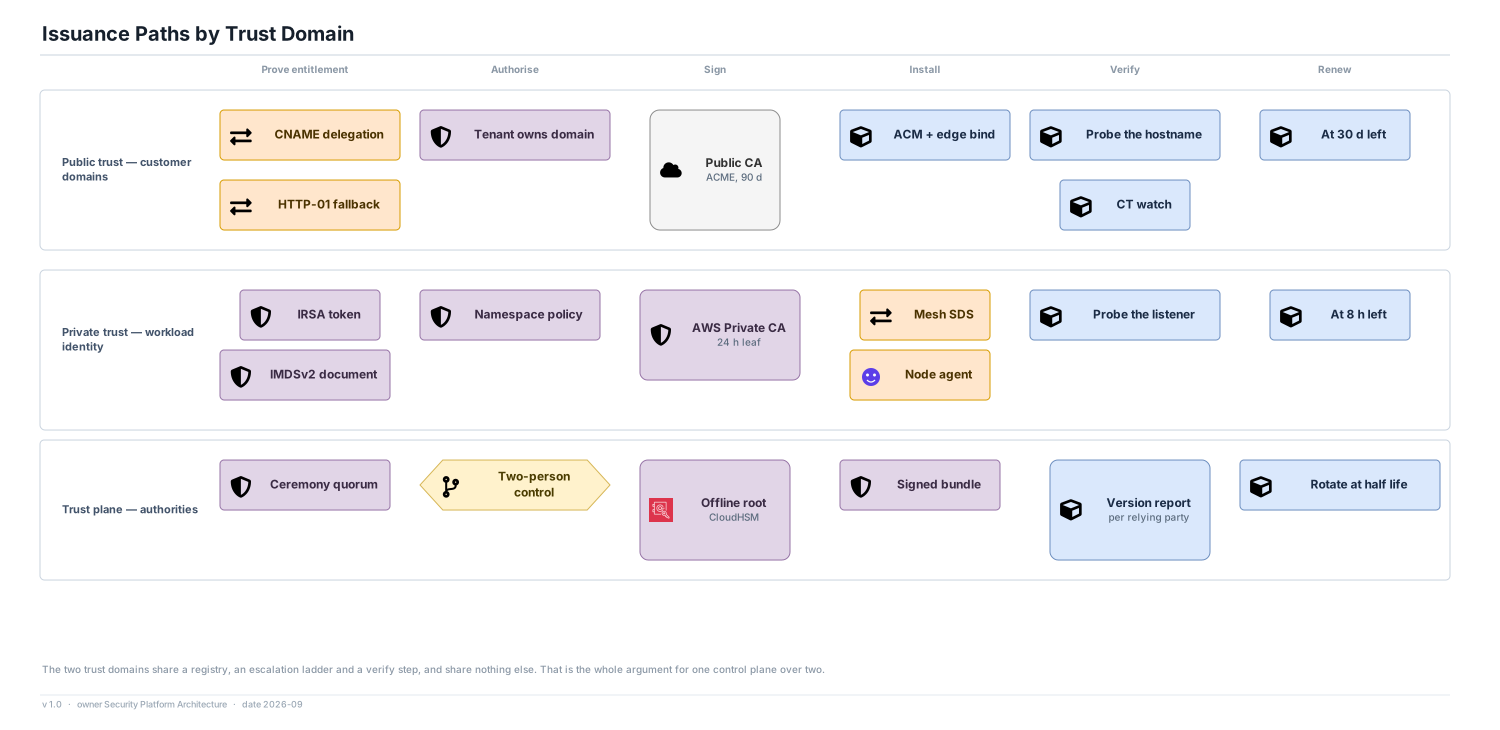
Three lanes across six stages, showing exactly how much the two trust domains share.

Editable source SVG draw.io All views
Prove entitlement Authorise Sign Install Verify Renew Public trust — customer domains CNAME delegation HTTP-01 fallback Tenant owns domain Public CA ACME, 90 d ACM + edge bind Probe the hostname CT watch At 30 d left Private trust — workload identity IRSA token IMDSv2 document Namespace policy AWS Private CA 24 h leaf Mesh SDS Node agent Probe the listener At 8 h left Trust plane — authorities Ceremony quorum Two-person control Offline root CloudHSM Signed bundle Version report per relying party Rotate at half life Issuance Paths by Trust Domain The two trust domains share a registry, an escalation ladder and a verify step, and share nothing else. That is the whole argument for one control plane over two. v 1.0 · owner Security Platform Architecture · date 2026-09

The finding

  • Public and private trust share a registry, an escalation ladder and a verify step. They share no protocol, no authority, no validation mechanism and no lifetime.
  • That is the whole argument for one control plane rather than two: the shared value is the inventory and the escalation, not the issuance mechanics.

Lifetimes

  • Public: 90 days, renewed at 30 days remaining, bounded by what public CAs will issue.
  • Private: 24 hours, renewed at 8 hours remaining, bounded by what the platform can afford to sign — 46,000 issuances a day at the assumed estate size.
  • Authorities: rotated at half of remaining life, never at the end, and tracked on the same clock as a leaf.

Risk

  • Shortening the private leaf multiplies issuance volume proportionally and shortens the estate's survival time without the control plane in the same stroke. The two numbers are the same decision.