URL Shortener & Link Management Service  ·  View 09 of 23  ·  Structure

Inside a Resolution

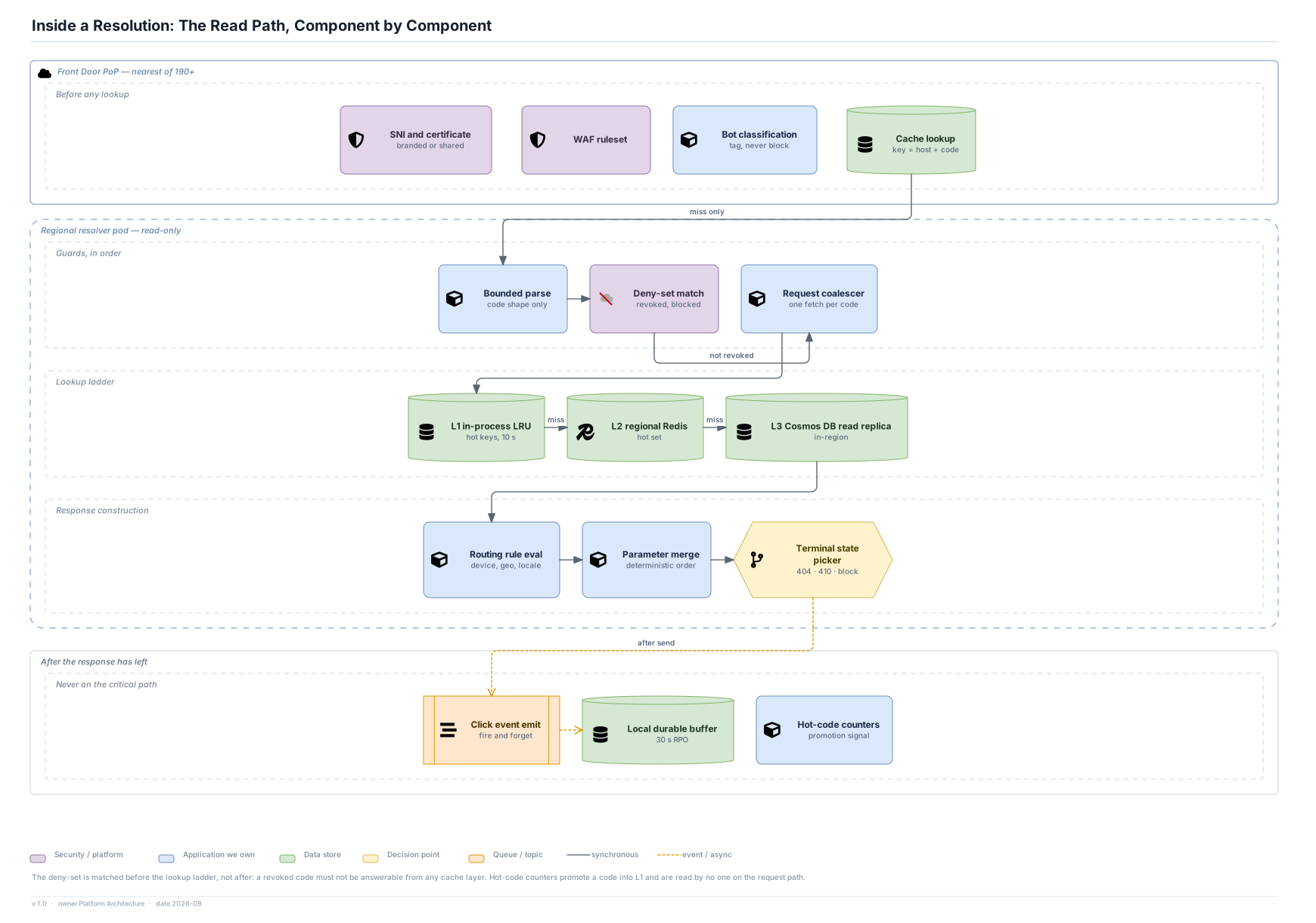
Every component a single click touches, in order, including the three guards that run before any lookup happens.

Editable source SVG draw.io All views
Front Door PoP — nearest of 190+ Before any lookup SNI and certificate branded or shared WAF ruleset Bot classification tag, never block Cache lookup key = host + code Regional resolver pod — read-only Guards, in order Bounded parse code shape only Deny-set match revoked, blocked Request coalescer one fetch per code Lookup ladder L1 in-process LRU hot keys, 10 s L2 regional Redis hot set L3 Cosmos DB read replica in-region Response construction Routing rule eval device, geo, locale Parameter merge deterministic order Terminal state picker 404 · 410 · block After the response has left Never on the critical path Click event emit fire and forget Local durable buffer 30 s RPO Hot-code counters promotion signal miss only not revoked miss miss after send Inside a Resolution: The Read Path, Component by Component Security / platform Application we own Data store Decision point Queue / topic synchronous event / async The deny-set is matched before the lookup ladder, not after: a revoked code must not be answerable from any cache layer. Hot-code counters promote a code into L1 and are read by no one on the request path. v 1.0 · owner Platform Architecture · date 2026-09

Order matters

  • Deny-set before the lookup ladder: a revoked code must not be answerable from any cache layer, which makes revocation independent of cache invalidation.
  • Coalescing before L1: one origin fetch per code per instance, so a viral cold code produces one read rather than 80,000.
  • Terminal-state selection last, so an expired, blocked and unknown code cannot collapse into the same response.

The lookup ladder

  • L1 in-process LRU, 10 s TTL — the hot-key absorber; L2 regional Redis — the working set; L3 in-region Cosmos replica — the cold path.
  • Assumption: 97% of clicks never reach L1 at all because the edge response cache answers them; of the misses, 97% stop at L1 or L2.
  • Cold path budget: p99 ≤ 120 ms including the regional read.

After the response

  • Click emission, the durable local buffer and the hot-code counters all run after the redirect has been sent. None of them can fail a click.
  • Hot-code counters are a promotion signal only; nothing on the request path reads them.