Storage Tiering Service · View 04 of 31 · 2 · People and journeys
The worst moment
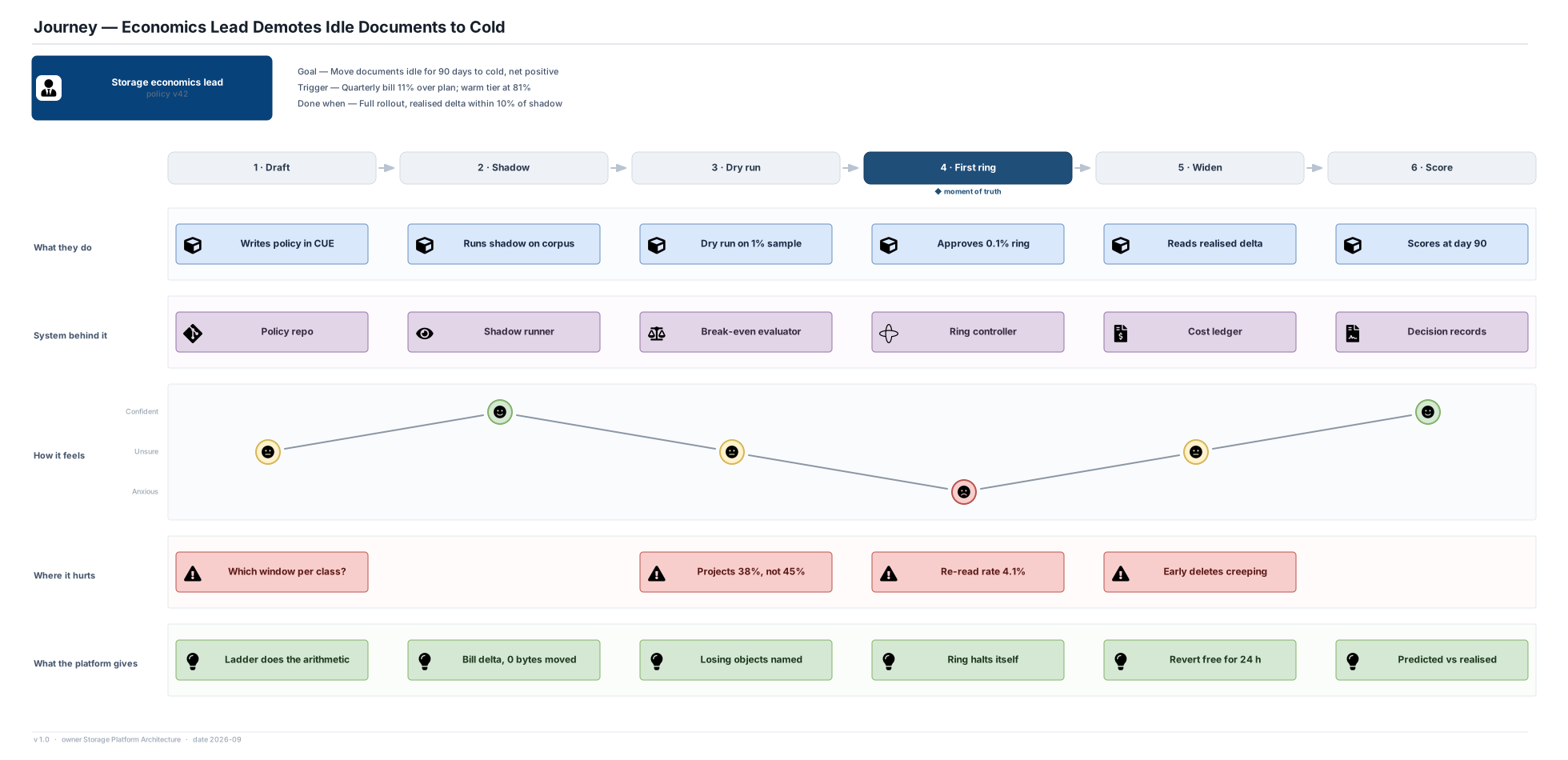
- The first ring. At 0.1% of eligible objects, 4.1% of what was demoted is read again by a promoting class within 14 days, against a 1.5% gate. Almost all of it is quarter-end finance workbooks: idle for 97 days and due to be reopened in the next fortnight. The policy used the 90-day document window; that workspace class should have been declared periodic.
- Without an automatic gate the lead would be deciding, alone and at speed, whether a number is noise. With one, the ring halts itself and the question becomes which object class was mis-declared.
What the architecture owes this journey
- Shadow mode over the whole corpus, so the first number the lead sees is a projected bill delta, not a moved byte (ADR-22).
- A dry run that really copies a 1% stratified sample to scratch space, so request cost and throughput are measured rather than estimated.
- A 24-hour release hold, so reversing a bad ring is a catalogue pointer flip rather than a retrieval (ADR-03).
Numbers
- Rings at 0.1%, 1%, 10% and 100% of eligible objects, each held for at least 72 hours. The gate reads re-read rate for immediate destinations, wrong-tier rate for delayed ones, and the charge ratio for both. No policy may move more than 2% of objects or 1.5 PB in any seven-day window.