Spot Capacity Orchestrator · View 17 of 32 · 5 · Runtime
Decisions
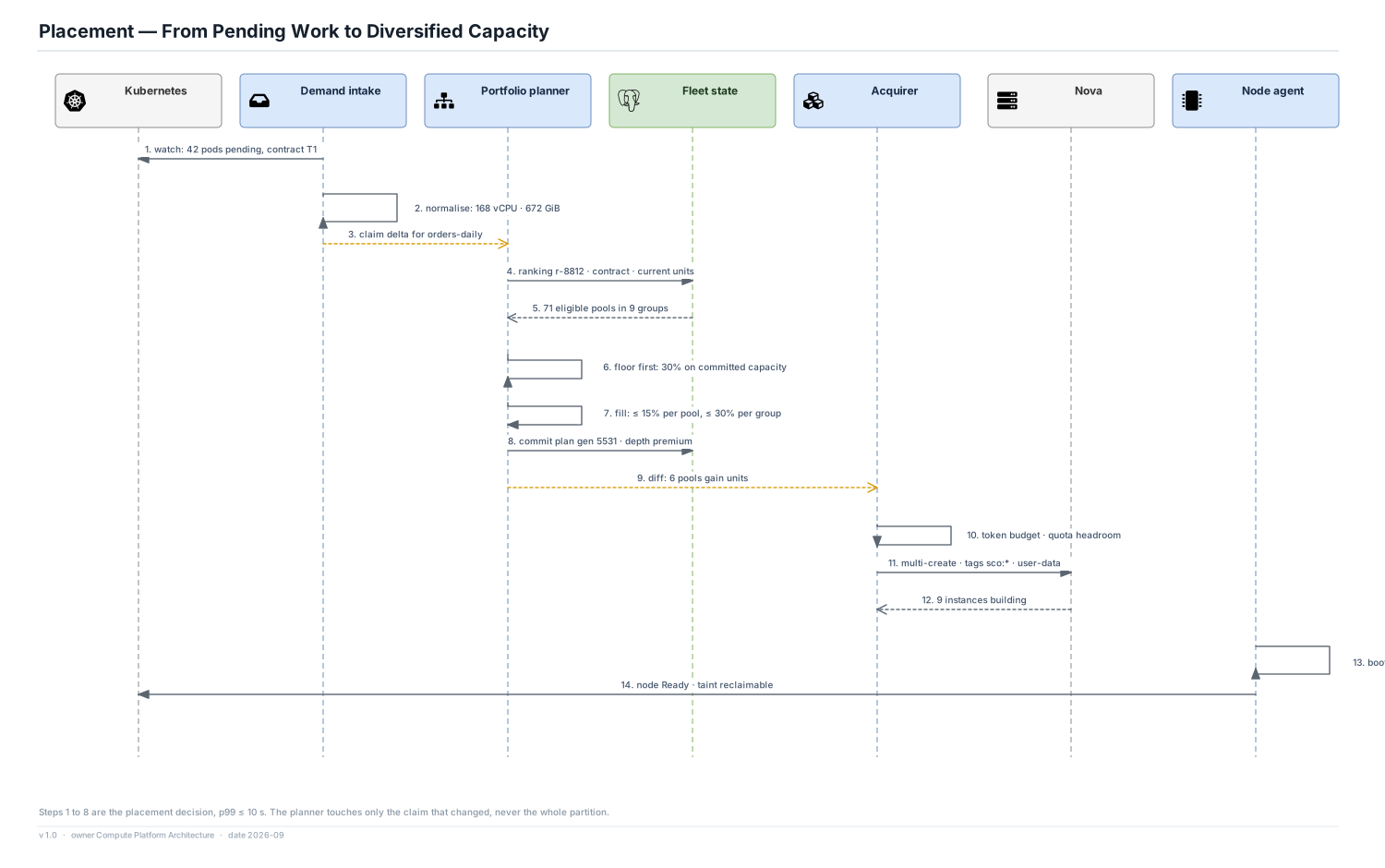
- Demand is normalised to vCPU, memory and accelerators before it reaches the planner. Asking for instance counts would lock a workload into one size and defeat diversification across sizes.
- The planner is incremental. It re-plans a workload when its claim, its eligible pools' ranking or an exclusion changes, and leaves the rest of the partition alone, which is what keeps the decision under 10 seconds as the fleet grows.
- Fill order is fixed: guaranteed floor first, from committed reservations; then reclaimable units by score, water-filled so no pool holds more than 15% and no correlation group more than 30%, across at least 8 pools.
Rate and quota
- The acquirer checks quota headroom and draws from a token budget of 10 mutating calls a second per region before calling Nova, and uses multi-create so one call launches many instances of a pool. The budget holds during recovery too.
Omitted
- Slurm demand takes the same path through slurmrestd; scale-down is the scheduler's idle timeout, after which the acquirer deletes the empty instance.