Enterprise Generative Search — Azure and Open Source  ·  View 09 of 41  ·  Structure

Layered Architecture

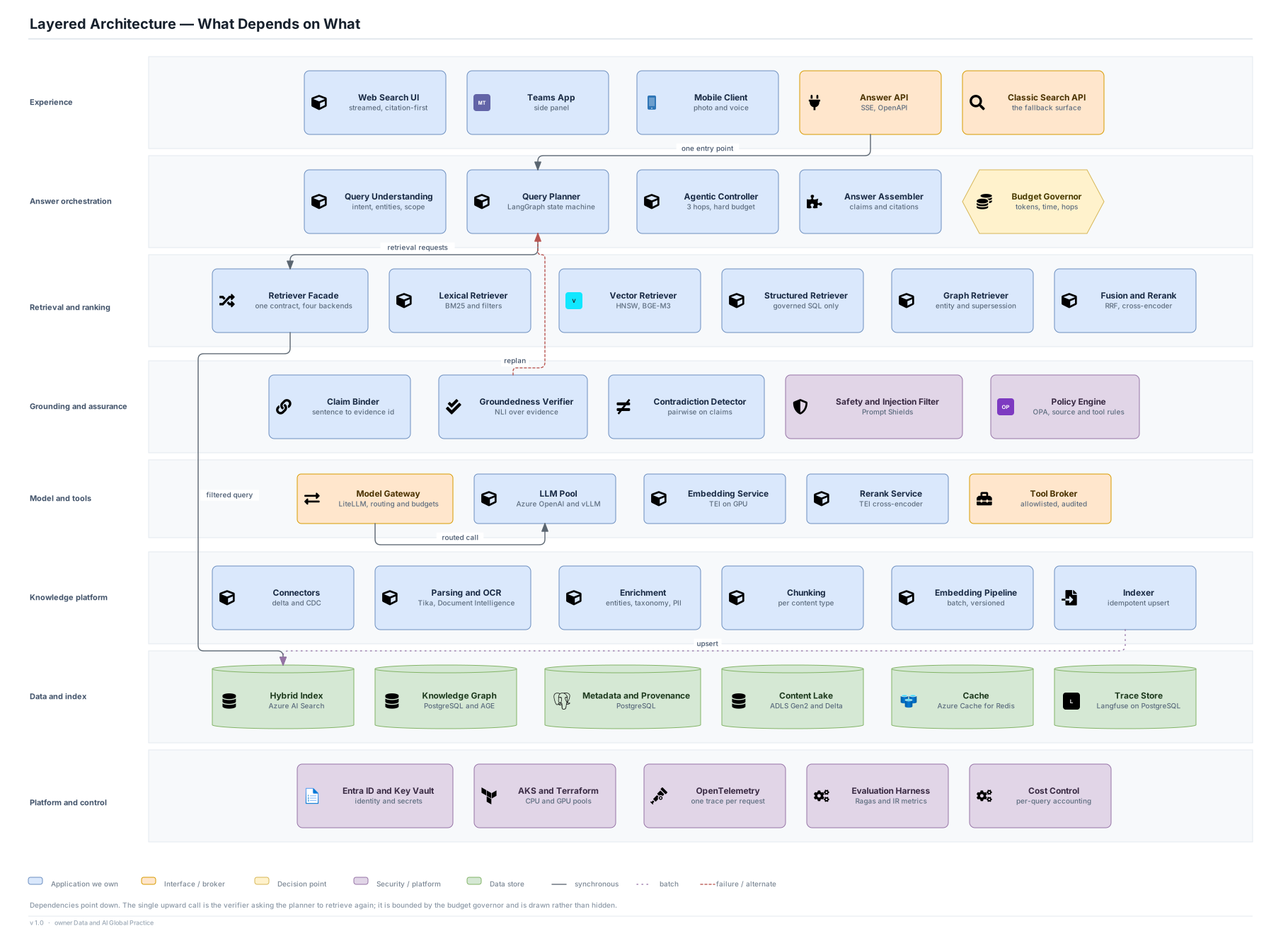
Eight layers, dependencies pointing down, and the single upward call drawn rather than hidden.

Editable source SVG draw.io All views
Experience Web Search UI streamed, citation-first Teams App side panel Mobile Client photo and voice Answer API SSE, OpenAPI Classic Search API the fallback surface Answer orchestration Query Understanding intent, entities, scope Query Planner LangGraph state machine Agentic Controller 3 hops, hard budget Answer Assembler claims and citations Budget Governor tokens, time, hops Retrieval and ranking Retriever Facade one contract, four backends Lexical Retriever BM25 and filters Vector Retriever HNSW, BGE-M3 Structured Retriever governed SQL only Graph Retriever entity and supersession Fusion and Rerank RRF, cross-encoder Grounding and assurance Claim Binder sentence to evidence id Groundedness Verifier NLI over evidence Contradiction Detector pairwise on claims Safety and Injection Filter Prompt Shields Policy Engine OPA, source and tool rules Model and tools Model Gateway LiteLLM, routing and budgets LLM Pool Azure OpenAI and vLLM Embedding Service TEI on GPU Rerank Service TEI cross-encoder Tool Broker allowlisted, audited Knowledge platform Connectors delta and CDC Parsing and OCR Tika, Document Intelligence Enrichment entities, taxonomy, PII Chunking per content type Embedding Pipeline batch, versioned Indexer idempotent upsert Data and index Hybrid Index Azure AI Search Knowledge Graph PostgreSQL and AGE Metadata and Provenance PostgreSQL Content Lake ADLS Gen2 and Delta Cache Azure Cache for Redis Trace Store Langfuse on PostgreSQL Platform and control Entra ID and Key Vault identity and secrets AKS and Terraform CPU and GPU pools OpenTelemetry one trace per request Evaluation Harness Ragas and IR metrics Cost Control per-query accounting one entry point retrieval requests filtered query routed call upsert replan Layered Architecture — What Depends on What Application we own Interface / broker Decision point Security / platform Data store synchronous batch failure / alternate Dependencies point down. The single upward call is the verifier asking the planner to retrieve again; it is bounded by the budget governor and is drawn rather than hidden. v 1.0 · owner Data and AI Global Practice

Decisions

  • Retrieval and ranking sit below grounding and assurance, so the verifier can question a retrieval but a retriever can never call a verifier. That ordering is what makes the failure classification in view 34 possible.
  • The model and tool layer is below the assurance layer on purpose: safety is not something the model layer is trusted to apply to itself.
  • The knowledge platform is a separate layer from the retrieval layer. Ingestion can be stopped, rebuilt or migrated with the query path untouched.

The one upward call

  • The groundedness verifier calls back into the planner to request more evidence. It is bounded by the budget governor to one extra hop on the common path and three in the agentic class.
  • The alternative — letting the model retry itself inside a single generation — was rejected because it produces retries that are invisible to the trace and unbounded in cost.

Deliberately omitted

  • Only seven of about forty inter-layer calls are drawn. The container view has the deployable detail; this view exists to establish the direction of dependency, nothing else.