File Upload & Scanning Pipeline  ·  View 06 of 21  ·  People and journeys

Journey — Review and Release a Blocked File

The journey that decides whether quarantine is a security control or a help-desk queue.

Editable source SVG draw.io All views
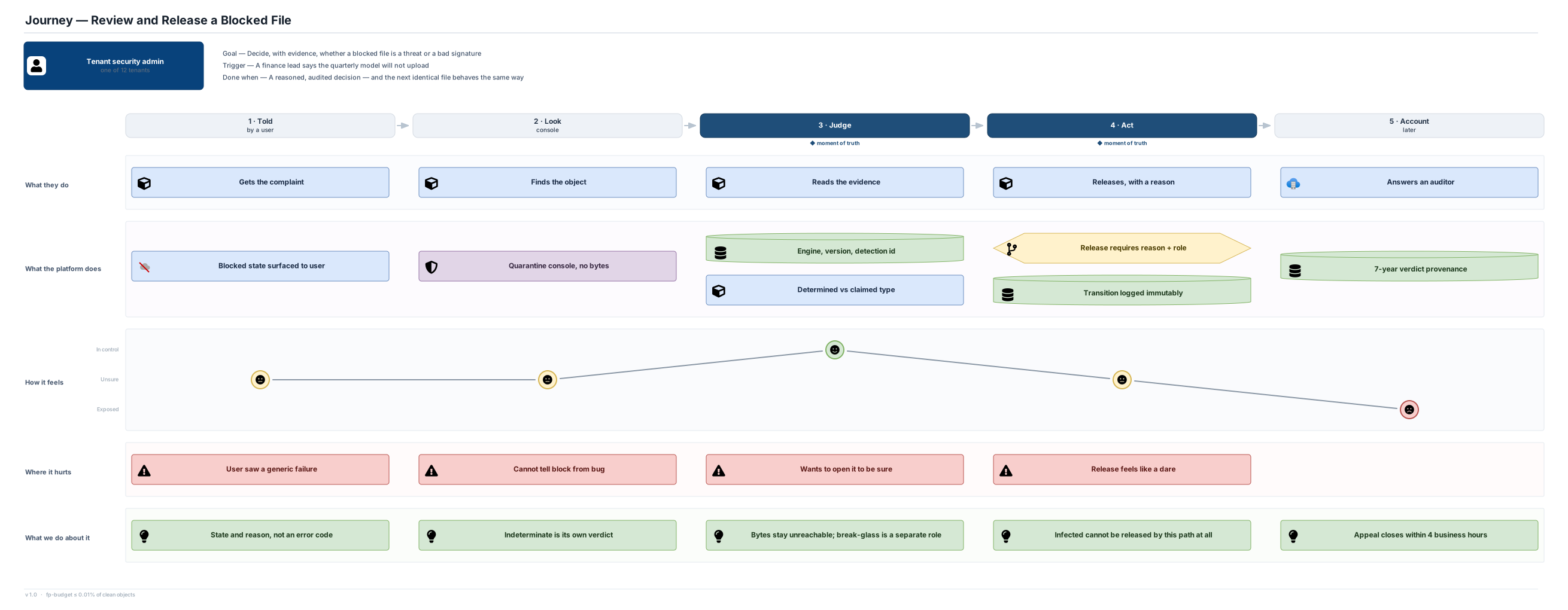
Tenant security admin one of 12 tenants Goal — Decide, with evidence, whether a blocked file is a threat or a bad signature Trigger — A finance lead says the quarterly model will not upload Done when — A reasoned, audited decision — and the next identical file behaves the same way 1 · Told by a user 2 · Look console 3 · Judge ◆ moment of truth 4 · Act ◆ moment of truth 5 · Account later What they do Gets the complaint Finds the object Reads the evidence Releases, with a reason Answers an auditor What the platform does Blocked state surfaced to user Quarantine console, no bytes Engine, version, detection id Determined vs claimed type Release requires reason + role Transition logged immutably 7-year verdict provenance How it feels In control Unsure Exposed Where it hurts User saw a generic failure Cannot tell block from bug Wants to open it to be sure Release feels like a dare What we do about it State and reason, not an error code Indeterminate is its own verdict Bytes stay unreachable; break-glass is a separate role Infected cannot be released by this path at all Appeal closes within 4 business hours Journey — Review and Release a Blocked File v 1.0 · fp-budget ≤ 0.01% of clean objects

What the journey proves

  • Indeterminate must be its own verdict and its own state: collapsing "we found something" with "we could not finish looking" makes every block unarguable and every appeal a guess
  • Release requires a named role, a recorded reason and an immutable transition — and an object with a current infected verdict cannot be released through this path at all
  • The admin decides without ever obtaining the bytes; reading the sample is a different authority, exercised by a different person, through an audited break-glass path

Where it hurts

  • The admin's instinct is to open the file to be sure, which is precisely the action the architecture exists to prevent
  • A false positive costs a finance team its quarter-end model, so the ≤ 0.01% budget and the 4-business-hour appeal are product requirements, not security ones
  • Evidence retention and the member's expectation of deletion are in genuine tension; the platform keeps the minimum and says so

Stated assumptions

  • False-positive budget ≤ 0.01% of clean objects; indeterminate ≤ 0.2%
  • Evidence retained 180 days, then irreversibly destroyed
  • Appeal resolved within 4 business hours