Feature Store  ·  View 03 of 21  ·  People and journeys

Actors and Journeys

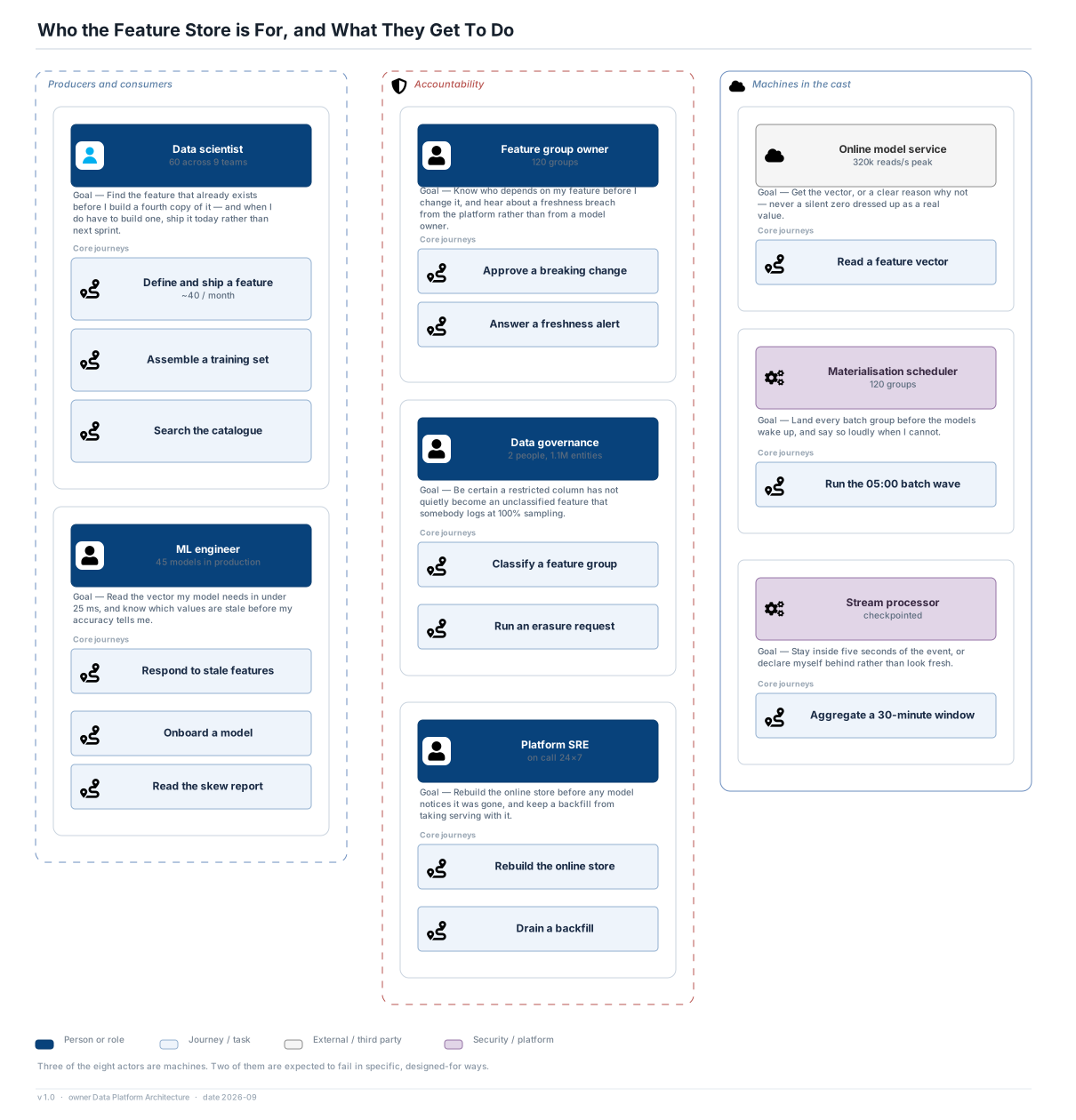
Eight actors, three of them machines, each with a goal in their own voice.

Editable source SVG draw.io All views
Producers and consumers Data scientist 60 across 9 teams Goal — Find the feature that already exists before I build a fourth copy of it — and when I do have to build one, ship it today rather than next sprint. Core journeys Define and ship a feature ~40 / month Assemble a training set Search the catalogue ML engineer 45 models in production Goal — Read the vector my model needs in under 25 ms, and know which values are stale before my accuracy tells me. Core journeys Respond to stale features Onboard a model Read the skew report Accountability Feature group owner 120 groups Goal — Know who depends on my feature before I change it, and hear about a freshness breach from the platform rather than from a model owner. Core journeys Approve a breaking change Answer a freshness alert Data governance 2 people, 1.1M entities Goal — Be certain a restricted column has not quietly become an unclassified feature that somebody logs at 100% sampling. Core journeys Classify a feature group Run an erasure request Platform SRE on call 24×7 Goal — Rebuild the online store before any model notices it was gone, and keep a backfill from taking serving with it. Core journeys Rebuild the online store Drain a backfill Machines in the cast Online model service 320k reads/s peak Goal — Get the vector, or a clear reason why not — never a silent zero dressed up as a real value. Core journeys Read a feature vector Materialisation scheduler 120 groups Goal — Land every batch group before the models wake up, and say so loudly when I cannot. Core journeys Run the 05:00 batch wave Stream processor checkpointed Goal — Stay inside five seconds of the event, or declare myself behind rather than look fresh. Core journeys Aggregate a 30-minute window Who the Feature Store is For, and What They Get To Do Person or role Journey / task External / third party Security / platform Three of the eight actors are machines. Two of them are expected to fail in specific, designed-for ways. v 1.0 · owner Data Platform Architecture · date 2026-09

Why this view exists

  • The data scientist's goal names reuse before authoring — which is why the catalogue, lineage and duplicate detection are load-bearing rather than documentation.
  • The model service's goal — 'never a silent zero' — is the single sentence the absence policy, reason codes and declared defaults all exist to honour.
  • The stream processor's goal is to declare itself behind rather than look fresh. That is a design requirement, not an operational aspiration.

Assumptions

  • 60 data scientists across 9 teams author roughly 40 new features a month.
  • Two people carry data governance for 1.1M entities, so classification has to be enforced by the platform rather than reviewed by hand.

Risks

  • Feature group ownership is the weakest link: 120 groups and no named owner for a group means no one answers its freshness alert.
  • Data governance is staffed too thinly to review definitions individually; if registration-time classification can be bypassed, nothing downstream catches it.