Embedding Pipeline Service · View 22 of 22 · Assurance
What this table is for
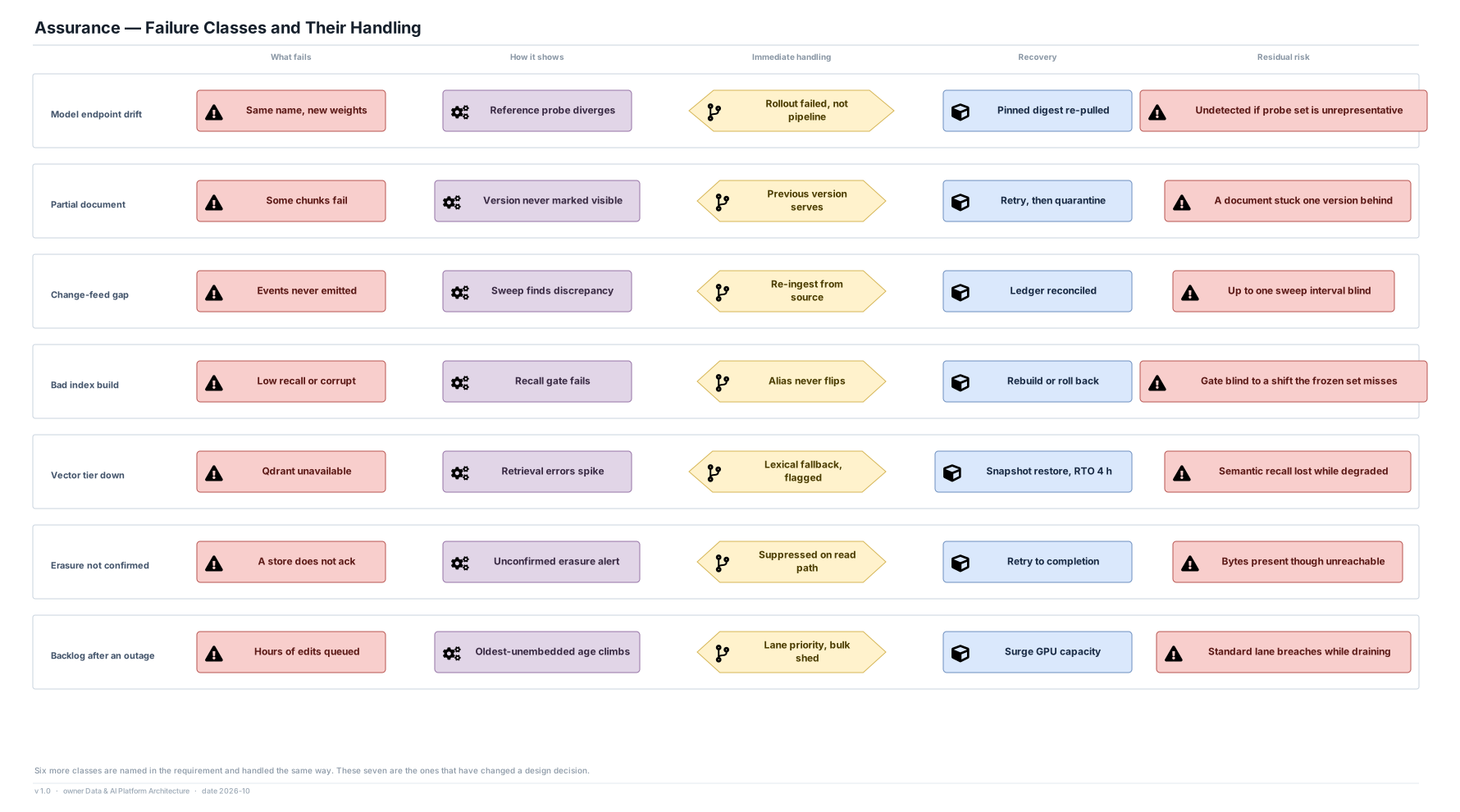
- Each row names what fails, how it becomes visible, what happens immediately, how it recovers, and what remains wrong afterwards. The last column is the one usually missing.
- Model endpoint drift justifies addressing replicas by digest. Partial document justifies atomic version visibility. Change-feed gap justifies the reconciliation sweep.
- Six further classes in the requirement — source unavailable, poison chunk, orphaned vectors, migration abandoned, deletion propagation, permission failure — are handled by the same mechanisms.
The posture
- Degrade a dimension rather than the service: freshness widens, retrieval goes lexical, re-ranking is skipped, telemetry samples — before anything returns an error.
- A failure is never silently absorbed: quarantine carries a typed reason, erasure carries an unconfirmed alert, withholding carries a count.
- No failure is answered by "it will catch up next sweep" where a user would notice in the meantime.
Residual risks worth naming
- A frozen reference set that is unrepresentative lets model drift through the probe, and an unrepresentative evaluation set lets a worse contract through the gate. Both gates are only as good as their sets.
- Erasure can be unreachable rather than absent while a retry is outstanding — correct on the read path, imperfect on the disk.
- Draining a large backlog breaches the standard lane while protecting the interactive one. That is the intended ordering, and it is still a breach.