Discord Bot Platform  ·  View 01 of 19  ·  Context and scope

System Context

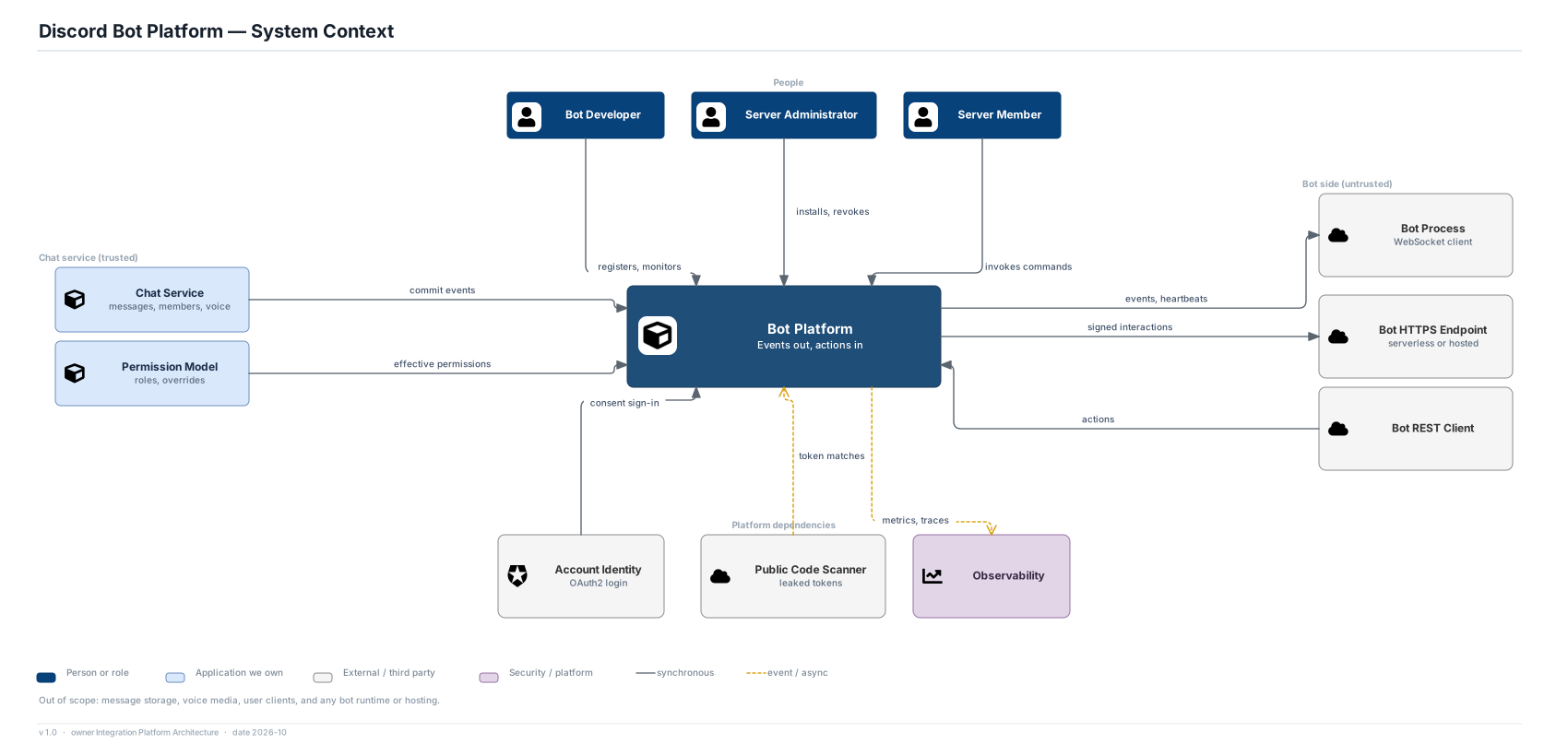
Who the platform talks to, and which side of the trust line each one is on.

Editable source SVG draw.io All views
People Bot Developer Server Administrator Server Member Chat service (trusted) Chat Service messages, members, voice Permission Model roles, overrides Bot side (untrusted) Bot Process WebSocket client Bot HTTPS Endpoint serverless or hosted Bot REST Client Bot Platform Events out, actions in Platform dependencies Account Identity OAuth2 login Public Code Scanner leaked tokens Observability commit events effective permissions registers, monitors installs, revokes invokes commands events, heartbeats signed interactions actions consent sign-in token matches metrics, traces Discord Bot Platform — System Context Person or role Application we own External / third party Security / platform synchronous event / async Out of scope: message storage, voice media, user clients, and any bot runtime or hosting. v 1.0 · owner Integration Platform Architecture · date 2026-10

Decisions

  • Everything on the right is untrusted and uncontrolled: a bot may be slow, down, malicious or written last night. Nothing the platform does for the chat service waits on it (ADR-01).
  • The chat service is a trusted peer, not a component: events and permissions cross a narrow, internal contract.
  • The server administrator, not the developer, owns the installation (ADR-06).

Explicitly out of scope

  • Bot hosting. The platform ships no runtime; developers run their own code.
  • Message storage and voice media. A bot that wants history keeps its own.
  • Marketplace and revenue share (Phase 3).

Assumptions

  • 150 M monthly users, 12 M applications, 2.5 M bots online (stated assumptions).
  • Modelled on the public Discord developer documentation; numbers are invented but defensible.