AI Code Completion Service  ·  View 17 of 21  ·  Operations

Deployment Topology

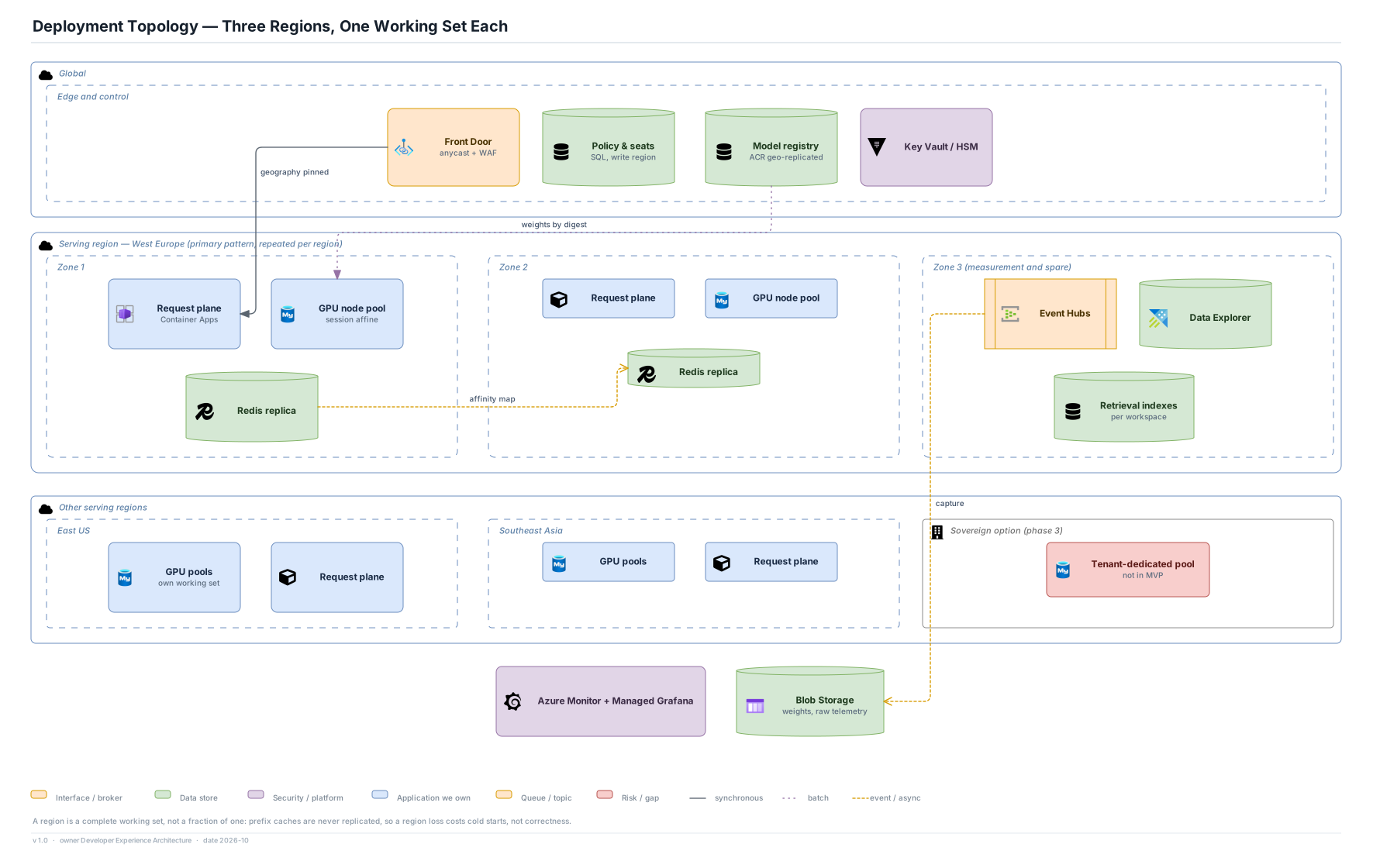
Three serving regions, each a complete working set rather than a fraction of one.

Editable source SVG draw.io All views
Global Edge and control Front Door anycast + WAF Policy & seats SQL, write region Model registry ACR geo-replicated Key Vault / HSM Serving region — West Europe (primary pattern, repeated per region) Zone 1 Request plane Container Apps GPU node pool session affine Redis replica Zone 2 Request plane GPU node pool Redis replica Zone 3 (measurement and spare) Event Hubs Data Explorer Retrieval indexes per workspace Other serving regions East US GPU pools own working set Request plane Southeast Asia GPU pools Request plane Sovereign option (phase 3) Tenant-dedicated pool not in MVP Azure Monitor + Managed Grafana Blob Storage weights, raw telemetry geography pinned weights by digest affinity map capture Deployment Topology — Three Regions, One Working Set Each Interface / broker Data store Security / platform Application we own Queue / topic Risk / gap synchronous batch event / async A region is a complete working set, not a fraction of one: prefix caches are never replicated, so a region loss costs cold starts, not correctness. v 1.0 · owner Developer Experience Architecture · date 2026-10

Decisions

  • Prefix caches are never replicated across regions: they are recomputable, and replicating them would couple regions for no durability gain.
  • Policy and seats have one write region with regional read replicas; the model registry is geo-replicated because weights are large, immutable and read everywhere.
  • Measurement is pinned to a third zone so that a telemetry incident and a serving incident are not the same incident.

Assumptions

  • 4,000 accelerators at peak across three regions; a region loss costs cold starts, not correctness.
  • RTO 5 minutes to serve the suggestion path from another region; the sovereign dedicated-pool option is phase 3 and is drawn as out of scope.

Risks

  • Three regional fleets batch less efficiently than one global fleet. This is the cost of the latency contract, and it is the trade the eighth core architecture question refuses to settle for the reader.