AI Agent Orchestration Platform  ·  View 23 of 32  ·  5 · Operations

Deployment Topology

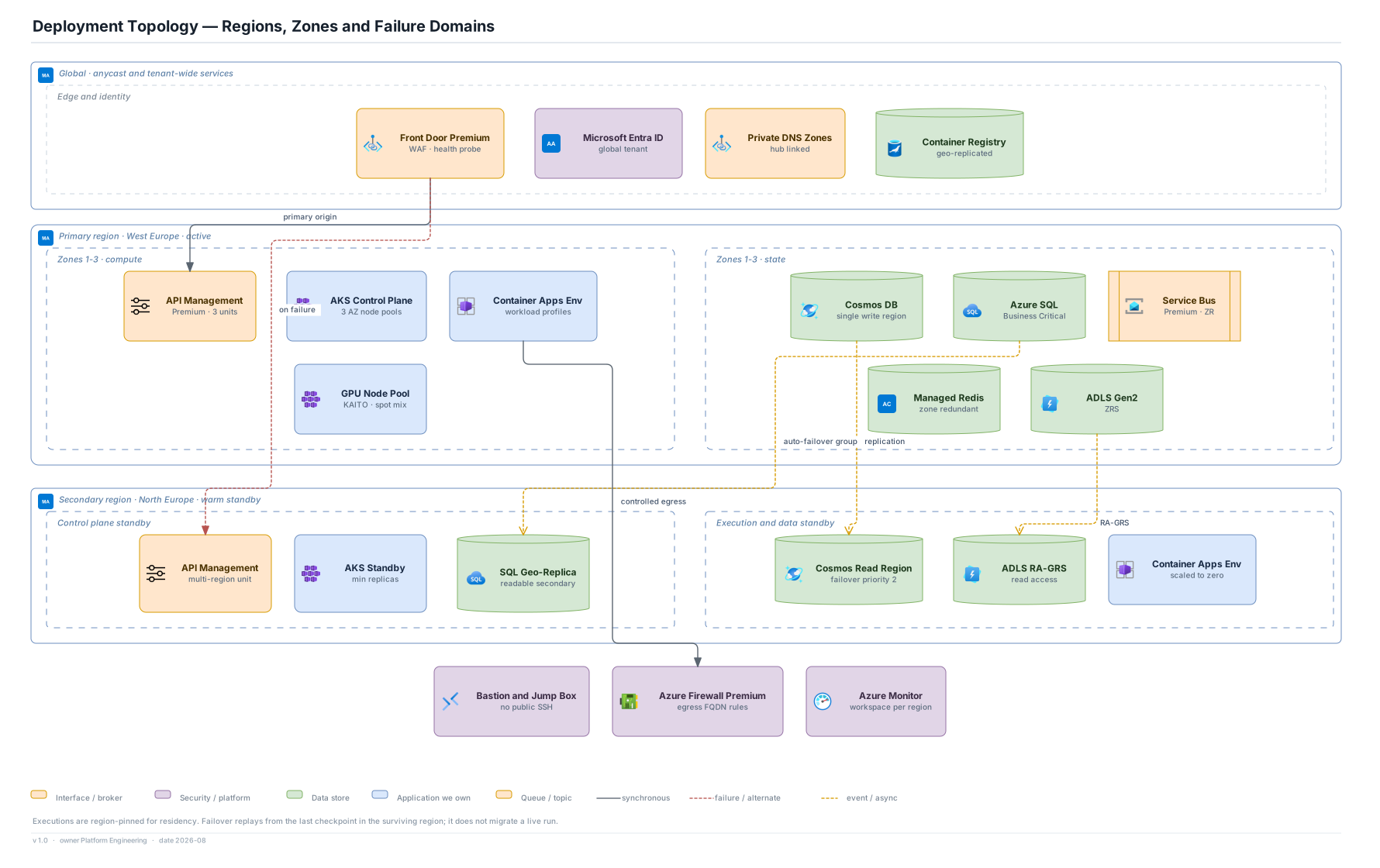
What runs where, what is redundant, and what a region loss actually costs.

Editable source SVG draw.io All views
Global · anycast and tenant-wide services Edge and identity Front Door Premium WAF · health probe Microsoft Entra ID global tenant Private DNS Zones hub linked Container Registry geo-replicated Primary region · West Europe · active Zones 1-3 · compute API Management Premium · 3 units AKS Control Plane 3 AZ node pools Container Apps Env workload profiles GPU Node Pool KAITO · spot mix Zones 1-3 · state Cosmos DB single write region Azure SQL Business Critical Service Bus Premium · ZR Managed Redis zone redundant ADLS Gen2 ZRS Secondary region · North Europe · warm standby Control plane standby API Management multi-region unit AKS Standby min replicas SQL Geo-Replica readable secondary Execution and data standby Cosmos Read Region failover priority 2 ADLS RA-GRS read access Container Apps Env scaled to zero Bastion and Jump Box no public SSH Azure Firewall Premium egress FQDN rules Azure Monitor workspace per region primary origin on failure replication auto-failover group controlled egress RA-GRS Deployment Topology — Regions, Zones and Failure Domains Interface / broker Security / platform Data store Application we own Queue / topic synchronous failure / alternate event / async Executions are region-pinned for residency. Failover replays from the last checkpoint in the surviving region; it does not migrate a live run. v 1.0 · owner Platform Engineering · date 2026-08

Decisions

  • Control plane is active in the primary region with a warm standby; execution is region-pinned so a run never crosses a residency boundary mid-flight
  • Zone redundancy is the primary resilience mechanism; the second region exists for region loss and for residency, not for everyday load
  • Failover replays from the last checkpoint in the surviving region — it does not migrate a live run, because a live run holds provider affinity

Targets

  • Control plane 99.9 percent; RTO 15 minutes and RPO 5 minutes for execution state
  • Front Door health probe interval 30 seconds; automated origin failover, manual data-tier failover with a documented runbook
  • Quarterly disaster-recovery exercise with a measured, published restore time

Risks

  • Cosmos DB is single-write-region for consistency; a write-region loss means a manual failover inside the RTO, not an automatic one
  • GPU capacity for self-hosted models is region-constrained; the standby region carries no GPU pool and those routes degrade to Foundry
  • Warm standby costs roughly 18 percent of primary; a cold standby would halve that and miss the RTO